
The blood of many species
swirls around me
The blood of many mothers
runs through me
The blood of many generations
comes from meThe blood of earth
feeds me
The blood of the Goddess
holds meWe dance together
in an ancient ecstasy
blood deep
bone rich
holy, potent, and pure.The blood of creation
The blood of inspiration
The blood of sacrifice
and renewal…
spirituality
Woodspriestess: Blood Ties

Categories: Goddess, moontime, nature, poems, spirituality, theapoetics, woodspriestess
1 Comment
Goddess Body, World Body
This post is reprinted from my column at the SageWoman blogs.
“Here is your sacrament
Take. Eat. this is my body
this is real milk, thin, sweet, bluish,
which I give for the life of the world…
Here is your bread of life.
Here is the blood by which you live in me.”
–Robin Morgan (in Life Prayers, p. 148)
“All religion is about the mystery of creation. If the mystery of birth is the origin of religion, it is women that we must look for the phenomenon that first made her aware of the unseen power…Women’s awe at her capacity to create life is the basis of mystery. Earliest religious images show pregnancy, rather than birth and nurturing, as the numinous or magical state” (Monica Sjoo and Barbara Mor, The Great Cosmic Mother, p. 71)
I am working on a thesis project about birth as a spiritual experience. As I collect my resources, the quotes above keep running through my head. Birth as the original sacrament. Breastfeeding as the original communion. Blood of my blood, flesh of my flesh, bone of my bone, women transmute blood into breath, into being, into life for others.
Abrahamic theology in its root mythology, sets up the male body as “normal” as well neatly includes the notion that there is a divine hierarchy in which men are above women in value, role, and power. It also twists reality, by asserting that women come from men’s bodies, rather than the other way around. This inversion didn’t begin with Christianity, it has roots in more ancient mythology as well. Connected to the conversion of women’s natural creative, divine-like powers of the  womb into the originators of sin and corruption, we readily see the deliberate inversion of the womb of the Goddess into the head of the father in the gulping down of Metis by Zeus and the subsequent birth of Athena from his head. Patriarchal creation myths rely heavily on biologically non-normative masculine creation imagery. I really appreciated the brief note from Sjoo in The Great Cosmic Mother that, “In later Hindu mysticism the egg is identified as male generative energy. Whenever you come upon something like this, stop and ponder. If it is absurdly inorganic—male gods ‘brooding on the waters’ or ‘laying eggs’—then you know you are in the presence of an original Goddess cosmology stolen and displaced by later patriarchal scribes” (p. 56).
Modern-day diet culture may actually be as potent an agent of female body control and manipulation as ancient church doctrine. And, where there are wounded, denied, oppressed, and suppressed female bodies, there is an exploited world body as well. Women who retain their “wild natures” see value in “wild nature,” rather than seeing nature as something to be dominated, exploited and controlled. Diet culture encourages this attitude of domination of bodies and restraining of physical, “earthy” impulses and needs—no wonder we see this same basic attitude of domination and control carried out in the macrocosm as well. Womb ecology reflects world ecology, world ecology reflects womb ecology…
According to Melissa Raphael in her book Thealogy and Embodiment, “Spiritual feminism consecrates flesh as something more than passive ‘fertility.’ The word ‘fertility’ cannot evoke the patriarchally uncontrollable generativity and proliferation of flesh. Spiritual feminism celebrates the bounty of flesh in the same moment that it celebrates the earth and the foods the earth produces in generous abundance” (p. 95).
Raphael also observes that, “where a woman’s embodiment is a manifestation of the Goddess that has a very different meaning than if that divinity were imaged as male…The Goddess, the earth, the female body are unified and charged with sacral powers for the transmutation of matter, for shape-shifting, and for the production of cosmogonic effluvia: blood, milk and water. This spiritual physiology of women is original but it is also subversive of and oppositional to its Western inheritance” (p. 76-77).
Monica Sjoo and Barbara Mor explain that, “Childbirth is a powerful drama and ritual” (p. 47). Ancient herstory is rooted in the generative powers of the female body. “…the facts of women’s experience of life are primordial. It is woman who goes through the sacred transformations in our own body and psyche—the mystery-changes of menstruation, pregnancy, birth, and the production of milk…Women’s mysteries are blood-transformation mysteries: the experience of female bodily transformations of matter. Matter: the mud: the Mother. She transforms herself.” (Sjoo & Mor, p. 50-51)
In this recent poem, composed spontaneously while standing in the woods, I am interested to see how I made the world-body connection somewhat unconsciously in this “theapoetical” experience…
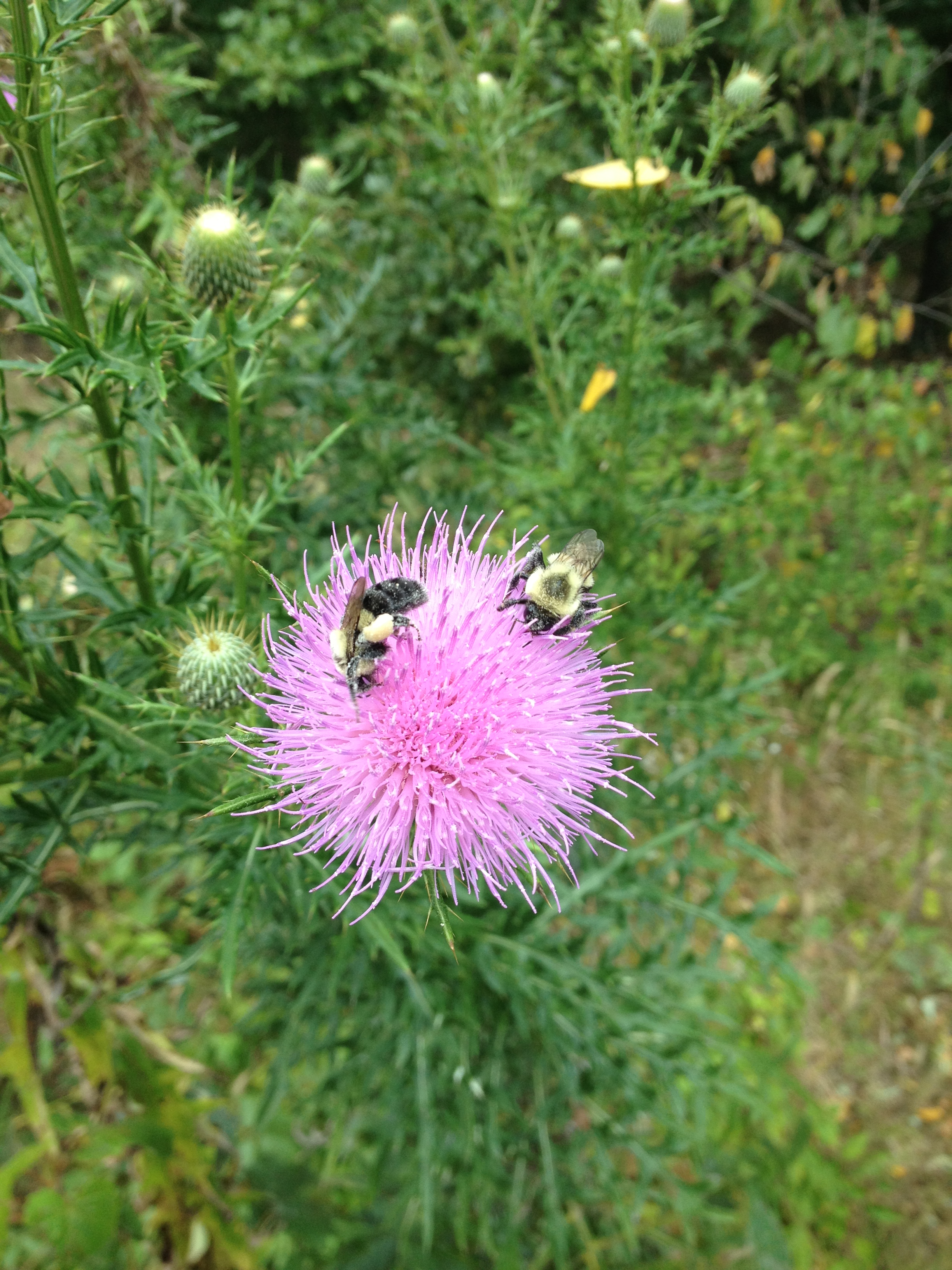
Observation of the day yesterday: bumblebees on gigantically tall thistles behind the deck.
I stand
on the body of the Goddess
I sit on her bones
I breathe
her breath
Spirit of Life
moving through me
Her voice
sings in my blood
stars shine in my veins
my heartbeat
a drum
tuned to the core
of the planet
my womb
pulled by the tide
my rhythms
guided

Delicate plant growing determinedly from strong rock.
by a distant moon
my cells springing
from hers
my heartsong
strummed
by ancient fingers
my passion
lit by wisdom
from within and without
my hope
kindled
each day
with my breath, blood, and pulse
I pray
I stand
on the body of the Goddess
I sit on her bones
I breathe
the breath of her lungs
I am one of her own…

Bee and butterfly hanging out together.
One of the most profound elements of Goddess spirituality is its affirmation of and respect for women’s bodies and reproductive processes. In this affirmation, we can find a degree of overlap between feminist spirituality and process philosophy. As Carol Christ explains, “Process philosophy shares with feminist theology and thealogy a common interest in restoring the body and the world body, disparaged and denied in classical theism. What process philosophy has frequently failed to recognize is that restoring the body and the world body has enormous consequences for women. A feminist process paradigm will make feminist insight an integral part of process thinking. A feminist process paradigm will also ensure that process philosophers understand the body, the world body, and the divine body in physical terms and not simply as metaphysical concepts” (She Who Changes, p. 199). Christ also asks a profoundly meaningful question, “Is the source of the theological mistakes of classical theism a rejection of embodied life that begins with rejection of the female body? In other words, are the six theological mistakes embedded in a way of thinking that is inherently anti-female?” (200). She suggests that the answer is yes, that these theological mistakes are intimately tied up, “in denial of the changing body and the changing world, which is rooted in a way of thinking that is inherently anti-female” (She Who Changes, p. 200).
While, like thealogy, process thinking is grounded in experience, the emphasis on philosophical thinking can contribute to a lack of full engagement with the real world. In thealogy many quickly realize that it is a spirituality better lived than analyzed: “Don’t just read about the Goddess, LOVE HER, listen to Her, reflect Her as the Earth and Moon reflect the Sun. Don’t just study Nature, put your hands in the dirt, your feet on the forest trail, turn your face to the wind and breathe Nature in and out of your lungs. Feel the connection. No books required.” (Esra Free, Wicca 404: Advanced Goddess Thealogy, 2007)

Accidentally got this “take off” picture and I love it because of the pollen-laden legs!
Categories: Goddess, nature, poems, spirituality, thealogy, theapoetics, thesis, woodspriestess
3 Comments
Inanna’s Ascent
Inanna’s Ascent
Tiny goddesses as gifts for my friends. See the crack in the chalice? We all go through the fire and get cracked by life, but that’s how the light gets in!
by Deanna Emerson
I have seen the piercing eyes
of the dark goddess
as she stands naked in the silent shadows
planting the seeds of vision
reached into the arms
of my deepest sorrow and
looked into the eyes of death
yet the world dance did not cease.
By the light of the waning moon
I have seen the faces
of the shining ones and
taking the sword of wisdom
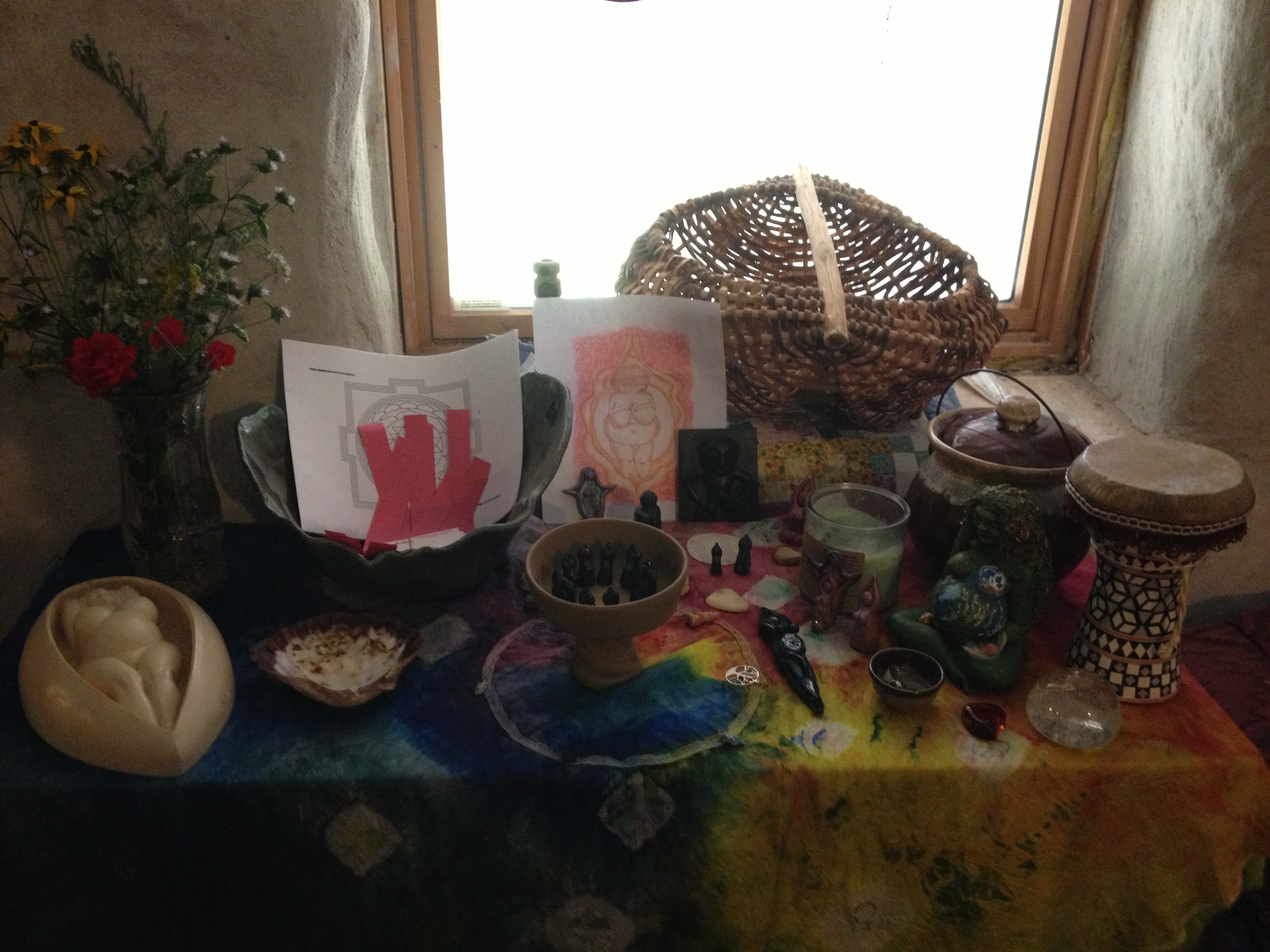
cut the cords that bind me.Altar space. The untidy red strips are for the hopes/fears for the “Kali” pot (I use quotation marks because its original identity was as a bean pot from an antique store! :))
Armed only with love
I have entered the healing
power of the moon
drawing it down around me
to enter the sacred womb
of the dark goddess and
turning pain into powerI have returned.

(In Casting the Circle by Diane Stein.)
During our last Rise Up class, we focused a lot on the dark goddess and the idea of endarkenment. There is wisdom and nurturance to be found in our dark places. We wrote down our fears and hopes and burned them in a “Kali” pot watching as the smoke transformed fear in the crucible of hopeful creation. The next day, I found this poem marked in one of my books and I wished I’d had it available to read during our class! 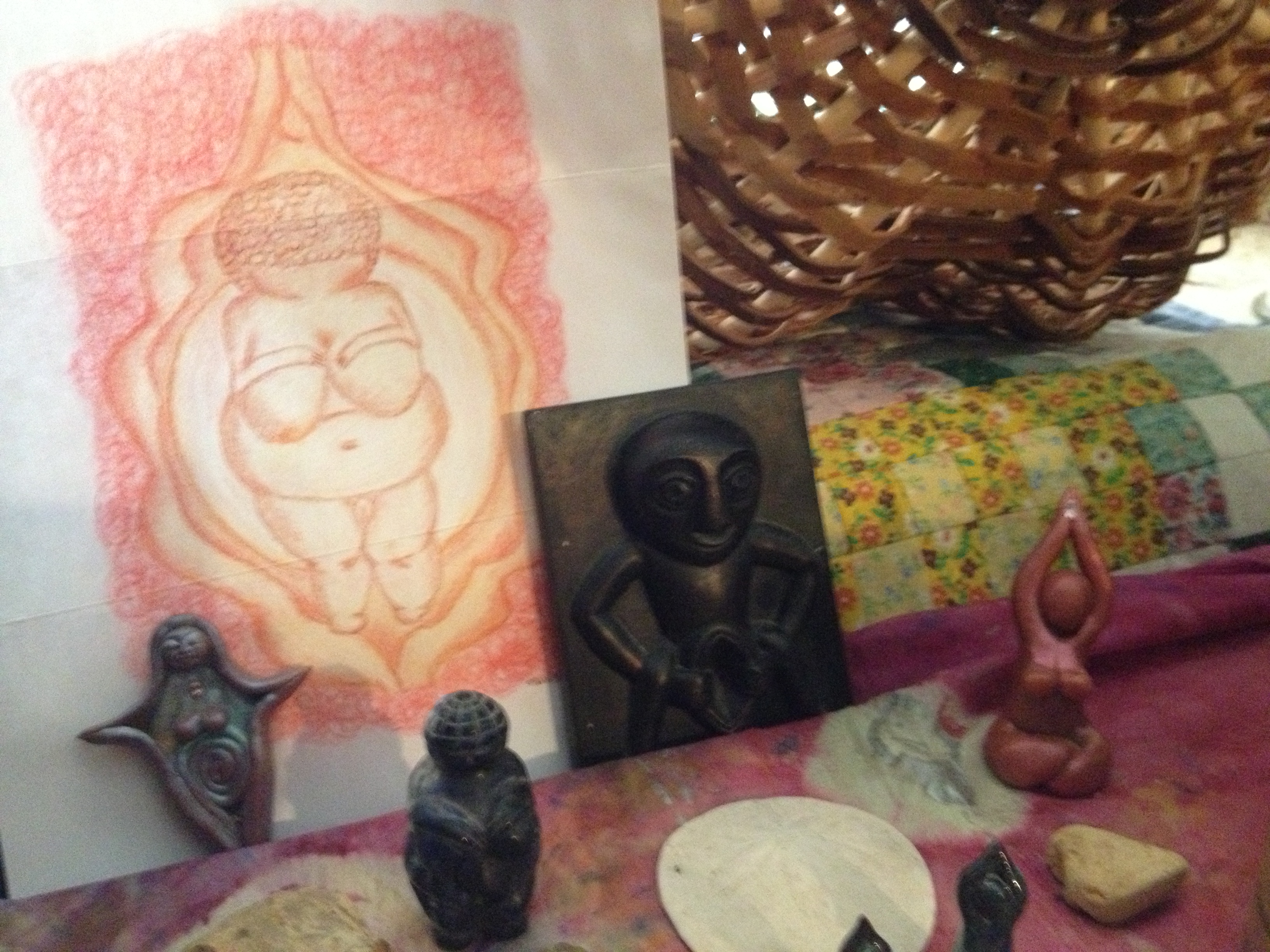

Categories: friends, Goddess, poems, quotes, retreat, ritual, spirituality, theapoetics, womanspirit, women's circle
1 Comment
Woodspriestess: Summer’s Surrender
Tiny flowers of summer
Waving colorful flags
of the season’s surrender
against a backdrop of dry leavesLifting tender, hopeful
tenacious faces
parched but promising
a last hurrah
a final fling
a tiny majestySpots of glorious color
on dry groundProof of life’s own love affair with itself.

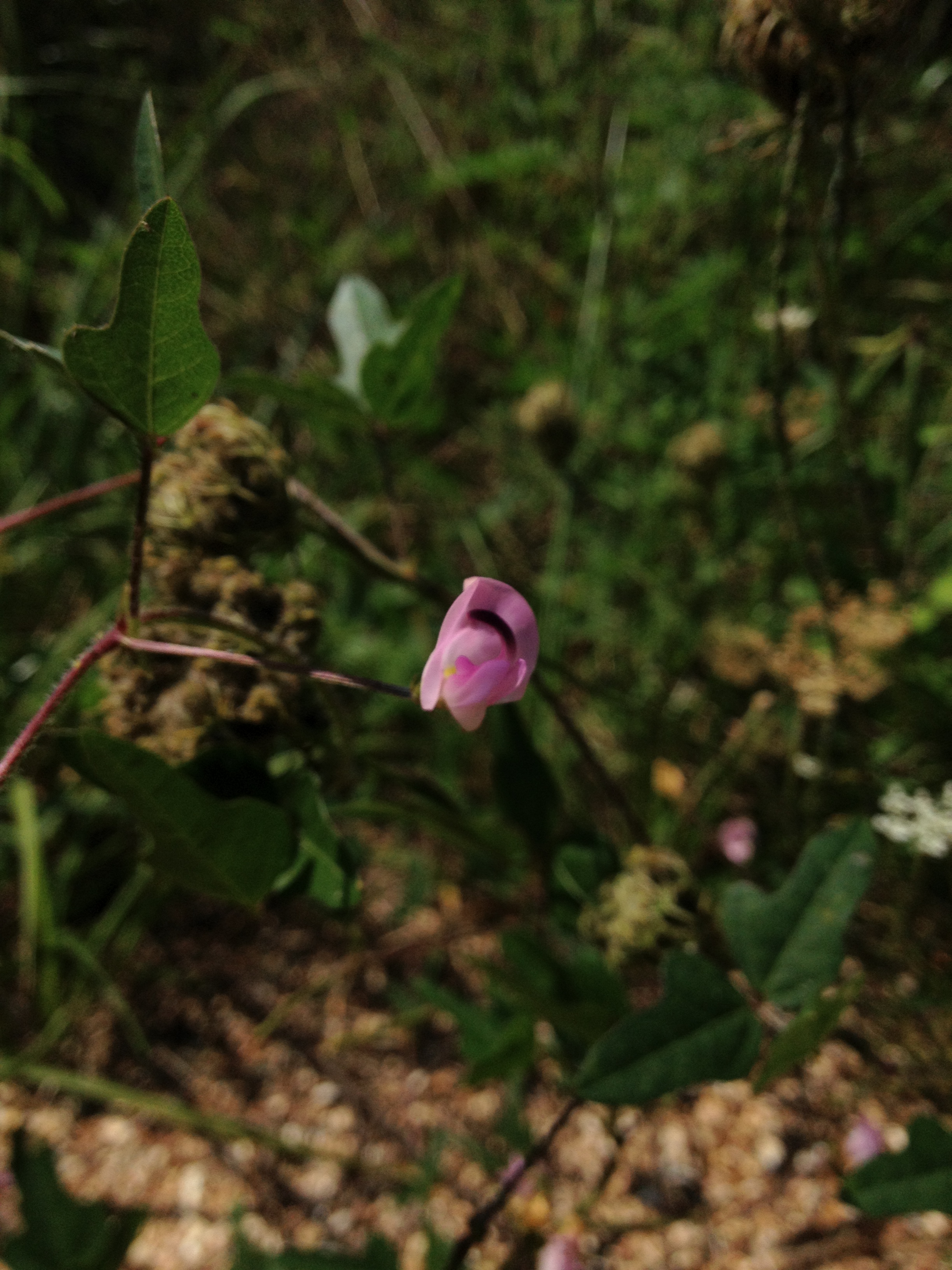 Speaking of love affairs, I had one with the tiny flowers of spring and I’m having another with the tiny flowers of summer. It is like a religious experience to me to discover the ever-changing tableau of what Nature has planted for us all season long. I love that these tiny flowers bloom whether I notice them or not. I love that they grow without me watering them or tending them. I love how they emerge in unlikely, unsuspecting places, such as the floor of the greenhouse or between cracks in stone or from piles of gravel. I love that they’re here, doing their own tiny thing, even as the leaves begin to fall from the trees and the winds shift towards autumn. They’re going to keep being beautiful, dang it, as long as they can. I’ve had a mini obsession with spotting them and taking pictures of them over the last two days. I don’t know the proper names for many of them and I also know that several of them turn into nuisance things like burs, but I see them. I’ve noticed and paid attention and this visual experience is my sweet reward. In this photo gallery, the only flowers pictured not planted by Nature are the roses, which are currently experiencing a delightful last hurrah as well, even after a major assault by Japanese beetles this year. Also pictured is a cute mushroom 🙂


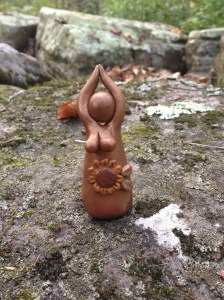
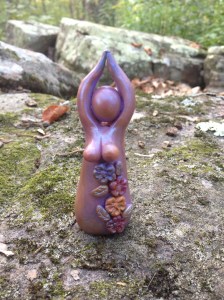
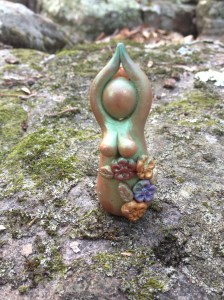
Perhaps not coincidentally, I was also inspired to make some fresh new goddesses this week with a floral motif! (available in my updated etsy shop) 🙂
And, in past odes to tiny flowers I have known:
Woodspriestess: Tiny Flowers
Tiny flowers know
that hope blooms eternal
pushing the way
through cracked stone
reclaiming
repopulating
rebirthing the EarthWhat is a seed
but a miracle
right in front of meWhat am I
but a miracle
to be seeing this right now…Woodspriestess: The Language of Spring

A blush of green begins
Delicate lace of wild plums
Graces gray forestscapesHeartbeat in the forest sings
The passion of life untapped.
The soul of the world
is speaking the language of spring.Woodspriestess: Stoneflower | Theapoetics
Like flower growing from rock
the world is full of tiny, perfect mysteries.
Secrets of heart and soul and landscape
guarded tenderly
taking root in hard crevices
stretching forth
in impossible silence.
And, while traveling: Sunday Sabbath: Tiny Desert Flowers
Tender green shoot in unlikely place
Tenacious tapestry of life
This weaving unfolding before my eyes
This is my religion.
Categories: art, nature, poems, spirituality, theapoetics, woodspriestess
1 Comment
Woodspriestess: Medicine Woman
Medicine Woman
She who heals
Reaching out
strong hands
supple wrists
cleansing touch
place your hand in hers
and you will feel it…Energy
passing from one to another
conduit of grace
and repair.Restoration
Medicine Woman reminds you
to sleep when you’re tired
to eat when you’re hungry
to drink when you’re thirsty
and to dance
just because.Medicine Woman
let her bind up your wounds
apply balm to your soul
and hold you
against her shoulder
when you need to cry.Medicine Woman
Earth healer
she’s ready to embrace you.(7/5/2013)


Memorial prayer flag
I wrote this poem last month as another character/archetype poem that came to mind after my original outraged ancestral mother poem and prayer. (Both of which were recently published in the current edition of The Tor Stone). Prophet Woman and Shakti Woman also showed up, as did Medicine Woman. I’ve still got Yoga Woman out there too and I thought there weren’t any more, until I had a Buzzard Woman encounter earlier in the month.
Last night I went to a local ceremony for the Day of Hope and Healing, which is a national memorial day for families who have experienced miscarriage, stillbirth, or infant loss. The photos in this post are from the event. And, today then felt like the perfect time to share my Medicine Woman poem. I’m also having a giveaway on my other blog for this pendant that I made over the weekend:
 I also made some new sculptures and necklaces and updated my etsy shop!

Categories: art, friends, poems, spirituality, theapoetics, womanspirit, women, woodspriestess
3 Comments
Thesis Project
“Here is your sacrament 
Take. Eat. this is my body
this is real milk, thin, sweet, bluish,
which I give for the life of the world…
Here is your bread of life.
Here is the blood by which you live in me.” –Robin Morgan (in Life Prayers, p. 148)
“…When I say painless, please understand, I don’t mean you will not feel anything. What you will feel is a lot of pressure; you will feel the might of creation move through you…” – Giuditta Tornetta in Painless Childbirth
“I am the holy mother; . . . She is not so far from me. And perhaps She is not so very distinct from me, either. I am her child, born in Her, living and moving in Her, perhaps at death to be birthed into yet some other new life, still living and having my being in Her. But while on this earth She and I share the act of creation, of being, and Motherhood.” —Niki Whiting, “On Being a Holy Mother” in Whedon
“Woman-to-woman help through the rites of passage that are important in every birth has significance not only for the individuals directly involved, but for the whole community. The task in which the women are engaged is political. It forms the warp and weft of society.” –Sheila Kitzinger
In 2011, I started working on my doctoral degree in thealogy (Goddess studies). Before I even began my first class, I chose my dissertation subject: birth as a spiritual experience. I’ve been steadily plugging away on my coursework and somehow in the midst of everything else that I am responsible for, I’ve successfully completed 13 of my classes. I already have a (not related) master’s degree and this is why I was admitted straight into the doctoral program, even though I have to complete a lot of M.Div (master’s of divinity) level coursework as prerequisites to the actual doctoral classes. After I finished my most recent class and got my updated transcript, I finally actually noticed how many M.Div classes I’ve completed thus far on my journey and it occurred to me to email to inquire what it would take to finish an M.Div degree first. I had this sudden feeling of what a nice stepping stone or milestone experience it would be to finish something, since I know that I have a minimum of three more years remaining before I complete the D.Min! They wrote back quickly and let me know that with the completion of three courses in matriarchal myth (I’m halfway through the first right now), my almost-completed year-long class in Compassion (I’m in month 11), and The Role of the Priestess course (involving three ten-page papers), all of which are also part of my doctoral program, the only other thing required for successful completion of my M.Div would be a thesis (minimum of 70 pages).
As I’ve been working through my classes, I’ve felt a gradual shift in what I want to focus on for my dissertation, and I already decided to switch to writing about theapoetics and ecopsychology now, rather than strictly about birth. I was planning to mash my previous ideas about birth and a “thealogy of the body” into this new topic somehow, perhaps: theapoetics, ecopsychology, and embodied thealogy. Then, when I got the news about the option of writing a thesis and finishing my M.Div, it became clear to me: my thesis subject is birth as a spiritual experience! This allows me to use the ideas and information I’d already been collecting as dissertation “seeds” as a thesis instead and frees me up to explore and develop my more original ideas about theapoetics for my dissertation! So…why post about this now? Well, one because I’m super excited about all this and just wanted to share and two, because I’d love to hear from readers about their experiences with birth as a spiritual experience! While I don’t have to do the kind of independent research for a thesis that I will be doing for my dissertation and while my focus is unabashedly situated within a feminist context and a thealogical orientation, I would love to be informed by a diverse chorus of voices regarding this topic so that the project becomes an interfaith dialog. Luckily for me I’ve already reviewed a series of relevant titles.
- The Gift of Giving Life (explores the divine nature of pregnancy and birth from a Christian, specifically LDS/Mormon, perspective)
- Embodying the Sacred (written from a Catholic point of view)
- Sacred Pregnancy (a gorgeous book with a non-specific spiritual perspective)
- L’Mazeltov (written specifically for Jewish parents-to-be)
- Birth on the Labyrinth Path (focuses on the divine nature of pregnancy and birth from a pagan wordview)
Now, I’d like to hear from you. What are your experiences with the spirituality of birth? Do you consider birth to be a spiritual experience? Did you have any spiritual revelations or encounters during your births or any other events along your reproductive timeline? (miscarriage, menstruation, lactation…) Did you draw upon spiritual coping measures or resources as you labored and gave birth? Did giving birth deepen, expand, or otherwise impact your sense of spirituality or your sense of yourself as a spiritual or religious person? Did any of your reproductive experiences open your understanding of spirituality in a way that you had not previously experienced or reveal beliefs or understandings not previously uncovered?
When I use the word “spiritual,” I mean a range of experiences from a humanistic sensation of being linked to women around the world from all times and spaces while giving birth, to a “generic” sense of feeling the “might of creation” move through you, to a sense of non-specifically-labeled powers of Life and Universe being spun into being through your body, to feeling like a “birth goddess” as you pushed out your baby, to more traditional religious expressions of praying during labor, or drawing upon scripture as a coping measure, or feeling that giving birth brought you closer to the God of your understanding/religion, or, indeed, meeting God/dess or Divinity during labor and birth). I’m particularly interested in women’s embodied experiences of creation and whether or not your previous religious beliefs or spiritual understandings in life affirmed, acknowledged, or encouraged your body and bodily experience of giving birth as sacred and valuable as well as your own sense of yourself as spiritually connected or supported while giving birth. I would appreciate links to birth stories or articles that you found helpful, books you enjoyed or connected with, and comments relating to your own personal experiences with any of the comments or questions I have raised above. I would love to hear about your thoughts as they relate to:
- Pregnancy

- Labor
- Birthing
- Lactation
- Miscarriage
- Infertility
- Menstruation
- Reproductive Rights
- Birth as a feminist or social justice issue…

Thank you!
With these things said, I also want to mention that I’m planning to redirect a lot of my writing energy/time into this thesis project rather than to blog posts. I’m trying to come up with a blog posting schedule for myself, but in order to actually do this thing, I must acknowledge that I have to re-prioritize some things and that means writing for my blogs probably needs to slip down a couple of notches in terms of priority of focus.
Oh, and I also hope this thesis project will turn into a book of some kind as well! 🙂
“It is hard to find a female-based concept such as Shakti alive within Western spiritual traditions. Shakti could be viewed as an expression of goddess in the female body at the time of birth. I would say its flow / expression and outcome of love is hindered by unnecessary interventions at birth which divert such energy towards fear- based, masculine forms. The use of masculine, rescue-based healing forms such as cutting (Grahn, 1993) can be necessary and useful, yet such procedures are currently used at the cost of women’s autonomy in the birthing process (see Jordan on C-section, 2007), and define the parameters of what feminist thinker Mary Daly called patriarchal medicine (1978). Modern women are largely lost when it comes to giving birth, turning to medical authority figures to be told what to do. Daly pointed to the dangers of this appropriation for women’s personal and collective autonomy.
Birthing bodies resist, disrupt and threaten standard North American modernist investments in linear time, rationality, order, and objectivity. Birth disrupts the Judeo-Christian male image of God, even as He hides the reality of female creation and creativity. I hold that women giving birth act from a focal point of power within their respective cultures and locations, the power to generate and renew human life itself from within the female body. This power is more absolute in its human reality then any other culturally sanctioned act of replication and material production, or social construction. I speculate that how this female power is expressed, denied, or acknowledged by women and within the society around a birthing woman reflects the degree to which women can and may express themselves at large. As each soul makes the journey through her/his mother, re-centring human consciousness within the female-based reality of human birth causes transformation of patriarchal consciousness as a whole…” –Nane Jordan, Towards an Ontology of Women Giving Birth
—
This post is crossposted at Talk Birth
Categories: birth, embodiment, feminism, feminist thealogy, Goddess, OSC, spirituality, thealogy, thesis, womanspirit, writing
8 Comments
Woodspriestess: Shakti Woman Speaks
A special gift from Paola of Goddess Spiral Health Coaching
Shakti woman speaks
She says Dance
Write
Create
Share
Speak.Don’t let me down
I wait within
coiled at the base of your spine
draped around your hips
like a bellydancer’s sash
snaking my way up
through your belly
and your throat
until I burst forth
in radiant power
that shall not be denied.Do not silence me
do not coil my energy back inside
stuffing it down
where it might wither in darkness
biding its time
becoming something that waits
to strike.Let me sing
let me flood through your body
in ripples of ecstasy
stretch your hands wide
wear jewels on your fingers
and your heart on your sleeveSpin
spin with me now
until we dance shadows into art
hope into being
and pain into power.7/1/2013
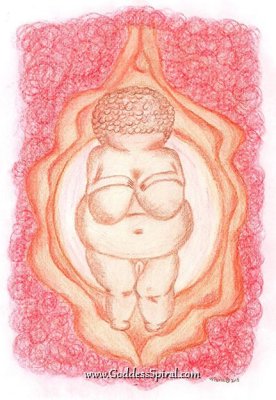
A couple of weeks ago, I published a Shakti Woman poem and the above is the companion piece that I actually wrote first. For the picture to go with it, I just had to share my recent gift from Paola of Goddess Spiral Health Coaching. Isn’t she lovely? Earlier this year, Paola offered to send a gift to the first several responders on her Facebook page and I was one of them 🙂
I love the Willendorf Goddess and consider it almost a personal “totem” of sorts for me. I love that she is so full-figured and not “perfect” or beautiful. I like that she is not pregnant (there is some disagreement about this, I guess) and what I like best is that she is “complete unto herself.” She is a complete form–not just a headless pregnant belly, etc. I just LOVE her. As I’ve written previously, I have a strong emotional connection to Paleolithic and Neolithic figures. I do not find that I feel as personally connected to Egyptian and Greek and Roman Goddess imagery, but the ancient figures really speak to something powerful within me. I have a sculpture of the Goddess of Willendorf at a central point on my altar. Sometimes I hold her and wonder and muse about who carved the original. I almost feel a thread that reaches out and continues to connect us to that nearly lost past—all the culture and society and how very much we don’t know about early human history. There is such a solid power to these early figures and to me they speak of the numinous, non-personified, Great Goddess.

Categories: Goddess, poems, prayers, spirituality, theapoetics, womanspirit, woodspriestess
2 Comments
Sabbath: Moon Races
“Goddess ritual, insofar as it generates reverence for and celebrates that which is female…is fiercely empowering,…[with] possibilities as limitless as the sunshine and the wind.” –Sonia Johnson

“Moon races!
All the women running with hair unbound,
All the women running free
and full of laughter.” –Donna Wilshire (Virgin, Mother, Crone)

You’re a song, a wished for song.
–Rumi
“The archetype of the witch is long overdue for celebration. Daughters, mothers, queens, virgins, wives, et al. derive meaning from their relation to another person. Witches, on the other hand, have power on their own terms. They have agency. They create. They praise. They commune with nature/ Spirit/God/dess/Choose-your-own-semantics, freely, and free of any mediator. But most importantly: they make things happen. The best definition of magic I’ve been able to come up with is “symbolic action with intent” — “action” being the operative word. Witches are midwives to metamorphosis. They are magical women, and they, quite literally, change the world…” via The Year of the Witch | Pamela J. Grossman.
(This was an interesting article! I have trouble embracing the term “witch” myself because of the many years and layers of negative cultural associations…)
The Goddess made the world
with her needle. First
she embroidered the moon
and then, the shining stars
and then the fine sun and
the warm clouds beneath.
Then the wet pines in the forest,
the pines with wild animals beneath,
then the shining waves of the sea,
the shining waves with fishes beneath.
Thus the goddess embroidered
the world. The world flowered
from the swift needle of the Goddess.Northern Russian folklore
via TheGypsyPriestess
“Shakti woman
I honor you
I carry youlooped looselylike a belt around my hips
shining from my eyes
tasting your words on my tongue
and in my heart…”

“Prophet Woman
she’s a warrior
speaking now
her voice is quiet
in this moment
but I hear
the distant thunder
and I feel
the breath of change
against my neck…”

Categories: feminist thealogy, Goddess, quotes, readings, sabbath, spirituality, womanspirit
Leave a comment
Woodspriestess: Shakti Woman
Shakti woman
coiled within
fiery voice
running snakelike up my spine
bursting free
in the language and poetry
of leaves and stonesPoems gather within me
coiled at the base of my spine
stirred in the cauldron of my belly
cradled by the bones of my hips
waiting until such time
as they spiral upwards
through my chest and throat
and past my waiting lips
speaking words
in patterns I’ve never heard before
and yet that waited inside me to be born.Shakti woman
unfurling
speaking through my mouth
caressing the planet with her breath
divine union
oracle
open heart
open throat
sweet
rich
biting
burning
energy of creationShakti woman
I honor you
I carry you
looped loosely
like a belt around my hips
shining from my eyes
tasting your words on my tongue
and in my heart.
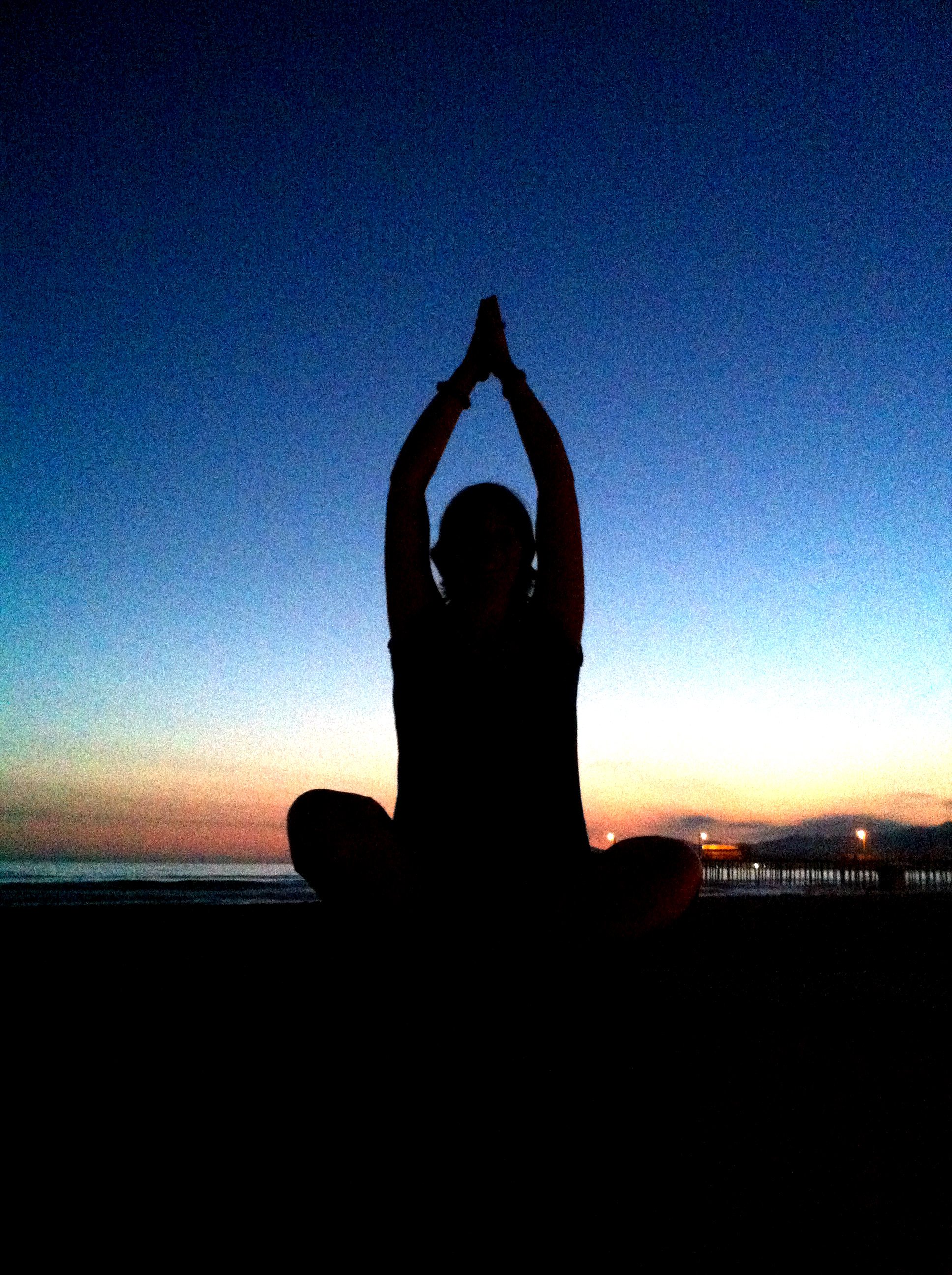
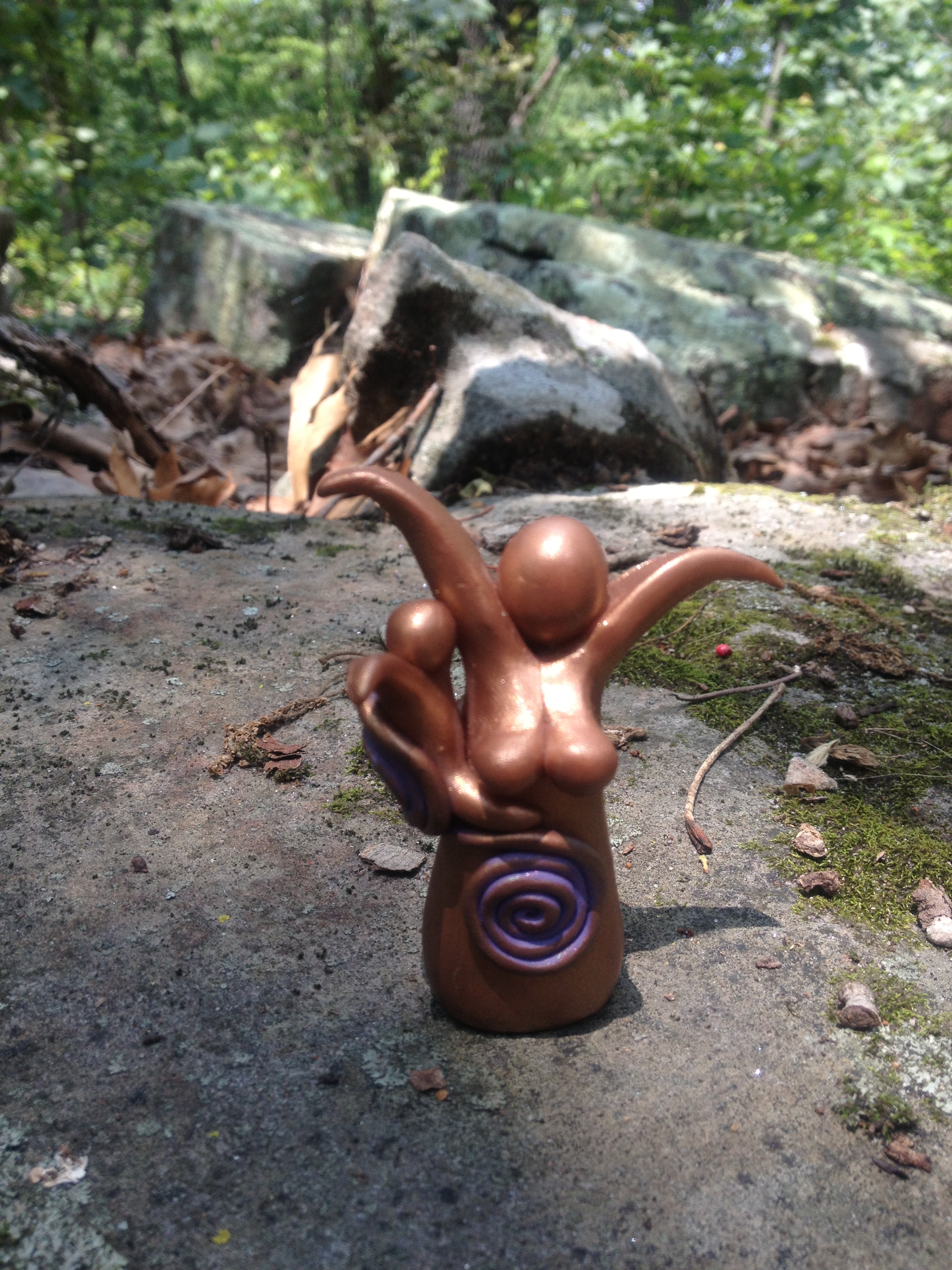
For several days after I wrote my Outraged Ancestral Mother poem and prayer other specific “character” poems kept coming to my mind. Prophet Woman was the first, but she was followed by several others, like Shakti Woman. For some reason, I felt like I needed some distance before they felt “safe” enough to publish.

Categories: Goddess, invocations, liturgy, poems, prayers, readings, spirituality, theapoetics, womanspirit, woodspriestess
4 Comments
Blackberry Sabbath
Earth grew it
sun kissed it
rain blessed it
and washed it.Forest sacrament
bread and body and wine and blood in one
globules of color
taut skin
shiny surfaces
collected communally
protecting the future
take it in
and be consecrated
by the sun, rain, earth, and spirit
that created this
that nourished this
and that gifted it to your lips.

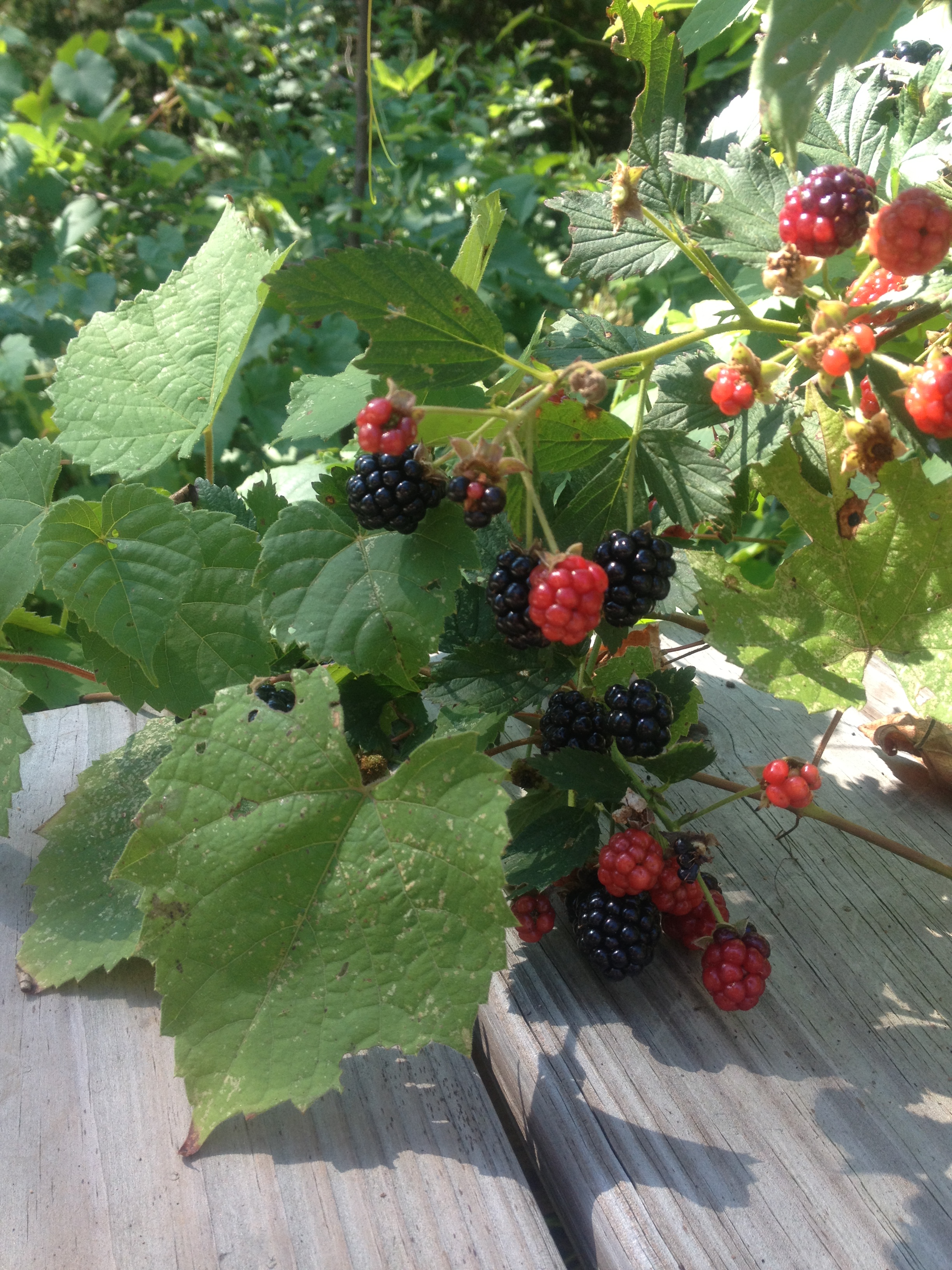
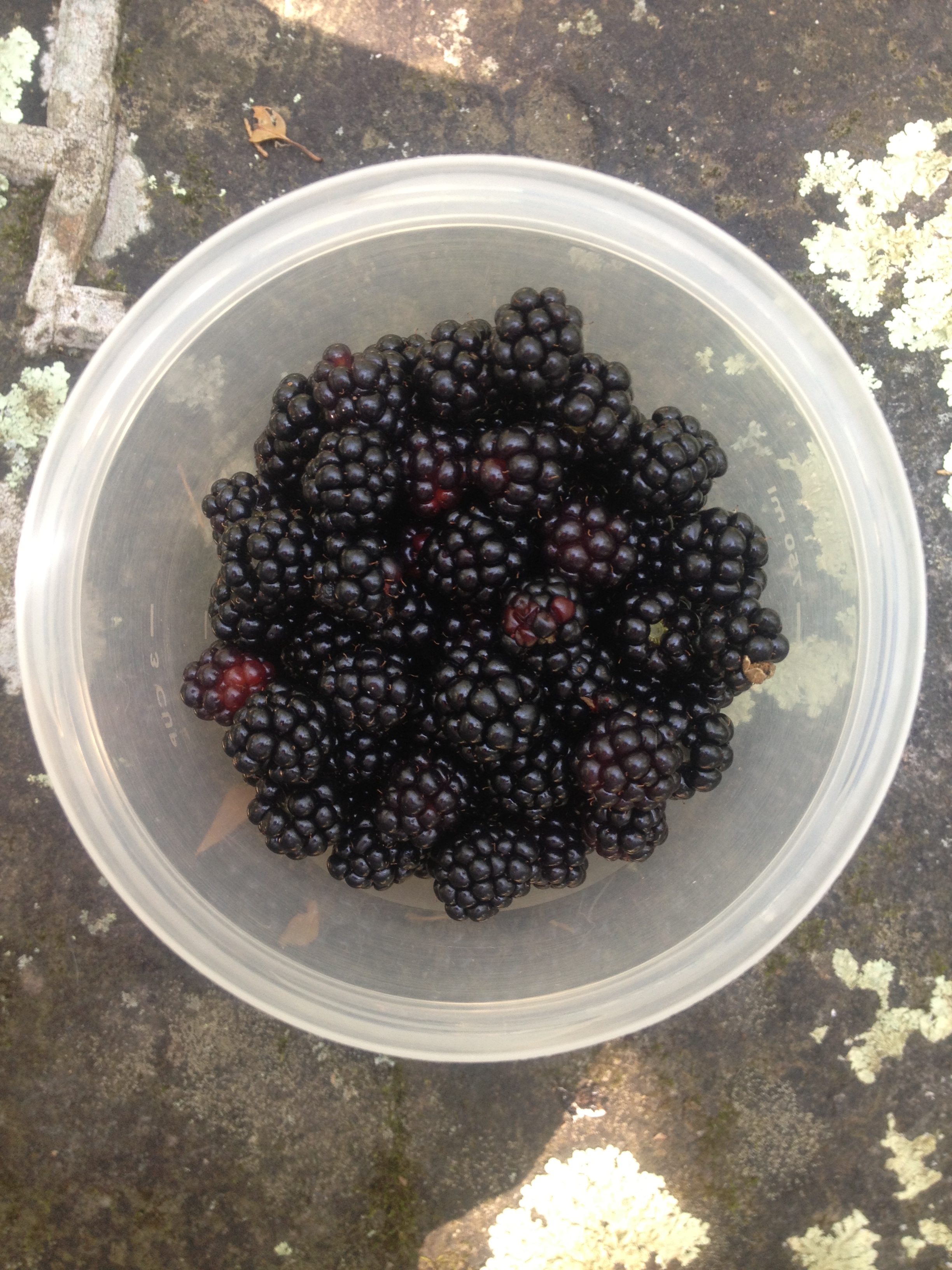
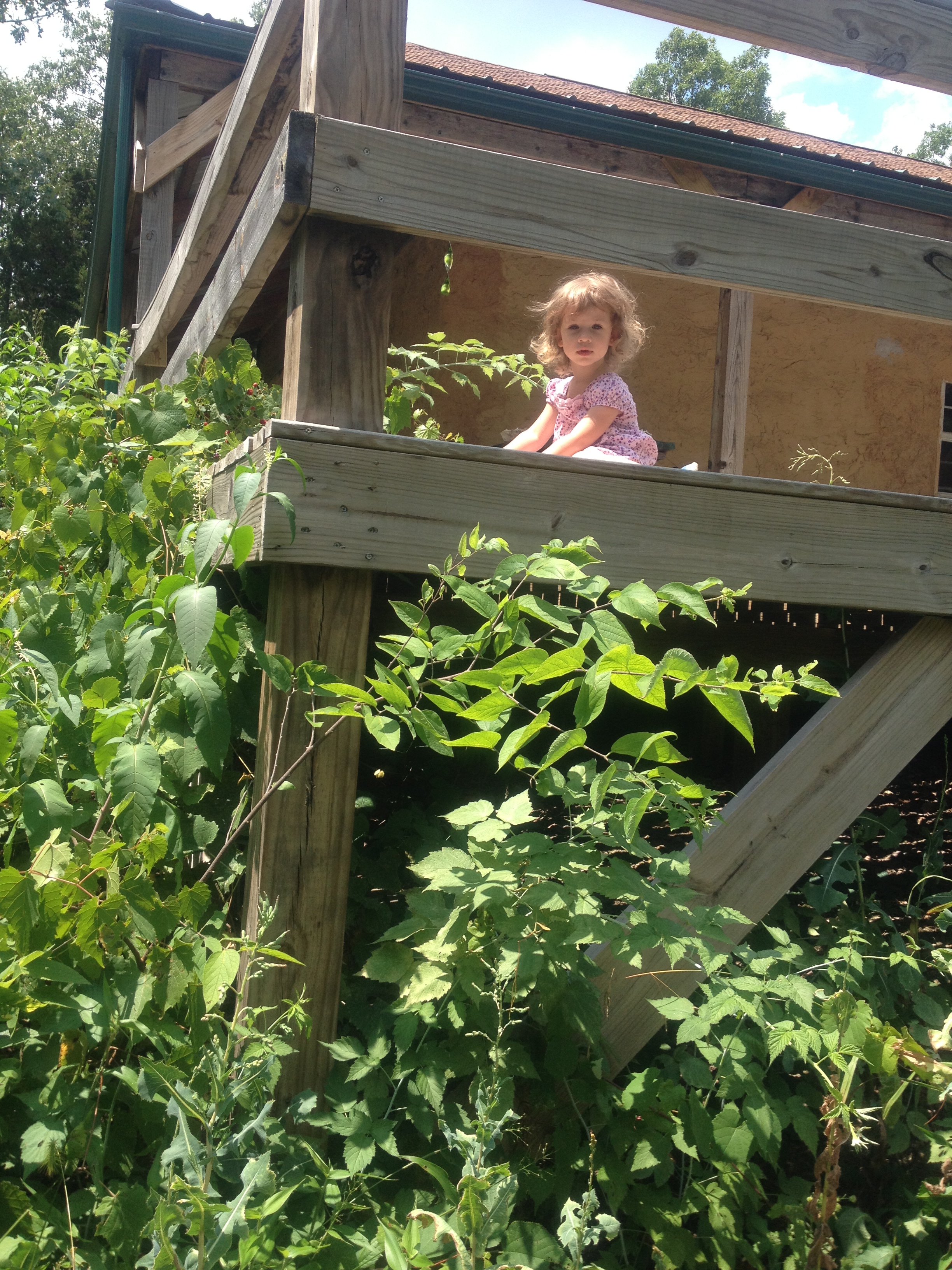
On Friday, I managed to pick one small quart of wild blackberries. Our usual trusty patch didn’t survive last year’s drought apparently, but surprisingly, some new ones have materialized right by the back deck saying, “we’re here, pick meeee!” The back of our house got almost unreclaimably overgrown while we were in CA, but the silver lining is that we can literally pick some blackberries while actually just sitting on the deck. I made a cobbler last night using a slightly modified version of this recipe. It was so amazing that I was inspired to take another holy mission to collect more. (And, I successfully got one more quart, so we get another cobbler!)
“…when you look and listen to nature, something appears, something always speaks. Animism is still a valid relationship. If ‘modern man’ neither sees nor hears, the fault is with his dead sensorium…” –Monica Sjoo

Categories: nature, poems, sabbath, spirituality, theapoetics
4 Comments
Ritual Recipe: Women’s Summer Retreat

My husband picked these summer wildflowers for our circle’s altar 🙂
Friday afternoon was our quarterly women’s retreat and I’d like to share the outline of our process as well as some reflections in case they are helpful for others…
Summer retreat outline
1. Choose bindis (I got some nice fresh ones that are not stuck to the paper!)
2. Circle up and group hum. We do this at every women’s ritual to unify our energy, to harmonize, to focus our intention and to bring our minds and bodies solidly into the ritual space. I feel like this simple action is what “casts the circle” for our group and is a point of continuity from ritual to ritual that we all value.
3. Invocation (slightly modified from Gathering for Goddess by Melusine Mihaltses):
South: We call on Fire with our flesh. Rub your hands together fast and furious, feel the heat you have generated. Now place this heat upon your chest. Feel the heat upon your heart.
We have invoked the powers of Fire.
(group together) Welcome Fire!
West: We call on Water with the moisture found on our lips, lick your lips, wet them with your saliva. Feel how this element lives within you.
We have invoked the powers of Water.
Welcome Water!
North: We call on Earth with the solidity of our own bodies, give your neighboring sister an embrace. All embrace each other.
We have invoked the powers of Earth.
Welcome Earth!
East: We call on Air with our breath, panting and sighs, inhales and exhales. Altogether, breath audibly.
We have invoked the powers of Air
Welcome Air!
4. Candle lighting with reading by volunteer:
…Make a sacred fire
and throw on it all that you would use to harm yourself.
Make kindling from shame.Let your dance be wild,
your voice be honest
and your heart untamed.Be cyclical,
don’t make sense..Initiate yourself.
Initiate yourself.By Aisha Wolfe
5. Quick centering guided meditation using Elemental Connecting by Traci Nichols.

Summer altar
6. We’re a bit past the summer solstice date, but the energetic theme and the season are still the same, so I shared some summer solstice information and reflections. Each woman took a turn to add a symbol of what she’s been womanifesting to the altar as well as discuss any responses to the questions…
It’s now that we Celebrate the womanifestation of the seed dream/s we conceived at Winter Solstice. Much like the Mother Mysteries associated with this time, we are giving our full attention, time and creativity to nurturing, sustaining and protecting our dreams, while reveling in the abundance of all that we are the creatrix of.
With all of this heightened activity and energy, we may find ourselves bumping up against the shadow of the Mother Archetype. With the full activation of our Fire energy that Summer Solstice generates, we can experience “burn out” by over-giving, over-nurturing, over-protecting, and/or over-doing. So remember to “Mother yourself” as you are caring for your creations. Seek out and create support systems that sustain YOU, as you work to sustain your hopes, dreams and all that you love.
The LIGHT of Summer Solstice not only activates us to “tend the fire” of our creative dreams, we can also feel the heat and challenge of spiritual tests we may be going through at this time. Honoring where we are in our spiritual journey, as well as all of what is being brought to “greater light” and asking for “healing” and “transformation” –
via Shine Your Light! – Chrysalis Woman – Returning to the Mother and Each Other.
QUESTIONS TO ASK YOURSELF:
What seed dream have I nurtured since Winter Solstice that is now in full radiance?
Do I Mother myself as I Mother my creations? How do I create support structures for myself that sustain me during times of high activity? Do I experience “burn out” during this time of year due to overwhelm or have I cared for myself in order to feel my full radiance and vitality?
What part of my soul’s growth is being “lit up” this season? What am I being asked to shine a light on in order to heal or transform?
Is my life a reflection of the abundance that is being mirrored to me by the Mother Earth? Does my life flow like Her rivers? Is it abundant like Her gardens? Is it buzzing with loving community? Does it illuminate others with the radiance of the sun? If not, how can I shift in my relationship to abundance so that I can fully and completely shine my radiant light?
via Shine Your Light! – Chrysalis Woman – Returning to the Mother and Each Other.
7. Dance! With jingly hip scarves and scarves in our hands, we raised some energy! This was new for us. After dancing to the African drumming on the Rise Up curriculum CD during our last Rise Up class, we re-visited the action during this retreat. My mom planned out a simple, circle dance and then we did a small spiral dance too. It was fun!
8. For this retreat, we also tried something new for the middle “working” part of the retreat in that I asked each woman to bring an offering to the circle as a sort of group-prepared “potpourri.” Women read stories, shared wisdom and articles, and we made a fun project (see more soon).
9. Shamanic drumming journey CD (15 minutes) followed by journaling and brief discussion. This was also new for the group and had interesting results. Our experiences varied widely, but most had a powerful experience. I think if we did this more often, we’d be more comfortable with the feel of a “journey” and would relax into more easily.
10. Then as my own potpourri contribution and reflection, I read my recent Outraged Ancestral Mother Prayer
11. Closing reading:
…May this day of longest light become for each of us a day of longest gratitude.
A day of longest peace.
A day of longest creativity.
A day of longest hope.
Hold up to the sun your heart, and feel fully present in your life.
May it be so.
via Teo Bishop: Summer Solstice 2013: Hold Up to the Sun Your Heart.
Then, joining hands, we sang Woman Am I together and headed for the kitchen for tasty potluck snacks! I’d originally planned to make a project using some nifty new  crescent moon charms I bought recently. My vision for what exactly we were going to do with them wasn’t very clear and so it was great that one of my friends had brought a surprise project to do as her potpourri offering. Perhaps by next time, I’ll have a charming plan in place! My friend had sewed a set of 40 tiny white prayer flags for each of us upon which we drew our Womanrunes symbols with Sharpies. She also brought us each a dowel upon which we can mix or match the womanrunes and stick it in a garden, a plant, or elsewhere to be a rotating sort of “prayer branch.” She suggested either choosing the runes whose meanings match that which we desire OR randomly selecting a set and seeing what messages want to be carried on the breeze. We can switch them out in a semi-infinite array of mini prayer flag action. It was a really good idea and I was excited that she brought something like that to offer to the circle. When my husband got home, he drilled a little hole in one of the beams of our front porch and we stuck my new prayer flag system into it (flying five randomly selected womanrunes).
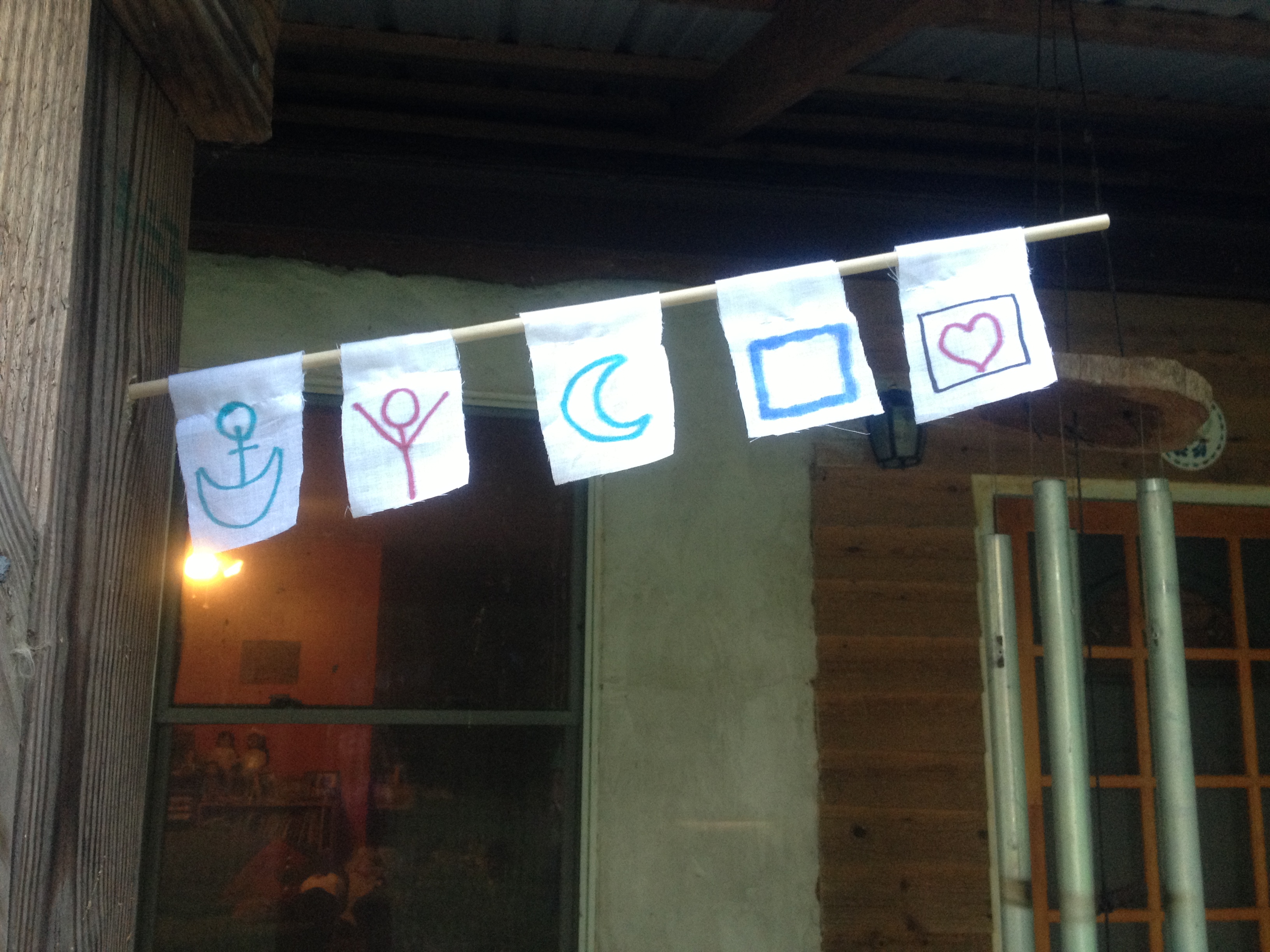

Isn’t that fun?!
I’ve been feeling a little discouraged about my retreats lately, primarily because there are a lot more women on the email list than actually show up and so I always feel like I’m doing something “wrong” or am not planning interesting enough things to attract them. I also take it kind of personally—there is a vulnerability in preparing an offering such as this and each time I do it I actually feel like I’m preparing a gift for my friends. When they decline the invite, it feels, in part, like a rejection of the gift I’m offering. Cognitively, I know (or, I hope!), this isn’t true, but emotionally that is how it usually registers. This summer retreat was a beautiful experience that felt just as I wish for these retreats to feel—nurturing, affirming, and celebratory—like a blessingway for all of us with no one needing to be pregnant!
Things I was reminded of after this experience:
- There is nothing like having friends who are willing to lie on your living room floor and listen to a shamanic drumming CD without laughing or saying you’re ridiculous.
- Small IS good—I already know from my years as a breastfeeding support group leader that I’m a sucker for bigger-is-better thinking (I tell my own students: don’t let your self-esteem depend on the size of your group!!!!!). When the group is small or RSVPs are minimal, it starts to feel like a personal “failing” or failure to me somehow. However, the reality is that there is a quality of interaction in a small group that is not really possible in a larger group. At this retreat there were seven women. While there was an eighth friend I really wished would come and who we missed a lot, the size felt pretty perfect. I reflected that while some part of me envisions some kind of mythically marvelous “large” group, ten is probably the max that would fit comfortably in our space as well as still having each woman be able participate fully. Twelve would probably be all right and maybe we could handle fifteen. I also need to remember not to devalue the presence of the women who DO come. They matter and they care and by lamenting I want more, it can make them feel like they’re not “enough.”
- Retreats like this provide an opportunity to explore/experiment with ideas and activities that we usually do not allow ourselves time for in everyday life—I know that I often “run out of time” for more spiritual/contemplative/relaxing pursuits.
- Circling together in a woman-to-woman atmosphere allows for a type of healing and connection through shared experience that is qualitatively different from getting together to casually chat and socialize. Shared experiences matter and are in some ways more satisfying than shared conversation (most women do plenty of chatting–we can benefit from some being and experiencing together).
- The potpourri thing was a good idea. While my husband said it sounded like a nightmare idea to him—he hates being responsible for bringing something to a group setting—I felt like it created a sense of investment and shared responsibility for our circle. It was fun for each woman to be at the center for a while and to share her contribution with the rest of us.
- I find great value in interacting with my friends in a woman-to-woman context, rather than a mother-to-mother context. So often when I’m with my friends we are in a space of “co-mothering” (i.e. mothering together and “friending” at the same time). While this can work and be fun, a lot of times it is actually kind of unfulfilling—there are constant distractions and I often feel I’m doing neither well–not paying full attention to my kids OR to my friends, and it is a scattered, distracted, stop-and-start, unfinished sort of mode of interacting (I think this is particularly a feature of having a toddler. If I only had my bigger kids, it probably would be a less scattering experience to co-mother). There was a time earlier in this year when I felt like the sense of unfulfillment or frustration I often experienced during friend conversations had to do with my friendships themselves and it took a post-retreat revelation in the spring to realize that it actually had to do with trying to have a substantive visit with friends with all of our kids present!
- That said, perhaps it is somewhat ironic that my own mother is a regular part of this women’s circle—apparently, she can’t escape her kid, ME. But, this too is of important value—despite the close proximity of our homes, we rarely actually have the chance to interact in a woman-to-woman context, rather than as busy adult daughter and grandmother co-strategist. Also, along the same lines of my first point, I also feel lucky to have a mom who is willing to plan ritual dances and lie on the floor with me listening to shamanic drums!

Categories: community, friends, liturgy, priestess, resources, retreat, ritual, spirituality, womanspirit, women, women's circle
7 Comments
Thursday Thealogy: Goddess as Symbol, Statement, and Experience
While in personal experience, I have an understanding of the Goddess both as a symbol and as a metaphysical, panentheistic presence in the world, I do not find that a “real” Goddess is  required for thealogy to matter. Her importance and value as a symbol, a philosophy, and a politics are profound. As metaphor and archetype she empowers women to value themselves, their bodies, and their experiences. This is then real, whether or not the Goddess herself is real. As a sociopolitical construct, she powerfully challenges dominant philosophies about culture, society, politics, women, religion, and ecology. The Goddess as a symbol stands for a better world. A more integrated world. A world worth pursuing, preserving, and honoring. I recognize that some feminists do not feel the need for the Goddess, but I believe that feminism is richer when the Goddess is a part of it. Like it or not, religion is a part of politics in our culture. By only talking politics and ignoring religion, we leave out a powerful part of the human psyche and relationship. An embodied spirituality in which we daily walk on sacred soil and with sacred awareness can transform both politics and religion. This is why the Goddess still matters, whether as symbol or as literally existing.
The Goddess image is a profound cultural, religious, social, and political statement. She does not just personify the human feminine, she validates, celebrates, and honors the existence of the female—as normative , valuable, worthy, sacred. Thealogy must be situated in a larger feminist political context considering the role, value, and social treatment of women in order to reach its full potential. To me, thealogy must engage with matters of social justice, health care, and reproductive rights, contextualizing those issues in an ethical religious framework.
Nonrealist and Realist Conceptions of the Goddess
The political value of the Goddess as symbol and experience is touched upon by Judith Antonelli who states, “The female power is primary in nature. Woman possesses a power that no man can ever have: the capacity to give birth to new life…Patriarchy is based on the ‘phallacy’ that the male is creator. Man’s original awe and envy of woman becomes, under patriarchy, resentment and hostility. The only way man can possess female power is through woman, and so he colonizes her, suppressing her sexuality so that it serves him rather than being the source of her power” (p. 401, The Politics of Women’s Spirituality). In this conceptualization, a split occurs in which men becomes associated with the head and the mind (since men can only create with their minds/hands, not with their wombs/bodies) and women become associated exclusively with the body and with nature and devalued as below or lesser than, rather than as primary creatrix of the world. “Women today who are trying to bring back Goddess worship are not worshipping idols, escaping through mysticism, or revering an external god-substitute. The Goddess represents nothing less than female power and woman’s deification of her own essence. It is external only to the extent that this power is contained within the cycles of nature as well as within ourselves” (Antonelli, p. 403).I believe feminist spirituality can be further distinguished from a more broad “women’s spirituality” or a more specific “Goddess religion,” because of the inclusion of a sociopolitical orientation. Feminist spirituality to me is the intersection of religion and politics. It is religious feminism. It may or may not include literal experience of or perception of the Goddess, but it names the female and the female body as sacred and worthy of protection, cherishment, and defense. Despite the persistent  emphasis on reflexivity and relativism, Goddess advocates and those who identify with feminist spirituality do take an uncompromising, non-relativistic stance on violence against women and names as evil and wrong, …”the abuse and alienation of rights from women, subject men and non-human life forms by institutions sacralizing and privileging masculinity” (Melissa Raphael). Experience of the divine is personal, experience of oppression, domination, and exploitation is political and universal.
As Carol Christ explains, “the symbol of the Goddess has much to offer women who are struggling to be rid of the ‘powerful, pervasive, and long-lasting moods and motivations’ of devaluation of female power, denigration of the female body, distrust of female will, and denial of women’s bonds and heritage that have been engendered by patriarchal religions. As women struggle to create a new culture in which women’s power, bodies, will, and bonds are celebrated, it seems natural that Goddess would reemerge as a symbol of the newfound beauty, strength, and power of women” (quoted in Diane Stein’s anthology The Goddess Celebrates, p. 253)
I was a feminist first and a Goddess feminist much later. As Cynthia Eller observes in Living in the Lap of the Goddess, “…having become highly sensitized to any hint of sexism, it would not do to simply ignore gender; nothing would suffice but to glory in femaleness, to proclaim the spiritual potential inherent in womanhood, to take the ‘weak vessel’ of Christianity and make her the holy chalice of the great goddess. This is what these women found in feminist spirituality.” This is the essence of feminist religion to me—women are sacred, women are holy, women are wholly worthy, and we celebrate being female, including an acknowledgement and experience of the feminine divine, of the great goddess.
As Charlene Spretnak explains, “We would not have been interested in ‘Yahweh with a skirt,’ a distant, detached, domineering godhead who happened to be female. What was cosmologically wholesome and healing was the discovery of the Divine as immanent and around us. What was intriguing was the sacred link between the Goddess in her many guises and totemic animals and plants, sacred groves, and womb like caves, in the moon-rhythm blood of menses, the ecstatic dance–the experience of knowing Gaia, her voluptuous contours and fertile plains, her flowing waters that give life, her animal teachers…” (p. 5, The Politics of Women’s Spirituality)
A world that honors the Goddess, that honors feminine representations of divinity, is a world that values women, in body and in mind. Goddess spirituality transcends the limitations and boundaries placed on women’s bodies by other traditions (i.e. that women’s sexuality is fearsome/dangerous, that girls should be virginal, that bleeding is “unclean,” that older women are unattractive or have outlived their [breeding] usefulness. As Susan Griffin states, “In Goddess spirituality, women experience their bodies as sacred…” She is the whole Universe and she creates the entire world; a world in which, not incidentally, human females are of inherent value and worth.
I connect to Karen Tate’s descriptions of Goddess as “deity, archetype, and ideal.” I also like Starhawk’s description of what Goddess means to her: “It all depends on how I feel. When I feel weak, she is someone who can help and protect me. When I feel strong, she is the symbol of my own power. At other times I feel her as the natural energy in my body and the world.” While this sounds perfect to me, this fluid conceptualization of divinity is profoundly and dramatically challenging to traditional  religious structures.
As Esra Free notes in her book Wicca 404:
“To view the reality of the Great Goddess of Wicca for ourselves, we need look no further than our own bodies, our own planet, our own universe. Our Goddess is not some distant, invisible, disembodied spirit, nor is she ‘supernatural’ in any way, shape or form. Our Goddess is Nature, in all its manifestations. From the inconceivable whole of the vast, living universe to that universe’s tiniest constituent particle, She is physically, spiritually, energetically and personally everywhere. All the time. The Great Goddess of Wicca is All That Is, past, present and future, here on Earth, in every distant corner of the physical cosmos, and in all the seen and unseen spaces in between. There is nothing you can look to that is not Her, that is not born of Her, that does not bear the imprint of Her essence…” Free also says, “Remember that what preserves the screen door is its openness, its ability to let the storm’s fury pass through. A closed door gets blasted to smithereens. If we think of our personal, intimate, experiential relationship with the Goddess as the doorframe, as that which maintains our ‘shape’ throughout the storm, solidly framing our identity and integrity as followers of the Goddess while the flood of life passes through our ‘screen,’ what do we have to fear from other Traditions?”
And, acknowledgment of these immense forces of life actually does not require theism at all:
Thus, one can be Pagan and polytheist; Pagan and humanist; or even Pagan and atheist. Because Paganism is not a theism – it is not a statement of religious doctrine on the existence of Gods per se. It is a broadly spiritual worldview in which the cosmos is alive with powers with which we can interact. Theisms involve the recognition of those forces specifically in the form of Gods.
The existence of an ontological Goddess
To me, Goddess is found in the act of specifically naming that ineffable sense of the sacred that we all, universally, experience or perceive at some point during our lives. Whether it be in gazing at the ocean or in climbing a mountain, in the births of our children or the hatching of a baby chick, almost all humans experience transcendent moments of mystery, meaning, wonder, and awe. We can call these experiences by different names and I feel that the Goddess arises when we have the courage and capacity to name Her as such, rather than stay hazy, generic, or afraid. In my own life, I call these numinous experiences Goddess and through this I know She exists in, of, around, and through the world that I live in. It is in these experiences that I touch Her directly.
I explored this idea in one of my first posts at Feminism and Religion:
A classic, though limited, ontological argument is that God(dess) is because we can conceptualize of that existence. Rather than frame my argument for the existence of Goddess this way, I would say that Goddess is because we feel or experience that She is. Additionally, I do not actually find it necessary for a deity to necessarily meet classic theological criteria of all good and all powerful. In one of my first classes at Ocean Seminary College, I wrote the following, inspired by Carol Christ’s writing: “I have a thealogical view of the world/universe as the body of the Goddess. Everything is interconnected in a great and ever-changing dance of life. Not as ‘all one,’ but as all interconnected and relating to one another, in an ever-present ground of relationship and relatedness…I imagine the divine as omnipresent (rather than omnipotent).” The Divine is located around and through each living thing as well as the great web of incarnation that holds the whole.
As an example of this divinity that permeates each living thing, I offer a newly hatched baby chick. Bright black eyes sparkling with life, fluffy down, perfect little three-toed feet. Minutes before there was an egg, delicately posed beneath a chicken, throbbing with something, ineffable, that unfurled in a steady sequence from two cells to many, until this moment when having used its little beak, stunning in its perfection, to crack out of its shell, now peers out onto the great, grand world. This life force so evident in the transition from egg to chick also beats all of our hearts and grows all of our fingernails. This force grows the trees and makes the flowers bloom. This force is both in and around me all of the time. I am embedded in it. When I tap into that feeling of spirit within, it is making a connection or being in relationship to, that larger Spirit that makes up the world and that we all participate in and belong to, separate but connected.
via Who is She? The Existence of an Ontological Goddess By Molly Remer | Feminism and Religion.
Experience is core and belief becomes unnecessary, as in this thoughtful exploration by T. Thorn Coyle:
…To paraphrase Joseph Campbell: I don’t need belief because I have experience. I can have profoundly moving experiences of deities, or swimming in a sea of light and connection, or have a deep intuitive insight into someone else. I might come up with theories based on these experiences over time, and test these against other people’s. I can hold all of this, and still recognize that tomorrow, some new information may come along to change my mind. I can hold all of this, and know that I am holding one drop in a great ocean. I can set my skeptic aside and feel the power of my experiences of the numinous without feeling the need to build a creed around them.
We humans are storytellers. Stories apply meaning to our experiences. This is a good thing. There is truth in our stories, as well as exploration, and a connection to the line of past and future. When story becomes concretized into an unshakable belief or faith, however, humans run into trouble. We forget that the cosmos is in process. We forget that we don’t hold the whole truth, but only one facet of it…
Our stories interlock, all trying to explain the mysterious, trying to understand what is just beyond our grasp. They are always incomplete, but pointing to some reality. Until germs became proven, we needed several stories to explain the phenomenon of germs. Not being a believer offers flexibility to my experience of Mystery. Not being a believer keeps the door of possibility open.
The most succinct way I have found to explain the lack of rationality in the midst of spiritual experiences is to remind myself: “Love is not only dopamine.” I don’t need to believe in love because I experience love. Love is partially a set of chemical responses that affect my emotions, but it is also something more. Love is ineffable. So is how I feel while staring at the night sky, or my experience in the midst of ritual when I call out, and something Other shows up and I am not the only one who experiences it.
My rational brain makes sense of all this by remembering that there are many things we cannot yet explain. The glory of the cosmos is a marvelous thing that causes me to feel a sense of awe. Music transports me when the musicians are in the groove with each other, the music and the audience, and something special just appears. This “something special” is what I name The Sacred. It is holy. None of this requires belief. The numinous arrives, and something in me changes. This can happen during ritual, during prayer or at any other moment…
In Merlin Stone’s essay about the three faces of goddess spirituality in The Politics of Women’s Spirituality she states, “So far, and let us hope in the future as well, feminists concerned with Goddess spirituality have seldom offered absolute or pat answers to theological questions. What has been happening is the experiencing, and at times the reporting, of these personal or group experiences: how it feels to regard the ultimate life force in our own image—as females; how it feels to openly embrace and to share our own contemplations and intuitive knowledge about the role of women on this planet; how it feels to gain a sense of direction, a motivating energy, a strength, a courage—somehow intuited as coming from a cosmic female energy force that fuels and refuels us in our struggle against all human oppression and planetary destruction.” To me, this makes sense—Goddess as life’s “fuel” and as an energy that surrounds and holds us all, but that does not control our behavior and does not have the ability to stop specific events from happening—events are multicausal and there are a multiplicity of forces and natural laws in the world (gravity, for example), that act in and upon the lives of humans without divine cause or intervention. She goes on to articulate a thealogical perspective that holds a lot of truth for me:
“Some say they find this force within themselves; others regard it as external. Some feel it in the ocean, the moon, a tree, the flight of a bird, or in the constant stream of coincidences (or noncoincidences) that occur in our lives. Some find access to it in the lighting of a candle, chanting, meditating—alone or with other women. From what I have so far read, heard, or experienced myself, I think it is safe to say that all women who feel they have experience Goddess spirituality in one way or another also feel that they have gained an inner strength and direction that temporarily or permanently has helped them
to deal with life. Most women interested or involved in feminist concepts of spirituality do not regard this spirituality as an end in itself but as a means of gaining and giving strength and understanding that will help us to confront the many tangible and material issues of the blatant inequities of society as we know it today.” (p. 66-67)
Finally, as Brian Swimme describes in one of my favorite theapoetical passages of all time: “From a single fireball the galaxies and stars were all woven. Out of a single molten planet the hummingbirds and pterodactyls and gray whales were all woven. What could be more obvious than this all-pervasive fact of cosmic and terrestrial weaving? Out of a single group of microorganisms, the Krebs cycle was woven, the convoluted human brain was woven, the Pali Canon was woven, all part of the radiant tapestry of being. Show us this weaving? Why, it is impossible to point to anything that does not show it, for this creative, interlacing energy envelops us entirely. Our lives in truth are nothing less than a further unfurling of this primordial ordering activity…Women are beings who know from the inside out what it is like to weave the Earth into a new human being” (p. 21, Reweaving the World).
This is creation, science, fact, come alive. This is theapoetics. The presence of the Goddess, in a way that cannot be denied.
Categories: feminism, feminist thealogy, OSC, spirituality, thealogy, theapoetics, Thursday Thealogy
2 Comments
Carpriestess: Prophet Woman
She’s been waiting
curled up
knees to chest
head to arms
sleeping
thinking
biding her time
but her eyes have flickered open
she’s stretching her arms
unfolding her legs
wriggling into her purpose
until it fits like a gloveShe’s opened up her heart
and her throat
and her voice comes pouring forth
like a swirling river
her ear is tuned
to the hopesong of the forest
her heart is tuned
to the rhythm of the earth
she feels the Goddess sing through her
alive in her blood
and she steps forth…She rattles cages
she stirs the pot
she shakes things up
she asks hard questions
she refuses to accept no
and you can’t.She digs deeper
she twists harder
she wonders more
she speaks her truth.Soon cages bend and open
veils fall away
fires of curiosity are lit
in hopeful breasts
and wisdom no longer belongs to secret places.The world is reborn
knowing love as the ground of being
and the source of all creation.
and refusing to kill anything
but illusion and despair.Prophet Woman
she’s a warrior
speaking now
her voice is quiet
in this moment
but I hear
the distant thunder
and I feel
the breath of change
against my neck.7/3/2013


On the way home a couple of days ago, I was listening to Matthew Fox and Karen Tate speak on the Voices of the Sacred Feminine talk show (see: Mary Magdalene & Matthew Fox on the Vatican, Pope & CIA 05/22 by Karen Tate | Blog Talk Radio). At the end of the show, Fox said that a spiritual presence that needs to be “brought back” and that is of vital importance is the “prophet warrior.” This archetype is that of a loving spiritual activist. Immediately after hearing this, some lines about “prophet woman” came floating into my mind. I was thinking about all the people who are “re-birthing goddess” on the earth or who are raising awareness of the “sacred feminine” or “divine feminine” or God-She or just about women—their bodies, minds, and spirits. I thought about my favorite Facebook presences: The Girl God, Journey of Young Women, The Gypsy Priestess, and Goddess Spiral Health Coaching, as well as many authors and publications that I so enjoy and I realized these are the prophet women speaking. I spoke aloud into my little recorder and when I got home, I typed up my poem and sent it to The Girl God: Prophet Woman.
She speaks! 🙂
Categories: invocations, poems, prayers, readings, spirituality, theapoetics, womanspirit, women
4 Comments
Collaborative Orisha Poem
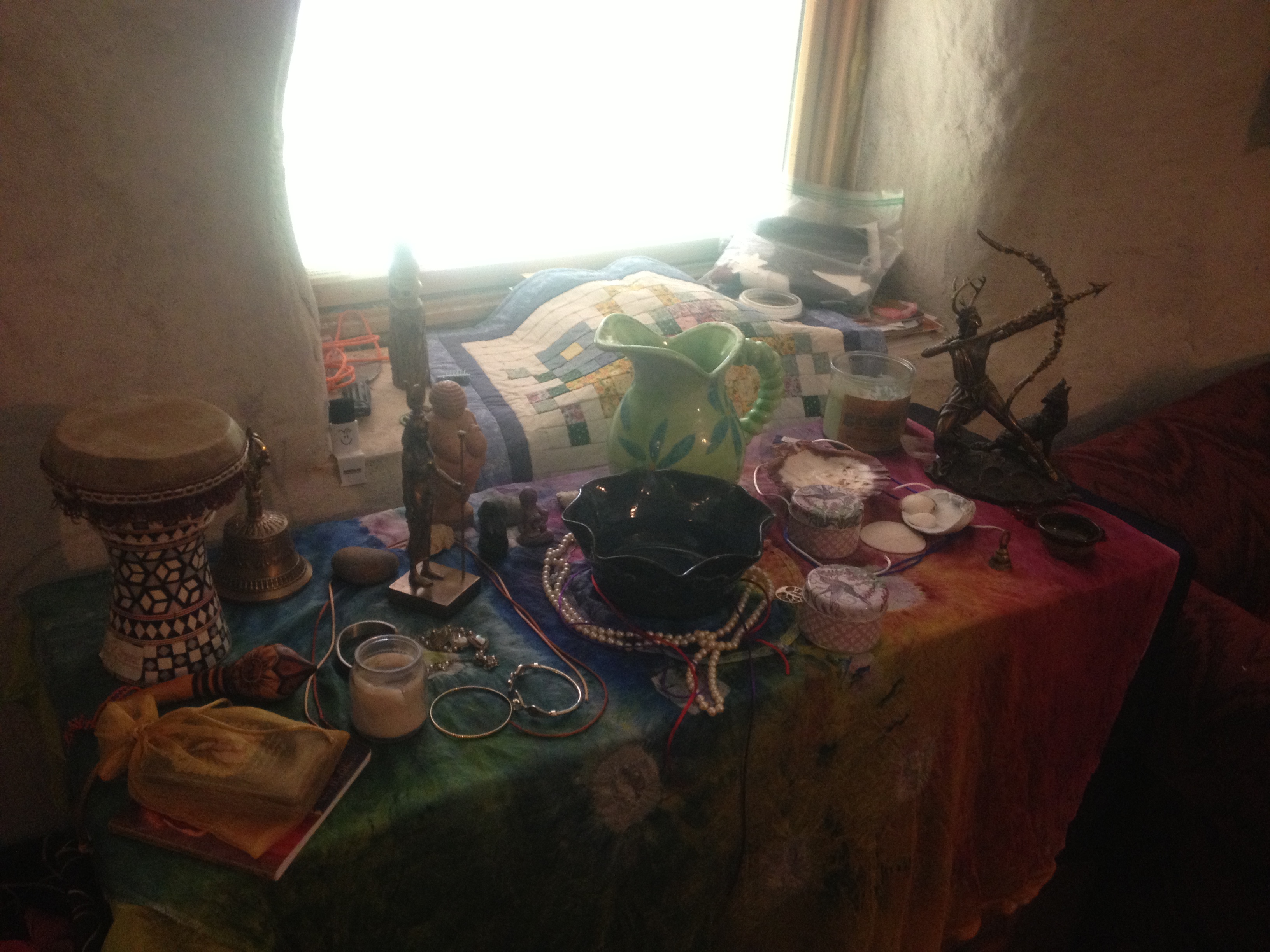
Orisha altar. A little cluttered! (there are three different areas, one for each orisha)
Spirit of change
destiny sweeping
good vibrations
respect
and thunder.Float freely
release
and encourage.Momentum building
crescendoWater wisdom.
At our last session of Rise Up, we were talking about the Yoruban Orishas, specifically Yemaya, Oshun, and Oya. After dancing together to honor the orishas, we looked into a bowl of water and each spoke aloud what had come to us following the dance. I wrote down what we said and the result was just what was supposed to happen: we’d created a collaborative poem about the orishas. I thought it was a neat experience 🙂 We did a double session of Rise Up this last time and I think it was too much to try to do at once since we kind of lost our steam. Next week, I had planned to do our next Rise Up class followed by our summer retreat, but now I think we should do only the retreat and keep Rise Up on a different day. It took a lot out of me to try to do two classes back to back and I could tell the rest of the group wasn’t really “feeling it” either. I have a tendency to always want to multitask and to double-up to be efficient, but sometimes there is a price to be paid for efficiency and in this case it was a lack of “steam” or connection during our time together. The dancing was fun and invigorating, but I felt like during other portions of the class people started to get bored or otherwise unfocused. I also left out some details about what to bring for our collaborative project and so that was confusing for people too and I kept losing my place in terms of what to do next, because the two classes blended together in my head and I couldn’t remember what went with what. I’d also had a bad morning with my kids (described on my other blog) and that dramatically impacted my ability to be present with our circle. In general, I felt like I basically failed with this particular session, though I try to remember that success or failure of a group endeavor does not rest with only one person, there is a collective responsibility to the usness of a group and a group is a living system with a personality and life of its own. At least our group poem worked pretty well! 🙂
Categories: blessings, community, friends, invocations, poems, priestess, spirituality, womanspirit, women's circle
Leave a comment
Thursday Thealogy: Matriarchal Myth or a New Story?
Some Pagans and spiritual feminists have chosen to use the myth of matriarchal prehistory as an inspirational sacred story, rather than understanding it as pure history. In this way, the story has supported activists in working for a more peaceful and more egalitarian society. By imagining a just society that might once have existed, feminist Pagans and Goddess-worshippers galvanize themselves to try to create such a society in the present day. Other Pagans, however, have been critical of the matriarchal myth. Greer, for instance, notes that the myth of matriarchal prehistory has many similarities to the story of the Garden of Eden. In the story from Genesis, humankind falls from grace and is cast out of utopia because of Eve’s disobedience. In Christianity, Eve’s “sin” has sometimes been blamed on women in general, and the Genesis story has been used to discriminate against women. The matriarchal myth reverses this sexism by envisioning a female-led utopia that was destroyed by “patriarchal invaders”— in other words, by men. Although both the matriarchal myth and the myth of the Garden of Eden can be interpreted in a non-sexist fashion, both narratives have been used to teach gender-based prejudice.
–Christine Hoff Kraemer, Seeking the Mystery: An Introduction to Pagan Theologies
I remain firmly convinced of the power of story. Story shapes our world. And, reality is socially constructed in an active process of storying and re-storying.
I’ve share these quotes in my classes and they feel relevant again today:
“The universe of made of stories, not of atoms.” –Muriel Rukeyser
“Power consists to a large extent in deciding what stories will be told.” –Carolyn Heilbrun
While the matriarchal myth has been critiqued and attacked from an anthropological and sociological perspective, I think it has important value—it doesn’t have to be true or verifiable to have a potent impact on society. The very fact that people feel that the matriarchal story is a myth that needs to be “debunked” to me is proof of the mythic power of our old, patriarchal story on current culture. Earlier this year I finished reading Reid-Bown’s book Goddess as Nature and he says this: “What is significant, however, is that the matriarchy thesis has considerable mythopoetic value for the Goddess movement: it affirms that the world was not always distorted by patriarchy, it contributes moral meaning to the state of the world today, and it aids in an imaginative revisioning of a better goddess-centred future” (p. 18). The power of the matriarchal story—myth or fact—is in the assertion that the world CAN be different. Patriarchy and war are not the “just way its always been,” or a “more evolved” society, or the only possibility for the future. The matriarchal myth opens up the door for a new FUTURE story, not just a revisionist look at the past.
Reid-Bowen goes on to explain: “Myths may be understood as narratives which enshrine a number of religious and cultural meanings within a framework where exceptional and supernatural events may take place; they are imaginative construals or presentations, in story form, relating to such issues as the origins and nature of the universe and the meaning of life; they possess a certain explanatory power; they reflect aspects of a particular world of meaning; and in most cases they provide an interpretive lens by which to understand the world. Difficult questions admittedly arise when myth and history are conflated or confused, and when one attempts to assess the epistemic status of a myth. However, it is important to emphasize that myths are, first and foremost, imaginative stories that carry with them a cluster of meanings relating to the way significant things originally were, or are, or ought to be” (p. 34). This is what I mean about story creating and shaping our world. Story also legitimizes social, political, cultural, and religious structures as in the classic quote from Mary Daly: “If God in ‘his’ heaven is a father ruling his people, then it is the ‘nature’ of things and according to divine plan and the order of the universe that society be male dominated. Within this context, a mystification of roles takes place: The husband dominating his wife represents God ‘himself.’ The images and values of a given society have been projected into the realm of dogmas and “Articles of Faith,” and these in turn justify the social structures which have given rise to them and which sustain their plausibility.”
Returning to Reid-Bowen, he goes on to describe that, “Myths may also serve to legitimate states of affairs that may be either oppressive or empowering, they may be subject to revision or stagnation, or else may lose credibility in the face of alternative or competing narratives. For Goddess feminists, patriarchy is understood to have  produced myths that have served to legitimate the oppression of women and the degradation of the non-human world, and also systematically empowered men to the detriment of women. Goddess feminists, in turn, recognize that patriarchal myths must be challenged by the creation or reclamation of gynocentric alternatives. That is, women must be empowered, female power legitimated and human relations with the rest of nature improved by a process of re-mythologization. The invidious ethos of patriarchy can, it is asserted by many Goddess feminists, only be supplanted by the provision of an alternative feminist mythos or worldview. The creation of gynocentric myths is conceived thealogically as a necessary component in the development of a post-patriarchal society, and it is also understood as vital to an ongoing process of female ontological and political becoming and liberation. Feminist mythmaking – whether understood as ‘psychic activism’ or as ‘re-spelling the world – is a remarkably important thealogical activity” (p. 34). I completely agree with this assessment—a remarkably important thealogical activity. Indeed, it may be the first step, the first introduction women have to realize that there is more “out there” than the classic, Abrahamic religions of their youth. So, in this way, I almost feel like the thealogical myths are a sacred task as well as community outreach!
In my readings for my Ecofeminism class, when discussing animal studies through a male-biased lens, Warren observes, “When those values, attitudes, assumptions and beliefs reinforce or maintain social constructed views of females and males in ways the inferiorize female behavior, they are ‘male-biased’…” (158) This reminds me of the question of whether a human matriarchal past is a myth or history—I firmly believe that most visioning of history and understanding of historical artifacts is rooted in a solidly male-biased (and Abrahamic) lens. Our interpretation of artifacts AND of animal behavior tell us more about our own current society and beliefs than they tell us about the past (or animals). “It has been noted that one of the most significant aspects of the contemporary feminist movement is its drive to reclaim from patriarchy the power of symbolizing and naming, to define femaleness from a female perspective and with a female voice, ‘to discover, revitalize and create a female oral and visual tradition and use it, ultimately, to change the world’.That is, in recognizing that languages and symbols mediate and in part construct reality (and most significantly patriarchal reality), many feminists have adopted a pro-active and interventionist role with regard to the formation and utilization of languages, narratives and symbols” (Reid-Bowen, p. 33)
The matriarchal myth is an “oral history.” As Eller explains, “Feminist spirituality’s sacred history is not a matter of doctrine or scripture; it is living story remade in every telling, by every teller.” (p. 153) Eller also says, “The rhythm of this story is unmistakable, moving in a great wave pattern across human history. Respect for the female surges, then ebbs; perhaps it will surge again. This rhythm is the heartbeat of the feminist spirituality movement. It pulses out into the greater culture where it gradually leaches into the popular mentality as something between folk wisdom and historical fact.” (p. 150-151)
What if history, as it is presently defined, leaves out a whole swath of human history, relegating it to “pre-history” status instead?
Spretnak states, “Patriarchal culture holds that a strong, courageous independent woman is an aberration, an unfortunate freak of nature. We know this to be a lie because we have discovered widespread traditions of mythic and historic women of power, our potential shapers of identity” (p. 89). So, how do we learn about the past and put our lives into a larger historical and sociocultural context? In Merlin Stone’s classic essay, she writes, “…many women of today suspect, or even firmly believe, that a study of the religious accounts ‘of different races and faith’ would probably result only in finding that womanhood has always been perceived and portrayed as secondary to manhood. Statements, some even by well-educated feminists, often convey the idea that if actual accounts from societies that regarded woman as powerful, as supreme creator, or as important culture heroine, ever did exist, such information is now buried in the dust of prehistory—a Goddess name here or there all that is left to ponder” (p. 92).
Stone goes on to note, “The gradual formation of these attitudes has been accomplished in various ways. One has been to confine grade school and high school studies primarily to what has existed in relatively recent, generally Caucasian, male-oriented societies. Another has been through reassurances by university teachers, and texts, that if some cultures had viewed women as supreme deity, or had had a female clergy that had deeply influence moral and social structure, indication of this occurs only in the scantiest (and, therefore, inconclusive) of references. A more subtle factor at work has been the rejection of all things ‘religious’ or ‘spiritual,’ by many who might agree with the need for finding positive images of woman but would prefer not to discover them in other than secular sources—thus ignoring the power and influence that contemporary male-oriented religions have upon even the most atheistic or agnostic of women today.”
In Spretnak’s footnotes on page 129 regarding anthropology and women she explains, “…anthropologists must refuse to consider at least eighty years of archaeological matrifocal finding from the prehistoric era…on a very basic level many of the perceptions of the above scholars are informed by patriarchal concepts the validity of which they have not yet examined and rejected. I have great respect for their work as descriptive analyses of patriarchy, but they repeatedly treat contemporary (patriarchal) attitudes and cultural structures as eternal ‘universals of the human condition,’ e.g., that women are always subservient because we bear children and because we are associated with nature more closely than are men (culture) and because ‘polluting’ menstrual blood and ‘messy’ lactation flow out of us. Nowhere do these scholars acknowledge the archaeological evidence that these female phenomenon carried positive—even awesome—value for 20,000 years prior to the advent of the patriarchal era. If childbearing is always considered limiting and degrading, why did our Paleolithic ancestors from Spain to Siberia carve myriad statues of powerful female figures whose vulvas, large breast and bellies cyclically yielded the very mysteries of life? One rarely sees infants hanging on these statues (a reflection of the diffusion of childcare within a clan system?); they are simply monuments to woman’s elemental power.”
Stories ARE power and that is why a feminist, matristic, Goddess-oriented narrative has value, regardless of whether it is myth or fact. As we know too well, the victors write the history books—they get to tell the stories and those stories, logically, may involve significant distortion of the facts of the past.
Sociocultural changes can occur rapidly and due to this writing of the history books it is difficult to fully assess the social structures that were in place prior to the invasion of the theoretically matriarchal and peaceful people by a warrior class. However, the idea that social evolution means becoming warrior-based and patriarchal and that patriarchy is more “advanced” or “civilized” is a fundamental flawed story underlying much of our “modern day” history. I believe that a re-visioning of the current “story” of the past is helpful in the critical assessment of present social structures and ideas. As Christ states on page 61, “…the institutionalizing of warfare as a way of life…is the single most important factor in the subordination of women.” Broadening our scope of consideration to include a matrifocal legacy brings hope as well as context to our current culture in a meaningful way. When warfare is way of life, boys are trained to dominate and be aggressive and to see women as possessions or “spoils” of war. We see this type of training on a global scale right now and to consider the notion that this is not an appropriate or inevitable “evolution” of society is radical and potentially transformative.
Eller addresses the notion of a dominator vs. partnership model—again, this doesn’t have to be mythic past to be a better future. As a matter of fact, I use the idea of dominator and partnership in the human services classes I teach. As she notes, Goddess scholars have thus successfully, “…detached feminist spirituality’s sacred history from its original roots…[and] made it possible for people to celebrate a ‘partnership’ past and condemn a ‘dominator’ present without feeling any compulsion to worship a goddess, practice magic, or meditate on menstrual fluid.” (p. 156)
Since stories create culture, create future people’s history, I take no issue with the detachment of the history in this manner—we desperately need alternate conceptions of possibility to the dominator present. If those conceptions can become even marginally “mainstream” and accessible to people from many faith traditions, not just Goddess 
women, then we may actually be making meaningful progress!
One form of “evidence” that Eller regards as potentially questionable, but strikes me as logical (and I’ve addressed it many time previously) is that of the role and value of childbirth. “Women’s ability to bear children, spiritual feminists say, gave natural cause for ancient peoples to image their creator deities in the form of a woman…’When our ancestors came out of caves, what did they think? Of course, woman gives birth. Whatever gave birth to us is a woman.’” (p. 158) Heck, even with all of the trappings of “modern” life, I STILL find the birth event to be magical, one of the truest, purest, and most authentic human experiences of magic there is. And, it was in giving birth gave me my first direct, explicit contact with the Goddess.
When discussing the story of Adam and Eve, Eller observes, “…childbirth is no longer a woman’s goddesslike creative miracle, but her cruel destiny of suffering and pain; her husband is no longer her delight freely chosen, but her master appointed over her…Adam is not born out of Eve, in the way that all men are born of women; rather, Eve is born of Adam, in a way the world has never seen before or since. Human reproduction, central to the goddess’s former power, is not a male prerogative.” (p. 167) This is the root of Christian patriarchy and continues to have a powerful legacy today.
So, in conclusion, the primary function of value of this sacred history is that patriarchy is no longer the only story we’ve known. An alternate past gives hope for an alternate future.
“Stories are medicine…They have such power; they do not require that we do, be, act anything—we need only listen. The remedies for repair or reclamation of any lost psychic drive are contained in stories.” –Clarissa Pinkola Estes
**This post is based on lessons completed for my Historical Roots of Goddess Worship class at OSC. Also, returning to my opening quote, are you interested in learning about Pagan theology? Seeking the Mystery: An Introduction to Pagan Theologies is on sale at Amazon this week for $2.99 (half price). Paperback version also available! The book includes activities and discussion questions for individuals and groups. **
Categories: feminist thealogy, Goddess, OSC, spirituality, thealogy, Thursday Thealogy
10 Comments
Come join the Circle!

Upcoming Events

Earthprayer Poetry Book
Womanrunes Book
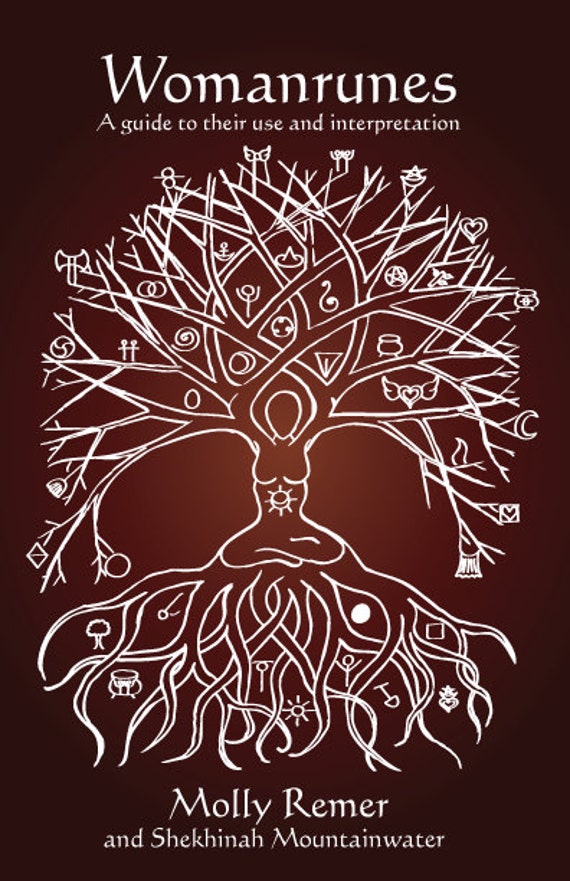
Etsy shop

Ritual Recipe Kit


 WoodsPriestess