Our Mother Prayer

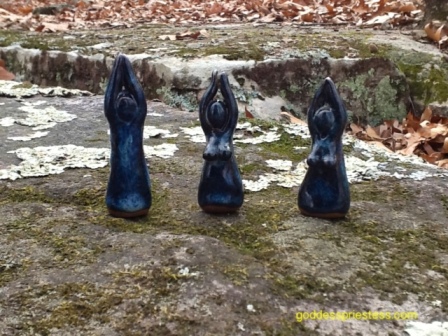
New sculptures drying and waiting to be fired!

New sculptures drying and waiting to be fired!

From the Autumn 1999 issue of SageWoman magazine:

Our Lady, Mother of us all,

Goddess is thy name.

Thy will be done,

with harm towards none,

below as it is above.

Give us this day

the ability to see

with compassion, grace and trust

that we might offer

perfect trust and perfect love

to others in your name.

May our hands be thine

to do thy work;

may our voices speak your words.

For Thou art

the beauty, the light and the spirit

as we dance the spiral together.

So be it.

by Candace

Categories: blessings, Goddess, liturgy, prayers, readings, ritual, spirituality | Leave a comment

Circle Closing

Open up the circle of healing and trust.
To the South, innocence and joy,
To the East, new beginnings,
To the North, cool winds of reason,
To the West, nighttime for dreaming,
Up above, the source of light, the Sky,
Beneath our feet, the womb of life, Mother Earth,
Open up the circle of healing and trust.

(modified version of a closing found here)

A good source for ritual chants is this site.

I’m in the process of planning a New Year’s Eve ritual right now and working hard to find readings and songs that will work well with a multi-age, mixed gender group (my first ritual of the sort–I’m nervous!)

December 2012 108

Categories: invocations, nature, readings, ritual, spirituality | 2 Comments

Book Review: Living Goddess Spirituality, a Feminine Divine Priestessing Handbook

A woman who connects with Goddess, connects with a most vital, ancient, powerful inner part of herself and she is awakened. It is this awakened state that is so empowering to women and downright frightening and dangerous to a patriarchal society.” –B. Melusine Mihaltses

Living Goddess Spirituality: A Feminine Divine Priestessing Handbook is a wonderful book! Containing lots of good resources and thoughtful commentary, the book explores twelve goddesses and associated rituals and workshop ideas for women’s spirituality circles. It also includes a chapter on priestess initiation and guidelines for starting a Goddess study circle.

I have a couple of small critiques in that some of the print is extremely tiny, some material is repeated from the author’s previous book, there is quite a bit of repetitiveness in general, and not all suggestions are fully developed (i.e. for each goddess there are multiple “workshops” suggested which include things like making various items. However, no further information or instructions for most of these things are included).

I don’t usually connect strongly with individual goddess imagery, but the way in which Living Goddess Spirituality is written brought in the significance of many different goddess images and I found myself learning and thinking about specific goddesses in different ways. I also loved all the different chants, ritual outlines, and invocations included. Really great pictures and some beautiful art enhance the book.

Great circle resource and a good resource for Goddess Priestesses!

Two chants I particularly enjoyed and that were new to me:

Eight Beads Chant
Girlseed
Bloodflower
Fruitmother
Spinmother
Midwoman
Earthcrone
Stonecrone
Bone…

Earth, Moon, Magick…
In the Earth, deep within
There is a Magick, I draw it in.
In her Caves, in the Trees
Hear her Heartbeat, Pulsing through me.
When I Rise, I feel her Love
with feet Grounded, I’m soaring high above,
In the Earth, deep within
There is a Magick, I draw it in
Ancient Moon, my Soul reveres
With my Singing, I call you here.
When this flame, ignites tonight,
Priestess dancing, Under the moonlit night…
In the Earth, deep within
There is a Magick
I draw it in…
There is a Magick, I draw it in (3x)

Additional lines for a familiar, favorite drum circle song:

Mother I Feel You…

Mother I feel you under my feet,
Mother I hear your heartbeat
Mother I feel you under my feet,
Mother I hear your heartbeat

heya heya heya yah heya heya ho
heya heya heya heya heya ho

Mother I hear you in the River song,
eternal waters flowing on and on.
Mother I hear you in the River song,
eternal waters flowing on and on

heya heya heya yah heya heya ho
heya heya heya heya heya ho

Mother I see you when the Eagles fly,
Flight of the Spirit gonna take us higher
Mother I see you when the Eagles fly,
Flight of the Spirit gonna take us higher

heya heya heya yah heya heya ho
heya heya heya heya heya ho

(Adapted from my quick review on Goodreads)

Disclosure: Amazon affiliate links in image/book title.

Categories: chants, Goddess, poems, priestess, readings, resources, reviews, ritual, spirituality, womanspirit, women's circle | Leave a comment

Winter Blessings!

20121223-184450.jpg

Categories: art, blessings, quotes, spirituality, womanspirit | 4 Comments

Goddess Wheel of the Year: Winter Solstice Ritual

This essay was originally written as part of an assignment for a class at Ocean Seminary College. It was revised into an article for the Winter Solstice edition of The Oracle, the online magazine of Global Goddess and published there on Dec. 18.

Frau Holle feels like a logical choice for me as a Goddess to invoke and celebrate during the winter months.  The 12 days of Christmas were traditionally sacred to Holle, so she’s a perfect match for my own Goddess Wheel of the Year. Remembering that, “Even in the darkness, we are capable,” now is a time to celebrate our capacities, our strengths, and our survival instincts. Holle was perhaps a real woman who was persecuted as a witch. Among other aspects, she survives to scatter the snowflakes and to bring out our hidden powers of being.

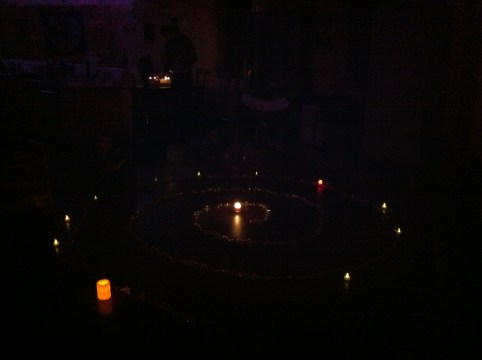
IMG_0419Holle was historically honored with a feast night on winter solstice and this is a day that my family also honors with ritual as a sacred day. We begin by listening to a song called “Invocation to Mother Holle” by Ruth Barrett on her Year is a Dancing Woman CD. Then, we go outside for our annual bell ringing ceremony—ringing bells to each direction, below, above, and within. After a feast including root vegetables (perhaps a baked potato bar!) and apples, we shut out the lights and contemplate the darkness and the richness of the things that take root in the dark. Then, lighting candles, we walk our traditional “solstice spiral” (made with gold garland laid out in the spiral on the floor, ringed with evergreen branches and candles)—leaving behind our losses and that which we no longer need in the darkness, and carrying forward the bright spark of new possibility that is taking root in our lives for the new year. After exiting the spiral, we place our candles together on the Yule log to represent that which we hope to bring into the full light of dawning year.

In the book Grandmother Moon by Z. Budapest, the very first part of the book discusses the “Cold Moon” and uses Holle as the Goddess who carries the message of this part of the year. Budapest writes beautifully as Holle and her tasks for us:

Frau Holle Speaks: You can find me in the still waters of your wells and the cold depths of lakes. Come, jump in and see! You will not die. The deep cool well that reflects your face like a mirror will show you the way to my house. When you dare to follow me into the depths of the earth, you will find that even though the world is cold, there I have sunshine. My womb-shaped ovens are baking fresh bread, making new bodies for souls. My apple trees are fruiting beautifully. The vitality of my abundance is yours if you harvest them. I am working hard to bring my children good fortune. If you serve me, perform my tasks and accept the responsibilities I bring you, to take out the fresh loaves from my hot ovens, pick the apples from my trees, accept the power that I give you, I will hire you as my personal helper. When you fluff my pillows, the feathers flying will make the ground white with snow. When you water my sacred plants, that action will create the blessed rain that is necessary to sustain the life above. I am all work, you see. I am all striving; I am all that is useful. When the Moon is full, I will come and look at your lifework. What have you woven from the fine threads I have given you? Under the Full Moon, I shall examine your relationships, your accomplishments. I shall inspect your house for order, your loom for neatness. If I find your work in inspired order, I shall bring you gold, because my footsteps turn into gold and the touch of my fingertips turns everything into silver. If your life is a mess when I come by, I may mess it up even more just to force you out of your old patterns (p. 43-44).

During this ritual, we experience the perfect time to evaluate our lifework, to evaluate our purposes, and the directions of our personal paths. We take time to celebrate the accomplishments of the past year and to set meaningful personal intention for the new year to come.

References: Budapest, Zsuzsanna (2011-02-25). Grandmother Moon (pp. 41-44). Women’s Spirituality Forum. Kindle Edition.

Molly is a certified birth educator, writer, and activist who lives with her husband and children in central Missouri. She is a breastfeeding counselor, a professor of human services, and doctoral student in women’s spirituality at Ocean Seminary College. This summer she was ordained as a Priestess with Global Goddess. Molly blogs about birth, motherhood, and women’s issues at http://talkbirth.me and about thealogy and the Goddess at http://goddesspriestess.com

Categories: family, holidays, resources, ritual | 4 Comments

Guest posts!

I haven’t had a chance to post here very often this month, but I do have several guest posts finding homes in other parts of the internet!

My guest post Blessingways and the role of ritual appeared on Pagan Families’ new home on Patheos this month. And, my other guest post for Pagan Families, Guardian of the Womb, has also been transferred to their new home on the web.

I’m looking forward to an online Winter Solstice ritual tomorrow night at Global Goddess and I’m pleased that my piece, Goddess Wheel of the Year: Winter Solstice Ritual, was just published in the Solstice edition of the online magazine The Oracle. I had to laugh a little because I got the issue via email and thought, “oh! I have to check out the ritual article, because it might have something I can use for our family ritual this Friday!” and then I looked and it was MY article. Oh well!

IMG_0419

Solstice spiral from last year’s family solstice ritual

Categories: holidays, writing | Leave a comment

A night wind woman…

“…Look at me
I am not a separate
woman
I am a continuance
of blue sky
I am the throat

of the Sandia Mountains
A night wind woman
who burns
with every breath
she takes.”
–Joy Harjo in Open Mind
photo(6)

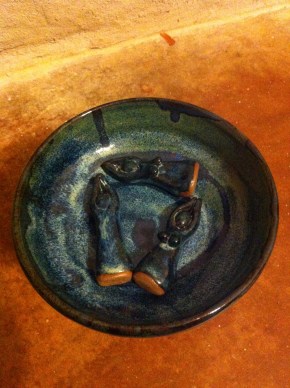
I recently made these sculptures and my mom glazed and fired them for me this week. Usually I work in polymer clay and regular clay was more difficult to work with, but the results are very pleasing. I love them!

Categories: art, poems, quotes, readings, spirituality, theapoetics, womanspirit | Leave a comment

Stand Still…

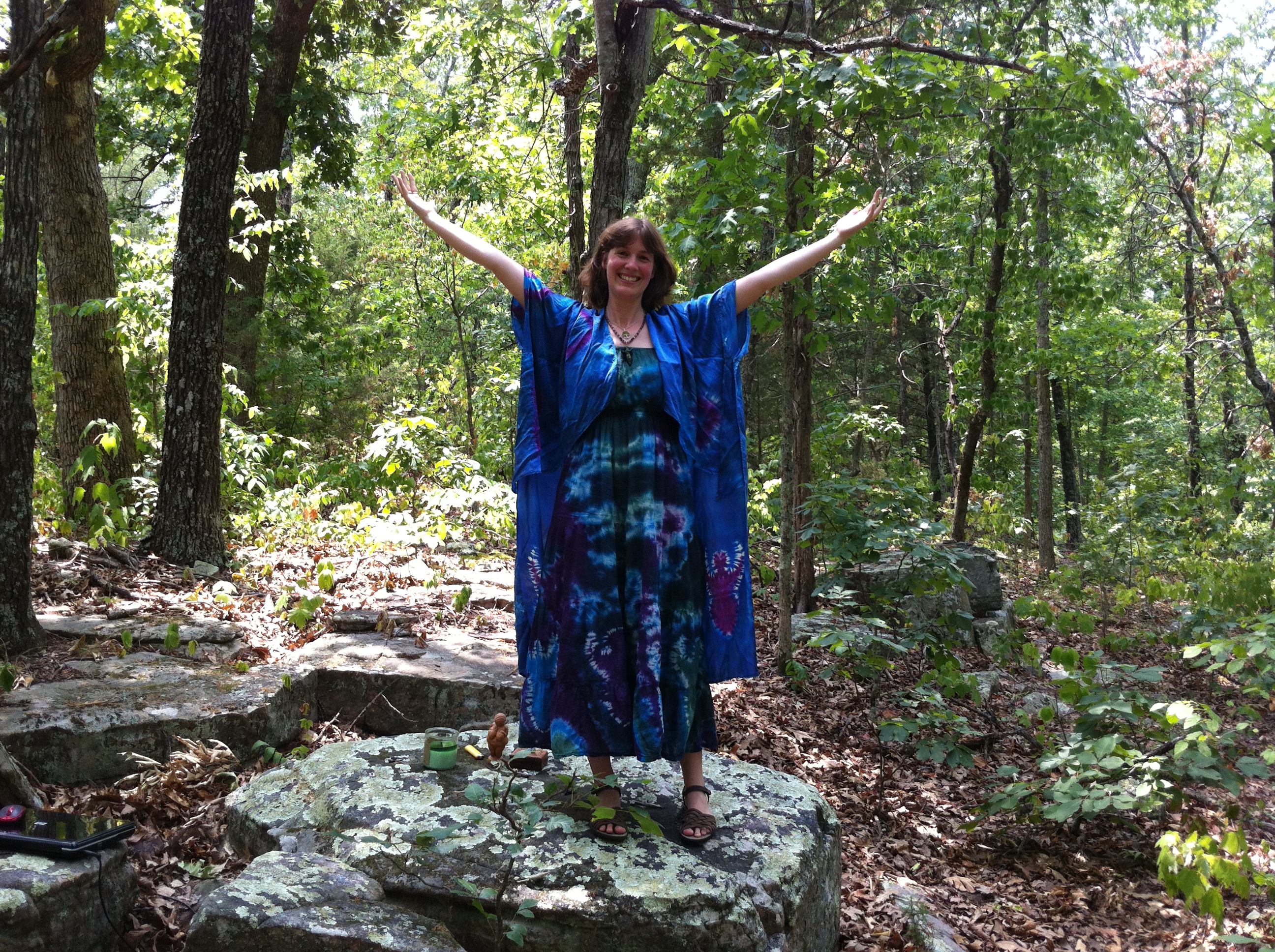
I chose this recent picture of me listening to the forest...and, remembering not to take myself too seriously ;)

I chose this recent picture of me listening to the forest…and…other things. This is a reminder to me to remember not to take myself/my life TOO seriously 😉

Stand still. The trees ahead and the bushes beside you

Are not lost. Where ever you are is called HERE.

And you must treat it as a powerful stranger.

Must ask permission to know it and be known.

The forest breathes. Listen. It answers,

I have made this place around you.

If you leave it, you may come back again, saying, HERE.

No two trees are the same to Raven.

No two branches are the same to wren.

If what a tree or a bush does is lost on you,

You are surely lost. Stand still. The forest knows

Where you are. You must let it find you.

–David Wagoner, in Life Prayers

Categories: nature, poems, prayers, quotes, readings, spirituality, theapoetics | 3 Comments

Essence of Paganism…

20121202-135542.jpg One of the things I enjoy about the UU church is that it can be distilled into a set of principles. No unnecessarily complex theology and layers of religious history and meaning, no convoluted mental gymnastics required to reconcile logically bizarre, but theologically required beliefs and practices, but instead some clear, basic, direct, assertive statements to which, I think, ANY reasonable person should agree with and support—and, indeed, if everyone did, the world would probably be a much better place. I also think many, many people are actually UU without knowing it—particularly those who describe themselves as, “spiritual, but not religious,” as “liberal,” as “humanist” (whether spiritual or secular) and even as, “progressive Christians.” I certainly was UU for approximately 7 years before knowing that I could be “labeled.” There is a broad understanding of the UU umbrella as welcoming everyone and accepting everything, but I don’t think that is really true (or desirable). Indeed, within the principles are strong statements for a certain way of being in the world and in viewing the world. Many, many people can find a spiritual home under the UU umbrella, but they are unlikely to be those who identify strongly and in a fundamentalist manner with the Abrahamic religions (though, the UU religion does draw upon the teachings and stories of all major world religions), or, quite frankly, Republicans.

I just had a discussion with a friend online in which I explained it like this: we do have a set of “principles” and people disagreeing with those principles wouldn’t actually be welcome. My favorite description is that we believe the light shines through many different windows in different ways and the only people who aren’t welcome are those who think the light only shines in their window and that we should throw rocks through the windows of everyone else who disagrees with us…. 😉

The discussion with the friend was prompted by my mention of using readings from the UU hymnal Singing the Living Tradition in the ceremony I held after the miscarriage-birth of my third baby. I explained that I sometimes describe my miscarriage as a “religious experience” of sorts and that’s because it wasn’t until then that I realized I do have a religious language, symbols, and resources I draw upon in times of need. I spent years describing myself as “areligious” (funny, since now I’m working on my D.Min degree). Her response was: “What’s the best way to label yours then, Molly? Unitarian? or something else? Unitarians kinda fit with everybody and nobody at once…”

The statement in bold is an issue the UU movement has struggled with for years. I responded that UU is fine (or Unitarian Universalist). They’re a good umbrella religion, but definitely don’t fit with everybody—I don’t think most “traditionally” Christian people, for example, who would recognize anything familiar in most UU resources/services.

She clarified that, “My (admittedly minimal) experience with UU is that they welcome pretty much anybody believing whatever works for them… but that there are many who don’t accept UU’s.” And that is when I used my light and windows example.

It seems funny to argue for exclusion, but I can think of many who would not be welcomed by UU’s! That guy telling rape jokes, that woman picketing Planned Parenthood, those people leaving hateful comments on YouTube videos, that company blasting the mountaintops off, and those people who protest marriage equality, to name a few. Within the UU world, the personal is political and political beliefs are entwined inextricably with our “religious” values. Standing on the side of love and all that. Indeed, as UU’s, “We seek to act as a moral force in the world, believing that ethical living is the supreme witness of religion. The here and now and the effects our actions will have on future generations deeply concern us. We know that our relationships with one another, with diverse peoples, races, and nations, should be governed by justice, equity, and compassion.” (http://www.uucfm.org/information-for-newcomers/what-is-unitarian-universalism)

In my own tiny church, to which I have not actually been for many months now, at the closing circle we hold hands and read the following from a cross stitched picture on the wall:

As Unitarian Universalists we cherish
The importance of individual thinking
Respect for the convictions of others
The warmth of caring
The perspective of humor
The dreams of the mystic
And the methods of the scientist
A way of life that avoids harm and scorn
A quest for justice through peaceful methods
A religion that is broad and encompassing
Personal, yet universal.

This is simple, direct, and clear and it is something I can stand behind for the rest of my life, regardless of how many times I actually attend a church service.

Apparently not every church uses this same reading, I couldn’t readily find it online, but I did find another short explanation I enjoy: “We encourage individuals to garner insights from all the world’s great faiths, as well as from Shakespeare and from science, from feminism and from feelings. We invite people to explore their spirituality in a responsible way. We ask Unitarian Universalists to cherish the earth, to free the oppressed, and to be grateful for life’s blessings. Out of this combination of reflection and experience, each one of us shapes a personal faith. For Unitarian Universalists the individual is the ultimate source of reality.” (http://www.uucfm.org/information-for-newcomers/what-is-unitarian-universalism)

Principles and sources

There are seven principles which Unitarian Universalist congregations affirm and promote:

  • The inherent worth and dignity of every person;
  • Justice, equity and compassion in human relations;
  • Acceptance of one another and encouragement to spiritual growth in our congregations;
  • A free and responsible search for truth and meaning;
  • The right of conscience and the use of the democratic process within our congregations and in society at large;
  • The goal of world community with peace, liberty, and justice for all;
  • Respect for the interdependent web of all existence of which we are a part.

Unitarian Universalism (UU) draws from many sources:

  • Direct experience of that transcending mystery and wonder, affirmed in all cultures, which moves us to a renewal of the spirit and an openness to the forces which create and uphold life;
  • Words and deeds of prophetic women and men which challenge us to confront powers and structures of evil with justice, compassion, and the transforming power of love;
  • Wisdom from the world’s religions which inspires us in our ethical and spiritual life;
  • Jewish and Christian teachings which call us to respond to God’s love by loving our neighbors as ourselves;
  • Humanist teachings which counsel us to heed the guidance of reason and the results of science, and warn us against idolatries of the mind and spirit;
  • Spiritual teachings of earth-centered traditions which celebrate the sacred circle of life and instruct us to live in harmony with the rhythms of nature.

These principles and sources of faith are the backbone of our religious community.
UUA

Wait a second, what does all of this have to do with my post title and about paganism? Well, I just read an article, surprisingly in Brain, Child magazine, called Beltane Flowers by Brit St. Clair, in which the author describes attending her first pagan ceremony. What I appreciate particularly about the article is how tidily St. Clair describes the core beliefs of Wicca, specifying that these concepts were beliefs she already held firmly, long before she realized they were also embraced by Wicca:

find divinity in self and nature; practice meditation for strength and balance; spirituality is individual, personal; don’t proselytize, but help others less fortunate anyway; examine your intentions; harm none; feel free to view a symbol like ‘God’ or ‘Goddess’ as just that: a representation of a creative life force energy we can possibly understand…

I appreciated this essence of paganism description, much as I appreciate the essence of UUism as described in the principles. And, I’m curious if there are other succinct, yet fully descriptive (i.e. not just, “harm none! Now, let’s party!”) explanations out there that my readers connect with in particular?
20121202-135708.jpg

Categories: spirituality, UU, womanspirit | 1 Comment

Thanksgiving

My life is like a flower, opening to the sun.
My life is like a fountain, spilling up from the deep.
Peace, I am discovering, is not a state of being, but a process of becoming.

–Ann Kreilkamp in SageWoman, 54, Summer 2001 (p. 50)

I have a special affinity for interfaith prayers and readings that strike the chord of the sacred within us all, without being identified with any particular belief structure, or, indeed, belief in anything outside of the natural world. So, I liked this Thanksgiving blessing from Starhawk:

“We give thanks for this good green earth and all that lives upon it.

Thanks for the air, the Great Breath that flows from leaf to lung and back again, sustaining life.

Thanks for fire, leaping flame and glowing hearth, warmth in the cold season.

Thanks for water, the life-renewing rain, the springs, streams, and rivers, the pools and lakes, the great oceans, womb of the first life….”

–Starhawk, A Pagan Thanksgiving blessing (that anyone can use)

I also really enjoyed this article by Shiloh Sophia, Ten Ideas for a Grateful Thanksgiving Day. The ideas are wonderful and I wish I’d read the article before yesterday so that I could more readily incorporate some of them into our family dinner today!

20121123-112701.jpg

Categories: blessings, invocations, liturgy, nature, poems, prayers, quotes, theapoetics | Leave a comment

2013 Moon Calamandala

This post is part of an assignment for my Birth-Death-Regeneration: Triple Goddess class at Ocean Seminary College.

First, I considered the relevance of the triple goddess concept and maiden, mother, crone archetypes/stages in my own life. I appreciate the expanded concept of the Women’s Wheel of Life elucidated by Elizabeth Davis and Carol Leonard and find there is more room within their construct for women to identify with the Wheel. The expanded wheel includes:

The Women’s Wheel of Life
(Amazon affiliate link included)


The Daughter
The Maiden
The Blood Sister
The Lover
The Mother
The Midwife
The Amazon
The Matriarch
The Priestess
The Sorceress
The Crone
The Dark Mother
The Transformer

However, I also find the original Triple Goddess concept is still useful. Why? Simply because in very, very broad ways, they encompass the three blood mysteries of womanhood and serve as clearly recognizable transition points in my own life. My life IS in fact divided into three distinct stages. Before menarche and after menarche are distinctly recognizable in my memory. A couple of months ago I finished working through a Women’s Rites of Passage workbook and in it we were asked to explore our relationship with menstruation. I was surprised to discover and write the following:

I was shocked to discover during the first menstruation meditation that there is a clear division in my bodymind between before menstruation and after and that after involves less happiness and more confusion and angst and altered relationship to my body. In the meditation I saw/experienced myself as carefree and happy prior to menstruation and also eagerly awaiting her arrival. Post-menstruation I recalled the intensely painful cycles I experienced, the feeling as if I was “sick” when I had my period, and no longer feeling in blissful harmony with my body. Giving birth in power and joy helped me reclaim my body joy, but it is only in the last year that I’ve begun to consider that moontime itself might hold sacred wisdom and opportunity for connection…

As referenced, giving birth is also a distinct, transformative and intiatory rite in my own life. As with menstruation, I also observe a definite distinction between before motherhood and after motherhood. And, in many ways, I am not the same person I was before going through this rite of transformation.

Finally, while I’m not to the Crone stage yet, I can sense that this will be similar only it will likely represent the division between life as a mother with children at home and life as a mother with adult children.

I wish to acknowledge that I know that many women do not become mothers for a variety of reasons, so they may in fact feel excluded from the very transitions and distinctions I describe above. That is why I prefer Davis and Leonard’s exploration of 13 archetypes. And, it is not my intention to make any reader feel excluded or overlooked by the Triple Goddess image, just to explain how I am able to see her represented in my own life’s trajectory.

As I have described previously, within my circle of friends, we have been wonderful for some time at celebrating the Blood/Women’s Mysteries. We have Mother Blessing ceremonies for each pregnant woman as well as maiden ceremonies for our girls who are coming of age. My mother and her friends had a coming of age ceremony for all of their daughters when I was 13 (and my sister 11) and it was very meaningful for us. Two years ago, I facilitated a blessingway ceremony for all of my friends’ 10-12 year old daughters follow a series of Meetings at the Moon classes. We also had a new SageWoman ceremony just this month to honor the wise women among us. One of my goals is to have a regular monthly Moon Circle–to bring some of that sense of celebration and power from our Mother Blessing ceremonies more fully into our lives and to celebrate the fullness and completeness of women-in-themselves, not just of value while pregnant. (In January 2011 some friends and I did begin holding quarterly women’s retreats loosely based on the seasonal cycles, with the intention of perhaps having this become a monthly circle, and with the intention of celebrating our lives, whatever the stage or experience.)

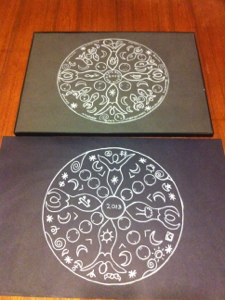
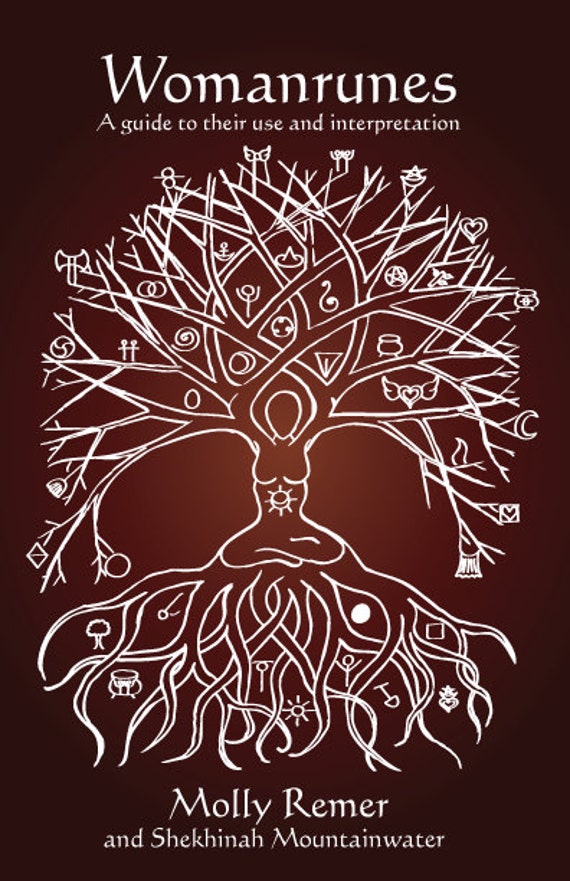
As I read the material for this lesson, I was thinking about the wheel of the year and about the woman’s wheel of life and I decided it was time to make my 2013 Moon Calamandala drawing! It seemed like the perfect time! The Moon Calamandala (TM* 😉 ) includes the dates of each full moon in 2013. It also includes a variety of “womanrune” symbols to pictorially explore what our family would like to bring into our lives during each quarter. In the classes I teach, sometimes I encourage my students to think in circles rather than in lines. To me, this is what the Moon Calamandala represents as well. Here, we see the year as a cycle, a circle, another turn around the sun, rather than as a series of linear boxes as a graph, implying a distinct beginning and ending. The four goddess images represent the seasons and the four quarters of the year. Within each quarter are that quarter’s moons and the womanrunes symbols I chose to indicate family hopes, dreams, or plans for that part of the year. The waxing and waning moons are also indicated symbolically.

20121123-104146.jpg

20121123-104206.jpg

My 2012 Moon Calamandala (above) and the 2013 drawing ready to go into the frame. You can see a larger image and description of my 2012 calendar in this post, which was part of an assignment for a different class at OSC.

20121123-104216.jpg

On the wall!

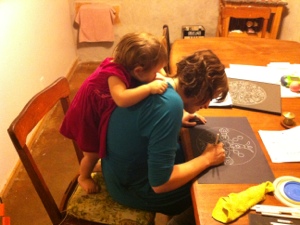
Seemingly appropriate for the Mother turn of the wheel, I received much assistance from my littlest one as I was completing the calamandala:

20121123-104230.jpg

Womanrunes

20121123-104245.jpg
*I think I may have just invented this new word 😉

Categories: art, family, Goddess, OSC, spirituality, womanspirit, writing | 2 Comments

Invocation Poem

by Lee Lanning and Nett Hart

We honor the energy of the elements within us.

We are earth, We are dark, we are heavy, we are substantial.

We are grounded.

We are water. We are fluid, we are clear, we are vital.

We are renewed.

We are fire. We are bright, we are hot, we are intense.

We are inflamed.

We are air. We are light, we are movement, we are open.

We are changed.

in the book Casting the Circle by Diane Stein

Categories: art, blessings, invocations, nature, prayers, quotes | Leave a comment

How the UU Church Introduced Me to the Goddess

Two blogs that I enjoy reading—Bishop in the Grove and Love, Joy, Feminism—both recently wrote about their personal experiences attending Unitarian Universalist Churches and the sense of community/value they found there. It made me think about the role of the UU Church in my own life and I decided it was time to give a shout-out to the UU Church and how it introduced me to the Goddess and to religion in a form that I not only could find palatable, but also deliciously meaningful and enriching. My first cause in life was feminism—a sense honed by my experiences as an agnostic homeschooled teenager amidst mostly fundamentalist Christians. I could not help but stand up for women’s rights and challenge the rhetoric my peers often shared about a “woman’s [lesser] place” in life and society. Because my developing sense of feminism burgeoned in response to patriarchal religious beliefs about women—the only religious beliefs I had yet encountered—I also developed a sense that feminism was not compatible with religion, period.

In college in the 1990’s as a psychology major, I always chose “women’s issues” as my main area of focus and I went on to graduate school in clinical social work, doing my internship at a battered women’s shelter (I also volunteered in one during my undergraduate years). My sense of the Goddess that later emerged is very intertwined with my deep beliefs about the inherent value and worth of women. After finishing graduate school in 2000, I started to have lots of “searching/seeking” conversations in the car with my husband–trying to find something to “plug into” and saying, “maybe I need to get religious?” But, there was no religion I could find that fit me/matched me and I decided it probably didn’t exist. As time passed, I continued to seek/discuss/ponder and a different friend mentioned her UU church and it being a “perfect spiritual home for her”–I dismissed it because of the word “church,” but in 2005, I took the infamous Beliefnet quiz and got a 100% match for Unitarian Universalism. Lo and behold–my beliefs about social justice and about the inherent dignity and worth of each human being, as well as about the deep mystery and wonder of the natural world were “pluggable” after all! By this time, we had moved and so I started attending my very, very tiny local UU fellowship.

Cakes “Gaia” logo

In 2003, my good friend had taken a women’s studies class in college and lent me the books When God was a Woman and The Chalice and the Blade and we began to have discussions about the Goddess and to explore our feelings about religion and meaning. She was the first person I was ever able to speak to deeply about spirituality. I was raised as a fourth generation “non-religious” person—my parents, grandparents, and great-grandparents all had/have no religious or church affiliation. My friend and I talked a lot about Wicca and paganism and as I read more books, I realized something was missing for me in most pagan literature. I eventually discovered the “missing” element, for me, was the Goddess emphasis of feminist spirituality.

After beginning to attend the small local UU church that I jokingly refer to as the Church of Democracy and Evolution, I discovered the fabulous Women and Religion subgroup within the larger UU world and started to realize that my strong draw towards Goddess actually had a place and a home under the UU “umbrella” and that I didn’t have to self-identify as pagan or Wiccan in order to explore a relationship with Goddess. I trained as a Cakes for the Queen of Heaven facilitator in 2008 and discovered something every powerful in these resources. At the conclusion of the training, I had profound sense of THIS is what else there is for me! It was a pivotal moment.

After the empowering and transformative births of my sons in 2003 and 2006, I became deeply enmeshed in birthwork—expanding my senses of women’s issues and social justice into birth activism and birth education. Then, in 2009, my third son died during my second trimester of pregnancy. My birth-miscarriage experience with him was a powerful and transforming experience as well and I was left with a sense of openness to change. A receptivity to larger forces and powers in the world.  Indeed, it felt like a spiritual experience of sorts. After his birth and in my journey through grief, I experienced a sense of myself as inherently worthy and valuable—that I didn’t need to do anything special to be a worthwhile human being. I also had the revelation shortly after his birth that the power of women that is so present in birth, is present in women, period. I realized that this sense of “birth power” could be found in women’s spirituality and I found myself irresistibly drawn to more and more reading and study of feminist spirituality and Goddess thealogy. However, reading wasn’t enough. I felt the thread of Goddess that had danced at the edges of my life for so long, had finally become a distinct and extremely important presence in my life and I felt a call to more formally dedicate myself to a Goddess path.

On my son’s due date on May 3, 2010, which was also my 31st birthday, I did a small, private ceremony in the little stone labyrinth in my front yard in which I formally declared to myself and to the nature around me that I was now committed to practicing the presence of the Goddess in my everyday life. In May of 2011 and May of 2012, I renewed that commitment in another private ritual. Also in May of 2010, I went to a healer for “somatic re-patterning” (or, as I call it, “reprogramming my brain!”) and let go of the remaining neural pathways doubting my own worth and value. During our session, she told me that my healing gift is in words (not in physical touch or treatment) and that I live my spirituality, I don’t have to explain it. She also told me that something big was shifting inside of me and that I was opening up it a new direction. She asked if I perceived that shift in my life and I said, YES, knowing that it was this new sense of connection to the feminine divine.

In November of 2010, I attended at women’s spirituality retreat at a UU church in St. Louis and we did an exercise in which we each wrote a “gift” on a piece of paper (following a guided meditation) and then put them into a communal bowl and each drew out another’s woman’s gift–she was sharing it with us. I drew out “sacred words.” My friend told me she thought it was perfect for me because talking to me about her own experience of spirituality had been deeply meaningful to her. When I got home, I started looking for study programs/schools online because I knew in my heart that the time had come to deepen my personal study/experiences. After this retreat, I also started planning and facilitating quarterly women’s spirituality retreats locally. And, in January 2011, I gave birth to my own baby girl. She was born at home into my own hands, alone, under my own power and with my heart full of hope and joy and the promise of new beginnings.

In March of 2011 I started working on my D. Min degree in Thealogy/Goddess Studies at Ocean Seminary College and in July of 2012 I became ordained as a priestess with Global Goddess. Without my tentative steps into the UU church, I do not know that I’d be where I am right now. As is kind of the tagline of the program, I can honestly say that, “Cakes changed my life!”  😉

Categories: feminism, feminist thealogy, Goddess, spirituality, UU, women | 3 Comments

The Web of Life

This essay is modified from one written for my Ecofeminism class at Ocean Seminary College.

Carol Christ’s understanding of “profound connection of all beings in the web of life,” (p. 58) is integral to my own understanding of the world, ethics, feminism, and spirituality. I very often return to the idea from Naomi Wolf of the “great invisible web of incarnation of which we are all a part,” indeed it forms the very foundation of my personal thealogy. My introduction to Goddess spirituality as a viable spiritual path distinct from Wicca came from my involvement with the UU Church, which holds an awareness of the web of life as one of its six core principles: “Respect for the interdependent web of all existence of which we are a part.” UU’s also draw from “seven sources,” one of which is: “Direct experience of that transcending mystery and wonder, affirmed in all cultures, which moves us to a renewal of the spirit and an openness to the forces which create and uphold life” and another of which is: “Spiritual teachings of earth-centered traditions which celebrate the sacred circle of life and instruct us to live in harmony with the rhythms of nature.” (http://www.uua.org/beliefs/principles/)  I find that direct experience for me comes most clearly and cleanly through nature and thus identified with Starhawk’s explanation in Reweaving the World that, “we must preserve the wilderness that’s left because that’s the place we go for renewal, where we can most strongly feel the immanence of the Goddess” (p. 82). This is dramatically true for me and in August I explored my relationship with the Goddess in the woods in a guest post on the Feminism and Religion blog about Theapoetics, based on earlier work I did with OSC.

As I just used in my prior post, I again thought of this quote: “When you grow, care for, cook, and eat a vegetable, you become emotionally attached to that vegetable for life. You eat with your heart, not with your mind.” –Liz Snyder (quoted in “Home Grown: Helping Your Child Develop a Love of Gardening” in Natural Life Magazine, May/June 2011). While this is about vegetables, I think we could say the same about animals and also about people. The direct relationship and connection is the key. I really do feel like the relational context of our lives is the fundamental core of the human experience. We cannot not be in relationship to the things around us, not just in terms of other humans, but plants, trees and animals. We are even in relationship with the sun, the wind, and the rain. And, the net that holds the whole, is what I name as Goddess/Divinity. Everything is interconnected and does not exist without connection/relationship. Connection is strength, not weakness, and it is central.  Goddess ethics are “discovered within the web of life” rather than imposed from without.  If we acted with our hearts and with love rather than with “logic” and if a corresponding ethic of care underlaid our beliefs, actions, and social structures, the overall functioning of society would change for the better.

As I read these final chapters in Reweaving the World, particularly Christ’s quote from Alice Walker about being a part of everything, “not separate at all,” I also thought about one of my long ago observations from my Ecology and the Sacred class:

My reflection was about how quickly the woods close in around human-made structures. When we built our house, it felt like we had scarred the land—we cleared some trees and had to dig for the septic tank and so forth. The ground looked stripped, some trees were damaged (or cut down), and our house was kind of plopped down there in the middle of the scar. We moved in to our house four years ago and you can no longer see these environmental scars—indeed, it feels at times like we have to hold the woods back from taking the area back over and reclaiming the land. A variety of grasses and wildflowers grow in the cleared areas and trees stretch out all around our house. I reflect upon how if we no longer lived here, our house would be swallowed up by the forest within only a handful of years. This is reassuring to me in a strange way. No matter how we have altered the landscape by our human presence and “meddling” with our ecosystem, Nature is waiting to reclaim and transform what we have attempted to mold and make our own.I also reflected about how we, as human inhabitants of this patch of ground, are part of the woods and the forest ecosystem. I guess in some ways I feel like we have “invaded” here, carving out a large footprint. But, while standing on our back deck, and looking all around me at the trees, grasses, and flowers, closing in…pressing in almost…on our house, I felt a sudden sense that we and our home were a part of these woods. We live here in our—albeit excessively large–“nest,” much like any other animal inhabits its nest or burrow within the forest. And, we are within it too, not on top of or apart from it.

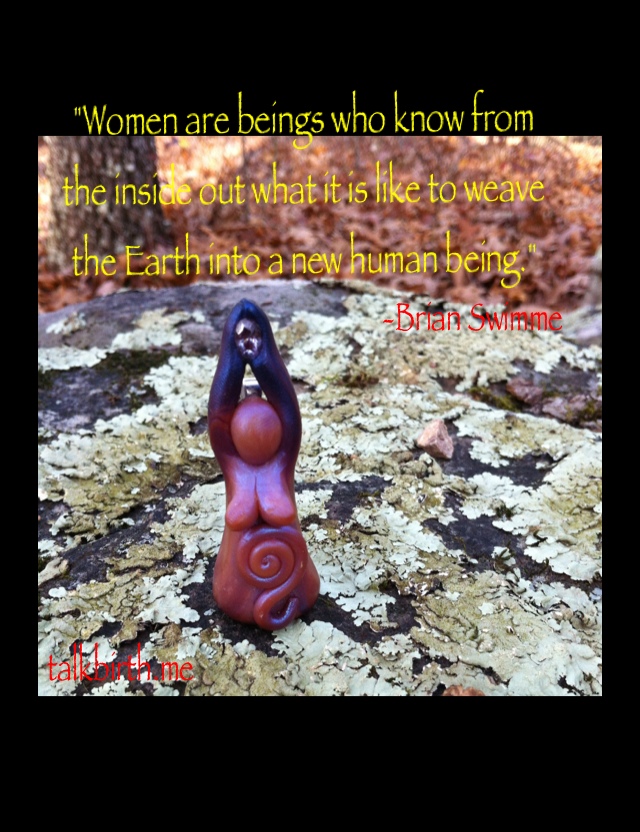
This idea that I was a legitimate part of nature and the woods as well was an important epiphany for me. Likewise, as I read Christ’s essay and I had another epiphany about interconnectedness and “all being one.” I’ve always struggled somewhat with the phrase, “we are all one,” but as I read her words, I had this new sense of clarity about it—we are all one weaving. A favorite example from earlier in this course is in Brian Swimme’s description of the Great Birth (Big Bang) in his essay in Reweaving the World: “From a single fireball the galaxies and stars were all woven. Out of a single molten planet the hummingbirds and pterodactyls and gray whales were all woven. What could be more obvious than this all-pervasive fact of cosmic and terrestrial weaving? Out of a single group of microorganisms, the Krebs cycle was woven, the convoluted human brain was woven, the Pali Canon was woven, all part of the radiant tapestry of being. Show us this weaving? Why, it is impossible to point to anything that does not show it, for this creative, interlacing energy envelops us entirely. Our lives in truth are nothing less than a further unfurling of this primordial ordering activity…Women are beings who know from the inside out what it is like to weave the Earth into a new human being” (Reweaving the World, p. 21. Emphasis mine).

I also greatly enjoyed Starhawk’s essay in Reweaving the World. As I read it and her passionate exploration of the earth-based tradition of paganism, I thought of a question I recently saw touched upon by a pagan blogger I enjoy, Bishop in the Grove, of whether or not pagans are still earth-based?  Explaining based on other posts and conversations Bishop asks:

“Lastly, are we “earth-based” anymore? It came up in response to Gus’s later statements about the political landscape that there are a wide-variety of Pagans, many of whom no longer identify as “earth-based.” This struck a chord with some people, and I’ve already received some feedback on Facebook which voiced appreciation for pointing out that some Pagans are more centered around deity.I think this one is worthy of a little unpacking. Do a little research, and you’ll see that the roots of the Neopagan movement were very much in the dirt, if you will. Earth-centered, or at the very least earth-aware spirituality has, up until fairly recently, been synonymous with Paganism. How exactly did we get to a place where someone could consider themselves a Pagan and not be “earth-based?” www.bishopinthegrove.com/archives/huffpost-live-paganism-roundtable-followup/

What would Starhawk make of this question I wonder, since her paganism is clearly deeply earth-based, indeed the earth is the foundation of her work, life, activism, teaching, and spirituality?! Starhawk reminds us that environmental issues are women’s issues, “for women sicken, starve, and die from toxins, droughts, and famines, their capacity to bear new life is threatened by pollution and they bear the brunt of care for the sick and the dying as well as for the next generation…unless we understand all the interconnections we are vulnerable to manipulation” (p. 83)

Starhawk passionately explains that earth-based principles call us to action: “earth-based spirituality makes certain demands. That is, when we start to understand that the Earth is alive, she calls us to act to preserve her life. When we understand that everything is interconnected, we are called to a politics and set of actions that come from compassion, from the ability to literally feel with all living beings on the Earth. That feeling is the ground upon which we can build community and come together and take action and find direction” (p. 74).

Categories: feminist thealogy, Goddess, nature, spirituality, thealogy, writing | 1 Comment

Community Empathy

This post is modified from a lesson for one of my classes at Ocean Seminary College. I received a lovely compliment on it from one of my fellow students and given the current contentious political climate, I felt like it might be a good time to share it here. The assignment was to consider empathy in the broader social context and how such empathy might impact social barriers.

“I have been reflecting recently that it is a lot easier to love another person than it is to trust that person. I feel compassion for people I have never met. You can have compassion for me without trusting me. Empathy and compassion are the foundation of morality and of our ability to live together.” –UU President Peter Morales in UU World magazine

Morales goes on to explain that compassion and love alone are not enough, you have to act. I think this is the core. If larger social environments were to act with empathy and compassion as the root, we would see a peaceful and harmonious world. When I was an undergraduate, I took a social psychology class and had a brief disagreement with the professor who stated that human society/relationships were based on competition as the defining feature. I said I thought that cooperation was more important—witness things like traffic and how almost everyone cooperates by following the laws. Or, with trash, and how we have a whole (albeit flawed and environmentally damaging) cooperative system of dealing with it—i.e. you pay and some guys come and pick it up for you. So on and so forth. He was adamant that I was wrong and so I yielded—he was the professor after all and I couldn’t “compete” with that!—however, it has always lingered with me and I still think cooperation trumps competitiveness if we’re thinking of the glue that holds human communities together. (Maybe it was just my secret thealogical/partnership model orientation peeking its head above the surface of my consciousness.)

I thought of this example again when I was considering empathy in the broader social context. I do NOT think it is unrealistic, naïve, or idealistic to think that we have the potential to create a world in which empathy and compassion form the basis of social operations at the community and national level. On the surface, it might sound naïve, but I believe we already have a social structure with cooperation as a root, why not add empathy too? The motives for cooperating might be selfish (i.e. I’ll stay on my side of the road rather than swerving all over because someone else might hit me), but the fact remains that many of our day-to-day social operations are founded in our human ability to cooperate with each other in our very large social context. Without cooperation it just wouldn’t work. I’m amazed by how our financial system works and our government works (such as it is) and our school system works, because billions of people have agreed to cooperate with each other in this way—the cooperation is often below the conscious level and these systems are FAR from perfect, but they continue to function and I assert that at a basic level the larger social environment functions on a basis of cooperation. I believe empathy and compassion could possibly become this “unconscious” and default as well and that we would then have a basic ethic of care as the foundation of human behavior and society. I’m not sure I’m fully making myself clear in this—it was making sense in my head, but is difficult to articulate fully. My basic thought process is that, we’ve got one already, why not the other…

I also thought of this quote: “When you grow, care for, cook, and eat a vegetable, you become emotionally attached to that vegetable for life. You eat with your heart, not with your mind.” –Liz Snyder (quoted in “Home Grown: Helping Your Child Develop a Love of Gardening” in Natural Life Magazine, May/June 2011). While this is about vegetables, I think we could say the same about animals and also about people. The direct relationship and connection is the key. I really do feel like the relational context of our lives is the fundamental core of the human experience. We cannot not be in relationship to the things around us, not just in terms of other humans, but plants, trees and animals. We are even in relationship with the sun, the wind, and the rain. And, the net that holds the whole, is what I name as Goddess/Divinity. Everything is interconnected and does not exist without connection/relationship. Connection is strength, not weakness, and it is central. Goddess ethics are “discovered within the web of life” rather than imposed from without. If we acted with our hearts and with love rather than with minds and logic and an ethic of care underlaid our beliefs, actions, and social structures, the overall functioning of society would change for the better.

In an article called 3 Surprises About Change in Experience Life magazine, author Chip Heath notes:

“We are frequently blind to the power of situations…people have a systemic tendency to ignore the situational forces that shape other people’s behavior…[this is referred to as] ‘Fundamental Attribution Error.’ The error lies in our inclination to attribute people’s behavior to the way they are rather than to the situation they’re in. But many times it is the situation–not the person–that is causing the trouble. Change your situation and you are better equipped to change your behavior.”

Shifting the environment, creates individual change. And, individual change has the potential to create change at the environmental level. I’m a systems thinker and just as people are constantly being impacted by a network of larger systems, people are constantly impacting systems and making changes within them…

20121102-152718.jpg

Categories: feminist thealogy, writing | 1 Comment

Blog at WordPress.com.