Goddess

Book Review: Living Goddess Spirituality, a Feminine Divine Priestessing Handbook

A woman who connects with Goddess, connects with a most vital, ancient, powerful inner part of herself and she is awakened. It is this awakened state that is so empowering to women and downright frightening and dangerous to a patriarchal society.” –B. Melusine Mihaltses

Living Goddess Spirituality: A Feminine Divine Priestessing Handbook is a wonderful book! Containing lots of good resources and thoughtful commentary, the book explores twelve goddesses and associated rituals and workshop ideas for women’s spirituality circles. It also includes a chapter on priestess initiation and guidelines for starting a Goddess study circle.

I have a couple of small critiques in that some of the print is extremely tiny, some material is repeated from the author’s previous book, there is quite a bit of repetitiveness in general, and not all suggestions are fully developed (i.e. for each goddess there are multiple “workshops” suggested which include things like making various items. However, no further information or instructions for most of these things are included).

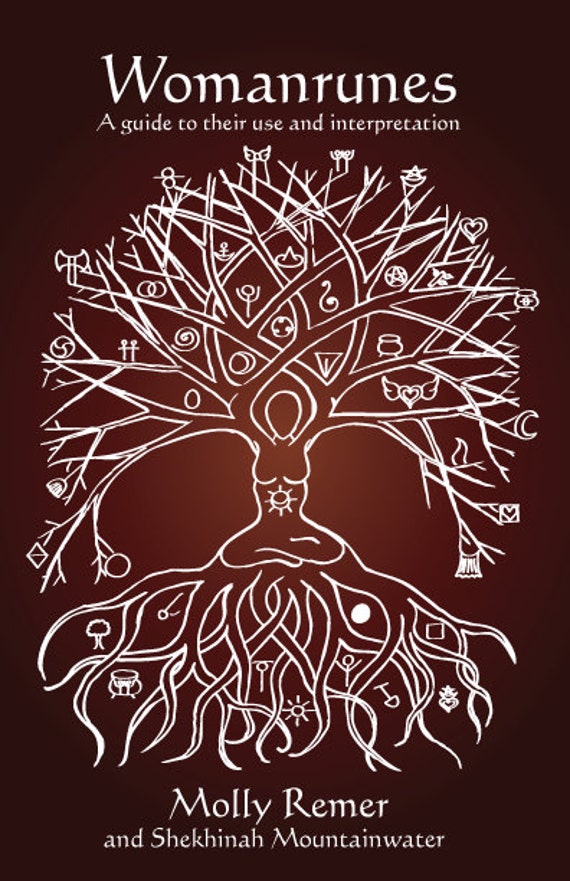
I don’t usually connect strongly with individual goddess imagery, but the way in which Living Goddess Spirituality is written brought in the significance of many different goddess images and I found myself learning and thinking about specific goddesses in different ways. I also loved all the different chants, ritual outlines, and invocations included. Really great pictures and some beautiful art enhance the book.

Great circle resource and a good resource for Goddess Priestesses!

Two chants I particularly enjoyed and that were new to me:

Eight Beads Chant
Girlseed
Bloodflower
Fruitmother
Spinmother
Midwoman
Earthcrone
Stonecrone
Bone…

Earth, Moon, Magick…
In the Earth, deep within
There is a Magick, I draw it in.
In her Caves, in the Trees
Hear her Heartbeat, Pulsing through me.
When I Rise, I feel her Love
with feet Grounded, I’m soaring high above,
In the Earth, deep within
There is a Magick, I draw it in
Ancient Moon, my Soul reveres
With my Singing, I call you here.
When this flame, ignites tonight,
Priestess dancing, Under the moonlit night…
In the Earth, deep within
There is a Magick
I draw it in…
There is a Magick, I draw it in (3x)

Additional lines for a familiar, favorite drum circle song:

Mother I Feel You…

Mother I feel you under my feet,
Mother I hear your heartbeat
Mother I feel you under my feet,
Mother I hear your heartbeat

heya heya heya yah heya heya ho
heya heya heya heya heya ho

Mother I hear you in the River song,
eternal waters flowing on and on.
Mother I hear you in the River song,
eternal waters flowing on and on

heya heya heya yah heya heya ho
heya heya heya heya heya ho

Mother I see you when the Eagles fly,
Flight of the Spirit gonna take us higher
Mother I see you when the Eagles fly,
Flight of the Spirit gonna take us higher

heya heya heya yah heya heya ho
heya heya heya heya heya ho

(Adapted from my quick review on Goodreads)

Disclosure: Amazon affiliate links in image/book title.

Categories: chants, Goddess, poems, priestess, readings, resources, reviews, ritual, spirituality, womanspirit, women's circle | Leave a comment

2013 Moon Calamandala

This post is part of an assignment for my Birth-Death-Regeneration: Triple Goddess class at Ocean Seminary College.

First, I considered the relevance of the triple goddess concept and maiden, mother, crone archetypes/stages in my own life. I appreciate the expanded concept of the Women’s Wheel of Life elucidated by Elizabeth Davis and Carol Leonard and find there is more room within their construct for women to identify with the Wheel. The expanded wheel includes:

The Women’s Wheel of Life
(Amazon affiliate link included)


The Daughter
The Maiden
The Blood Sister
The Lover
The Mother
The Midwife
The Amazon
The Matriarch
The Priestess
The Sorceress
The Crone
The Dark Mother
The Transformer

However, I also find the original Triple Goddess concept is still useful. Why? Simply because in very, very broad ways, they encompass the three blood mysteries of womanhood and serve as clearly recognizable transition points in my own life. My life IS in fact divided into three distinct stages. Before menarche and after menarche are distinctly recognizable in my memory. A couple of months ago I finished working through a Women’s Rites of Passage workbook and in it we were asked to explore our relationship with menstruation. I was surprised to discover and write the following:

I was shocked to discover during the first menstruation meditation that there is a clear division in my bodymind between before menstruation and after and that after involves less happiness and more confusion and angst and altered relationship to my body. In the meditation I saw/experienced myself as carefree and happy prior to menstruation and also eagerly awaiting her arrival. Post-menstruation I recalled the intensely painful cycles I experienced, the feeling as if I was “sick” when I had my period, and no longer feeling in blissful harmony with my body. Giving birth in power and joy helped me reclaim my body joy, but it is only in the last year that I’ve begun to consider that moontime itself might hold sacred wisdom and opportunity for connection…

As referenced, giving birth is also a distinct, transformative and intiatory rite in my own life. As with menstruation, I also observe a definite distinction between before motherhood and after motherhood. And, in many ways, I am not the same person I was before going through this rite of transformation.

Finally, while I’m not to the Crone stage yet, I can sense that this will be similar only it will likely represent the division between life as a mother with children at home and life as a mother with adult children.

I wish to acknowledge that I know that many women do not become mothers for a variety of reasons, so they may in fact feel excluded from the very transitions and distinctions I describe above. That is why I prefer Davis and Leonard’s exploration of 13 archetypes. And, it is not my intention to make any reader feel excluded or overlooked by the Triple Goddess image, just to explain how I am able to see her represented in my own life’s trajectory.

As I have described previously, within my circle of friends, we have been wonderful for some time at celebrating the Blood/Women’s Mysteries. We have Mother Blessing ceremonies for each pregnant woman as well as maiden ceremonies for our girls who are coming of age. My mother and her friends had a coming of age ceremony for all of their daughters when I was 13 (and my sister 11) and it was very meaningful for us. Two years ago, I facilitated a blessingway ceremony for all of my friends’ 10-12 year old daughters follow a series of Meetings at the Moon classes. We also had a new SageWoman ceremony just this month to honor the wise women among us. One of my goals is to have a regular monthly Moon Circle–to bring some of that sense of celebration and power from our Mother Blessing ceremonies more fully into our lives and to celebrate the fullness and completeness of women-in-themselves, not just of value while pregnant. (In January 2011 some friends and I did begin holding quarterly women’s retreats loosely based on the seasonal cycles, with the intention of perhaps having this become a monthly circle, and with the intention of celebrating our lives, whatever the stage or experience.)

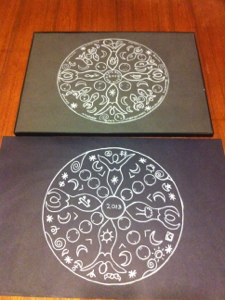
As I read the material for this lesson, I was thinking about the wheel of the year and about the woman’s wheel of life and I decided it was time to make my 2013 Moon Calamandala drawing! It seemed like the perfect time! The Moon Calamandala (TM* 😉 ) includes the dates of each full moon in 2013. It also includes a variety of “womanrune” symbols to pictorially explore what our family would like to bring into our lives during each quarter. In the classes I teach, sometimes I encourage my students to think in circles rather than in lines. To me, this is what the Moon Calamandala represents as well. Here, we see the year as a cycle, a circle, another turn around the sun, rather than as a series of linear boxes as a graph, implying a distinct beginning and ending. The four goddess images represent the seasons and the four quarters of the year. Within each quarter are that quarter’s moons and the womanrunes symbols I chose to indicate family hopes, dreams, or plans for that part of the year. The waxing and waning moons are also indicated symbolically.

20121123-104146.jpg

20121123-104206.jpg

My 2012 Moon Calamandala (above) and the 2013 drawing ready to go into the frame. You can see a larger image and description of my 2012 calendar in this post, which was part of an assignment for a different class at OSC.

20121123-104216.jpg

On the wall!

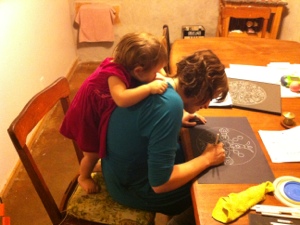
Seemingly appropriate for the Mother turn of the wheel, I received much assistance from my littlest one as I was completing the calamandala:

20121123-104230.jpg

Womanrunes

20121123-104245.jpg
*I think I may have just invented this new word 😉

Categories: art, family, Goddess, OSC, spirituality, womanspirit, writing | 2 Comments

How the UU Church Introduced Me to the Goddess

Two blogs that I enjoy reading—Bishop in the Grove and Love, Joy, Feminism—both recently wrote about their personal experiences attending Unitarian Universalist Churches and the sense of community/value they found there. It made me think about the role of the UU Church in my own life and I decided it was time to give a shout-out to the UU Church and how it introduced me to the Goddess and to religion in a form that I not only could find palatable, but also deliciously meaningful and enriching. My first cause in life was feminism—a sense honed by my experiences as an agnostic homeschooled teenager amidst mostly fundamentalist Christians. I could not help but stand up for women’s rights and challenge the rhetoric my peers often shared about a “woman’s [lesser] place” in life and society. Because my developing sense of feminism burgeoned in response to patriarchal religious beliefs about women—the only religious beliefs I had yet encountered—I also developed a sense that feminism was not compatible with religion, period.

In college in the 1990’s as a psychology major, I always chose “women’s issues” as my main area of focus and I went on to graduate school in clinical social work, doing my internship at a battered women’s shelter (I also volunteered in one during my undergraduate years). My sense of the Goddess that later emerged is very intertwined with my deep beliefs about the inherent value and worth of women. After finishing graduate school in 2000, I started to have lots of “searching/seeking” conversations in the car with my husband–trying to find something to “plug into” and saying, “maybe I need to get religious?” But, there was no religion I could find that fit me/matched me and I decided it probably didn’t exist. As time passed, I continued to seek/discuss/ponder and a different friend mentioned her UU church and it being a “perfect spiritual home for her”–I dismissed it because of the word “church,” but in 2005, I took the infamous Beliefnet quiz and got a 100% match for Unitarian Universalism. Lo and behold–my beliefs about social justice and about the inherent dignity and worth of each human being, as well as about the deep mystery and wonder of the natural world were “pluggable” after all! By this time, we had moved and so I started attending my very, very tiny local UU fellowship.

Cakes “Gaia” logo

In 2003, my good friend had taken a women’s studies class in college and lent me the books When God was a Woman and The Chalice and the Blade and we began to have discussions about the Goddess and to explore our feelings about religion and meaning. She was the first person I was ever able to speak to deeply about spirituality. I was raised as a fourth generation “non-religious” person—my parents, grandparents, and great-grandparents all had/have no religious or church affiliation. My friend and I talked a lot about Wicca and paganism and as I read more books, I realized something was missing for me in most pagan literature. I eventually discovered the “missing” element, for me, was the Goddess emphasis of feminist spirituality.

After beginning to attend the small local UU church that I jokingly refer to as the Church of Democracy and Evolution, I discovered the fabulous Women and Religion subgroup within the larger UU world and started to realize that my strong draw towards Goddess actually had a place and a home under the UU “umbrella” and that I didn’t have to self-identify as pagan or Wiccan in order to explore a relationship with Goddess. I trained as a Cakes for the Queen of Heaven facilitator in 2008 and discovered something every powerful in these resources. At the conclusion of the training, I had profound sense of THIS is what else there is for me! It was a pivotal moment.

After the empowering and transformative births of my sons in 2003 and 2006, I became deeply enmeshed in birthwork—expanding my senses of women’s issues and social justice into birth activism and birth education. Then, in 2009, my third son died during my second trimester of pregnancy. My birth-miscarriage experience with him was a powerful and transforming experience as well and I was left with a sense of openness to change. A receptivity to larger forces and powers in the world.  Indeed, it felt like a spiritual experience of sorts. After his birth and in my journey through grief, I experienced a sense of myself as inherently worthy and valuable—that I didn’t need to do anything special to be a worthwhile human being. I also had the revelation shortly after his birth that the power of women that is so present in birth, is present in women, period. I realized that this sense of “birth power” could be found in women’s spirituality and I found myself irresistibly drawn to more and more reading and study of feminist spirituality and Goddess thealogy. However, reading wasn’t enough. I felt the thread of Goddess that had danced at the edges of my life for so long, had finally become a distinct and extremely important presence in my life and I felt a call to more formally dedicate myself to a Goddess path.

On my son’s due date on May 3, 2010, which was also my 31st birthday, I did a small, private ceremony in the little stone labyrinth in my front yard in which I formally declared to myself and to the nature around me that I was now committed to practicing the presence of the Goddess in my everyday life. In May of 2011 and May of 2012, I renewed that commitment in another private ritual. Also in May of 2010, I went to a healer for “somatic re-patterning” (or, as I call it, “reprogramming my brain!”) and let go of the remaining neural pathways doubting my own worth and value. During our session, she told me that my healing gift is in words (not in physical touch or treatment) and that I live my spirituality, I don’t have to explain it. She also told me that something big was shifting inside of me and that I was opening up it a new direction. She asked if I perceived that shift in my life and I said, YES, knowing that it was this new sense of connection to the feminine divine.

In November of 2010, I attended at women’s spirituality retreat at a UU church in St. Louis and we did an exercise in which we each wrote a “gift” on a piece of paper (following a guided meditation) and then put them into a communal bowl and each drew out another’s woman’s gift–she was sharing it with us. I drew out “sacred words.” My friend told me she thought it was perfect for me because talking to me about her own experience of spirituality had been deeply meaningful to her. When I got home, I started looking for study programs/schools online because I knew in my heart that the time had come to deepen my personal study/experiences. After this retreat, I also started planning and facilitating quarterly women’s spirituality retreats locally. And, in January 2011, I gave birth to my own baby girl. She was born at home into my own hands, alone, under my own power and with my heart full of hope and joy and the promise of new beginnings.

In March of 2011 I started working on my D. Min degree in Thealogy/Goddess Studies at Ocean Seminary College and in July of 2012 I became ordained as a priestess with Global Goddess. Without my tentative steps into the UU church, I do not know that I’d be where I am right now. As is kind of the tagline of the program, I can honestly say that, “Cakes changed my life!”  😉

Categories: feminism, feminist thealogy, Goddess, spirituality, UU, women | 3 Comments

The Web of Life

This essay is modified from one written for my Ecofeminism class at Ocean Seminary College.

Carol Christ’s understanding of “profound connection of all beings in the web of life,” (p. 58) is integral to my own understanding of the world, ethics, feminism, and spirituality. I very often return to the idea from Naomi Wolf of the “great invisible web of incarnation of which we are all a part,” indeed it forms the very foundation of my personal thealogy. My introduction to Goddess spirituality as a viable spiritual path distinct from Wicca came from my involvement with the UU Church, which holds an awareness of the web of life as one of its six core principles: “Respect for the interdependent web of all existence of which we are a part.” UU’s also draw from “seven sources,” one of which is: “Direct experience of that transcending mystery and wonder, affirmed in all cultures, which moves us to a renewal of the spirit and an openness to the forces which create and uphold life” and another of which is: “Spiritual teachings of earth-centered traditions which celebrate the sacred circle of life and instruct us to live in harmony with the rhythms of nature.” (http://www.uua.org/beliefs/principles/)  I find that direct experience for me comes most clearly and cleanly through nature and thus identified with Starhawk’s explanation in Reweaving the World that, “we must preserve the wilderness that’s left because that’s the place we go for renewal, where we can most strongly feel the immanence of the Goddess” (p. 82). This is dramatically true for me and in August I explored my relationship with the Goddess in the woods in a guest post on the Feminism and Religion blog about Theapoetics, based on earlier work I did with OSC.

As I just used in my prior post, I again thought of this quote: “When you grow, care for, cook, and eat a vegetable, you become emotionally attached to that vegetable for life. You eat with your heart, not with your mind.” –Liz Snyder (quoted in “Home Grown: Helping Your Child Develop a Love of Gardening” in Natural Life Magazine, May/June 2011). While this is about vegetables, I think we could say the same about animals and also about people. The direct relationship and connection is the key. I really do feel like the relational context of our lives is the fundamental core of the human experience. We cannot not be in relationship to the things around us, not just in terms of other humans, but plants, trees and animals. We are even in relationship with the sun, the wind, and the rain. And, the net that holds the whole, is what I name as Goddess/Divinity. Everything is interconnected and does not exist without connection/relationship. Connection is strength, not weakness, and it is central.  Goddess ethics are “discovered within the web of life” rather than imposed from without.  If we acted with our hearts and with love rather than with “logic” and if a corresponding ethic of care underlaid our beliefs, actions, and social structures, the overall functioning of society would change for the better.

As I read these final chapters in Reweaving the World, particularly Christ’s quote from Alice Walker about being a part of everything, “not separate at all,” I also thought about one of my long ago observations from my Ecology and the Sacred class:

My reflection was about how quickly the woods close in around human-made structures. When we built our house, it felt like we had scarred the land—we cleared some trees and had to dig for the septic tank and so forth. The ground looked stripped, some trees were damaged (or cut down), and our house was kind of plopped down there in the middle of the scar. We moved in to our house four years ago and you can no longer see these environmental scars—indeed, it feels at times like we have to hold the woods back from taking the area back over and reclaiming the land. A variety of grasses and wildflowers grow in the cleared areas and trees stretch out all around our house. I reflect upon how if we no longer lived here, our house would be swallowed up by the forest within only a handful of years. This is reassuring to me in a strange way. No matter how we have altered the landscape by our human presence and “meddling” with our ecosystem, Nature is waiting to reclaim and transform what we have attempted to mold and make our own.I also reflected about how we, as human inhabitants of this patch of ground, are part of the woods and the forest ecosystem. I guess in some ways I feel like we have “invaded” here, carving out a large footprint. But, while standing on our back deck, and looking all around me at the trees, grasses, and flowers, closing in…pressing in almost…on our house, I felt a sudden sense that we and our home were a part of these woods. We live here in our—albeit excessively large–“nest,” much like any other animal inhabits its nest or burrow within the forest. And, we are within it too, not on top of or apart from it.

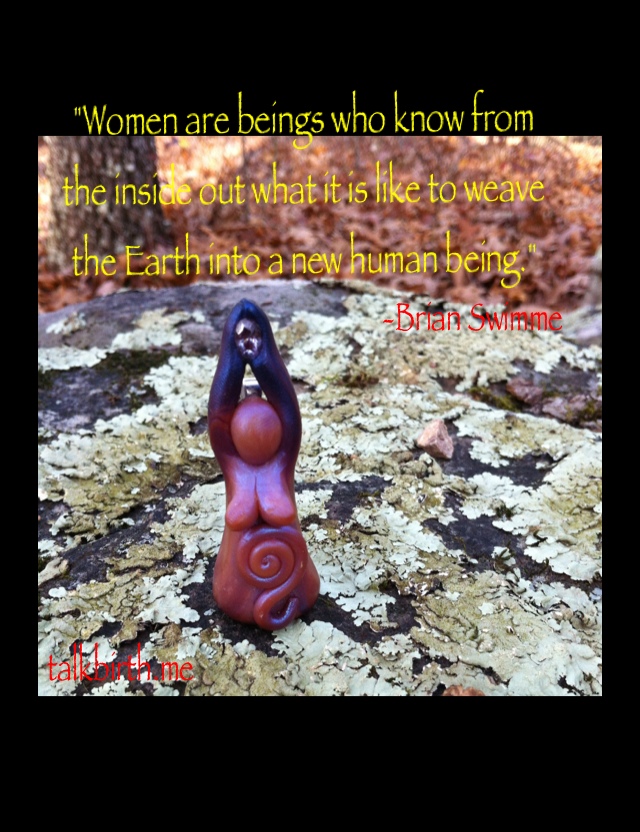
This idea that I was a legitimate part of nature and the woods as well was an important epiphany for me. Likewise, as I read Christ’s essay and I had another epiphany about interconnectedness and “all being one.” I’ve always struggled somewhat with the phrase, “we are all one,” but as I read her words, I had this new sense of clarity about it—we are all one weaving. A favorite example from earlier in this course is in Brian Swimme’s description of the Great Birth (Big Bang) in his essay in Reweaving the World: “From a single fireball the galaxies and stars were all woven. Out of a single molten planet the hummingbirds and pterodactyls and gray whales were all woven. What could be more obvious than this all-pervasive fact of cosmic and terrestrial weaving? Out of a single group of microorganisms, the Krebs cycle was woven, the convoluted human brain was woven, the Pali Canon was woven, all part of the radiant tapestry of being. Show us this weaving? Why, it is impossible to point to anything that does not show it, for this creative, interlacing energy envelops us entirely. Our lives in truth are nothing less than a further unfurling of this primordial ordering activity…Women are beings who know from the inside out what it is like to weave the Earth into a new human being” (Reweaving the World, p. 21. Emphasis mine).

I also greatly enjoyed Starhawk’s essay in Reweaving the World. As I read it and her passionate exploration of the earth-based tradition of paganism, I thought of a question I recently saw touched upon by a pagan blogger I enjoy, Bishop in the Grove, of whether or not pagans are still earth-based?  Explaining based on other posts and conversations Bishop asks:

“Lastly, are we “earth-based” anymore? It came up in response to Gus’s later statements about the political landscape that there are a wide-variety of Pagans, many of whom no longer identify as “earth-based.” This struck a chord with some people, and I’ve already received some feedback on Facebook which voiced appreciation for pointing out that some Pagans are more centered around deity.I think this one is worthy of a little unpacking. Do a little research, and you’ll see that the roots of the Neopagan movement were very much in the dirt, if you will. Earth-centered, or at the very least earth-aware spirituality has, up until fairly recently, been synonymous with Paganism. How exactly did we get to a place where someone could consider themselves a Pagan and not be “earth-based?” www.bishopinthegrove.com/archives/huffpost-live-paganism-roundtable-followup/

What would Starhawk make of this question I wonder, since her paganism is clearly deeply earth-based, indeed the earth is the foundation of her work, life, activism, teaching, and spirituality?! Starhawk reminds us that environmental issues are women’s issues, “for women sicken, starve, and die from toxins, droughts, and famines, their capacity to bear new life is threatened by pollution and they bear the brunt of care for the sick and the dying as well as for the next generation…unless we understand all the interconnections we are vulnerable to manipulation” (p. 83)

Starhawk passionately explains that earth-based principles call us to action: “earth-based spirituality makes certain demands. That is, when we start to understand that the Earth is alive, she calls us to act to preserve her life. When we understand that everything is interconnected, we are called to a politics and set of actions that come from compassion, from the ability to literally feel with all living beings on the Earth. That feeling is the ground upon which we can build community and come together and take action and find direction” (p. 74).

Categories: feminist thealogy, Goddess, nature, spirituality, thealogy, writing | 1 Comment

More Guest Posts!

This week I had another guest post published and the Feminism and Religion blog. Lots of powerful voices there and I’m really proud to be included amongst them!
Who is She? The Existence of an Ontological Goddess

I do feel Her presence directly in my life—call it an energy, call it the sacred feminine, call it the divine, call it source, call it soul, call it spirit, call it the great mystery…I perceive a web of relatedness and love within the world and I choose to put a feminine form to that energy—to name it and know it as Goddess…

And then, based on a blog post here by the same name, my essay about The Role of Death in the Circle of Life was published in the Fall Equinox issue of The Oracle.

While looking up something else, I came across the Wikipedia entry for Goddess movement and appreciated this explanation of who/what Goddess is:

Another point of discussion is whether the Goddess is immanent, or transcendent, or both, or something else. Starhawk (1988) speaks of the Goddess as immanent (infusing all of nature) but sometimes also simultaneously transcendent (existing independently of the material world). Many Goddess authors agree and also describe Goddess as, at one and the same time, immanently pantheistic and panentheistic. The former means that Goddess flows into and through each individual aspect of nature—each tree, blade of grass, human, animal, planet; the latter means that all exist within the Goddess (Starhawk 1979, Laura 1997, Christ 1997).

Starhawk (1979:77) also speaks of the Goddess as both a psychological symbol and “manifest reality. She exists and we create Her” (italics hers). Laura (1997:175) describes Goddess as being interactive. Possibly building on Mary Daly’s (1973 and 1978) suggestion that the divine be understood not as a Being (noun), but as Be-ing (verb), Carol P. Christ (2003), shows the similarities between Goddess theology and process theology, and suggests that Goddess theologians adopt more of the process viewpoint.

Categories: feminist thealogy, Goddess, spirituality, thealogy, writing | Leave a comment

Our Mother Prayer, version 3

Crescent moon over our field a couple of weeks ago.

Our Mother who art within us,
Each breath brings us to you.
Thy wisdom come,
Thy will be done,
as we honor your presence within us.
You give us this day all that we need.
Your bounty calls us to give and receive
all that is loving and pleasurable.
You are the courage that moves us to be true to ourselves
and we act with grace and power.
We relax into your cycles of birth,
growth, death and renewal.
Out of the womb, the darkness, the void, comes new life.
For you are the Mother of All Things.
Your body is the Sacred Earth and our bodies.
Your love nurtures us and unites us all.
Now and forever more.

“Our Mother” by Dale Allen

Via The Girl God

Two other versions previously posted:

Our Mother Prayer, Version 2
Our Mother Prayer
I actually use a slightly modified version of these two each morning before I get up, as a way to start my day in a “tuned in” frame of mind, rather than a frantic or stressed one. Now, I want to try to memorize this new version also, which is longer and a little more complicated!

Categories: blessings, Goddess, invocations, liturgy, poems, prayers, quotes, readings | 1 Comment

Her Name by Janine Canan

She is dancing her Dance
and everything changes.
This is what is meant by Impermanence,
buddhist for God.

She is dancing her Dance
and nothing remains.
This is what is meant by Nothingness,
atheist for God.

She is dancing her Dance
and everything is beautiful.
This is what is meant by Changing Woman,
navajo for God.

She is dancing her Dance
and planets whirl around the sun.
This is what is meant by Allah,
sufi for God.

She is dancing her Dance
and her forms are never-ending.
This is what is meant by Shakti, Energy,
hindu for God.

She is dancing her Dance
and the Dance is She.
This is what is meant by God,
human for Mystery.

~~~~~~~~~~~~~~~~~~

poem from Ardor: Poems of Life

via Her Name by Janine Canan « Feminism and Religion.

Categories: Goddess, poems, quotes, spirituality, theapoetics, womanspirit | Leave a comment

The Central Value of Relationship

This post was originally published in The Oracle, the publication of Global Goddess and is based on a lesson I completed during one of my classes at Ocean Seminary College.

According to one of my favorite Goddess scholars, Carol Christ, the central ethical vision of Goddess religion is that all beings are embedded in a web of interconnected relatedness. All beings are part of the web of life. Everything is in relation—indeed it is possible to have relationships with the sun, sky, wind, and rainbow, as well as to other people, animals, plants, and the Divine. Everything is interconnected and does not exist without connection/relationship. Connection is strength, not weakness, and it is central.

As Christ explains, “The rituals and symbols of Goddess religion…[bring] experience and deep feeling to consciousness so that they can shape our lives; helping us broaden and deepen our understanding of our interdependence to include all beings and all people; binding us to others and shaping communities in which concern for the earth and all people can be embodied.” This connection is celebrated ritually through:

  • Invoking the four directions in ritual
  • Earth-honoring practices
  • Invoking the four elements in ritual and including symbolic representations of them
  • Visioning the Earth as the body of the divine
  • Venerating the Divine Female, which celebrates rather than denigrates women, the body, the earth, and the natural cycles of life
  • Wheel of the year orientation/celebration

These things are the mythos of Goddess religion and the ethos that results is:

  • Women who have pride in being female and pride in and love for their bodies.
  • Men who respect women as inherently valuable
  • A planet that is treated responsibly and with care
  • People who act as if they are a part of rather than apart from it—damaging the earth becomes no longer acceptable
  • Nurturing life and caregiving are acts that are valued
  • Motherhood and children and parenting are treated as worthwhile and meaningful activities and this is reflected in cultural, social, and political practices (such as in paid maternity leave of adequate duration)

Goddess ethics are “discovered within the web of life” rather than imposed from without. This has been true for me as a non-religious person for much of my life, who later discovered Unitarian Universalism and through that Goddess spirituality. I’ve never seen the need to have religion define for me what is a good, moral action and what is not (my experience is that many people with Christian backgrounds can’t understand how this is possible). What feels right and good and moral and ethical can be learned through living and in the context of family and relationship, it is does not have to be doctrine. Some people would argue that you cannot trust your “feelings” as to moral action, but I find more evidence to support the idea that ignoring your feelings and doing what you’re told instead has historically created a good deal of harm.

Also according to Christ there is “no self that is not created in relationship with another.” I used to struggle somewhat with this notion—my inherent understanding of the world was of the central value of human relationship, but if this is true, then without my relationships who am I? Relatedness as central originally seemed to me to make humans your “god.” I spent what feels like years trying to figure out who I was independent of other people and it is basically impossible to do so, BUT, this also gives other people too much credit or responsibility for my identity. I was consumed with needing to find my core self, my true self, and I chafed at the notion of “no self” or “selflessness” from Buddhist traditions. I have since learned that defining myself in the context of relationships to other people is too narrow a lens, I left out many other pieces of the web of connection. I exist in relation to the world, not just other people, and that includes Goddess power/energy. I name the holding web as Goddess.

It is profoundly disordered to think you can exist independently of others, but I also believe that you can be in relation to yourself, in a sense, in a healthy and strong way.

Interestingly, it was through my discovery of women’ spirituality and Goddess that I finally was able to regain a sense of myself as inherently worthy and valuable and NOT have this worth tied to doing for others, because I found that I could be related/relational TO the web or larger whole rather than just other people, whose affection towards or need of me may be transient. I used to feel so buffeted by the whims of others, rather than having a solid sense of being held in the hand of the Goddess (embedded in the web of relatedness). My sense of related embeddedness allows me to still be intimately engaged with and related to, while still not dependent on others for self-concept/identity/definition. My sense of self can come from within a relationship to my perceived place in a larger whole or web of existence. I feel I have reached a point where I can value all relatedness/relationships, rather than identity seeking through relationship or role exclusively with other people.

My favorite quote about the concept of existing in the context of relationship comes from another of Christ’s books, She Who Changes:

“Martin Buber, there can be no ‘I’ without a ‘thou,’ no self apart from relationship. Martin Buber said that before speech is developed, the hand of the infant reaches out for its mother (or other nurturer).’ In other words, before Descartes could formulate a thought, and certainly before he knew that he thought, he reached out his hand in relationship. The existence of the other is as certain as the existence of the self. Long before infants learn to speak, they come into relationship with others besides the mother, and with the physical world, with cribs, toys, sunbeams, shadows of leaves blowing in the wind. The existence of a world and the existence of others can be doubted only by someone who imagines that he or she could exist apart from relationships. According to process philosophy, a person who imagines he has no relationships is to be pitied-or committed to a mental institution. His thoughts on this matter certainly should not have become the foundation of modern western thought.” (Christ, 74)

I have learned a lot about the fundamental truth of relatedness through my own experiences as a mother and the quote above brings chills to my body. Relationship is our first and deepest urge. The infant’s first instinct is to connect with others. Before an infant can verbalize or mobilize, she reaches out a hand to her mother. I have most definitely seen this with my own babies. Mothering is a profoundly physical experience. The mother’s body is the baby’s “habitat” in pregnancy and for many months following birth. Through the mother’s body is how the baby learns to interpret and to relate to the rest of the world and it is to mother’s body that she returns for safety, nurturance, and peace. Birth and breastfeeding exist on a continuum as well, with mother’s chest becoming baby’s new “home” after having lived in her womb for nine months. These thoroughly embodied experiences of the act of giving life and in creating someone else’s life and relationship to the world are profoundly meaningful. With my last baby, I actively introduced her to the world—taking her out one morning and touching her feet to the earth and introducing her to the planet.

With my baby, I also see so clearly how she sees herself reflected in my eyes—loved and worthy and wonderful and true and beautiful. She looks to me, in my eyes, to gauge safety and danger as well as worth and respect. She sees me seeing her and what I see is SO GOOD. (And, I also see her seeing me and I’m pretty great myself!)

Molly is a certified birth educator, writer, and activist who lives with her husband and children in central Missouri. She is a breastfeeding counselor, a professor of human services, and doctoral student in women’s spirituality at Ocean Seminary College. She was recently ordained as a Priestess with Global Goddess. Molly blogs about birth, motherhood, and women’s issues at http://talkbirth.me and about thealogy and the Goddess at http://goddesspriestess.com

References: Carol P. Christ. She Who Changes: Re-imagining the Divine in the World. Kindle Edition.

20120912-161657.jpg

Categories: feminist thealogy, Goddess, spirituality, thealogy, women, writing | 3 Comments

I can hear Her breathing…

20120907-134122.jpg

Sitting on the earth before it
I feel it

Life force, energy

Powerful, potent

running throughout

Everything is something

Life prevails and is beautiful.

–Molly, April 30, 2002

Several years ago, I jotted this down while sitting next to a special rosebush in my front yard. I was thinking about it this morning and realizing that today I would personalize that “it” as Goddess, but also that I’ve had a sense of “it”–this divine web of incarnation–for a long time.

She is always whispering to us

we may call Her by different names

yet She is always there

even when we forget to listen


My attention was caught by these quotes via Facebook this week:

“‎The most beautiful thing we can experience is the mysterious. It is the source of all true art and science. [She] to whom this emotion is a stranger, who can no longer pause to wonder and stand wrapt in awe, is as good as dead.” —Albert Einstein

“‎What you are basically, deep, deep down, far, far in, is simply the fabric and structure of existence itself.”
~ Alan Watts
via www.pantheism.net

“So for me the Goddess was just a certainty, easy to contact, no need for temples. All you need is to walk out in nature. If you have nothing, just a blade of grass, you pray with that one blade of grass and she will still come. It seemed like a loving, ever present deity who liked to take care of her own, appreciated being prayed to.” ~ Z Budapest

via The Girl God

Categories: Goddess, nature, poems, quotes, spirituality, theapoetics | 1 Comment

Knocking…

Last night I dreamed I was in

the living room with my friend

There was a knock on the door

Listen, I said

That’s the Goddess

We looked at each other for a long moment

and then I said,

It is time to open the door

and let Her in…

20120827-164655.jpg

8/27/2012

Edited to add–when I hit publish on this, the random WordPress quote I got was suitably this one: “Dreams are illustrations from the book your soul is writing about you.” –Marsha Norman 🙂

Categories: Goddess, spirituality, womanspirit, women, writing | Leave a comment

Guest Posts!

I’m pleased and excited and proud to have a guest post on the Feminism and Religion blog today! The article is about theapoetics–discovery of the Goddess through poetry and direct experience. As I note in the comments, I think I might be the first person to use the term “theapoetics” (instead of theopoetics) in this manner and that is extra exciting to me.:)

I had a guest post on The Divine Feminine blog this weekend also. This one is about defining Goddess. I have lots more to share about this subject saved in my drafts folder waiting to eventually see the light of day.

These topics feel tender/vulnerable to me and I don’t actually feel “safe” sharing the links on my personal Facebook page the way I usually do when I have articles published. I also asked that my last name not be used on the defining Goddess one. Why publish work that I feel tender about? I have no freaking idea. I just feel like I MUST. It is a compulsion almost. To write, to share, to tell about it. Even when it is scary. I have said before that I’m not a risk taker. But, I then realized that is only in the sense of not taking risks like going sky-diving—in my personal, spiritual, emotional, and academic life, I take risks all the time. I’m brave!

20120827-173851.jpg

Wildflower I noticed yesterday in the vineyard–both tender and brave 😉

Categories: Goddess, spirituality, writing | Leave a comment

Embodied Prayer

Sister, before you get all busy and serious about your new year resolutions,
take a moment to tune into that force which beats your heart,
which grows the leaves on the trees, which creates and tears down,
everything.
Tune into the captivating rhythm of evolution,
and dance your way into your holy calling.
The whole universe is dancing with you.

–Awakening Women Institute

I’ve felt a pull to return to this quote above and to something I wrote about embodied prayer at the dawning of 2012. I have had a tense, taut, and tight couple of days in which I’ve been irritable and impatient with those closest to me (for whatever reason, the people I know less well, usually get the “better” side of me, which just doesn’t seem like the way things should be!). It is strange because on one hand I feel like wonderful things are unfolding in my life in ways that feel meaningful, on purpose, and right, while at the same time I continue to struggle with finding the balance between what I need in my life for myself and what my children need/expect/deserve from me–the two often, frankly, feel incompatible. I continue to believe that there is a way for our family to live in harmony together, companionably meeting each member’s needs for self-expression, self-development, love, and authenticity, but then with weeks like this, I feel as if perhaps that IS an unreasonable hope!

When I became ordained as a priestess, one of the things that I vowed to myself was that I would remember to be a priestess of my own hearth first, rather than to become so pulled by the expectations of others outside my family that they get my best and my family gets the scraps. I’m amazed by how opportunities have been opening up to me since accepting the priestess call—I’m planning multiple rituals and ceremonies, I’m going to a Goddess festival next month, I continue to make steady progress on my doctoral degree and finished another one of my classes this week, my brain buzzes with ideas for my dissertation, I’m absolutely stoked to have two articles accepted for publication at the Feminism and Religion blog (one of which seems to actually be an original/fresh idea in the field of thealogy!), I have a guest post accepted for publication on The Divine Feminine blog,  and I had an essay published in The Oracle (the online zine for Global Goddess) called The Central Value of Relationship. I also have other ideas for classes/circles I’d like to facilitate and participate in. These things feel great. They feel right. They feel like where I belong. They also feel risky and brave and big and complex. I love the life of the mind and ideas that I’m experiencing in my classes. I love spending time in my own brain. I love thinking and writing and teaching and learning—“priestessing” my community in all of these ways. And, yet, then I feel bad and guilty about having snapped at my kids while trying to finish these–how ironic–essays on spiritual growth and development and then I feel like a fraud. And, every day I find myself with a “time deficit” and feeling taut and on the edge of freaking out because there is just SO. MUCH. TO. DO. All the time. And, I don’t feel like I ever get a break to just be still and rest. It is almost like I don’t know how to rest.

So, here’s what I wrote at the beginning of the year:

This year, I’d like to let go of shoulding myself. If I don’t truly have to do something, I’m only going to do it if I want to do it. If the word “should” enters the picture about anything, I’m going to use that as my cue to NOT do whatever it is I’m letting should me. Sound like a plan?

I enjoyed reading this post from Dreaming Aloud recently and the writer observes that she is only going to be able to be her for the new year: “I might even let myself mother to my own standards too! Wouldn’t that be nice, rather than failing every day because I don’t do everything the way the books say.” She also included this interesting idea about 3/4 baked: “Another influential book in my life…Zugunruhe… talks about the 3/4 baked philosophy, where the author urges us to do our work the best we can, but rather than spending all our energy in refining it ad infinitum, put it out to the world 3/4 baked and let the feedback and the inspiration it creates, and your own distance, do the final honing, because really there is no such thing as perfect.”

Embodied Prayer

My other  intention for 2012 was a very personal one that I felt extremely hesitant to write about. As soon as I read the quote I shared above from The Awakening Women Institute, I knew I wanted to share it. When I applied to graduate school in thealogy, I wrote in my application that I wanted my life to be a living prayer for social justice and women’s empowerment. Then, based on my work in my graduate classes, I started to be asked to write for publications focused on women and religion. I have always felt very cautious and wary of sharing any of my ideas about spirituality or religion publicly and so this makes me nervous for a variety of reasons. So did starting this blog and I’ve sort of tried to avoid connecting it to my “other life.” However, if I’m actually going to be writing these articles and having original ideas in the field, it is time to shed discomfort and speak my truth! I think my primary concept of living prayer is really about mindfulness. Being here and being aware.

In September, the Awakening Women Institute offered via Twitter to give people “temple names”—you were asked to respond to the question about “your edge right now in your life. What is calling you, what is challenging, what is opening?” I was instantly intrigued and responded to the offer with the following: “I have multiple edges–I feel at the edge of being able to truly live my faith, having my life be a living prayer. I also constantly teeter on the edge between meeting my children’s needs and meeting my own needs–and trying to find the harmony in that; trying to find the place in which our family works in harmony to meet each member’s needs (not requiring ‘sacrifice,’ because we have a seamless integration!).” The temple name I received was: Embodied Prayer. At first I felt slightly disappointed, like, yeah, I said that already. But, as I “rested” with the name and stated it aloud—i.e. “I am Embodied Prayer”—it became a powerful daily practice for me (that I seem to have lost hold of recently).

I have long sought strategies to integrate a sense of the sacred in daily life and have also known that at the root, what I’m really wanting is daily mindfulness. My “temple name” came to serve in some ways as mindfulness touchstone for me—as I go about my life, I ask myself what kind of “prayer” I’m offering in this moment. And, is this the kind of prayer I want to embody right now? (i.e. this week as I feel cranky and overextended and tense and annoyed, I’ve been stepping back slightly and looking at my “prayer” and realizing that I wanted to embody a much different sort of offering to the divine, to the web of life, than a stressed out cranky prayer.) This step back and self-reminder,  sometimes calms my mood and allows me to breathe more deeply and kindly, but recently I’ve solely been using it in a self-flagellating way: what kind of prayer is THAT, you loser! You think you’re a priestess?! What a JOKE, you SUCK. What about this priestess of your own hearth bit, failure woman?! I also become angry at myself when I forget to use it, forget to be mindful. I’ve also described this practice as reaching out to touch my thread in the fabric of the tapestry of the world. When I get caught up in my own busyness, I lose sight of my “weaving” within the overall tapestry of life, that holding web of incarnation that I call Goddess, and I’d like to always remain mindful of that connectedness—or, at least to notice when I’ve lost it and reach out my hand to that which is always there, surrounding me.

Then, as I was thinking these thoughts and berating myself, and always continuously trying to be better and dang it failing every single day at being better (and, yet, trying again the next day!), I read this blog post today from Jen Louden called I’m Not Liking Myself and I’m Not Doing Anything About It. Say what? Do you mean I DON’T always have to “be better” and to have my life be one long, relentless, ever-failing self-improvement project?! Maybe this is possible: “So if you ever find yourself not liking yourself, put down the self-improvement and take a nap.  But no mean thoughts allowed!”

Oh, and by the way…to what/why is this prayer of which you speak offered anyway?

This is actually part of the main subject of my upcoming guest posts on those other blog, but I’ll touch on it now anyway. Something that made me feel as if I belonged to our tiny little Unitarian Universalist church and like there was indeed a spiritual niche I fit into, was a hymn we sang during one of my first visits with a line of, “some call it evolution, and others call it God.” That notion that there is something widely felt by many, but called by different names and within vastly different systems of belief and understanding, is why I continue to identify as a UU, even though I’m not closely involved with the local church any longer. This force, this connecting “glue” that holds the universe together might be named by others “God” or “the Universe” or “Nature” or “Life Force” or “the Sacred” or “Divinity” or “the Tao”—I feel most satisfied when I personalize it as Goddess. I do also feel Her presence directly in my life—call it an energy, call it the sacred feminine, call it the divine, call it source, call it soul, call it spirit, call it the great mystery…I perceive a web of relatedness and love within the world and I choose to put a feminine form to that energy—to name it and know Her as “Goddess.” When I am embodied prayer, it is mindfulness of this connection and relatedness of which I speak.

Categories: family, Goddess, spirituality, thealogy, womanspirit | 4 Comments

Gratitude Prayer

Beautifully cloudy sky

Goddess, thank you for the rain that has fallen.
thank you for this reprieve from summer’s heat
the coolness of the air
the freshness of the breeze
thank you for the mantle of green that has settled back softly into its rightful forest home

thank you for this sacred place
where I can come to listen
and to be heard

thank you, Goddess, for these beautiful rocks on which to sit
for the security of having a place upon the earth
for being a part of the whole

thank you for the steady pulse of my heart
thank you for the easy rhythm of my breath

thank you for the endless creativity of my mind and of my womb
Goddess, I thank you for the many blessings of my life.

–Molly, August 13, 2012

Categories: Goddess, nature, poems, prayers, spirituality, theapoetics, writing | Leave a comment

Relatedness

Goddess, I enter your sacred space
space that is always there
waiting
open
welcoming

Space that I forget to touch
that I forget to drink from
space that I forget to look for
expansive space
space within
and space surrounding me
space that can be found in a group of women
and space that can be found
in a life with small children
perhaps difficult to see or grasp
but there waiting
holding
just the same

In the quiet I can hear myself
and I can hear You
I can feel myself
and I can feel You
Breathing
resting
holding
pulsing
in an everpresent ground of relationship
and relatedness
and beingness
together

The great invisible web of incarnation
in which we are all
held
touched
connected
deeply, authentically
and forever.
–Molly, 7/9/12

Categories: Goddess, poems, prayers, spirituality, thealogy, theapoetics, writing | 2 Comments

My Explanation…

20120620-150518.jpg

My little farm baby in the field

My Explanation
Pick up a stone.
Hold it in your hand.
Feel the vibration?
Pick up a leaf.
Trace the vines.
Feel the life?
Climb a tree.
Trust the sturdy branches.
Feel the stability?
Go out side right before a storm.
Hear the thunder, watch the lightning.
Feel the energy building?
Lie down in a field on a cool day when the sun is shining.
Feel it surround you with warmth and safety?
Stand up and turn around in circles.
Feel the wind rush through your hair.
Feel the spirit?
Go out to that same field at night when the moon is full.
Let the moon light guide your way.
Feel the magic?
As you look up to the sky
and count the stars
know that they hold no prejudice, no hate, and no judgment.
Know that you have a home in the universe (which means
one song)
as long as you know that you are a part of all that
surrounds you
and all that surrounds you is a part of you.
The vibration you felt in the rock,
the life in the leaf,
the stability of the tree,
the energy of the storm,
the warmth of the sun,
the spirit in the wind,
the magic of the moon,
and the unconditional love of the stars,
know those are your gods and goddesses,
and the earth is your bible.
Everything possesses a spark of divinity, including you.
You need to look no further than the world around you,
or your own mirror
to find God(dess) and know where you belong.
That is my religion.
–Diana “Sollitaire” H. in Talking to Goddess

20120620-150729.jpg

Wildflower in the field

Categories: family, Goddess, poems, readings, spirituality, theapoetics | Leave a comment

Blog at WordPress.com.