Goddess

Thursday Thealogy: Death & Suffering

This post is excerpted from an OSC assignment written last year. The subject is so close to the things in my life recently that I felt compelled to dig out these previous writings.

How does thealogy envision death? How does thealogy address the problem of suffering?

The Abrahamic religions tend to associate death with that which is evil and wrong. Dominant religions traditions also often emphasize transcendence over the physical form and in these traditions the spiritual and the physical are seen as separate (with women associated with the “lower” body-based realm and men associated with the transcendent and divine)—the body and the earth is seen as a prison, rather than of value or as holding wisdom. In thealogy, on the other hand, death is another part of the endless “wheel” of life.

As the refrain of a Goddess song goes, in the womb of the mother…we find rest. daCosta notes that, “This darkness she equates with the  darkness of innate, instinctive knowing, where we are within the womb of the Goddess” (p. 115). I find a comforting feeling in the notion of coming to rest in the womb of the Goddess–whether that is very literal in terms of my body returning to the earth and being absorbed back into it, or it is more metaphysical (i.e. drop returning to the “ocean”). I also do not completely rule out the possibility of some form of personal continuation of spirit/energy/consciousness after physical death–just as the physical body doesn’t “disappear” after the body physically shuts down and dies, it seems semi-logical that our soul/our life spark/life energy, also does not disappear, but does or become something else/somewhere else.

Some time ago I had a “vision” during the day in my post-yoga routine meditation time. I “heard”—the moments of your life are beads on a April 2013 024necklace. Death is one of those beads. Why be preoccupied with one single bead of many, many beads? I recognize this as related to something I previously read in a Zen book I think—your consciousness being the string that holds the beads and each bead passing into the next bead, no need to cling to any of them or to become attached to one point. But, this yoga experience was the first in which I had conceived of death as just one more bead on the string—and, just like I wouldn’t spend a whole lot of my life energy thinking about the bead from my sixth birthday, say, why would I spend a lot of time thinking about the bead of my eventual, guaranteed death. That said, I do find it very relevant and appropriate to consider my own life choices and path in the context of my eventual death–i.e. I probably think at least once per day, “If I died tomorrow, would this matter?” Or, “what would choose to be doing now, if I knew that I was about to die?” etc., etc. I make a lot of life decisions based on not wanting to have regrets when I come to die, on wanting to live fully, vibrantly, authentically, and consciously.

In this same timeframe, I also had an epiphany—no matter WHAT happens after my own death, it still represents the end of life as I know it (there are actually many of these points in the course of an average life—our life as a twenty year old also “ends,” as does our life as the parent of a toddler, and so on). BUT, regardless, I still have to be at peace with THAT—this life as I know it coming to an end, whether or not there is any continuity of self or soul post-death.

I previously spent a significant number of years feeling very preoccupied with existential questions about death and life purpose (essentially of the, “if you’re just going to die anyway, what’s the point?” variety) and after having these two realizations, I was no longer preoccupied by the topic. I made my peace with having no concrete answers. You must come to terms with your life, making meaning, and reconciling your life’s path and purpose regardless of what, if anything, happens “next.” You must still live well and wisely your one wild and precious life on this earth at this time and in this place, because your time here in this way will definitely come to an end.

Returning to the question of “why suffering?” Carol Christ presents a primarily panentheistic representation of Goddess. But, if Goddess is essentially earth and is all around us, then how do we justify evil and suffering in this world? Should She not be able to protect us from harm and suffering?

Personally, I have never turned to religion to provide explanations of evil or suffering. Perhaps if I had a past tradition of conventional theology, I would then find thealogy lacking in this way. However, I came to Goddess traditions from a history of basically…nothing…and had made my peace with the existence of suffering and inhumane treatment of others as a feature of the “human condition” rather than ever conceiving of it as something under divine influence or power.April 2013 036

However, to scholars like Melissa Raphael, “[b]ecause Goddess religions ascribes little or no moral transcendence to the Goddess, it becomes difficult to use the Goddess as the religious justification for a struggle against evil, or to construct meaning in the face of it” (p. 208). Personally, I look to humanism or feminism (as philosophy and theory), as well as my own inner sense of “rightness” and morality, rather than religion to provides this justification. I have never needed religion for morality. I think that is an “old fashioned” seeming reason to need religion and something that I’ve always found puzzling when Christians bring it up—i.e. “well, without Christ, how can you be a moral person? How can you know right from wrong?” I just can. It doesn’t need to come from an external authority or power and needing to have some “higher authority” impose the rules upon you, basically has always seemed to me like having a less mature brain somehow. In a similar manner this is how I’ve also always accepted the existence of “bad stuff” in the world—it just is. No overarching power causes it, or controls it, it is just part of the ebb and flow of life, of nature, itself. I also do not find New Agey concepts of “everything happening for a reason” or “attracting the lessons your soul needs” relevant or appropriate most of the time. Sometimes there just are tornadoes or earthquakes or people get cancer. Those things feel awful and are bad to experience, but they are not punishments or under the control of any divine authority or power. Perhaps this is depressing or nihilistic, but that is the past belief from which I have come to Goddess thought, so the “failure” of Goddess feminism to offer explanations for these phenomena is almost a non-issue for me—a Goddess outlook on the world is more than I’ve ever had before, it is not a replacement for or a substitute for a previous (religious) system of belief. To me, Goddess religion has filled a void left by an agnostic, default worldview, if I was trying to use it to replace a more traditional Judeo-Christian system of belief, perhaps I would also find it lacking.

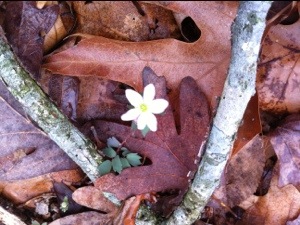
I am a sucker for things growing out of rocks. Check out this delicate little rue anemone making its life here on a big stone!Raphael also states, “…many of the things theology has associated with evil or suffering (impermanence, disease and natural disasters) are not problematic for thealogy. It would be unreasonable to attribute moral responsibility to the divine for suffering when (natural) evil is an ecological and thealogical given” (p. 208). She goes on to further explain, “It may be that if the reality of human wrong-doing and suffering does not count against the existence or worth of a reality called ‘the Goddess,’ then thealogy cannot ultimately do some of the most important work of a popular religious theory, namely, to reconcile people to existential pain and to construct meaning in the face of it” (p. 210).

As I’ve indicated, personally, I don’t feel as if I need Goddess or religion to explain these things for me, but I understand that the failure of thealogy to provide answers on these issues means that it may never attract large amounts of followers who were formerly committed to more traditional religious views of the world. What I find helpful is Carol Christ’s process philosophy outlook on thealogy that asserts divine sympathy. Goddess/God cannot prevent suffering, but suffers with those who suffer, omnipresent, while not omnipotent. It is true that thealogy doesn’t completely fill the void left by theological understandings of divinity and suffering, but I believe that may well be because traditional religious interpretations have significant issues and theological mistakes that unravel under critical thought.

In Merlin Stone’s essay about the three faces of goddess spirituality in the collection, The Politics of Women’s Spirituality (p. 66), she writes “So far, and let us hope in the future as well, feminists concerned with Goddess spirituality have seldom offered absolute or pat answers to theological questions. What has been happening is the experiencing, and at times the reporting, of these personal or group experiences: how it feels to regard the ultimate life force in our own image—as females; how it feels to openly embrace and to share our own contemplations and intuitive knowledge about the role of women on this planet; how it feels to gain a sense of direction, a motivating energy, a strength, a courage—somehow intuited as coming from  a cosmic female energy force that fuels and refuels us in our struggle against all human oppression and planetary destruction.” As I’ve written before, this makes sense to me—Goddess as life’s “fuel” and as an energy that surrounds and holds us all, but that does not “control” our behavior and does not have the ability to stop specific events from happening—events are multicausal and there are a multiplicity of forces and natural laws in the world (gravity, for example, lightning for another), that act in and upon the lives of humans without divine cause or intervention, but still as part of an overall tapestry of being (that as a whole, might be called Divinity).

Personally, I actually found Goddess most meaningfully during a time of personal suffering. While I previously connected with Goddess imagery and was interested in Goddesses and women’s spirituality from a feminist perspective that valued the symbolism in a socio-political context, I did not feel a truly personal experience of Goddess “energy” until, as I’ve also written about several times previously, I experienced pregnancy loss. That is when I felt She actually existed and when I realized that I was in relation to her as well as recognized that I wasn’t “areligious” after all, but did have a set of spiritual beliefs, perspectives, and “tools” to draw on for personal support. I was amazed to discover at this time (after an “a-religious” self-definition of the past) that I did in fact have a spiritual language and conceptualization of my own and that these were the deep resources I gathered to draw upon during a time of significant distress, fear, and challenge.

Culpepper reflects on the reframing of redemption:

“Reframing redemption necessitates renewed reflection upon the meaning of death. Rosemary Ruether is at pains to distance the notion of redemption from its eschatological interpretations. Instead, she focuses on its political implications, and rejects any formulation of the concept of salvation which views it as ‘an escape from the body and the world into eternal life’.  She offers an ecological account of immortality, which suggests the cosmic recycling of matter, not the survival of the individual in some otherworldly realm. At the heart of this rejection is a serious reappraisal of the effect that longings for immortality have had upon human self-consciousness. Our true home, this idea seems to say, lies beyond the stars. McFague is highly critical of such a view, arguing that there is no need for some postmortem existence to maintain the divine-human relationship: ‘We are with God whether we live or die, for whether our bodies are alive or return to the other form of embodiment from which they came, they are within the body of God.’  Redefining death finds a ready resonance with key aspects of thealogy. Starhawk argues that what we perceive as destruction should not be feared but acknowledged as a necessary part of the whole lifeprocess.” (Culpepper, p. 36)

According to Starhawk, paraphrased in Clack, “In thealogy, the Goddess is generally understood as the generative power of ‘all that lives and loves life…’ Therefore, when women or natural things recover their naturalness or return to the aliveness of the wild state, they are recovering their divinity in the goddess: and as the goddess is female energy, women who situate themselves inside nature, in the body of the goddess, will recover divine/natural energies and powers that will, like nature/the goddess, overcome patriarchy. For to repeat, nature/the goddess is stronger and older than patriarchy.” (Clack, p. 56)

Related past post:

The role of death in the circle of life

Rocks look at dogwoods.

Categories: feminist thealogy, Goddess, OSC, spirituality, thealogy, Thursday Thealogy | 2 Comments

Thursday Thealogy: Theapoetics

April 2013 074

Sculpture made by my six-year-old and named, “The Cutest Goddess in the World.”

Turkeys gobble
birds sing
plum petals fall
raindrops kiss stone

take a moment and sit
hear, taste,
smell, and touch
the very field of creation.

(4/16/13)

I’m having such a hard time lately focusing enough to write coherent posts. I flit from site to site, idea to idea, and just can’t settle my mind enough to say what I want to say. I feel distracted, preoccupied, and unfocused. Maybe I need to go to the woods more often. As it is, I sit here with my little stack of books: Midwifing Death, What Dying People Want, and Sacred Dying. They came too late for me to really use them in any sort of helpful way for my mom or grandma, but at least I’ll have them in case I know anyone else who needs them. I am a tiny librarian in my own way and it is books that I turn to when I need help or want to help. They’re what I offer. Books are my first and longest-lasting love. I also sit by a pile of books waiting to be turned over as I plan my spring women’s retreat and write two assignments for my OSC class on Ritual and Liturgy. My heart doesn’t quite feel in that though either—too many variables, too much unknown…

There is so much we don’t know 20130416-140924.jpg
so many possibilities we can’t imagine
maybe that is what I touch
in the dreamtime
and the woodstime
maybe I am surrounded
in all times
and all ways
by those who have gone before me

here, in the woods
I touch
and am touched
by something
something that kisses my eyelids
with a breeze
that blesses my brow
with a raindrop
that cradles my body
with stone
that fills my senses April 2013 029
with pleasure and awareness
and that connects me
to the great, grand whole of creation

and I know that I am a part of Her
and She is a part of me
forever.

Though my individual thread might end
my part of the tapestry is eternal
and I dance right now
with the lifeblood
of purpose and connection.

(4/16/13)

A few days ago, I sat in the woods and thought about death and life and ancestors and children. While I sat and spoke into my little recorder, the plum petals fell steadily all around me like snow. It was beautiful and soothing.

April 2013 071

In my piles of books are also those which I want to put back on the shelf, but that are waiting because they had sections I marked to share. One of them—a really excellent anthology of essays by priestesses (or “sibyls”) called Voices of the Goddess—contained a section that made me think of my own theapoetical experiences. Though, I then feel self-conscious, embarrassed, or somehow “arrogant” or something for identifying with it—like, who do I think I am?!

The Goddess grants her gifts of creativity in many ways, but the personal invocation, the inspired lyrical utterance is always nearest to the surface. This poetic wellspring is part of the sibylline legacy and there is no denying it. It speaks the language of the blood and belly as well as the language of the crystalline stars. It is a weaving song that meshes heaven and earth with the underworld. Poetry is the mouthpiece of the metamemory, the deep, ecstatic memory of an oral tradition that remembered the Goddess daily in domestic and tribal rituals. Since there are not Goddess rituals or liturgies from former times, we have written our own, often drawing directly upon the raw material of personal experience…Poetry can both bless and uproot, it can extol or refute. It is the true voice of the Goddess speaking through her sibyls. Personal or prophetic, poetry is communication with a deeper level of understanding. It is a gateway for the Goddess to pass through.

–Caitlin Matthews in Voices of the Goddess

While I wouldn’t venture to call myself “prophetic,” I do experience something personally very important to me there in the woods, something I’ve previously referred to as, “Entering into radical relationship with the Goddess through art, poetry, and nature…” or, theapoetics. When I wrote about this topic for Feminism and Religion, I included this poem:

Goddess Direct

Goddess, where are you?
I am within you and around youApril 2013 037
in your heart that seeks answers
and connection

Goddess, do you exist?
Yes, I am as real as your own heartbeat.
I am here in the bird’s song
I am here in the breeze that touches your face
I am as solid as the stone you sit on

I am that which weaves the Whole.
I am that which holds the All.
I am that which flows,
dancing lightly
through the heartbeat of every form on this earth

I am within you and around you
beneath you and above you
I am your home

I am that which you seek
I am that which you know
And, I love deeply, richly, and well.

via Theapoetics By Molly | Feminism and Religion.

I still don’t think of myself as writing poetry and certainly not as a “poet.” These words are something that just comes out. Something that emerges. Something that is created in a very different manner than the rest of my writing. It actually feels like an altered state of consciousness that “writes itself” and when I go back to listen to what I said, I’m often surprised or feel like I’m listening to someone else speak. That’s theapoetics. Go sit in the woods and see what happens when you open your mouth! 🙂

Categories: Goddess, nature, poems, prayers, priestess, spirituality, theapoetics, Thursday Thealogy, womanspirit, woodspriestess, writing | 2 Comments

Thursday Thealogy: The Motheredness of the World

My most recent post is up at Feminism and Religion on the subject of Mother Goddess imagery (and my mamapriestess art). It was written partially in response to the critique sometimes expressed that Mother Goddess imagery is “exclusive” of women who are not mothers:

I am also of the opinion that Mother Goddess imagery may well be less about women as mothers and more about the motheredness of the world. In this way, I do not find the image of the Mother Goddess is exclusive, rather I find it exceedingly appropriate. Every person and mammal on this planet—male, female, black, white, hetero/homosexual– since the dawn of humanity has had a mother. It is a truly unifying feature. And, it isn’t about the role, it is about the primal relationship. The root of life. As Naomi Wolf writes in Misconceptions while reflecting on an ordinary street scene and suddenly understanding the web of life and the universality of motherhood (even the squirrels!):

“We were all held, touched, interrelated, in an invisible net of incarnation. I would scarcely think of it ordinarily; yet for each creature I saw, someone, a mother, had given birth….Motherhood was the gate. It was something that had always been invisible to me before, or so unvalued as to be beneath noticing: the motheredness of the world.”

This understanding of the invisible net of incarnation is the foundation of my own thealogy and my ethics.

via Goddess Mother | Feminism and Religion.

Goddess imagery is also about valuing human women and their bodies:

The sociocultural value of a divine presence that validates women’s bodies cannot be overestimated. Indeed, patriarchal religion in its most destructive way seems to have grown out of the devaluation and rejection of female bodies. A religion that rejects the female body, that places the male and its association with “the mind” and the soul rather than the earthy relational connection of body, is a religion that easily moves into domination and control of women. Reclaiming Goddess, reclaims women’s bodies—names them not only as “normal,” but as “divine,” and this is profoundly threatening to traditional Judeo-Christian belief systems. Thus, the primacy of relatedness and connectedness as the core feature of the Mother Goddess model has broad reaching implications for women’s spirituality, as a direct contrast to the dominator model of patriarchy.

In Carol Christ’s classic essay, Why Women Need the Goddess, she quotes feminist theologian Mary Daly (Beyond God the Father):

“If God in ‘his’ heaven is a father ruling his people, then it is the ‘nature’ of things and according to divine plan and the order of the universe that society be male dominated. Within this context, a mystification of roles takes place: The husband dominating his wife represents God ‘himself.’ The images and values of a given society have been projected into the realm of dogmas and “Articles of Faith,” and these in turn justify the social structures which have given rise to them and which sustain their plausibility.”

In the same essay, Christ explains: “The symbols associated with these important rituals cannot fail to affect the deep or unconscious structures of the mind of even a person who has rejected these symbolisms on a conscious level…Symbol systems cannot simply be rejected, they must be replaced. When there is not any replacement, the mind will revert to familiar structures in times of crisis, bafflement, or defeat.”…

via Goddess Mother | Feminism and Religion.

Last time I wrote about a similar topic here, I received some comments asking about the role of “the God,” which is not a symbol I engage with or feel comfortable with given how steeped that name is in the oppression of women, saying that a thealogy without the God doesn’t seem very “whole.” While I would still like to address this question with more thought in a future post, as I wrote the above, it came to my mind again, because it is true that almost everything has a father as well—so, what about the “fatheredness of the world”? My thought when originally asked about “wholeness” was that I don’t have a particularly literalist conception of the Goddess and so to me, she is a name for that which holds the all, which is, ultimately unnameable, but can be experienced in a variety of direct ways. I experience it as the Goddess. And, I find political, social, cultural, and spiritual value in the naming of that subjective experience/wholeness/weaving of life as Goddess. “Goddess” as word and symbol is important, really important, because it breaks the patriarchal “hold” on defining divinity.

However, as a mother of sons and the wife of a husband, I have wrestled with questions as to whether Goddess-oriented thealogy excludes them as males in the same way that Judeo-Christian imagery primarily excludes women. I continue to return to “no,” because in their own experience of having been grown and birthed by me (well, my sons, not my husband!), the notion of a female image being fully capable of literally being able to hold both male and female within her, is exceedingly natural, appropriate, and logical to them. When we do family rituals, I do often use spiritual naturalist or spiritual humanist type of language rather than gendered divinity. Sacred Universe is a great term as are the generic labels Spirit or the Sacred or Nature.

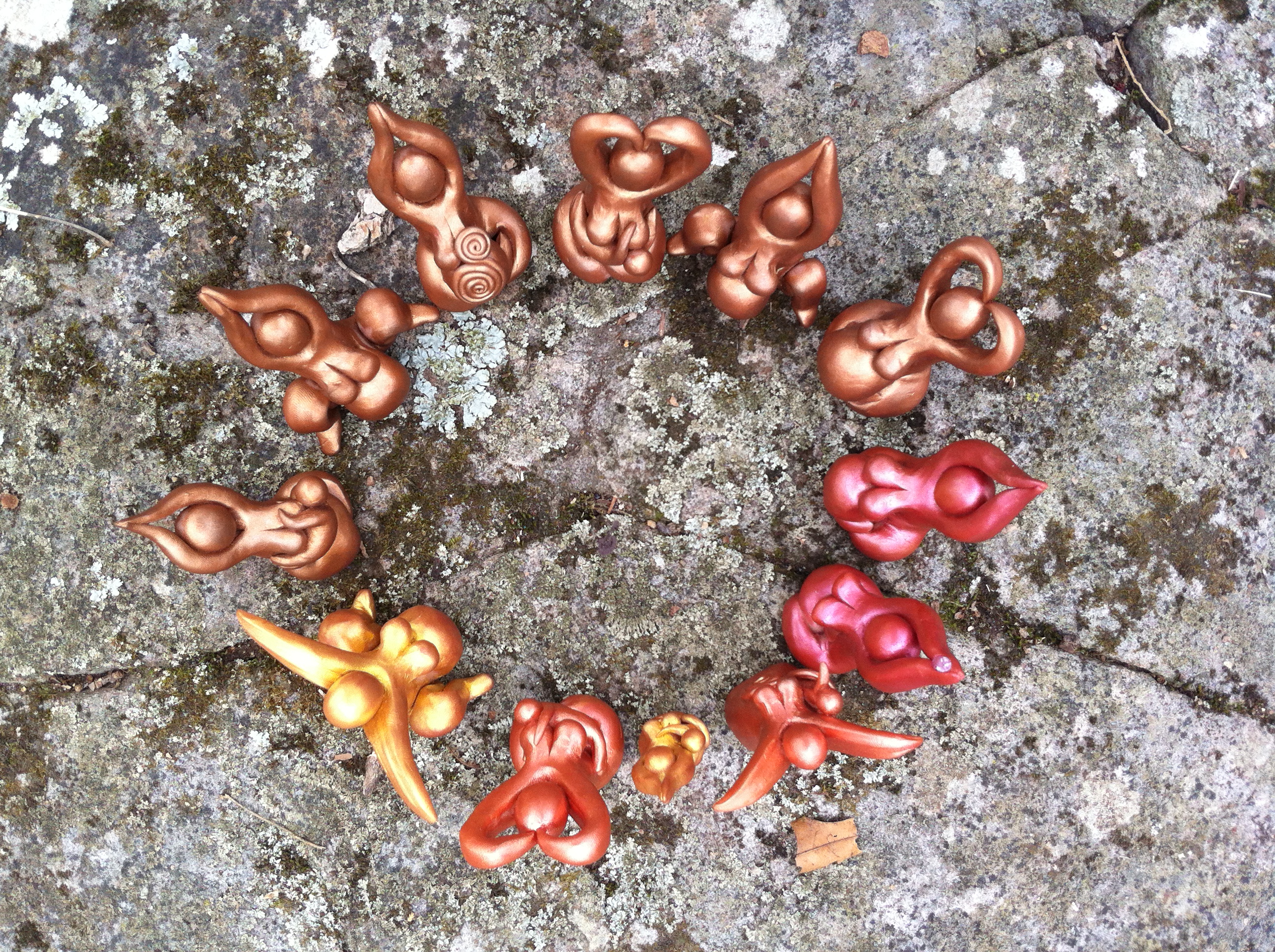
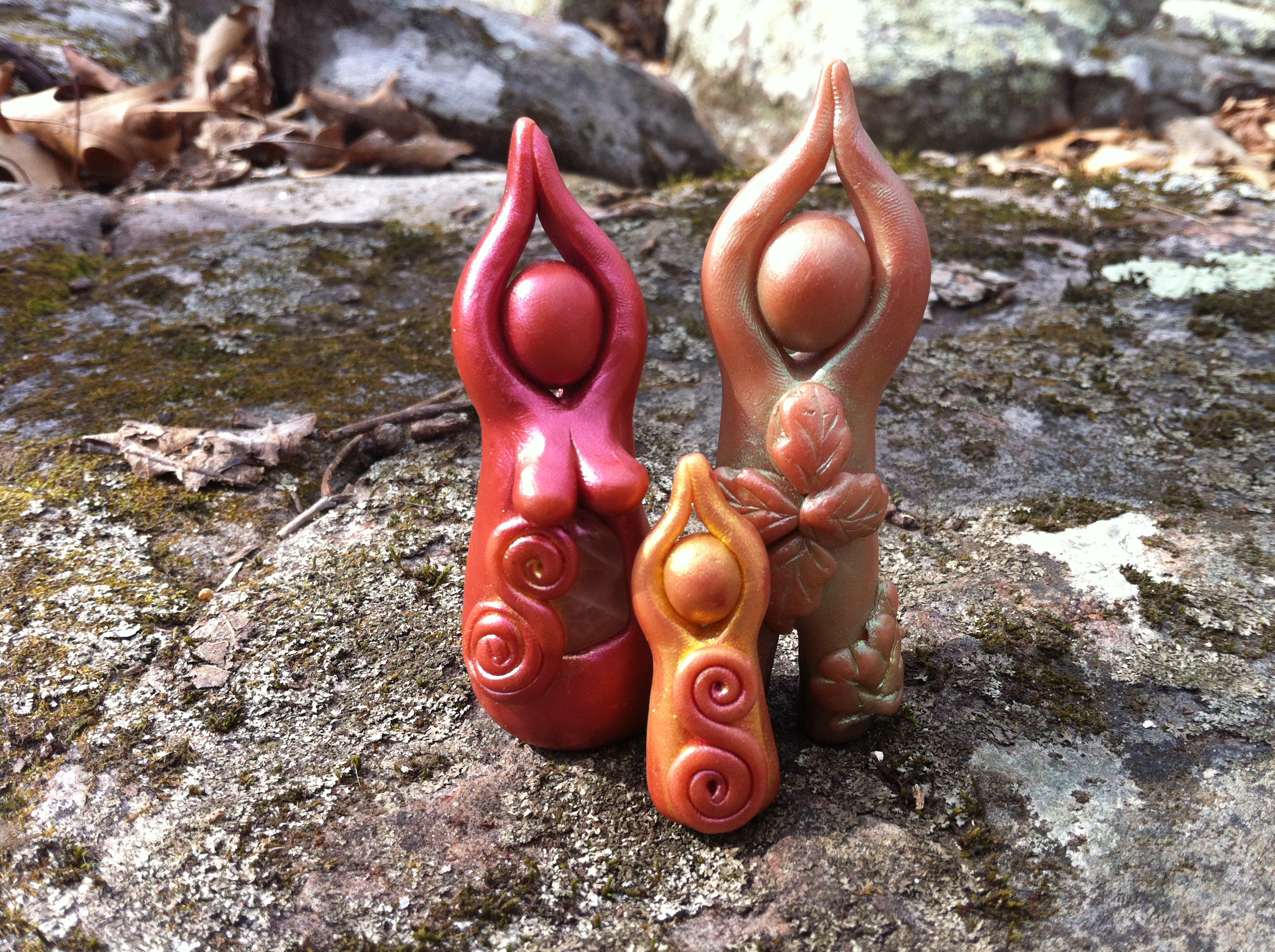
As I’ve shared a photo of previously, at my toddler daughter’s request, I recently made a “Daddy Goddess” sculpture as well to go with my many others—as I was making him, I realized I do have some room for a Green Man type of symbolism after all:

April 2013 004And, as I shared in my Feminism and Religion piece, a couple of months ago my six-year-old son made this sculpture for me…

February 2013 051 “This is the Goddess of Everything,” he told me. “See that pink jewel in her belly, that is the WHOLE UNIVERSE, Mom!!

Yep. He gets it! 🙂

Categories: family, feminist thealogy, Goddess, parenting, spirituality, thealogy, Thursday Thealogy, writing | 4 Comments

Thursday Thealogy: Dreams & Daily Practices

“Form is the language of the universe singing its praises. Its rejoicing is seen everywhere–in the sun through a web of hair, in the flower and its petals, in the subtle folds of a garment, in the human body.” –Dianora Niccolini

A couple of months ago I experienced a really profound dream. I was walking down to the woods and in the sky above the priestess rocks saw a gigantic, beautiful, pulsating, pink, jeweled flower. I was awe-struck and staring at it. It was the most beautiful thing I’d ever seen. I became aware that a golden cord stretched from the center of the flower to the top of my head and I became aware that all people were connected to it by these golden cords as well. Then, in that uniquely expansive character of dreams, I somehow traveled through the center of the flower. On the other side was an immense snake of unimaginable proportion, spiraling around “the cosmic egg.” As I looked at it, I became aware that the snake was actually the whole of the universe and that along its body, in the scales, one could perceive not only each galaxy, but also a point for all times and places that ever were or will be. It is hard to describe in writing, but I still deeply remember by feelings of both awe and comprehension and this expansive awareness of reality. It was a gorgeous, trippy, and meaningful dream. I tried to draw something about it, but couldn’t do it. What I’m left with is that feeling of majesty, magnitude, and incredible connection.

In somewhat of a surprise, after the conclusion of my 31 day writing experiment, I’m very much missing my daily woodspriestess writing. “They” say it takes 30 days (or 21 or 15 or whatever) to create a habit and I created one that was pretty powerful. And, I’m realizing that it wasn’t only about the woodsvisits—I’ve been doing that since January and continue doing it today—it was the synthesis of experience with the written word. The writing itself was a practice too. I mentioned a couple of times that it sometimes felt like a burden, and it did, and I thought I was looking forward to having a “break” from having to write every day, and I do. However, I feel like there is something missing from my trips to the woods now—the writing afterward was an integrative experience or one that provided form, structure, and application of what I learned each day. Without the writing portion, I find I’m much more apt to leave and immediately “forget” what I experienced or learned that day. When I’m no longer thinking about how to shape it into written form, it loses some of its impact. During the experiment I felt bad at several points in going and only looking for things to blog about—it felt like the writing was a distraction to the experience—but, now I see how the link between experience and description provided a spiritual “container” for me, in which I could dig more deeply, look harder, and witness more. Writing offered a type of accountability. So, while I’ve enjoyed having a break from “having” to write on one hand, on the other I really actually feel a sense of loss and sadness about those missed opportunities to write and share and I’ve felt sort of at loose ends each day—like, “what about my blog post?” While I’m not going to force myself into an every day practice for the rest of the year with writing, I would truly like to continue to make it a priority. It is sad to me to notice how those things that nourish my spirit are easy to cut from my schedule when I become too busy, when in reality, they should take even more priority during those rhythms of life.

Today I also thought I might experiment with a new practice—one of drawing a card or a rune or a crone stone each day and perhaps make a daily blogging experience of that. I’m not sure I will, I’m toying with the idea—maybe a good daily pr20130403-161544.jpgoject for May—but I did draw a Crone Stone today and I got the Daydreamer. It seemed very apt, describing fantasizing about things being different—“life can be boring at times–something is missing.” It describes the image as the woman resting against a tree, dreaming of a far away plan, while the tree behind her withers from neglect. It asks the receiver to consider how we can ground the fantasy and bring the vision into reality. As I looked at it, I thought of multiple things. One was simply about my life and family and sacred space being right there in the woods—I’ve got it. The people I love are right here in front of me, waiting for me. Sacred space is right there in the woods, waiting for me. This is it. I also thought about two recent experiences—I was dreaming as I often do of having a Women’s Temple or Goddess Temple and then I looked around my own living room and had the sudden realization, I’ve already got one. And, second, I was feeling disappointed in myself for not planning a springtime ritual and having people over and doing a fabulous ceremony, but then as I laid out the spring time altar for my Rise Up class last week I had a moment of realization, oh, yeah. This IS a springtime ritual. I DID do it (but, it wasn’t for my family, it was for my friends. I’d like to do more things for my family in this capacity).

My first class at Ocean Seminary College was called Ecology and the Sacred and a theme that emerged for me as I worked through the class was of a deep hunger for daily practice. I like looking back and seeing how my current practices evolved from the desire I tried to convey in the “reflection” portions of my assignments. In the first lesson, I wrote:

I have a thealogical view of the world/universe as the body of the Goddess. Everything is interconnected in a great and ever-changing dance of life…all things as intimately connected—not as “all one,” but as all interconnected and relating to one another, in an everpresent ground of relationship and relatedness. I am currently reading the book She Changes: Re-imagining the Divine in the World by Carol Christ and the concepts from the lesson are closely related to the process philosophy she explores and that I am personally connecting to in many ways. As does she, I imagine the divine as omnipresent (rather than omnipotent) and I feel like I can see Goddess/God in the bright black eyes of a newly hatched baby chick and in the curve of my baby’s cheek against my breast. I do not feel like the Goddess is something I believe in, but a reality that I experience in daily life.

In response to my Week 1 assignment, I was asked “when you go about your everyday life activities do you have any rituals that you incorporate into them to vivify your spiritual insight with your day-to-day ecological mindfulness? If not, this may be something worth exploring.” This question stayed in my mind throughout the remaining twelve lessons of the course. In the second lesson, I wrote:

I do feel a powerfully strong urge to bring spiritual mindfulness more fully into my daily life–“practicing the presence of the Goddess” in a more explicitly developed/acknowledged manner–but I have trouble figuring out exactly how I wish to do this. I wear a Goddess ring that serves as a mindfulness touchstone for me (when I remember to look at it!) and I find listening to various spiritual CDs as I go about the mundane activities of my day brings a sense of the sacred into my everyday tasks (like laundry), but I have a hunger in me to do something more

Shortly after, I added to these thoughts:

…when engaged in these outdoor observations, I was struck by how I feel this deep sense of being part of the fabric of life most profoundly, clearly, and cleanly while outside. As Naomi Wolf said, I feel that “We were all held, touched, interrelated, in an invisible net of incarnation…”I might describe this additionally as being held in the hand of the Goddess. However, in practice, I spend much more time inside than outside. There are always so many things “to do.” Work to do, chores to catch up on, things to be done inside the house, that my experience of the natural world and that sense of being held in a net of incarnation is often postponed, in a way for, “later,” once I’m finished with all my work (which, never ends!). And, I realized today, that means my sense of the sacred or of divinity in the world is sometimes also postponed. This isn’t satisfactory! So, I continue to think about—and welcome ideas about—how to incorporate some rituals into my day a way that more meaningfully integrates my spiritual life with my everyday life…

And, about midway through the course, I wrote:

I also continue to reflect on my interest in incorporating more “ritual” into my life that honors or expresses my sense of the divine and I realized that I think I’m really simply seeking to cultivate a state of basic mindfulness in my day. So, not ritual per se, but ongoing awareness and mindful participation in the daily rhythms of life (including mindfulness of my connection within a larger environmental whole).

Thanks to the opportunity to articulate this desire, I started my first truly daily practice, some time at my living room altar:

In the course of my experiences with this class, I’ve started to spend a little time in the morning before my yoga practice in prayer/reflection/communion with my sense of the divine. Since that sense is intimately entwined with nature, I find the best way to do this is to sit looking out my window, watching the play of sunlight and shadow, and talking quietly to myself/to Goddess energy about what I envision for my day. This has been a powerfully grounding and focusing experience and something that I felt was missing in my day, something I was seeking to cultivate and have now been able to do because of the observer/reflection sense that is being honed more clearly through this course.

During week six, I also wrote: I feel emotionally embedded with the land and this daily process of energy exchange.

20130403-161720.jpg

This is NOT a black and white picture, it is actually how the day looked just this Tuesday. I thought: “this looks as gray as I feel right now…”

And, I also thought about this quote by Robert Kennedy Jr. as quoted in the book Last Child in the Woods:

“‘We’re part of nature, and ultimately we’re predatory animals and we have a role in nature…and if we separate ourselves from that, we’re separating ourselves from our history, from the things that tie use together. We don’t want to live in a world where there are not recreational fishermen, where we’ve lost touch with the seasons, the tides, the things that connect us—-to ten thousand generations of human beings that were here before there were laptops and ultimately connect us to God.’ We shouldn’t be worshipping nature as God, he said, but nature is the way that God communicates to us most forcefully. ‘God communicates to us through each other and through organized religion, through wise people and the great books, through music and art,’ but nowhere ‘with such texture and forcefulness in detail and grace and joy, as through creation…And when we destroy large resources, or when we cut off our access by putting railroads along river banks, by polluting so that people can’t fish, or by making so many rules that people can’t get out on the water, it’s the moral equivalent of tearing the last pages out of the last Bible on Earth [emphasis mine]…Our children ought to be out there on the water…This is what connects us, this is what connects humanity, this is what we have in common. It’s not the Internet, it’s the oceans.” (page 198)

During week nine, I also got thealogical about chickens:

I’ve said before that baby chicks are one of the things that make me believe in “the Goddess.” Maybe that sounds silly, but when I sit before a nest and see the bright black eyes and soft down of a new baby chick, where before there was just an egg, I feel like I am truly in the presence of divinity. This, this is Goddess, I think whenever I see one. There is just something about the magic of a new chick that brings the miracle of the sustaining force of life to my attention in a profound way. (New babies of all kinds do it for me, but there is something extra special about chicks!) Of course, when several died, I couldn’t help but feel sad about all of that work and that wasted potential and how that little baby had come so far only to die shortly after hatching, but that, to me, is part of Goddess/Nature/Life Force too. I do not believe in a controlling/power-over deity who can give life or take it away at will or at random. I know that things just happen, that the wheel keeps turning, and that while that force that I name Goddess is ever-present and able to be sensed and felt in the world and in daily life, it/she does not have any kind of ultimate “control” over outcomes.

This was a really, really long way of saying that I want to keep writing regularly about my “woodspriestess” observations as I continue my year-long experiment with visiting the same place in the woods on daily basis. I found something I was seeking in the interplay between visit, spoken word, and written exploration and I think it is something worth continuing.

Here I bear witness to the universe singing its praises…

March 2013 071

Categories: Goddess, nature, spirituality, thealogy, Thursday Thealogy, woodspriestess | 4 Comments

Saturday Sabbath: Song from the Mother

20130325-110510.jpg

(c) Jaine Rose. Reprinted with permission.

Today, we were gone all day at one of our work parties with friends. While I didn’t actually take a full digital sabbatical, it made sense to me to switch my “sabbath” day post/thoughts around and share those today and then share my end-of-the-31-day woodspriestess blogging experience tomorrow. I’ve been saving this gorgeous picture and lovely Mother Song to post (reprinted with permission from the artist) and the time finally has arrived!

I also read these two fabulous quotes:

“Whoever you are
whatever you are
start with that,
whether salt of the earth
or only white sugar.”
–Alice Walker (in Open Mind)

And…

“Let it be clear that when I say Goddess I am not talking about a being somewhere outside of this world, nor am I proposing a new belief system. I’m talking about choosing an attitude; choosing to take this living world, the people and creatures on it, as the ultimate meaning and purpose of life, to see the world, the Earth, and our lives as sacred.” –Starhawk (in Open Mind)

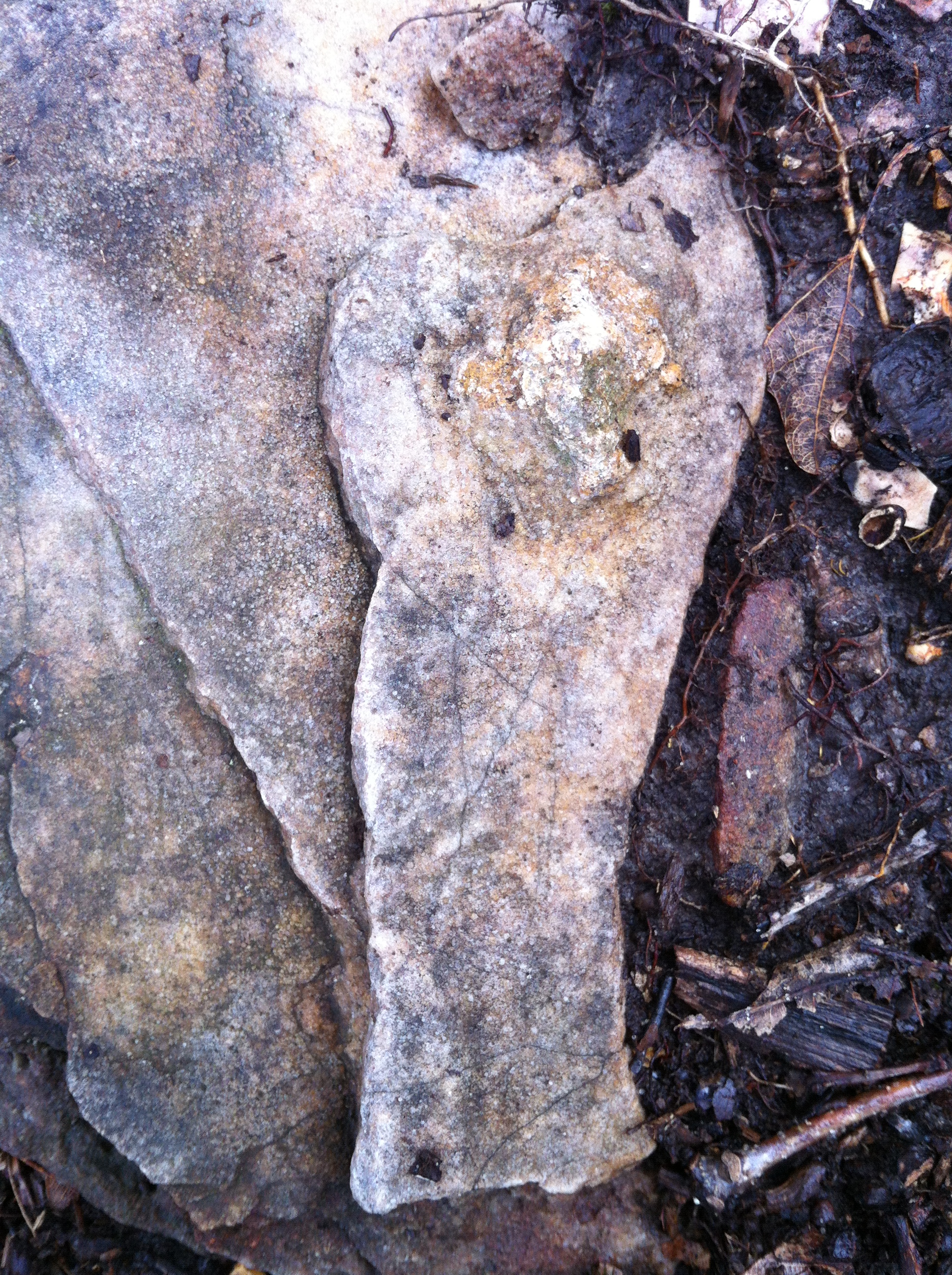
And, on my extremely brief visit to the woods this morning, I took a picture of the rock I think of as the “yoni stone.”

20130330-235441.jpg

Categories: Goddess, nature, quotes, sabbath, woodspriestess | Tags: , , , | 4 Comments

Top Thirteen Most Influential People in Goddess Spirituality

Earlier this month I was very interested to see a series of posts on Raise the Horns about the top 25 most influential people in the birth of paganism. When I read Mankey’s post, it reinforced my own conception of Goddess spirituality as having a distinctly different lineage and flavor than much of contemporary paganism. His list, while extensive, useful, and accurate, involves a distinct lack of Goddess scholars, highlighting to me that Goddess spirituality IS a different movement and isn’t actually just a Goddess-oriented branch of contemporary paganism. Indeed, almost everyone on his list I’d either never heard of, not read, or don’t enjoy their writing. I immediately started to draft a list of my own and came up with 13 women, which seemed delightfully appropriate. We in the Goddess feminist community have our own path, herstory, and lineage, one that really only began in the 1970’s in direct connection to the feminist movement, rather than the pagan movement.

Not necessarily in a particular order, here is my own list of the top thirteen most influential people in the development and articulation of Goddess Spirituality as its own distinct path. (I’ve been scrambling to finish collecting my thoughts in time to post this list while it is still Women’s History Month!) Only one of my own picks also appears on Mankey’s list. December 2012 097

  1. Carol Christ–this feminist scholar is the most skillful and intelligent thealogian of the present day. Christ’s influence on my own ideas and concepts has been profound. Her work is academic, focused, and deep, and she wrestles with heavy questions. I particularly enjoy her books Rebirth of the Goddess and She Who Changes. A brilliant, thoughtful, amazing writer, Christ’s essay Why Women Need the Goddess remains, in my opinion, one of the most important and influential articles of our time.
  2. Merlin Stone–author of the classic When God was a Woman, this professor of art history changed the landscape and understanding of ancient cultures and their relationship to the Goddess (and, yes she drew on the work of Murray and Graves, but moved into feminist thealogy rather than pagan practice).
  3. Riane Eisler—author of The Chalice and the Blade, she made a significant contribution to the understanding of the history and development of patriarchy as well as offering a solution in the form of a partnership model of society.
  4. Marija Gimbutas—scholar and archaeologist and author of several books chronicling Goddess figurines from around the world, including The Language of the Goddess, her work has come under scrutiny and criticism, but remains a potent contribution to the lineage of the Goddess movement.
  5. Starhawkthe first of two on my list who bridge the gap between more “classic” paganism and feminist spirituality, Starhawk had a huge impact on the development of a female-oriented spiritual tradition. Her book The Spiral Dance was the first introduction to the Goddess for many women. In keeping with what I find to be a personal lack of click with a lot of pagan authors, I did not particularly enjoy The Spiral Dance and actually read it much later than most of the other books about feminist spirituality that I reference in this post, but regardless of personal taste, her influence on the Goddess movement is profound.
  6. Z. Budapest—considered by many to be one of the first mothers of the feminist spirituality movement in the U.S., like Starhawk, Z’s writings are not my personal favorite resources because of their heavy Wiccan orientation, but they are undeniably classics in Goddess circles. Z has taken heat from many pagans for her position on transgender people.
  7. Patricia Mongahan–recently departed author of Goddess-specific resource books like The Goddess Path and Wild Girls, Patricia’s writing is more practical and less scholarly/thealogy-oriented than some of my other favorite authors. March 2013 086
  8. Monica Sjoo—radical artist, ecofeminist, and Goddess scholar, Sjoo wrote The Great Cosmic Mother and one of my other favorites, a critique of New Age spiritual paths called New Age Armageddon. Her classic and awesome painting God Giving Birth narrowly avoided ended up in Court on the charge of “obscenity and blasphemy.”
  9. Hallie Iglehart—while less well-known and influential than some of the other women on my list, Hallie was personally very impactful to my own Goddess path, since her books were some of the first, personal and experientially-oriented Goddess-specific books that I read. She is the author of Womanspirit, a synthesis of feminism and religion, and of The Heart of the Goddess, a visually stunning collection of Goddess images and meditations/reflections.
  10. Cynthia Eller—while Eller’s book focused on debunking the “myth of matriarchal prehistory” made her lose popularity among many in the Goddess community (see her clarifying comments here), her scholarly engagement with the complexities of articulating the concepts of feminist spirituality and of thealogy is challenging, illuminating, and offers the opportunity to dig deeply into one’s own perspectives. Her book Living in the Lap of the Goddess is a thorough exploration of women’s spirituality and the Goddess movement.
  11. Charlene Spretnak–another rocking writer with a thorough grasp of the sociopolitical and cultural context, value, and purpose of Goddess spirituality, her classic anthology The Politics of Women’s Spirituality is one of the best and deepest explorations of the concepts, personal experiences, philosophies, and thealogies of why Goddess.
  12. Karen Tatethrough her weekly radio show, Voices of the Sacred Feminine, I would venture to say that Tate is one of the most influential and dedicated “Goddess advocates” of the present day.
  13. Elizabeth Fisher and Shirley Ranck—authors of germinal religious education curriculums focused on feminist spirituality and woman-honoring traditions, originally published by the UU Women and Religion program, their work with Rise Up and Call Her Name andCakes for the Queen of Heaven continues to change the lives of women around the country by introducing them to a vision of what the world could be like if the divine was imaged as female.

Also deserving of mention are:

  • SageWoman Magazine (and her editors)—this specifically Goddess-women oriented publication is a treasure and a delight.
  • Feminism and Religion blog–daring to explore the intersection of religion, scholarship, activism, and community, FAR is not specifically Goddess-oriented, but includes Goddess scholars amongst their contributors and weaves a beautiful, living, organic tapestry of the multifaceted web of feminist spirituality in the present day.

I find that feminist spirituality can be distinguished from paganism because of the inclusion of a core sociopolitical orientation and distinct sociocultural critique. Feminist spirituality to me is the intersection of religion and politics. It is religious feminism. It may or may not include literal experience of or perception of the Goddess, but it names the female and the female body as sacred, worthy, and in need of defense and uses Goddess symbols, metaphors, stories, and experiences as primary expressions of divinity and the sacred.

After originally writing this list, I thought of many more women I should have included and I kept meaning to do a part two follow-up article. I’ve yet to finish that, but this is who I would add…

Six More Influential Women: 1

  1. Shekhinah Mountainwater (pictured at right): tremendous personal influence on my life and work.Original creator of Womanrunes and author of one of my all-time favorite goddess spirituality books, Ariadne’s Thread.
  2. Diane Stein–I particularly enjoy her anthology The Goddess Celebrates and also her book, Casting the Circle.
  3. Vicki Noble–her book Shakti Woman is a powerful and important read.
  4. Barbara Ardinger–if I had to choose a favorite book for ritual resources and goddess spirituality, her book A Woman’s Book of Rituals and Celebrations would be one of those at the top! I also enjoy interacting with her as a sister blogger at Feminism and Religion.
  5. Barbara Walker–author of several goddess-oriented sourcebooks, The Essential Handbook of Women’s Spirituality is another of my favorite resources.
  6. Nancy Vedder-Shults–I first “met” Nancy through hearing her music at a Cakes for the Queen of Heaven training. Her CD, Chants for the Queen of Heaven, was my first-ever purchase of goddess-specific music (I didn’t even know there was such a thing until hearing her songs!). Later, I continued to enjoy her contributions to SageWoman magazine and now through direct interaction on the Feminism and Religion blog.

 Other cool books/honorable mentions:

March 2013 058

Save

Categories: books, feminism, feminist thealogy, Goddess, resources, spirituality, thealogy, womanspirit | 74 Comments

Woodspriestess: Sensory

20130316-165127.jpg

The chair rock has a couple of nice little “shelf” nook on the side of it. I’m always tempted to leave things on it, but I make a habit of not leaving things in or (usually) taking things from the woods. Sometimes I set something on the shelf just during the time that I am out there.

Breathe deep
Breathe peace

Open hands
Open heart
Open mind
Open spirit

This is both my prayer
And my vow

Resting in sheltering stone
Listening to bird song
Feeling the breeze
Seeing the trees against sky
Tasting the very center of life.

A thealogy of embodiment is the subject of my dissertation, so I was very interested to read the Allergic Pagan’s smart and thought-provoking follow-up post to his thoughts about objectivity. He draws the conclusion that it is the body that bridges the gap between the subjective and objective. While I focused on subjective experience and the Goddess in my prior post about objectivity, I actually do find that the Goddess can be interpreted/understood through science as well—some people call it evolution, others call it Goddess and others call it God…subjective experience need not exclude scientific concepts/understanding. As in my breastmilk example from that post, I can understand the experience both objectively and subjectively and, just as John notes, this intersection occurs within the body. I also believe theapoetical language can include both as well. I’m going to explore the question of the place of the God within thealogy in my Thursday Thealogy post next week. I tend to come from the notion that Goddess holds all—and, that Goddess-language is simply a consciously chosen name for unnameable forces of life, the weaving that holds the world, a weaving including but not limited to females and males of all kinds.

Today, rather than standing or sitting on the priestess rocks, I visited the chair rock instead. It is super comfortable and I used to come here to sit after my miscarriages and then during my pregnancy with my daughter and then this is where I brought her one-month-old self to introduce her to the Earth. I used to sit here with her in a pouch or the Ergo and feel our bodies breathing in harmony, chest to chest.

20130316-164909.jpg

20130316-165137.jpg

The scenery looks different when considered from the chair rock rather than the priestess rocks. Here is a “slingshot” tree” and behind the big mother tree that I like so much (and that I keep hoping is still alive!)

As I’ve previously referenced, Gloria Orenstein refers to endarkenment as, “a bonding with the Earth and the invisible that will reestablish our sense of interconnectedness with all things, phenomenal and spiritual, that make up the totality of our life in our cosmos. The ecofeminist arts do not maintain that analytical, rational knowledge is superior to other forms of knowing. They honor Gaia’s Earth intelligence and the stored memories of her plants, rocks, soil, and creatures. Through nonverbal communion with the energies of sacred sites in nature, ecofeminist artists obtain important knowledge about the spirit of the land, which they can then honor through creative rituals and environmental pieces” (Reweaving the World, p. 280). This speaks to me because of my theapoetical experiences of the presence of “the Goddess” in my own sacred spot in the woods behind my house, where I go to the priestess rocks to pray, reflect, meditate, do ritual, think, and converse with the spirits of that place.

Categories: embodiment, endarkenment, family, feminist thealogy, Goddess, nature, pregnancy loss, spirituality, thealogy, theapoetics, womanspirit, woodspriestess | 1 Comment

Thursday Thealogy: Objectivity & Personal Experience

20130314-173059.jpg

Tree Sisters

“What is life? It is the flash of a firefly in the night. It is the breath of a buffalo in the winter time. It is the little shadow which runs across the grass and loses itself in the Sunset.” –Crowfoot in The Earth Speaks

“To go into the dark with a light is to know the light. To know the dark, go dark. Go without sight and find that the dark, too, blooms and sings, and is traveled by dark feet and dark wings.” –Wendell Berry in The Earth Speaks

As I mentioned last week, I wanted to call your attention to a great post at about objectivity at The Allergic Pagan. Among other interesting stuff, John writes:

Take for example the idea that the earth revolves around the sun. We laugh at the thought that anyone would think the sun was revolving around the earth. But, in point of fact, that is our most immediate experience of the world: The sun rises east, moves over our heads, sets in the west, and then rises again in the east. But we say that what is “really” happening is the earth is rotating and revolving around the sun. That explanation is the most mathematically parsimonious, because is most easily accounts for the movement of the earth, the sun, and the other celestial spheres. But is it the most “accurate” one? Accurate to what? Certainly not accurate to our everyday experience…

…Objectivity is a myth. It is a good myth and it functions well for many things. But it is a myth nonetheless….

…For once I would love to hear someone say, “Oh, that’s just objective“, instead of, “Oh, that’s just subjective.” Subjectivity is not less than objectivity. In fact, I think objectivity is a less complete account of the world that the subjective one. We gain a certain power to control our environment when we attempt to bracket our subjectivity; but we also lose something. We lose the reality of our own experience, and we lose the sense of our own participation in that reality….

The Sun Also Riseth: The limits of objectivity (UPDATED) | The Allergic Pagan.

When I applied to Ocean Seminary College, I included the following explanation as part of my letter:

In recent months I have come to the conclusion that I need to follow my intuition as to what feels right to me, rather than to try to find answers in books or articles. What feels right in my heart and in my bones. Goddess feels right to me—authentic in a way that no other spiritual framework ever has. While I do not usually interpret Goddess in a literal sense, I do still feel Her presence in my life—call it an energy, call it the sacred feminine, call it the divine, call it source, call it soul, call it spirit, call it the great mystery…I perceive forces in the world larger than myself and I choose to put a feminine form to that energy—to name it and know it as Goddess. It only seems logical to me that SHE gave birth to the world, to reality—women are the birth givers and they are made in HER image.

I come to Goddess spirituality from a childbirth education and activism background. I am deeply committed to women’s birth rights and to me it has always seemed very logical that ancient peoples would have revered that which created the earth—which gave birth to the earth—the primary life force of the planet, as female. Though it could perhaps be viewed as an unnecessary personification, it just makes plain sense to me to vision the divine as feminine. Side note about personification and tying it to John’s post about objectivity, whenever I type the word I am reminded of a story I read somewhere in which a husband asks a wife, “why must you take everything so personally?” And she responds with something like, “this is my life, how could I not take it personally? It makes sense to relate to the world in a personal way.”)

And, still thinking about the value of subjective experience and the limits of objectivity, as I wrote in an article for Restoration Earth and later republished on my own blog:

How many generations of women have pushed out their babies and fed them at the breast without knowing the exact mechanics of reproduction, let alone milk production. There are all kinds of historical myths and “rules” about breastmilk and breastfeeding and even ten years ago we used to think the inner structure of the breast was completely different from what we think it is like now. Guess what? Our breasts still made milk and we still fed our babies, whether or not we knew exactly how the milk was being produced and delivered. Body knowledge, in this case, definitely still trumped scientific knowledge. I love that feeling when I snuggle down to nurse my own baby—my body is producing milk for her regardless of my conscious knowledge of the patterns or processes. And, guess what, humans cannot improve upon it. The body continues to do what the human mind and hand cannot replicate in a lab. And, has done so for millennia. I couldn’t make this milk myself using my brain and hands and yet day in and day out I do make it for her, using the literal blood and breath of my body, approximately 32 ounces of milk every single day for the last [two years]. That is beautiful.

via Breastfeeding as a Spiritual Practice | Talk Birth.

A couple of months ago, while discussing biology, physics, botany and more with a friend, she commented to the effect of, “Once we know how it works, it isn’t amazing any more.” But, I said, isn’t it? And, do we ever really know how something “really works,” when we constantly are learning new things about the way things “really are”? Can we ever truly boil it down to “just the facts” or is there something invisible, ineffable also there? A creative, interlacing energy in which we are embedded all the time? Back to nursing babies, objectively my body is converting blood into milk to feed my offspring. A biological, hormonally programmed response to having reproduced. That’s hella cool too. But, subjectively, it’s love made flesh, it is embodied motherhood, it is biological synchronicity, it is pure magic. I don’t have to know how it works, I just have to do it. Some of the most important aspects of my life can’t be objectively determined and why should they be able to be? I take it personally.

One of the things that continues to keep me involved with Goddess spirituality is the value of direct experience. As Charlene Spretnak explains, “We would not have been interested in ‘Yahweh with a skirt,’ a distant, detached, domineering godhead who happened to be female. What was cosmologically wholesome and healing was the discovery of the Divine as immanent and around us. What was intriguing was the sacred link between the Goddess in her many guises and totemic animals and plants, sacred groves, and womb like caves, in the moon-rhythm blood of menses, the ecstatic dance–the experience of knowing Gaia, her voluptuous contours and fertile plains, her flowing waters that give life, her animal teachers…” (p. 5)

In Merlin Stone’s essay about the three faces of goddess spirituality she states, “So far, and let us hope in the future as well, feminists concerned with Goddess spirituality have seldom offered absolute or pat answers to theological questions. What has been happening is the experiencing, and at times the reporting, of these personal or group experiences: how it feels to regard the ultimate life force in our own image—as females; how it feels to openly embrace and to share our own contemplations and intuitive knowledge about the role of women on this planet; how it feels to gain a sense of direction, a motivating energy, a strength, a courage—somehow intuited as coming from a cosmic female energy force that fuels and refuels us in our struggle against all human oppression and planetary destruction.” She goes on to articulate a thealogical perspective that holds a lot of truth for me:

“Some say they find this force within themselves; others regard it as external. Some feel it in the ocean, the moon, a tree, the flight of a bird, or in the constant stream of coincidences (or noncoincidences) that occur in our lives. Some find access to it in the lighting of a candle, chanting, meditating—alone or with other women. From what I have so far read, heard, or experienced myself, I think it is safe to say that all women who feel they have experience Goddess spirituality in one way or another also feel that they have gained an inner strength and direction that temporarily or permanently has helped them to deal with life. Most women interested or involved in feminist concepts of spirituality do not regard this spirituality as an end in itself but as a means of gaining and giving strength and understanding that will help us to confront the many tangible and material issues of the blatant inequities of society as we know it today.” (p. 66-67)

This is one of the greatest strengths of spiritual feminism or Goddess traditions—women are capable of defining their own experiences. This means that the Goddess is hard to pin down. She means many different things to different people. I think that fluidity of definition is a powerful attribute that leaves the Goddess path open to many, many women. This fluidity is why it is possible for us to see Jewitches and Goddess Christians and spiritual feminists who connect to the symbol/metaphor, but not a literalist interpretation. The Goddess can hold it all.

When addressing the idea of the Goddess’ ability to elude definitional capture, it is also important to look at the notion of “believing in” the Goddess. Whether or not people “believe” in her might actually be an irrelevant question. I steer away from using the word myself and find I share the tendency of many spiritual feminists to prefer the explanation that they experience the Goddess.

This does not mean the Goddess is fictional, she can be experienced directly, but that she is not believed in in the conventional theological sense. “Most spiritual feminists explain this by saying it is only a question of semantics: everyone experiences goddess, but not everyone chooses to call her that” (p. 140). I identify with this, as I wrote above, having reached a point in my life where I consciously chose to name/label/identify those larger natural powers of the world as “Goddess.”

In Judith Laura’s book, Goddess Matters, she describes Goddess as “she who flows through all” and contrasts this with “God as manipulator.” Goddess is: “She what connects us, not only like a link in a chain but also like an electrical current.”

And, why personalize this or anthropomorphize it anyway? Because society is so very deeply rooted in the lens of patriarchal theology. This doesn’t dissolve because we say, “the Universe” or “the Mystery”—the white bearded old man in the sky remains our collective cultural image of Divinity (as something to which we can be in relation) unless we consciously and deliberately offer, reinforce, and promote other imagery.

As Christ quoted in Edelson remarks, “The real importance of the symbol of Goddess is that it breaks the power of the patriarchal symbol of God as male over the psyche” (p. 313). This is part of what I mean when I say that my interest in Goddess is first political and then later personal/religious. Both have great value to me and I do believe that whether or not someone believes in Goddess as literal or metaphorical, Her importance and value as a symbol within feminism, politics, and culture cannot be overestimated.

In the book Women’s Rituals by Barbara Walker, she makes this point: “Theology, or ‘God-knowledge,’ is a pseudoscience invented by men to define and describe the God whom they simultaneously call indefinable and indescribable. Real science studies objective phenomena. Theology studies a collective male fantasy. Much theological effort goes into hiding the fact that God is not an objective phenomenon but a construct of men’s imaginations, based on their own sense of what they are, what they wish to be, or what they think they ought to be” (p. 135). To this I would add, OR, what they wish to control and what type of social and political structures they wish to justify or wars they wish to engage in. Walker describes theaology thusly, “Thealogy, or ‘Goddess-knowledge,’ may be reinstated, after its long eclipse, as a similar collective image developed by women critical of the ethical shortcomings of patriarchal culture” (p. 135). Walker goes on to says, “Theologians established their God with a pretense of his objective existence. Thealogians need not to resort to such hypocrisy. It is possible to deal with the image of divinity as the collective self-expression that it really is, as a symbol of women’s true knowledge, and as the arbiter of moral instruction represented by humanity’s most ancient mothers” (p. 136).

So what, then, is Goddess? Walker shares the conclusions of a variety of women summarized here:

Goddess is love. Power. Nature. Femaleness. Feminine morality (rooted in care and relationship). Irresistible force. The universe. Creativity that drives me. Oldest power of the universe. Everything from born from her. The earth. The moon. Anger at patriarchal domination and oppression. Sense of what the world needs to relieve suffering. My own sentience. The trinity of Maiden, Mother, Crone. Light and dark. Body-oriented spirituality. Self-worth, liberation from inner shame (“original sin of being born female”). Each person contains her divine spark. “Cauldron-womb, the eternal matrix from which everything comes and to which everything returns…” Loving creativity. Mother. (pp 136-139)

We take her personally.

20130314-173111.jpg

In the woods this morning with my little pal again!

Categories: feminist thealogy, Goddess, spirituality, thealogy, Thursday Thealogy, womanspirit, women, women's circle | 9 Comments

Woodspriestess: Echoes of Mesopotamia

20130311-153821.jpg

Custom sculpture for a Facebook follower 🙂


Echoes of Mesopotamia
small figures from ancient places
ancient times
and ancient faces
ancient words
and ancient wisdom
still flowing in my veins

Clay in my hands
clay in her hands
running on the rivers of time
spiraling in the mysteries of being
spinning in the eddies and ripples of eternity

I have a strong emotional connection to Paleolithic and Neolithic Goddess sculptures. I do not find that I feel as personally connected to Egyptian and Greek and Roman Goddess imagery, but the ancient figures really speak to something powerful within me. I have a sculpture of the Goddess of Willendorf at a central point on my altar. Sometimes I hold her and wonder and muse about who carved the original. I almost feel a thread that reaches out and continues to connect us to that nearly lost past—all the culture and society and how very much we don’t know about early human history. There is such a solid power to these early figures and to me they speak of the numinous, non-personified, Great Goddess.

What were they thinking? Those ancient woman who transformed stone into potent and enduring images of the Goddess. Who crafted with their hands, something that persisted for 5,000, 10,000, 15, 000, 20,000, 30,000 years. Images so compelling that they reach across time, space, and understanding to say hello. Who made them and what was she thinking? Who am I and what am I thinking? Perhaps it is encoded in the layers of our being. Carrying on a legacy. The next link in a chain that spans the centuries and that is beyond the reach of history.

During our last women’s circle meeting we talked about our personal cultural histories and we began work on “sacred bundles” that we will continue to add to throughout the year-long course. I added photos of my ancestors, a fossilized stone shell, (because the Earth itself represents the shared cultural history of us all!), and one of my own Goddess sculptures and I tied the bundle with a Goddess of Willendorf necklace. I surprised myself by bursting into tears when I tried to explain the significance of my items, feeling the swift swirl of time and how those grandmothers in my pictures are now gone, but they were people, just like me. I also shared about the deep connection I feel to the land I live on and how my parents moved here in the 1970’s, so maybe this isn’t really where I “come from,” but that this is where my blood and roots belong. I continued crying as I described how when I sculpt my little figures, I feel like I’m part of an unbroken chain that stretches back at least 35,000 years, from the person who carved the Willendorf Goddess, all the way down to me with my rocks and clay. Later that week, my dad said he needed to talk to me and he shared that in our family history it is really only HIM who “broke the chain” of being “from” this exact patch of the Earth, here in Missouri. He was actually the only member of his side of the family in a long time who wasn’t born here and that, in truth, six generations of my family were born, lived, and died within a 25 mile radius of this very hillside that I find so meaningful. He said that he feels like his blood called him back here and he returned to this land as a young man and raised his own children here because it called so powerfully (I was born one mile from where I now live). So, he said, no wonder you feel like this is your cultural heritage and where you belong. Your lineage is right here, right where you like to be.

When I was taking a Goddess history class at OSC, I wrote the following about the common use of red ochre on Goddess figures:

As I saw the slideshow and reflected on goddess figures I have known and loved, I was suddenly struck by the realization that the walls of my home are, in a sense, colored with red ochre. We live in a straw bale house and the walls are plastered with an earthen plaster that include the red Missouri “clay dirt” that is a feature of the Ozarks region in which I live. The clay is red because of iron oxide, which is what red ochre is defined as. I looked at the Goddess of Willendorf on my altar and at her rich reddish color that exactly matches the shade of the earth on my bedroom walls. No wonder I feel such a deep, personal connection to these ancient figures—quite literally, some part of me identifies Her with home!

Last month when I shared a photo of some of my Goddess sculptures on Facebook, someone left a comment saying simply: Echoes of Mesopotamia. And, I really liked that.

Goddesscraft. 20130311-153757.jpg
Womancraft.
Lifecraft.
Who molds who?
Who sculpts who?
Is it just one beautiful dance
of exuberant co-creation?

Expansive memory,
silent witness,
inner wisdom,
embodied connection
solid space
all twisted together
in an incredible tapestry
of time
culture
power
and life.

Today, in the woods, I carried some of the sculptures I’ve made recently and am getting ready to ship to their new homes and I offered this prayer for them:

In this place of elemental peace 20130311-153846.jpg
with the earth, stone, trees, sky
as my witnesses
I bless, dedicate, and consecrate
these sculptures.

May they go forth
in wisdom
love
grace
and peace

May they bring a message
may they carry with them
the loving intention
with which they were birthed
and may they go forward
to speak to those who need to hear from
to enter the hands and homes of other women
with love, joy, power, and connection

May they recall deep wisdom of deep places
bright kindness
of bright spaces
and may they be just
what another woman needs

20130311-153723.jpg

Categories: art, blessings, Goddess, nature, OSC, prayers, sculpture, spirituality, theapoetics, womanspirit, women's circle, woodspriestess | 6 Comments

Woodspriestess: Saving the World?

Today marks the beginning of a 30 day experiment in daily writings/photos about my sacred space in the woods. I made a New Year’s resolution of sorts to visit the same spot every day for a year and to take at least one photo and to explore through that process my relationship to the environment around me and its seasonal evolution.

First a picture…

March 2013 038
It started snowing again today and one of our cats, Big Mama, followed me down to the priestess rocks. I noticed her delicate little footprints in the snow on top of one of the rocks. Another thing I noticed and have remarked on before to my husband, is how there is a little trail of naturally occurring “stepping stones” that make a path through the woods to the rocks. When we first moved here, one of the things I wrote on my to-do list was, “make a sacred spot in the woods” and I imagined putting stepping stones down to said place. Well, come to find out, no “making” of a sacred space necessary…it was already there…AND, no need to put down my own stepping stones either. They, too, were already there. Metaphor for life? Or, just life.

March 2013 040

The path naturally appears/is uncovered as the stones there keep the light snowfall from sticking to them.

Some posts may be very brief, or photo-only, but I’m actually kicking off my experiment with some heavy thinking today…

I’ve been feeling depressed and discouraged lately after reading some really horrifying articles about incredible, unimaginable violence and brutality against women in Paupa New Guinea who are accused of being witches as well as a book about human trafficking around the world (I wrote about this in a post for Pagan Families last week). Then, I finished listening to David Hillman on Voices of the Sacred Feminine recently, in which he issues a strong call to action to the pagan community and to “witches” in the U.S. to do something about this violence, essentially stating that it is “your fault” and that instead of wasting energy on having rituals to improve one’s love life (for example), modern witches should be taking to the streets and bringing these abusers to justice. And, he asserts, the fact that they don’t, shows that they don’t really “believe”—believe in their own powers or in their own Goddess(es). This brought me back to a conversation I had with a friend before our last women’s circle gathering…does this really matter that we do this or is it a self-indulgence? We concluded that it does matter. That actively creating the kind of woman-affirming world we want to live in is a worthy, and even holy, task. I don’t have time to fully go into it all right now, but I also think the legacy of the sixteenth century “witchcraze” is powerful and the attitudes that drove it are alive and well in the world today. There is a lot of fear still bound up in that word and perhaps that is why people fail to respond to Hillman’s challenge to take to the streets.

I asked the woods today and they responded…

What can I do to save the world?

Saving the world is a Christ complex
an illusion of superiority
a delusion of grandeur.
Or is it?

Is it instead
a description
of what it is like to care?

Be awake
Be sensitive
Be present

Keep reading
Keep reading
Keep reaching
Keep laughing

Raise sons and daughters
who love themselves
and each other
and the earth

Say no to violence
in home
in thought
in act
in deed.

Say no to microaggressions
and to micro-spending decisions that support oppression
Say yes to micro-acts on the side of love
Say yes to not giving up on macro vision
and big picture thinking

Always be willing to dig deep
to think hard
to feel strongly

Rise up
stand tall
say no
be counted
hug often
hold your babies
hold your friends

Circle often
stand together
refuse to give up
when defeated, rally once more.
Persist in a vision of the way things could be
and take action
to bring that vision into reality.

Hug well
laugh often
live much

Speak your truth
tell your story
stand up for the silenced
speak for the voiceless
believe that hope still has a place

Hold steady
hold strong
hold the vision
hold each other.

When I came back inside, I added another Kiva loan to the three I already have going. I chose a women’s cooperative in Pakistan with a craft business. I paid for the loan using my profits from selling my own goddess art. I also signed up to sponsor a woman in the Congo via Woman to Woman International. Maybe this isn’t “enough,” but it is something. I work hard to support women in my own community in a variety of ways.  I write all over the place…maybe that isn’t “real” help, or maybe it is, but I can’t stop doing it.

Categories: feminism, feminist thealogy, Goddess, nature, spirituality, thealogy, women, women's circle, woodspriestess, writing | 4 Comments

Shekhinah Mountainwater

Make for yourself a power spot
Bring you a spoon and a cooking pot
Bring air
Bring fire
Bring water
Bring earth
And you a new universe will birth…

–Shekhinah Mountainwater in The Goddess Celebrates by Diane Stein

It took me a lot of years of interest in Goddess spirituality to eventually discover Shekhinah Mountainwater and when I did, she’d already passed away. I bought her book Ariadne’s Thread on Amazon and fell in love with it. In the book I quote above, Shehkinah describes herself in this way:Book

“…I have taken vows to be a full-time priestess and Goddess-worker. I teach classes, make ceremony, develop calendars and culture, write, play music, create art and poetry. I long for a society where women and men are free to be themselves, to be creative and loving and fulfilled in all their great potential…” (p. 86)

Some writings from Shekhinah are available at this link.

I also completely fell in love with her womanrunes system. I have included scans of them here before:

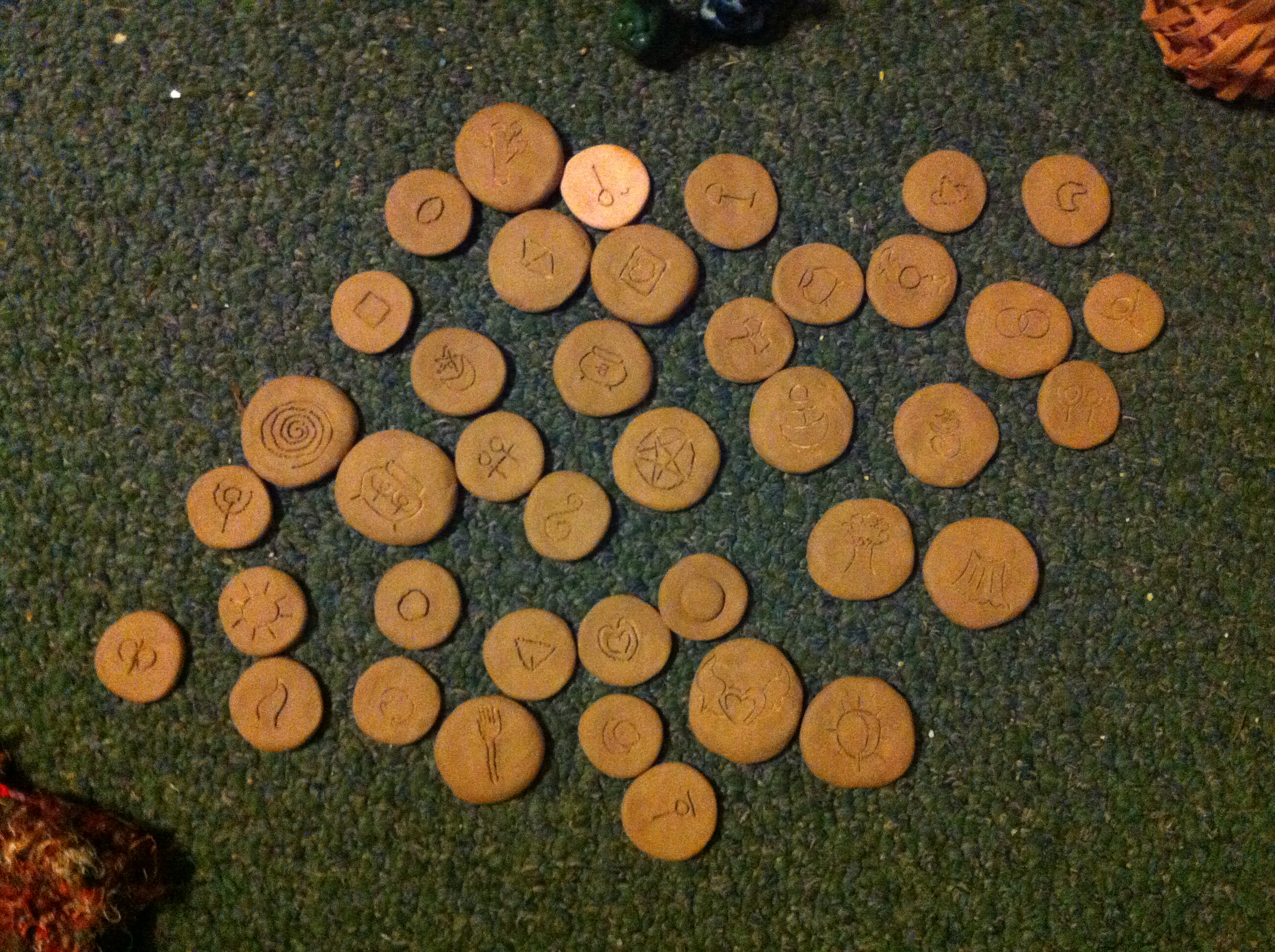
And, after writing my name with them, I then decided to make a goddess priestess sculpture with all the womanrunes on her skirt (each family member also made a little pocket token with our names and special symbols during one of our “family full moon fun” events).

870IMG_2550

I then made a mini-priestess with some significant womanrunes on her skirt to take to the Gaea Goddess Gathering in September. I was going to put her into a medicine bundle there, but I decided not to do that and she still comes out to sit next to my computer while I work sometimes.
December 2012 106

I revisited the womanrunes when I crafted my 2013 full moon calamandala:

20121123-104146.jpg

and then again when my kids and I drew designs for MakIt plates for a Christmas party project.

20121203-100623.jpg

And, finally, during our fall women’s retreat, we each made a full set of clay womanrunes that my mom then fired in her kiln. Here is a picture of my own set after the first firing:
December 2012 100

She offered to re-fire mine while firing some other things and I wanted her to do that since it would make them darker and little smoother.

Just out of the kiln!

Just out of the kiln!

January 2013 184

Womanrunes re-fired (save one that I missed and left in the bag by mistake!)

I’ve been inspired by this to start working on my own personal rune symbol system 🙂

Update: eventually my work with Womanrunes evolved into a real book!

Categories: art, Goddess, ritual, spirituality, womanspirit, women's circle | 37 Comments

Born flaming…

20130115-151044.jpg

A Little Planet
Every particle of every thing
rock, water, flower, human
has been in the same place flaming
in the heart of our ancient sun
before the earth
came flying out of it.
The irises in your eyes
the tissue of roses

the slow giant rocks in mountain hearts

were all born flaming
locked in the sun as it drifted
like a light on dark water.

–Lawrence Collins in The Earth Speaks

And, this:

“The Goddess Herself is not a belief or a dogma, she is a symbol for a transformative understanding of what is already here, what we know, what we can become. She is a real power, the name we give to the binding force that holds together the universe.”

–Starhawk (in The Politics of Women’s Spirituality)

20130115-133240.jpg

Categories: Goddess, nature, quotes, spirituality, theapoetics | Leave a comment

Connecting to the Maiden

This post is part of an assignment for my Triple Goddess class at OSC.

As I consider the Maiden, I realize I feel extremely disconnected from the Maiden in my own life.  I haven’t actually spent much time giving her any thought. I connect deeply to the Mother and am maybe even too embedded in that archetype. I can even look forward to the Crone with some degree of understanding or anticipation. I have women around me in that stage of life and I feel I learn from watching their experiences and hearing their voices and opinions. The Maiden, however, she’s distant past. If the signature event of the Maiden stage is menarche, I do feel as if I’m starting to reclaim menstruation in my life as a “shamanic event” and as an important biological and even spiritual occurrence, rather than as a nuisance. But, the Maiden goes beyond just menarche (or being virgin), she is a feeling too. A freespiritedness. I’ve been serious for a long time. I’ve been on break from teaching during the past month and a couple of weeks ago I was laughing in the kitchen and being totally silly with my family and I said to my husband, “I forgot that I’m really funny.” I think the Maiden reminds me of this!
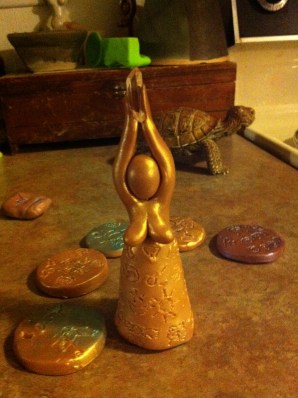
20130106-100029.jpg
I make goddess art in the form of little sculptures of polymer clay. I have only tried to include the Maiden a handful of times in Triple Goddess sculptures and she never turns out quite right. Recently, I branched out into using regular clay for some sculptures and only three from my first batch of seven survived. One of them lost her breasts pre-firing, and when I first looked at the three of them after the glazing firing, I realized I had accidentally created a Maiden Mother Crone triad—the breastless maiden is tall, straight, and unencumbered, the middle sculpture has a slightly rounded belly, full breasts, and open hands indicating receptivity, and the final one is again self-contained… 20130106-101214.jpg

As I considered this lesson, I went down to the woods and asked a question:

What do I need to know about the Maiden?

She is still within you

She is the one who laughs in the night

Who gets punchy and silly

Who runs to the car

She is the one who loves dolls

And creating art

And being hugged

She is that part of you

That wants to wallow in books

To lay on the floor and take a nap

She is the part that still feels like an awkward nine-year-old

The dawning of a time when you wonder what others think of you

She is the one who skips

She is the one who dances in the kitchen

She is the one who eats chocolate chips by the handful

She is you.

1/5/2012

When I came back, I had the realization that what the Maiden is ready to remind me of is to have fun and to play, to remember to bring those things to the fore and not always be working/getting things done/being productive (though, those things are also often fun for me!). I came into the house all ready to type up my thoughts and observations. My little almost-two-year old daughter, however, was getting out candles and setting up a ritual. She spread out a cloth and set up little goddesses and stones and candles and was tugging at me and calling to me to the light the candles. I was kind of shrugging her off and saying, “not now, honey, I need to do something first,” and suddenly I was like oh my goddess, DUH, this IS THE MAIDEN RIGHT HERE IN FRONT OF ME and she has a plan! And, I’d come very, very close to missing it, and also, flat-out missing the whole point of what I was trying to learn from this lesson.So, my husband and I both sat with our daughter on the floor in the little altar space she had created and we all held our lit candles and spent some sacred, Maiden time together:

20130106-100011.jpg

After getting her little ritual space set up. I’m really interested by how she sets it all up and arranges things…

20130106-100016.jpg

20130106-100140.jpg

This picture was taken last month. Earlier in Dec. I participated in an online winter solstice ritual offered by Global Goddess and Alaina was fascinated by lighting the candle and sitting on the floor with me. Ever since then, she keeps wanting to get out candles and lay out little altars on the floor. So, this picture is from one of those times. Look how pleased she is with herself 🙂

Categories: family, Goddess, OSC, ritual, spirituality | 5 Comments

Endarkenment « Feminism and Religion

My third guest post at the Feminism and Religion blog centered around the idea of Endarkenment. Here is an excerpt:

Mandala drawing from last pregnancy

It is from this dark space that we emerge—whether from our own mothers or from the more mysterious cosmic “sea” of soul—and it is to darkness that we return when we close our eyes for the final time…

I find that within Goddess circles the idea of “the dark” remains commonly associated with that which is evil, negative, bad, or unpleasant. The Dark Mother, while acknowledged and accepted, is often at the same time equated with death, destruction, challenge, trials, and obstacles. While I recognize that the concept of a dark, demonic, and destructive mother might too have a place in goddess traditions…I also think this is unnecessarily limiting and that the idea of the “Dark” in general is in need of re-visioning. It is not just with regard to the role or place of death within the wheel of life or the Goddess archetype that Goddess as Dark Mother and destroyer can be honored or recognized, but the Dark as a place of healing and rest can also be explored.
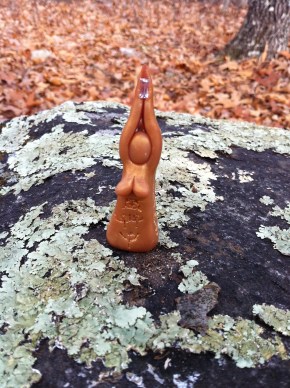
via Endarkenment By Molly Remer « Feminism and Religion.

The post received a lot of comments and some people definitely disagreed with my remark that in “Goddess circles” the dark is associated with that which is negative. I’d love to hear your thoughts as well!

Categories: feminist thealogy, Goddess, spirituality, thealogy, writing | 4 Comments

Our Mother Prayer

New sculptures drying and waiting to be fired!

New sculptures drying and waiting to be fired!

From the Autumn 1999 issue of SageWoman magazine:

Our Lady, Mother of us all,

Goddess is thy name.

Thy will be done,

with harm towards none,

below as it is above.

Give us this day

the ability to see

with compassion, grace and trust

that we might offer

perfect trust and perfect love

to others in your name.

May our hands be thine

to do thy work;

may our voices speak your words.

For Thou art

the beauty, the light and the spirit

as we dance the spiral together.

So be it.

by Candace

Categories: blessings, Goddess, liturgy, prayers, readings, ritual, spirituality | Leave a comment

Create a free website or blog at WordPress.com.