womanspirit

Thursday Thealogy: Objectivity & Personal Experience

20130314-173059.jpg

Tree Sisters

“What is life? It is the flash of a firefly in the night. It is the breath of a buffalo in the winter time. It is the little shadow which runs across the grass and loses itself in the Sunset.” –Crowfoot in The Earth Speaks

“To go into the dark with a light is to know the light. To know the dark, go dark. Go without sight and find that the dark, too, blooms and sings, and is traveled by dark feet and dark wings.” –Wendell Berry in The Earth Speaks

As I mentioned last week, I wanted to call your attention to a great post at about objectivity at The Allergic Pagan. Among other interesting stuff, John writes:

Take for example the idea that the earth revolves around the sun. We laugh at the thought that anyone would think the sun was revolving around the earth. But, in point of fact, that is our most immediate experience of the world: The sun rises east, moves over our heads, sets in the west, and then rises again in the east. But we say that what is “really” happening is the earth is rotating and revolving around the sun. That explanation is the most mathematically parsimonious, because is most easily accounts for the movement of the earth, the sun, and the other celestial spheres. But is it the most “accurate” one? Accurate to what? Certainly not accurate to our everyday experience…

…Objectivity is a myth. It is a good myth and it functions well for many things. But it is a myth nonetheless….

…For once I would love to hear someone say, “Oh, that’s just objective“, instead of, “Oh, that’s just subjective.” Subjectivity is not less than objectivity. In fact, I think objectivity is a less complete account of the world that the subjective one. We gain a certain power to control our environment when we attempt to bracket our subjectivity; but we also lose something. We lose the reality of our own experience, and we lose the sense of our own participation in that reality….

The Sun Also Riseth: The limits of objectivity (UPDATED) | The Allergic Pagan.

When I applied to Ocean Seminary College, I included the following explanation as part of my letter:

In recent months I have come to the conclusion that I need to follow my intuition as to what feels right to me, rather than to try to find answers in books or articles. What feels right in my heart and in my bones. Goddess feels right to me—authentic in a way that no other spiritual framework ever has. While I do not usually interpret Goddess in a literal sense, I do still feel Her presence in my life—call it an energy, call it the sacred feminine, call it the divine, call it source, call it soul, call it spirit, call it the great mystery…I perceive forces in the world larger than myself and I choose to put a feminine form to that energy—to name it and know it as Goddess. It only seems logical to me that SHE gave birth to the world, to reality—women are the birth givers and they are made in HER image.

I come to Goddess spirituality from a childbirth education and activism background. I am deeply committed to women’s birth rights and to me it has always seemed very logical that ancient peoples would have revered that which created the earth—which gave birth to the earth—the primary life force of the planet, as female. Though it could perhaps be viewed as an unnecessary personification, it just makes plain sense to me to vision the divine as feminine. Side note about personification and tying it to John’s post about objectivity, whenever I type the word I am reminded of a story I read somewhere in which a husband asks a wife, “why must you take everything so personally?” And she responds with something like, “this is my life, how could I not take it personally? It makes sense to relate to the world in a personal way.”)

And, still thinking about the value of subjective experience and the limits of objectivity, as I wrote in an article for Restoration Earth and later republished on my own blog:

How many generations of women have pushed out their babies and fed them at the breast without knowing the exact mechanics of reproduction, let alone milk production. There are all kinds of historical myths and “rules” about breastmilk and breastfeeding and even ten years ago we used to think the inner structure of the breast was completely different from what we think it is like now. Guess what? Our breasts still made milk and we still fed our babies, whether or not we knew exactly how the milk was being produced and delivered. Body knowledge, in this case, definitely still trumped scientific knowledge. I love that feeling when I snuggle down to nurse my own baby—my body is producing milk for her regardless of my conscious knowledge of the patterns or processes. And, guess what, humans cannot improve upon it. The body continues to do what the human mind and hand cannot replicate in a lab. And, has done so for millennia. I couldn’t make this milk myself using my brain and hands and yet day in and day out I do make it for her, using the literal blood and breath of my body, approximately 32 ounces of milk every single day for the last [two years]. That is beautiful.

via Breastfeeding as a Spiritual Practice | Talk Birth.

A couple of months ago, while discussing biology, physics, botany and more with a friend, she commented to the effect of, “Once we know how it works, it isn’t amazing any more.” But, I said, isn’t it? And, do we ever really know how something “really works,” when we constantly are learning new things about the way things “really are”? Can we ever truly boil it down to “just the facts” or is there something invisible, ineffable also there? A creative, interlacing energy in which we are embedded all the time? Back to nursing babies, objectively my body is converting blood into milk to feed my offspring. A biological, hormonally programmed response to having reproduced. That’s hella cool too. But, subjectively, it’s love made flesh, it is embodied motherhood, it is biological synchronicity, it is pure magic. I don’t have to know how it works, I just have to do it. Some of the most important aspects of my life can’t be objectively determined and why should they be able to be? I take it personally.

One of the things that continues to keep me involved with Goddess spirituality is the value of direct experience. As Charlene Spretnak explains, “We would not have been interested in ‘Yahweh with a skirt,’ a distant, detached, domineering godhead who happened to be female. What was cosmologically wholesome and healing was the discovery of the Divine as immanent and around us. What was intriguing was the sacred link between the Goddess in her many guises and totemic animals and plants, sacred groves, and womb like caves, in the moon-rhythm blood of menses, the ecstatic dance–the experience of knowing Gaia, her voluptuous contours and fertile plains, her flowing waters that give life, her animal teachers…” (p. 5)

In Merlin Stone’s essay about the three faces of goddess spirituality she states, “So far, and let us hope in the future as well, feminists concerned with Goddess spirituality have seldom offered absolute or pat answers to theological questions. What has been happening is the experiencing, and at times the reporting, of these personal or group experiences: how it feels to regard the ultimate life force in our own image—as females; how it feels to openly embrace and to share our own contemplations and intuitive knowledge about the role of women on this planet; how it feels to gain a sense of direction, a motivating energy, a strength, a courage—somehow intuited as coming from a cosmic female energy force that fuels and refuels us in our struggle against all human oppression and planetary destruction.” She goes on to articulate a thealogical perspective that holds a lot of truth for me:

“Some say they find this force within themselves; others regard it as external. Some feel it in the ocean, the moon, a tree, the flight of a bird, or in the constant stream of coincidences (or noncoincidences) that occur in our lives. Some find access to it in the lighting of a candle, chanting, meditating—alone or with other women. From what I have so far read, heard, or experienced myself, I think it is safe to say that all women who feel they have experience Goddess spirituality in one way or another also feel that they have gained an inner strength and direction that temporarily or permanently has helped them to deal with life. Most women interested or involved in feminist concepts of spirituality do not regard this spirituality as an end in itself but as a means of gaining and giving strength and understanding that will help us to confront the many tangible and material issues of the blatant inequities of society as we know it today.” (p. 66-67)

This is one of the greatest strengths of spiritual feminism or Goddess traditions—women are capable of defining their own experiences. This means that the Goddess is hard to pin down. She means many different things to different people. I think that fluidity of definition is a powerful attribute that leaves the Goddess path open to many, many women. This fluidity is why it is possible for us to see Jewitches and Goddess Christians and spiritual feminists who connect to the symbol/metaphor, but not a literalist interpretation. The Goddess can hold it all.

When addressing the idea of the Goddess’ ability to elude definitional capture, it is also important to look at the notion of “believing in” the Goddess. Whether or not people “believe” in her might actually be an irrelevant question. I steer away from using the word myself and find I share the tendency of many spiritual feminists to prefer the explanation that they experience the Goddess.

This does not mean the Goddess is fictional, she can be experienced directly, but that she is not believed in in the conventional theological sense. “Most spiritual feminists explain this by saying it is only a question of semantics: everyone experiences goddess, but not everyone chooses to call her that” (p. 140). I identify with this, as I wrote above, having reached a point in my life where I consciously chose to name/label/identify those larger natural powers of the world as “Goddess.”

In Judith Laura’s book, Goddess Matters, she describes Goddess as “she who flows through all” and contrasts this with “God as manipulator.” Goddess is: “She what connects us, not only like a link in a chain but also like an electrical current.”

And, why personalize this or anthropomorphize it anyway? Because society is so very deeply rooted in the lens of patriarchal theology. This doesn’t dissolve because we say, “the Universe” or “the Mystery”—the white bearded old man in the sky remains our collective cultural image of Divinity (as something to which we can be in relation) unless we consciously and deliberately offer, reinforce, and promote other imagery.

As Christ quoted in Edelson remarks, “The real importance of the symbol of Goddess is that it breaks the power of the patriarchal symbol of God as male over the psyche” (p. 313). This is part of what I mean when I say that my interest in Goddess is first political and then later personal/religious. Both have great value to me and I do believe that whether or not someone believes in Goddess as literal or metaphorical, Her importance and value as a symbol within feminism, politics, and culture cannot be overestimated.

In the book Women’s Rituals by Barbara Walker, she makes this point: “Theology, or ‘God-knowledge,’ is a pseudoscience invented by men to define and describe the God whom they simultaneously call indefinable and indescribable. Real science studies objective phenomena. Theology studies a collective male fantasy. Much theological effort goes into hiding the fact that God is not an objective phenomenon but a construct of men’s imaginations, based on their own sense of what they are, what they wish to be, or what they think they ought to be” (p. 135). To this I would add, OR, what they wish to control and what type of social and political structures they wish to justify or wars they wish to engage in. Walker describes theaology thusly, “Thealogy, or ‘Goddess-knowledge,’ may be reinstated, after its long eclipse, as a similar collective image developed by women critical of the ethical shortcomings of patriarchal culture” (p. 135). Walker goes on to says, “Theologians established their God with a pretense of his objective existence. Thealogians need not to resort to such hypocrisy. It is possible to deal with the image of divinity as the collective self-expression that it really is, as a symbol of women’s true knowledge, and as the arbiter of moral instruction represented by humanity’s most ancient mothers” (p. 136).

So what, then, is Goddess? Walker shares the conclusions of a variety of women summarized here:

Goddess is love. Power. Nature. Femaleness. Feminine morality (rooted in care and relationship). Irresistible force. The universe. Creativity that drives me. Oldest power of the universe. Everything from born from her. The earth. The moon. Anger at patriarchal domination and oppression. Sense of what the world needs to relieve suffering. My own sentience. The trinity of Maiden, Mother, Crone. Light and dark. Body-oriented spirituality. Self-worth, liberation from inner shame (“original sin of being born female”). Each person contains her divine spark. “Cauldron-womb, the eternal matrix from which everything comes and to which everything returns…” Loving creativity. Mother. (pp 136-139)

We take her personally.
20130314-173111.jpg

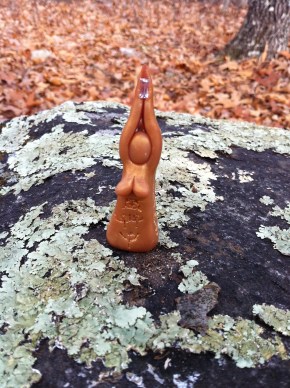
In the woods this morning with my little pal again!

Categories: feminist thealogy, Goddess, spirituality, thealogy, Thursday Thealogy, womanspirit, women, women's circle | 9 Comments

Woodspriestess: Echoes of Mesopotamia

20130311-153821.jpg

Custom sculpture for a Facebook follower 🙂


Echoes of Mesopotamia
small figures from ancient places
ancient times
and ancient faces
ancient words
and ancient wisdom
still flowing in my veins

Clay in my hands
clay in her hands
running on the rivers of time
spiraling in the mysteries of being
spinning in the eddies and ripples of eternity

I have a strong emotional connection to Paleolithic and Neolithic Goddess sculptures. I do not find that I feel as personally connected to Egyptian and Greek and Roman Goddess imagery, but the ancient figures really speak to something powerful within me. I have a sculpture of the Goddess of Willendorf at a central point on my altar. Sometimes I hold her and wonder and muse about who carved the original. I almost feel a thread that reaches out and continues to connect us to that nearly lost past—all the culture and society and how very much we don’t know about early human history. There is such a solid power to these early figures and to me they speak of the numinous, non-personified, Great Goddess.

What were they thinking? Those ancient woman who transformed stone into potent and enduring images of the Goddess. Who crafted with their hands, something that persisted for 5,000, 10,000, 15, 000, 20,000, 30,000 years. Images so compelling that they reach across time, space, and understanding to say hello. Who made them and what was she thinking? Who am I and what am I thinking? Perhaps it is encoded in the layers of our being. Carrying on a legacy. The next link in a chain that spans the centuries and that is beyond the reach of history.

During our last women’s circle meeting we talked about our personal cultural histories and we began work on “sacred bundles” that we will continue to add to throughout the year-long course. I added photos of my ancestors, a fossilized stone shell, (because the Earth itself represents the shared cultural history of us all!), and one of my own Goddess sculptures and I tied the bundle with a Goddess of Willendorf necklace. I surprised myself by bursting into tears when I tried to explain the significance of my items, feeling the swift swirl of time and how those grandmothers in my pictures are now gone, but they were people, just like me. I also shared about the deep connection I feel to the land I live on and how my parents moved here in the 1970’s, so maybe this isn’t really where I “come from,” but that this is where my blood and roots belong. I continued crying as I described how when I sculpt my little figures, I feel like I’m part of an unbroken chain that stretches back at least 35,000 years, from the person who carved the Willendorf Goddess, all the way down to me with my rocks and clay. Later that week, my dad said he needed to talk to me and he shared that in our family history it is really only HIM who “broke the chain” of being “from” this exact patch of the Earth, here in Missouri. He was actually the only member of his side of the family in a long time who wasn’t born here and that, in truth, six generations of my family were born, lived, and died within a 25 mile radius of this very hillside that I find so meaningful. He said that he feels like his blood called him back here and he returned to this land as a young man and raised his own children here because it called so powerfully (I was born one mile from where I now live). So, he said, no wonder you feel like this is your cultural heritage and where you belong. Your lineage is right here, right where you like to be.

When I was taking a Goddess history class at OSC, I wrote the following about the common use of red ochre on Goddess figures:

As I saw the slideshow and reflected on goddess figures I have known and loved, I was suddenly struck by the realization that the walls of my home are, in a sense, colored with red ochre. We live in a straw bale house and the walls are plastered with an earthen plaster that include the red Missouri “clay dirt” that is a feature of the Ozarks region in which I live. The clay is red because of iron oxide, which is what red ochre is defined as. I looked at the Goddess of Willendorf on my altar and at her rich reddish color that exactly matches the shade of the earth on my bedroom walls. No wonder I feel such a deep, personal connection to these ancient figures—quite literally, some part of me identifies Her with home!

Last month when I shared a photo of some of my Goddess sculptures on Facebook, someone left a comment saying simply: Echoes of Mesopotamia. And, I really liked that.

Goddesscraft. 20130311-153757.jpg
Womancraft.
Lifecraft.
Who molds who?
Who sculpts who?
Is it just one beautiful dance
of exuberant co-creation?

Expansive memory,
silent witness,
inner wisdom,
embodied connection
solid space
all twisted together
in an incredible tapestry
of time
culture
power
and life.

Today, in the woods, I carried some of the sculptures I’ve made recently and am getting ready to ship to their new homes and I offered this prayer for them:

In this place of elemental peace 20130311-153846.jpg
with the earth, stone, trees, sky
as my witnesses
I bless, dedicate, and consecrate
these sculptures.

May they go forth
in wisdom
love
grace
and peace

May they bring a message
may they carry with them
the loving intention
with which they were birthed
and may they go forward
to speak to those who need to hear from
to enter the hands and homes of other women
with love, joy, power, and connection

May they recall deep wisdom of deep places
bright kindness
of bright spaces
and may they be just
what another woman needs

20130311-153723.jpg

Categories: art, blessings, Goddess, nature, OSC, prayers, sculpture, spirituality, theapoetics, womanspirit, women's circle, woodspriestess | 6 Comments

Prayer

February 2013 148

New custom goddess sculptures

Stars give her strength
Sun turn her eyes
Moon guide her feet
Earth turning hold her
We pray for her
We sing for her
We drum for her
We pray.

Chrystos (in Open Mind)

Categories: blessings, poems, prayers, quotes, readings, ritual, spirituality, womanspirit, women, women's circle | Leave a comment

I keep vigil…

This post is cross-posted at Pagan Families.

One of the first Pagan bloggers I ever followed online is Teo Bishop, a solitary Druid and prolific writer. Recently, Bishop wrote about creating community poetry for use in liturgy based on the starting line, “I keep vigil to the fire in my heart” (see current contributions from other writers via this post: We Keep Vigil: Crowdsourced Poetry). Bishop started this experiment last year during Imbolc, when he composed a spontaneous poem to Brigid. As someone who frequently experiences spontaneous poetry in the sacred spot in the woods behind my house, an experience I refer to as theapoetics, I was instantly captivated by this whole keeping vigil thing. Imbolc has a natural connection to the cycle of pregnancy, birth, and breastfeeding and the fire in my own heart burns brightly for these pivotal life experiences. So, I went down to the woods, opened my mouth and this is what emerged…

I keep vigil
to the fire
in my heart.

I keep vigil
to the women
of the world

women’s voices
women’s stories
women’s lives

I keep vigil for the birthing women of the planet
whether she gives birth
at 5 weeks, 12 weeks,
15 weeks, 20 weeks
or 42 weeks

I keep vigil for the mothers
who cry over tiny bodies
of their babies
I keep vigil to
the bright hot spirit
of the newborn babies
that greet the world
with eyes wide open

I keep vigil for the woman
who cries in the night
I keep vigil for the woman
who births with joy and exultation
I keep vigil for the woman
who struggles and suffers in birth

I keep vigil to the midwives
and the women who serve each other
midwife means loves women

I keep vigil to
the breastfeeding women
of the world
and I keep vigil to the mother
whose heart was broken
in trying to nurse her baby

I keep vigil for the mothers who laugh
and the mothers who cry
the mothers who sing
and the mothers who moan
the mothers who need
and the mother give
the mothers who triumph
and the mothers who “fail”

I keep vigil for the mothers
who try again

I keep vigil for the mothers
who want more children
and who cannot have them
and I keep vigil for the mothers
who have more children
than they truly want

I keep vigil for the women
who pull their sweet, warm, slippery babies
up to grateful hearts and breasts following birth
and I keep vigil for the women
who let tiny bodies slip through their own
never to take a breath of life

I keep vigil for the women
snuggling nose to nose with their children
hugging
laughing
braiding hair
playing
reading
dancing
cooking
and I keep vigil
to the mothers driving,
transporting,
shuttling,
attending lessons,
taking movies and pictures
losing sleep at night

I keep vigil
for the mothers of the world
I keep vigil
for the women of the world

I keep vigil
to the fire
in my heart.

1/28/2013

What comes to your mind when you think about keeping vigil? This Imbolc, what fire in your heart are you tending? What burns brightly in your spirit? To what are you keeping vigil?

Categories: liturgy, nature, poems, prayers, spirituality, theapoetics, womanspirit, women, writing | Leave a comment

Breathe peace

January 2013 028Open your heart to the world
open your hands to your sisters
open your life to your children
open your spirit to the Goddess

spread your arms
open your chest
lift your face to the sky

breathe deep
breathe peace

Each year, during the first week of February, I take a “computer-off retreat” (within the parameters of having a job that requires being online). That time is now and I’m so looking forward to a digital rest. I also treated myself to a Breathe Peace online class (ah, the irony, since I’m having a computer off retreat! Luckily, the online class lasts throughout the month of February, so I can take my break and still come back to it!) I also have a new book called The Magickal Retreat: Making Time for Solitude, Intention & Rejuvenation and I’m toying with the idea of doing an outdoor, all night “vigil” of sorts (maybe as a family).
(Amazon affiliate link included)

Categories: nature, poems, retreat, womanspirit | Leave a comment

Body Blessing to and from the Mother

20130116-165127.jpg

Feet planted solidly on Mother Earth
Drawing up
Solid
Gaia energy
Rich life
Pulsing planet
Power of being

Shoulders back
Chest open
I breathe in the Breath of Life
Wind
Air
Oxygen
Swirling
Flowing
Breathing me

Spreading my arms
Hands open
I feel the pulse of my heart
Blood flowing
Life giving
Throughout my body
The blood of my womb
Matching the tides of the ocean
And the pull of the moon
Linked in watery wonder

Breathing deep
and clearing my mind
I feel the spark of life within
Fiery
Molten
Passion blooming
Vibrantly alive
And dancing
Twisting through my spirit
With energetic ecstasy

Breathe in
Breathe out
Draw it up
Draw it in

Resting now,
In the hand of Mother Goddess
Breathing with her
Standing with her
Resting with her
Knowing her
Deeply

Blessed be.

I composed the above as my first post as a regular contributor to the Pagan Families blog on Patheos!

Alternate:

This month I was also planning our winter women’s retreat and I decided to modify the blessing somewhat to use as our opening invocation. This was the first time I’d used something that I written entirely on my own and it felt vulnerable—I had to ask, “how was that? Was that okay? Did that work?” 😉

The purpose of the invocation is to ground us in our bodies, while also connecting us to the larger swirl of energies that surround us—as I composed it, I envisioned sort of a circle, in which we are embedded and moving within. I feel as if this invocation itself creates a circle and brings the immanent and transcendent together into shared space, as it both invokes the elements and awakens your body.

In this version, the words included in parentheses are optional replacements or additions, according to your specific group’s needs.

January 2013 051

Little herbal goddess doll we made during the retreat also.

Feet planted solidly on Mother Earth
Drawing up
Solid
Gaia energy
Rich life
Pulsing planet
Power of being

Shoulders back
Chest open
Breathe in the Breath of Life
Wind
Air
Oxygen
Swirling
Flowing
Breathing you

Spreading your arms
Hands open
Feel the pulse of your heart
Blood flowing
Life giving
Throughout your body
The blood of your womb (veins)
Matching the tides of the ocean
And the pull of the moon
Linked in watery wonder

Breathing deep
and clearing your mind
Feel the spark of life within
Fiery
Molten
Passion blooming
Vibrantly alive
And dancing
Twisting through your spirit
With energetic ecstasy

Breathe in
Breathe out
Draw it up
Draw it in

Resting now,
on the Earth
And in this circle (of women)
(In the hand of the Goddess)

Breathing with her
Standing with her
Knowing her
Deeply

Blessed be.

Categories: blessings, friends, invocations, poems, prayers, priestess, readings, ritual, spirituality, theapoetics, womanspirit, women, women's circle, writing | 1 Comment

Shekhinah Mountainwater

Make for yourself a power spot
Bring you a spoon and a cooking pot
Bring air
Bring fire
Bring water
Bring earth
And you a new universe will birth…

–Shekhinah Mountainwater in The Goddess Celebrates by Diane Stein

It took me a lot of years of interest in Goddess spirituality to eventually discover Shekhinah Mountainwater and when I did, she’d already passed away. I bought her book Ariadne’s Thread on Amazon and fell in love with it. In the book I quote above, Shehkinah describes herself in this way:Book

“…I have taken vows to be a full-time priestess and Goddess-worker. I teach classes, make ceremony, develop calendars and culture, write, play music, create art and poetry. I long for a society where women and men are free to be themselves, to be creative and loving and fulfilled in all their great potential…” (p. 86)

Some writings from Shekhinah are available at this link.

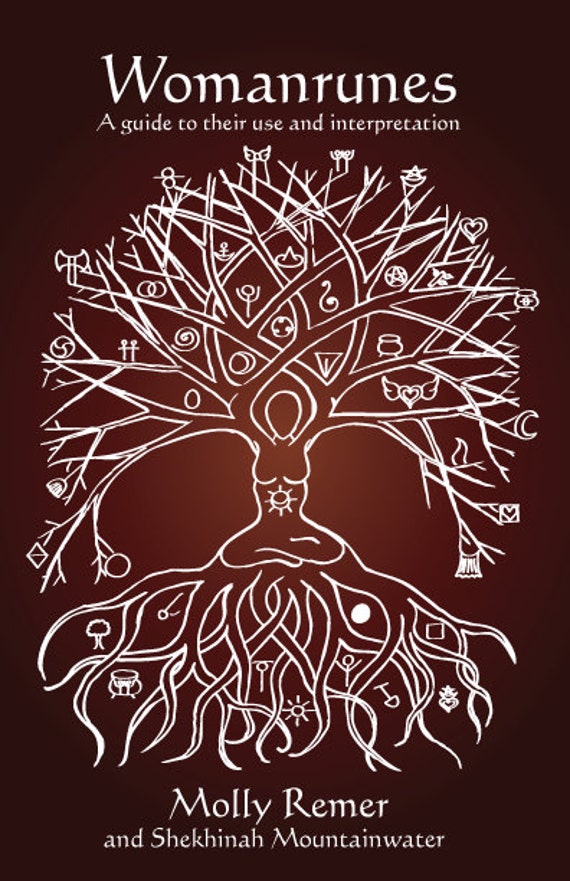
I also completely fell in love with her womanrunes system. I have included scans of them here before:

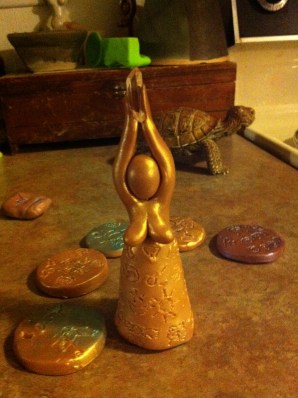
And, after writing my name with them, I then decided to make a goddess priestess sculpture with all the womanrunes on her skirt (each family member also made a little pocket token with our names and special symbols during one of our “family full moon fun” events).

870IMG_2550

I then made a mini-priestess with some significant womanrunes on her skirt to take to the Gaea Goddess Gathering in September. I was going to put her into a medicine bundle there, but I decided not to do that and she still comes out to sit next to my computer while I work sometimes.
December 2012 106

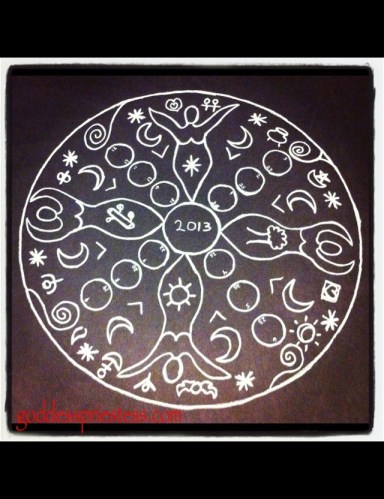
I revisited the womanrunes when I crafted my 2013 full moon calamandala:

20121123-104146.jpg

and then again when my kids and I drew designs for MakIt plates for a Christmas party project.

20121203-100623.jpg

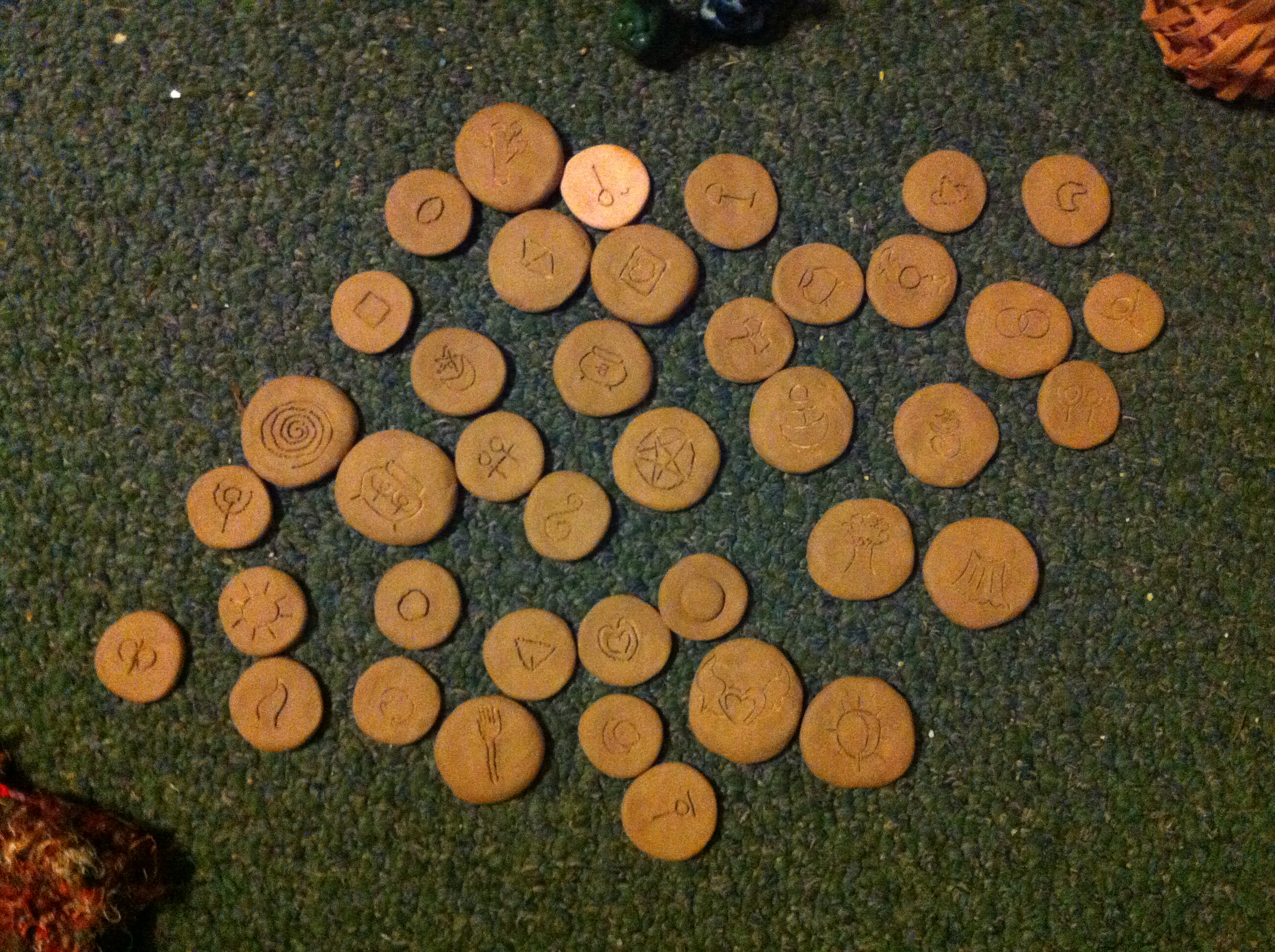
And, finally, during our fall women’s retreat, we each made a full set of clay womanrunes that my mom then fired in her kiln. Here is a picture of my own set after the first firing:
December 2012 100

She offered to re-fire mine while firing some other things and I wanted her to do that since it would make them darker and little smoother.

Just out of the kiln!

Just out of the kiln!

January 2013 184

Womanrunes re-fired (save one that I missed and left in the bag by mistake!)

I’ve been inspired by this to start working on my own personal rune symbol system 🙂

Update: eventually my work with Womanrunes evolved into a real book!

Categories: art, Goddess, ritual, spirituality, womanspirit, women's circle | 37 Comments

Gaia’s Heartbeat

20130116-165909.jpg
Spirit of the solid earth
I draw you up
through my feet
into my legs
pelvis
torso
arms
hands
heart
throat

Gaia’s heartbeat
fills me
the rhythm of the tide
tugs at my womb
the breath of life
breathes through my lungs
the iron of the stars
runs through my veins
and the fire of life
pulses at my core

I draw it up
draw it in
breathe it out
breathe it in

I am it
and it is me
She pulses through every fiber of my being.

1/15/2013

Categories: blessings, nature, poems, prayers, thealogy, theapoetics, womanspirit, writing | Leave a comment

New Moon Ritual

This is part of an assignment for a class in Ritual and Liturgy at OSC.

Sept 2012 3 050The altar is laid outdoors in sight of the new moon. It contains one candle for each direction as well as a central candle. Symbols are present for each direction as well: a stone and a glass globe for Earth, a feather for air, a bowl and a shell for water, a chalice for fire. Also on the altar is a Goddess of Willendorf and a handmade “Moontime” Goddess sculpture. The altar cloth is a deep green. There is also a candle for each participant.

Participants circle up and place hands on each other’s backs and do a group hum of, “Om” and then toning with a bell.

Using the bell, each person names themselves and is called into the ritual circle (name repeated three times and then bell chimes)

The invocation chosen acknowledges the power of the various phases of the moon as the candles are lit in the appropriate directions (modified by a sun invocation by Luisah Teish in Jump Up):

East: In the East we call upon the power of the New Moon, the bright sliver of renewal. Here we ask for new beginnings and we commit to renewing ourselves.

South: In the South, we call upon the power of the Full Moon, the steady, energetic light that illuminates the world. Here we ask for strength to be with us, and we commit to using our strength for the good of the community.

West: In the West, we call upon the power of the Waning Moon, the deep light that calms the mind at the end of the day. Here we ask for a sense of satisfaction, and we pledge to take care of ourselves.

North: In the North we call upon the power of the Dark Moon and Night Sky, the time of incubation that permits us to rest. Here we ask for the vision of dreams, and we agree to meet our inner wisdom in that place.
Each participant takes a turn lighting their personal candle and sharing something they’re thankful for from the past cycle and then naming something they’d like to bring into this energy of new beginnings.

We will start a CD of flute music (Womanspirit) and engage in a dancing gratefulness prayer described in SageWoman magazine (number 64, page 10).

After the dance, we will join hands again and say a closing prayer to open up the circle:

Open up the circle of healing and trust.

To the South, innocence and joy,

To the East, new beginnings,

To the North, cool winds of reason,

To the West, nighttime for dreaming,

Up above, the source of light, the Sky,

Beneath our feet, the womb of life, Mother Earth,

Open up the circle of healing and trust.

Then, we’ll have time for a family drum circle!

September 2012 3 055

Categories: family, friends, invocations, liturgy, readings, resources, ritual, spirituality, womanspirit, women's circle | 1 Comment

Desert Priestess Book

desertpriestess

Desert Priestess: a memoir (Amazon affiliate link included)

I absolutely loved this book! Written by Anne Key, Desert Priestess: a memoir, is a memoir of her three years as the priestess at the Sekhmet Goddess Temple in Nevada. The memoir is beautifully written in a very honest manner with the narrative including her self-doubts and follies as well as her priestessly moments. After I finished it, I felt like my heart was yearning to take a pilgrimage to the desert, as well as to further deepen and refine my own priestess path! I highlighted several sections of the Kindle version of the text to share:

Writing about her role as a priestess, Anne explains:

…And I can only say that, as priestess, I worked so very hard to open my heart to each person who came, to meet each in perfect love and perfect trust of the structure and beauty of our desert wreath. To do this, I realized that I had to be not only sure of my purpose and strong in my stance but that I also had to see each person as an integral and necessary part of our circle. To do that, I had to be clear about myself and my intentions and I had to stay connected to the Divine…

I realized early in my tenure as priestess that I must stay connected to the Divine to allow things to come through me instead of from me. Everything depended on that: my ability to lead ritual, my ability to stay centered, my ability to understand those who came to the temple, my ability to see my way out of difficult issues. Striving to stay connected to the Divine made another point painfully apparent: I had to be clear, to the depths of my soul. I had to understand what I was, where my limits were, and accept totally who I was. I had to be able to be fully and totally present at each moment of ritual, wide open to everything, and firmly, firmly rooted. This was a real challenge…

Key, Anne (2011-03-29). Desert Priestess: a memoir (p. 45). Goddess Ink. Kindle Edition.

Another very good section of Desert Priestess was Key’s exploration of why it matters to call the Divine “Goddess”:

I lecture at various academic venues on Goddess Spirituality, and I continue to be amazed at the answer to my question: “Does your god have a gender?” While the wording would seem to make the question rhetorical, people almost always answer: “No, my god does not have a gender.” Given the statistic that over 75 percent of people living in the United States claim Christianity as their faith, when I lecture I assume that most of my audience is Christian. When I ask them to describe their god, to tell me what that god looks like in art, many times someone will mention a long white beard, which firmly answers the gender inquiry. But even if they don’t go as far as to mention a beard, when I ask them if their god is a woman, they are shocked and absolutely, defiantly sure that their genderless god is not a woman. We women who create life, the highest of all divine acts, cannot be considered a god.

Between my experiences at the temple and in academia, it has become clear to me that most women in twenty-first-century American culture never see themselves as divine. And it is no wonder. The most predominant images of women in the modern media are as accoutrements to products such as cars or purses. This to me is one of the greatest gifts of the goddess temples, because images of the Female Divine are important. They are important because they begin the process of consecrating women’s bodies as divine. When we as women begin to see our bodies as a reflection of the Divine, then our bodies are removed from the sole category of “object of the male gaze” to corporealized divinity, the embodiment of the Divine.

When women come into the temple, they see themselves, and they see themselves venerated. They see themselves in various shapes and colors, from the round and almond-eyed Madre del Mundo to the black and slim Sekhmet to the brown and regal Virgen de Guadalupe. We women have lived our lives trying to see ourselves in the image of the Christian God, living with the cognitive dissonance of the sound of Charlton Heston’s voice as God, in Michelangelo’s beefy finger, and in the picture tacked on the wall in Sunday school of a man’s aged and ageless face whose white beard melts into the clouds. We live in this culture of the image of God as white and male. As if this were not enough to get the point across, most of those who represent God in the Christian religion—the priests, preachers, and pastors—are men. And if women do represent the Christian God, there is almost always a controversy involved. Still, we women have persevered to find ourselves in the Divine and to see ourselves as divine, and even more courageously to represent the Divine. A sigh of relief automatically escapes me and the cognitive dissonance melts away when I am in the presence of an image of the Divine that is female. Images of the Female Divine are important because they embody the divine qualities of the feminine. The roles of mother, healer, guide, protector, lover, provider, and nurturer combine with the qualities of compassion, justice, truth, fertility, strength, and love to present women in multiple dimensions…

Key, Anne (2011-03-29). Desert Priestess: a memoir (pp. 50-52). Goddess Ink. Kindle Edition.

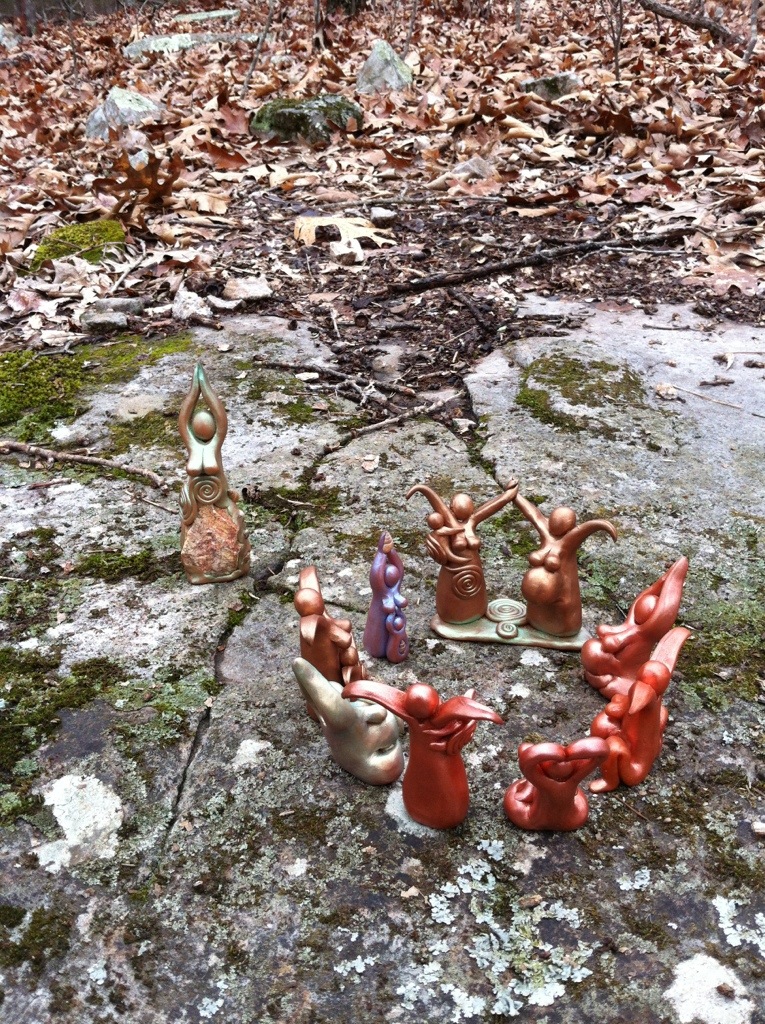
Sculptures hanging out in the sunshine!

Sculptures hanging out in the sunshine!

She goes on to make this important point: “It is of course no small wonder why graven images are so tightly controlled by religious traditions.” (p. 52) Sometimes I feel like this is what I’m tapping into when I make my own goddess sculptures—a resistance to tight control over graven images and over personalization of divinity as female in essence!

Later, Anne writes about creating a sisterhood of priestesses and she describes their vow to each other in a lovely way:

As sisters, we are one another’s truth tellers. We are one another’s loving and honest mirrors. We advise, even when we are not queried. And we let go so that each may fly on her own wings. Our sisters are our bonds with the deepest mysteries. As sisters, we are the ones who bleed, we are the ones who birth, we are the ones who nourish, we are the ones who weave the web, and we are the ones who cut the cord. As women, as sisters, as priestesses, we stand at the doorways of life and death, bonded by the cycles of our bodies and our lives.

Key, Anne (2011-03-29). Desert Priestess: a memoir (p. 57). Goddess Ink. Kindle Edition.

She also writes about creating ritual and liturgy in a desert climate:

At the beginning of each ceremony, we honored the four directions and an element associated with each: east and air; south and fire; west and water; north and earth. Many times when the directions are called, they are written with a wet, lush environment in mind: cool breeze, deep black earth, rushing rivers, dense forests. But these images did not reflect the desert land, a dry, thriving environment.

I wrote a call of directions specifically for this land, for this place, for this temple:

Winds of the mind, open free.

Breath of life, breathe in me.

Red flame of truth, burning pure.

Spark of life, ignite me.

Water of my soul, blood of earth.

Spring of life, wash me.

Bones of rock, sand, and earth.

Roots of life, ground me.

Key, Anne (2011-03-29). Desert Priestess: a memoir (pp. 90-91). Goddess Ink. Kindle Edition.

And, finally, another section I marked was in her description of feeding sweet little birds outside her window, only to see them snapped out of the air and eaten by a hawk. She says,  “Of course, I would have preferred that the hawks eat the mice. Much as I loved the cute little mice, the mess they left in our kitchen cupboards was disgusting and infuriating. But the birds! The little birds had done nothing but entertain us.” (Amen!) But, then she goes to make the best point ever about nature: “Obviously, this cycle was not about me, or what I thought was cute” (p. 116).

I really recommend this book! It is of particular interest to priestesses and to those interested in Goddess Temples and women’s spirituality in general, but I also think it would be interesting to people who like memoirs and stories about women’s lives and simple, yet profound, adventures.

Categories: books, nature, priestess, quotes, resources, reviews, spirituality, womanspirit, women | 2 Comments

Priestess Year in Review

“May you experience each day as a sacred gift woven around the heart of wonder”

–J. Donohue

“The revolution must have dancing; women know this. The music will light our hearts with fire,
The stories will bathe our dreams in honey and fill our bellies with stars…”

–Nina Simons in We’Moon 2012

Happy New Year!

Two things I’d like to note as 2012 closes out and I welcome 2013: When I became ordained as a priestess with Global Goddess in July of last year, one of the commitments I made as part of ordination was to be of service in some way to the organization and to document my service to my community through the year. And second, after the ordination ceremony and I was all excited and saying to my boys, “I’m officially a priestess now!” they said, “what’s a priestess?” and I explained that a priestess was someone who does a variety of things including planning ceremonies and holding rituals. And, they said, “oh, you already were a priestess.” This might sound casual, but it was really meaningful to me because it affirmed that not only was I on the right path, but that I also wasn’t “pretending” or taking on a new identity or role I wasn’t ready for, I was already doing it–my kids saw it and some important friends in my life saw it also.

So, in keeping with these two things, this is my priestess year in review… 🙂

  • Wrote articles for each one of the four issues of The Oracle (Global Goddess online publication) following my ordination in July. This was the commitment of service to the organization I made. I already have a couple of articles planned for the upcoming issues as well.
  • Moderated at my UU church (only once in 2012. I’m on the schedule again for the spring).
  • Planned at least six family full moon rituals (my own family only).
  • Hosted winter women’s retreat
  • Planned, hosted, and facilitated summer women’s retreat
  • Facilitated a full series of Cakes for the Queen of Heaven classes (five weeks)
  • Planned and facilitated what we termed a “journeyway” ceremony for a close friend—the ceremony was like our “traditional” mother blessing ceremonies, but had a threefold purpose and involved acknowledging miscarriage, celebrating the friend’s birthday, and holding a house blessing ceremony.
  • Planned and facilitated a mother blessing ceremony for a new friend.
  • Officiated at a wedding ceremony and handfasting in October.
  • Planned and facilitated an overnight women’s retreat and SageWoman ceremony in November. This, for me, was the highlight of my service to my local women’s circle this year 🙂
  • Officiated at a wedding ceremony and handfasting in December.
  • Held a small winter solstice ritual for my immediate family and my parents.
  • Planned and facilitated our first fireside ritual/ceremony and drum circle involving whole families (instead of either just women or just my own family) for New Year’s Eve last night.
  • Not so much in service or in priestess work, I also had three guest posts published on the Feminism and Religion blog. And, I went to the Gaea Goddess Gathering in Kansas and brought back various ideas and resources for my local community (including the inspiration to purchase a big community/powwow drum).

    ;

    20121218-231445.jpg

    Handfasting with a lovely bride and handsome groom!

    2013 Full Moon Calamandala

    2013 Full Moon Calamandala

Plans for 2013:

    • Family full moon ritual each month. We meant to do one during every full moon in 2012, but there were various reasons why we didn’t actually achieve this every month. I would like 2013 to include all 13 moons. I am considering inviting other people to participate instead of only my own family.
    • Facilitate the whole series of Rise Up and Call Her Name classes. I bought this program in 2010, it is high time I use it! I’m envisioning this as a once a month class, spread out over the whole year.
    • Continue to hold quarterly women’s spirituality retreats, one during each season.
    • Plan and host four seasonal rituals for whole families (not just women, not just my own family)
    • Hold a house blessing/blessingway ceremony for a friend who is building her own house.
    • Continue writing all over the place and taking classes at Ocean Seminary College.

I feel blessed by connection to others, my sense of community experience, a wonderful group of friends, and a supportive family! Welcome, 2013!

“I know myself linked by chains of fires,
to every woman who has kept a hearth.
In the resinous smoke
I smell hut, castle, cave,
mansion and hovel,
See in the shifting flame
my mother and grandmothers
out over the world.”
-–Elsa Gidlow (quoted in The Politics of Women’s Spirituality)

Ipad Pix 117

Someday…someday!

Categories: family, friends, priestess, ritual, spirituality, womanspirit, women's circle | 10 Comments

Book Review: Living Goddess Spirituality, a Feminine Divine Priestessing Handbook

A woman who connects with Goddess, connects with a most vital, ancient, powerful inner part of herself and she is awakened. It is this awakened state that is so empowering to women and downright frightening and dangerous to a patriarchal society.” –B. Melusine Mihaltses

Living Goddess Spirituality: A Feminine Divine Priestessing Handbook is a wonderful book! Containing lots of good resources and thoughtful commentary, the book explores twelve goddesses and associated rituals and workshop ideas for women’s spirituality circles. It also includes a chapter on priestess initiation and guidelines for starting a Goddess study circle.

I have a couple of small critiques in that some of the print is extremely tiny, some material is repeated from the author’s previous book, there is quite a bit of repetitiveness in general, and not all suggestions are fully developed (i.e. for each goddess there are multiple “workshops” suggested which include things like making various items. However, no further information or instructions for most of these things are included).

I don’t usually connect strongly with individual goddess imagery, but the way in which Living Goddess Spirituality is written brought in the significance of many different goddess images and I found myself learning and thinking about specific goddesses in different ways. I also loved all the different chants, ritual outlines, and invocations included. Really great pictures and some beautiful art enhance the book.

Great circle resource and a good resource for Goddess Priestesses!

Two chants I particularly enjoyed and that were new to me:

Eight Beads Chant
Girlseed
Bloodflower
Fruitmother
Spinmother
Midwoman
Earthcrone
Stonecrone
Bone…

Earth, Moon, Magick…
In the Earth, deep within
There is a Magick, I draw it in.
In her Caves, in the Trees
Hear her Heartbeat, Pulsing through me.
When I Rise, I feel her Love
with feet Grounded, I’m soaring high above,
In the Earth, deep within
There is a Magick, I draw it in
Ancient Moon, my Soul reveres
With my Singing, I call you here.
When this flame, ignites tonight,
Priestess dancing, Under the moonlit night…
In the Earth, deep within
There is a Magick
I draw it in…
There is a Magick, I draw it in (3x)

Additional lines for a familiar, favorite drum circle song:

Mother I Feel You…

Mother I feel you under my feet,
Mother I hear your heartbeat
Mother I feel you under my feet,
Mother I hear your heartbeat

heya heya heya yah heya heya ho
heya heya heya heya heya ho

Mother I hear you in the River song,
eternal waters flowing on and on.
Mother I hear you in the River song,
eternal waters flowing on and on

heya heya heya yah heya heya ho
heya heya heya heya heya ho

Mother I see you when the Eagles fly,
Flight of the Spirit gonna take us higher
Mother I see you when the Eagles fly,
Flight of the Spirit gonna take us higher

heya heya heya yah heya heya ho
heya heya heya heya heya ho

(Adapted from my quick review on Goodreads)

Disclosure: Amazon affiliate links in image/book title.

Categories: chants, Goddess, poems, priestess, readings, resources, reviews, ritual, spirituality, womanspirit, women's circle | Leave a comment

Winter Blessings!

20121223-184450.jpg

Categories: art, blessings, quotes, spirituality, womanspirit | 4 Comments

A night wind woman…

“…Look at me
I am not a separate
woman
I am a continuance
of blue sky
I am the throat

of the Sandia Mountains
A night wind woman
who burns
with every breath
she takes.”
–Joy Harjo in Open Mind
photo(6)

I recently made these sculptures and my mom glazed and fired them for me this week. Usually I work in polymer clay and regular clay was more difficult to work with, but the results are very pleasing. I love them!

Categories: art, poems, quotes, readings, spirituality, theapoetics, womanspirit | Leave a comment

Essence of Paganism…

20121202-135542.jpg One of the things I enjoy about the UU church is that it can be distilled into a set of principles. No unnecessarily complex theology and layers of religious history and meaning, no convoluted mental gymnastics required to reconcile logically bizarre, but theologically required beliefs and practices, but instead some clear, basic, direct, assertive statements to which, I think, ANY reasonable person should agree with and support—and, indeed, if everyone did, the world would probably be a much better place. I also think many, many people are actually UU without knowing it—particularly those who describe themselves as, “spiritual, but not religious,” as “liberal,” as “humanist” (whether spiritual or secular) and even as, “progressive Christians.” I certainly was UU for approximately 7 years before knowing that I could be “labeled.” There is a broad understanding of the UU umbrella as welcoming everyone and accepting everything, but I don’t think that is really true (or desirable). Indeed, within the principles are strong statements for a certain way of being in the world and in viewing the world. Many, many people can find a spiritual home under the UU umbrella, but they are unlikely to be those who identify strongly and in a fundamentalist manner with the Abrahamic religions (though, the UU religion does draw upon the teachings and stories of all major world religions), or, quite frankly, Republicans.

I just had a discussion with a friend online in which I explained it like this: we do have a set of “principles” and people disagreeing with those principles wouldn’t actually be welcome. My favorite description is that we believe the light shines through many different windows in different ways and the only people who aren’t welcome are those who think the light only shines in their window and that we should throw rocks through the windows of everyone else who disagrees with us…. 😉

The discussion with the friend was prompted by my mention of using readings from the UU hymnal Singing the Living Tradition in the ceremony I held after the miscarriage-birth of my third baby. I explained that I sometimes describe my miscarriage as a “religious experience” of sorts and that’s because it wasn’t until then that I realized I do have a religious language, symbols, and resources I draw upon in times of need. I spent years describing myself as “areligious” (funny, since now I’m working on my D.Min degree). Her response was: “What’s the best way to label yours then, Molly? Unitarian? or something else? Unitarians kinda fit with everybody and nobody at once…”

The statement in bold is an issue the UU movement has struggled with for years. I responded that UU is fine (or Unitarian Universalist). They’re a good umbrella religion, but definitely don’t fit with everybody—I don’t think most “traditionally” Christian people, for example, who would recognize anything familiar in most UU resources/services.

She clarified that, “My (admittedly minimal) experience with UU is that they welcome pretty much anybody believing whatever works for them… but that there are many who don’t accept UU’s.” And that is when I used my light and windows example.

It seems funny to argue for exclusion, but I can think of many who would not be welcomed by UU’s! That guy telling rape jokes, that woman picketing Planned Parenthood, those people leaving hateful comments on YouTube videos, that company blasting the mountaintops off, and those people who protest marriage equality, to name a few. Within the UU world, the personal is political and political beliefs are entwined inextricably with our “religious” values. Standing on the side of love and all that. Indeed, as UU’s, “We seek to act as a moral force in the world, believing that ethical living is the supreme witness of religion. The here and now and the effects our actions will have on future generations deeply concern us. We know that our relationships with one another, with diverse peoples, races, and nations, should be governed by justice, equity, and compassion.” (http://www.uucfm.org/information-for-newcomers/what-is-unitarian-universalism)

In my own tiny church, to which I have not actually been for many months now, at the closing circle we hold hands and read the following from a cross stitched picture on the wall:

As Unitarian Universalists we cherish
The importance of individual thinking
Respect for the convictions of others
The warmth of caring
The perspective of humor
The dreams of the mystic
And the methods of the scientist
A way of life that avoids harm and scorn
A quest for justice through peaceful methods
A religion that is broad and encompassing
Personal, yet universal.

This is simple, direct, and clear and it is something I can stand behind for the rest of my life, regardless of how many times I actually attend a church service.

Apparently not every church uses this same reading, I couldn’t readily find it online, but I did find another short explanation I enjoy: “We encourage individuals to garner insights from all the world’s great faiths, as well as from Shakespeare and from science, from feminism and from feelings. We invite people to explore their spirituality in a responsible way. We ask Unitarian Universalists to cherish the earth, to free the oppressed, and to be grateful for life’s blessings. Out of this combination of reflection and experience, each one of us shapes a personal faith. For Unitarian Universalists the individual is the ultimate source of reality.” (http://www.uucfm.org/information-for-newcomers/what-is-unitarian-universalism)

Principles and sources

There are seven principles which Unitarian Universalist congregations affirm and promote:

  • The inherent worth and dignity of every person;
  • Justice, equity and compassion in human relations;
  • Acceptance of one another and encouragement to spiritual growth in our congregations;
  • A free and responsible search for truth and meaning;
  • The right of conscience and the use of the democratic process within our congregations and in society at large;
  • The goal of world community with peace, liberty, and justice for all;
  • Respect for the interdependent web of all existence of which we are a part.

Unitarian Universalism (UU) draws from many sources:

  • Direct experience of that transcending mystery and wonder, affirmed in all cultures, which moves us to a renewal of the spirit and an openness to the forces which create and uphold life;
  • Words and deeds of prophetic women and men which challenge us to confront powers and structures of evil with justice, compassion, and the transforming power of love;
  • Wisdom from the world’s religions which inspires us in our ethical and spiritual life;
  • Jewish and Christian teachings which call us to respond to God’s love by loving our neighbors as ourselves;
  • Humanist teachings which counsel us to heed the guidance of reason and the results of science, and warn us against idolatries of the mind and spirit;
  • Spiritual teachings of earth-centered traditions which celebrate the sacred circle of life and instruct us to live in harmony with the rhythms of nature.

These principles and sources of faith are the backbone of our religious community.
UUA

Wait a second, what does all of this have to do with my post title and about paganism? Well, I just read an article, surprisingly in Brain, Child magazine, called Beltane Flowers by Brit St. Clair, in which the author describes attending her first pagan ceremony. What I appreciate particularly about the article is how tidily St. Clair describes the core beliefs of Wicca, specifying that these concepts were beliefs she already held firmly, long before she realized they were also embraced by Wicca:

find divinity in self and nature; practice meditation for strength and balance; spirituality is individual, personal; don’t proselytize, but help others less fortunate anyway; examine your intentions; harm none; feel free to view a symbol like ‘God’ or ‘Goddess’ as just that: a representation of a creative life force energy we can possibly understand…

I appreciated this essence of paganism description, much as I appreciate the essence of UUism as described in the principles. And, I’m curious if there are other succinct, yet fully descriptive (i.e. not just, “harm none! Now, let’s party!”) explanations out there that my readers connect with in particular?

20121202-135708.jpg

Categories: spirituality, UU, womanspirit | 1 Comment

Blog at WordPress.com.