spirituality

Womanrunes: The Sun

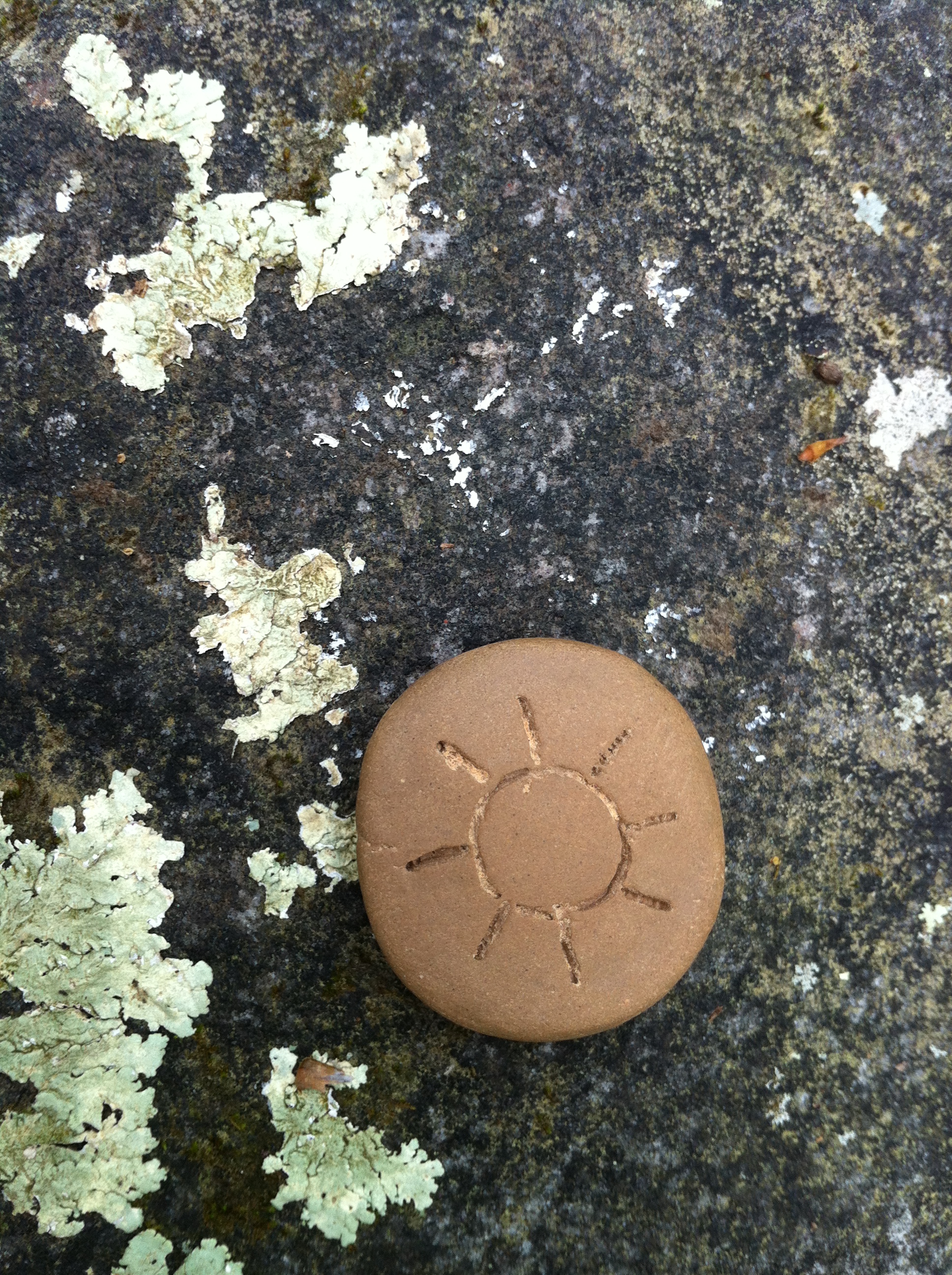
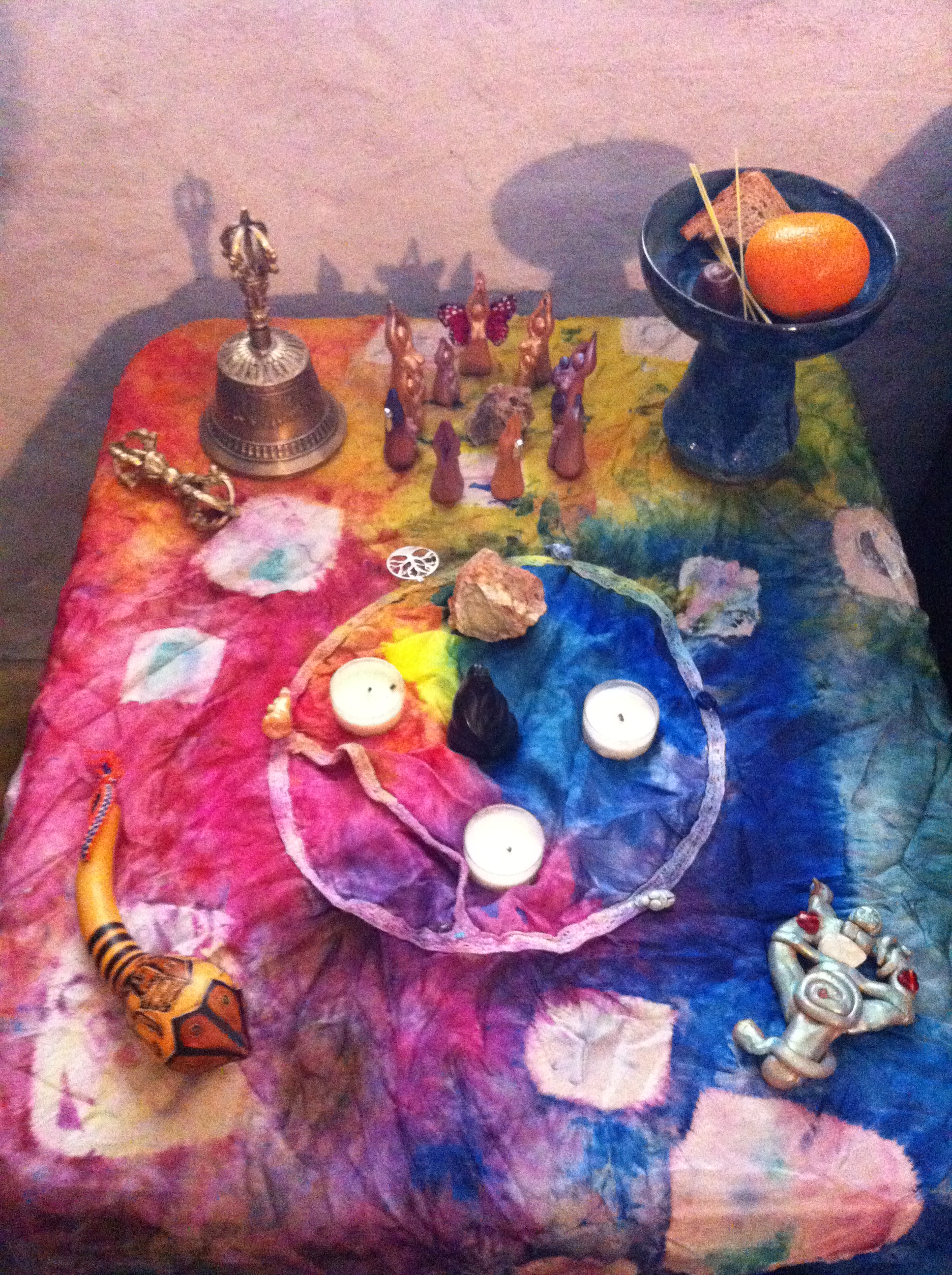
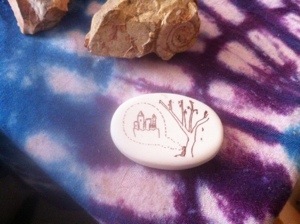
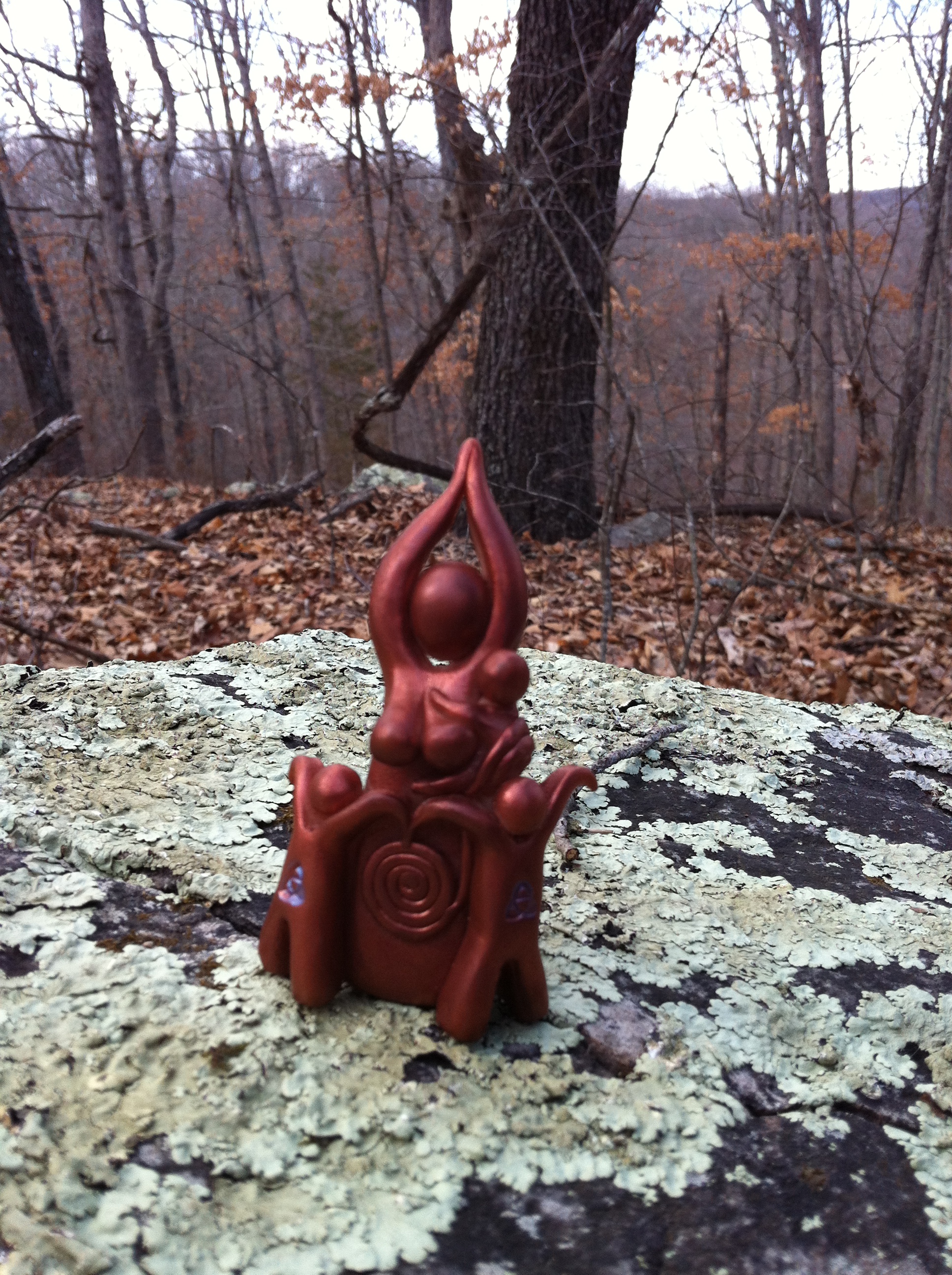
Womanrunes: The Sun. Rune of Healing. Rejuvenation, Recreation, Play, Radiance. May 2013 002

When you draw this stone, you know the time has come to be healed. Not healing as in forgetting, or in letting go, but in accepting, opening, changing, and growing. An integration of difficult changes you may have experienced in life. Healing may be physical, it may be emotional, it may be spiritual, it may be relational. Consider in which ways you need healing and rejuvenation. In interpersonal relationships? Physical health? Emotional well-being? Mental health? In your relationship with yourself? In your relationship with your body and with the earth?

Healing is both possible in all there is and available, sourced, through all there is. Healing comes in sharing silences, and sharing stories, and in sharing songs. Healing comes in creation, in offering to others, in opening your heart to the circle with women, in silence with another, in connection with your partner. It is also found in being playful; laughing together. This stone also reminds us that trying again is always worthwhile. Draw upon the resources of the earth. Draw upon the resources of your sister. Draw upon the resources of your own heart. And, in quiet spaces and laughing faces, you will be healed.

Yesterday, as I was getting ready to set up the altar for our women’s ritual/retreat, I decided to draw my womanrune for the day. I drew it as I was looking at the altar space and thinking about how to make it a “healing altar,”  to bring the energy of renewal in for my mom who gave so much of herself during my grandma’s dying process. I drew the stone and saw the sun on it and immediately knew it was a “healing” rune and it felt like a “blessing” upon this retreat. I was also struggling with a crisis of confidence because several people cancelled at the last moment and the night before I’d been feeling like I shouldn’t bother trying to do this kind of thing any more. I explained to my husband that each time I I plan a retreat I really feel like I’m offering a “gift” to my friends–so, when people don’t come, it is like they are saying, “take that back, we don’t want it!” There is a tenderness and a vulnerability to trying to serve my community in this way. After drawing the womanrune, I then went on a divination feeding frenzy and drew cards from all of my different decks! They were all remarkably connected and had good insights to share about “surrender” and letting things flow and also about new beginnings and new projects, but the best was the Seven of Wands from the Motherpeace Tarot deck which opened with: May 2013 003

“The priestess is challenged by her group…

…anxiety, doubt, and fear may be clouding her ability to stand up for herself…”

This retreat was a combination of rituals. We had a Maiden turning 12 and so we had a coming of age ritual for her. My mom is turning 60 this month and so it was also a surprise birthday ritual for her with an emphasis on healing. We also had a tea ceremony, a yoga practice, and a guided meditation.

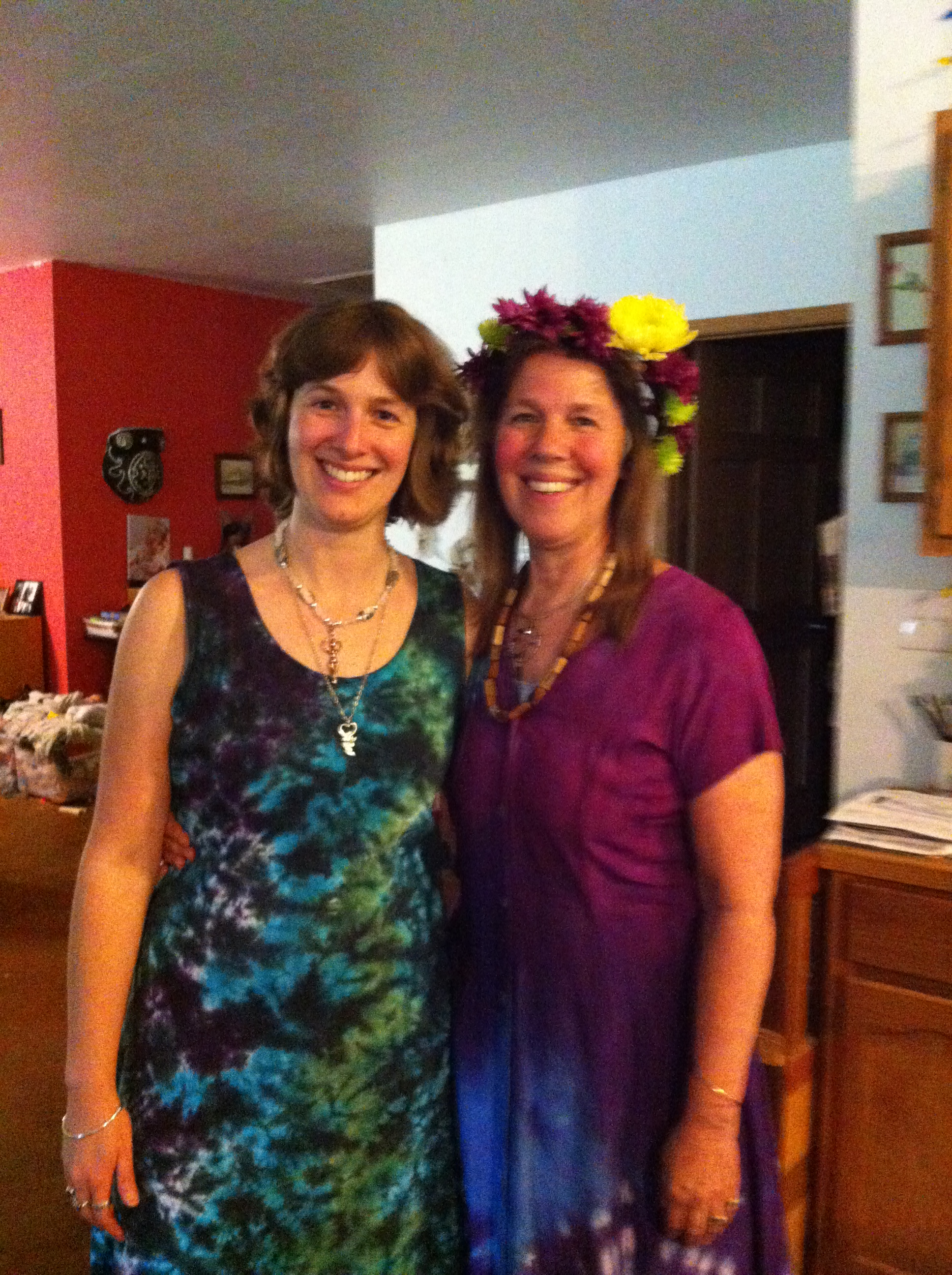
My mom went through a lot in the final stages of my grandma’s life. She born witness to her mother’s final journey and it was really, really hard, but she did it. I wanted to hold this ritual for her so she might know that we see her. She offered a deep gift of love and we came together in this space because we wanted to help her rest and restore and to give her back some of the care she shared so graciously with her mom. After she was seated with flowers in her hair and her feet in a footbath, I offered her the body blessing of renewal I wrote for her:

Gratitude body blessing

Head

May your mind be blessed, so that you may be at peace that you were enough.

Eyes

May your eyes be blessed, you saw her through. May 2013 014

Nose

May your nose be blessed, breathe easy now.

Lips

May your lips be blessed, you spoke with love.

Chest

May your heart be blessed, you have loved and been loved.

Hands

May your hands be blessed, you have reached out when you were needed.

Belly/womb area

May your center be blessed, so that you may honor all you have created.

Feet

May your feet be blessed, so that you may continue to walk your own true path, knowing that you do not walk alone—there are those that support and care for you. You do not walk alone.

May 2013 027

My mama!

May 2013 020

Aromatherapy footbath for maiden!

May 2013 008

Triple Goddess cord that I braided for the Maiden to step over as a symbolic threshold into womanhood. I wrote a blessing that goes with it and will post that in a separate post in the future, hopefully.

May 2013 001

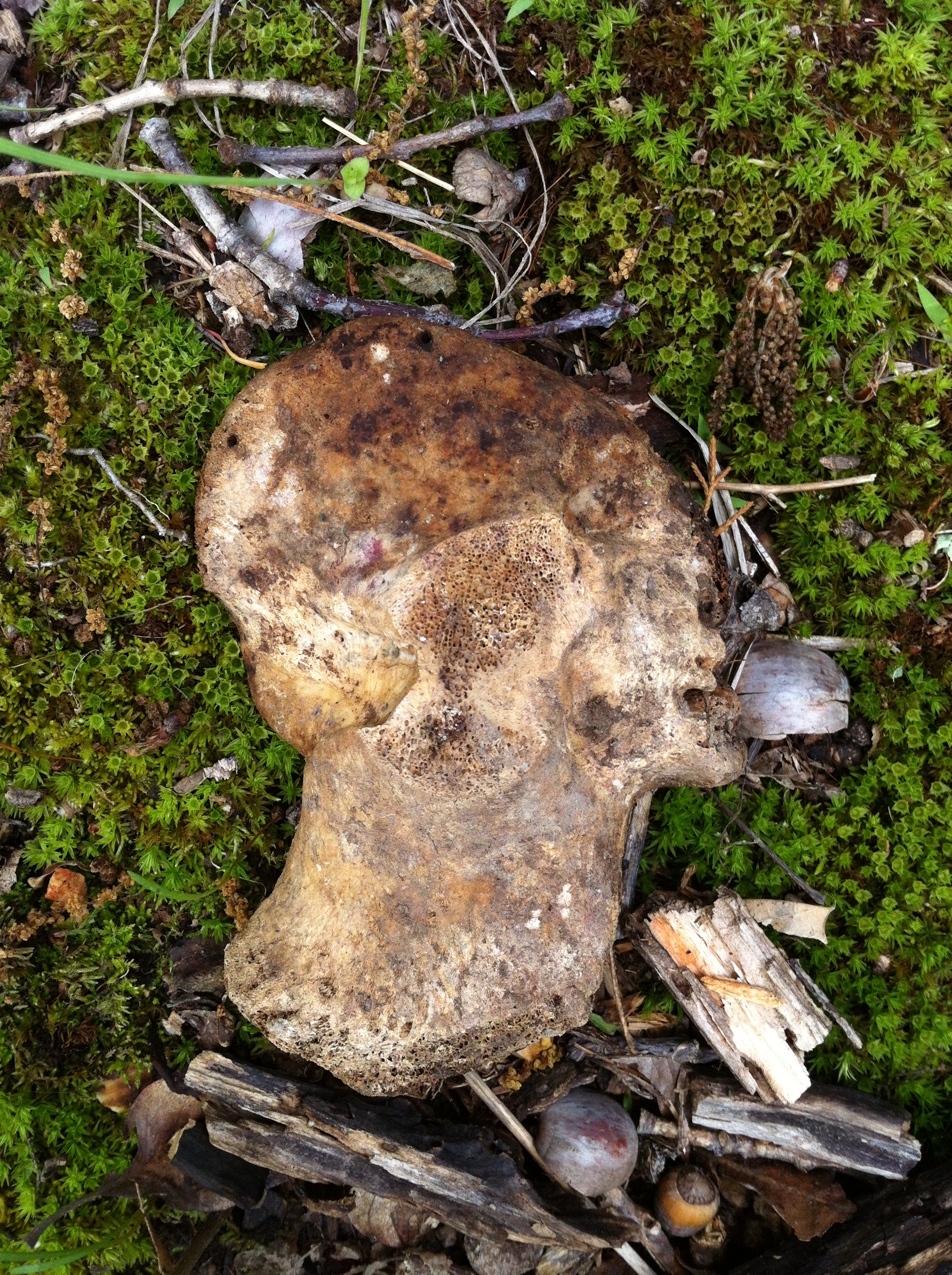
This interesting, unidentified bone was sitting right in the middle of my path on the way down to the woods shortly before our ritual.

May 2013 012

My toddler went with me to bless the ritual items and yelled and complained the whole time. My nine year old was also yelling out the door at me, “you have NINE MINUTES left, Mom! Mooooooom!!!! NINE MINUTES.” I kept going anyway. Such is the mamapriestess life.

Update: this project evolved into a real book!

The first post in my Womanrunes series is available here. The runes and the names of them come from Shekhinah Mountainwater’s Womanrunes system for which there are no written interpretations available other than the name and one word meanings. I’m engaging in a semi-daily practice of drawing one and then going down to the woods with it to see what it “tells” me–basically, creating what I wish I had, which is a more developed interpretation of the meaning of each womanrunestone.

Categories: blessings, friends, ritual, spirituality, Womanrunes, womanspirit, women's circle | 1 Comment

Thursday Thealogy: Rituals–to read, or not to read…

November 2012 151

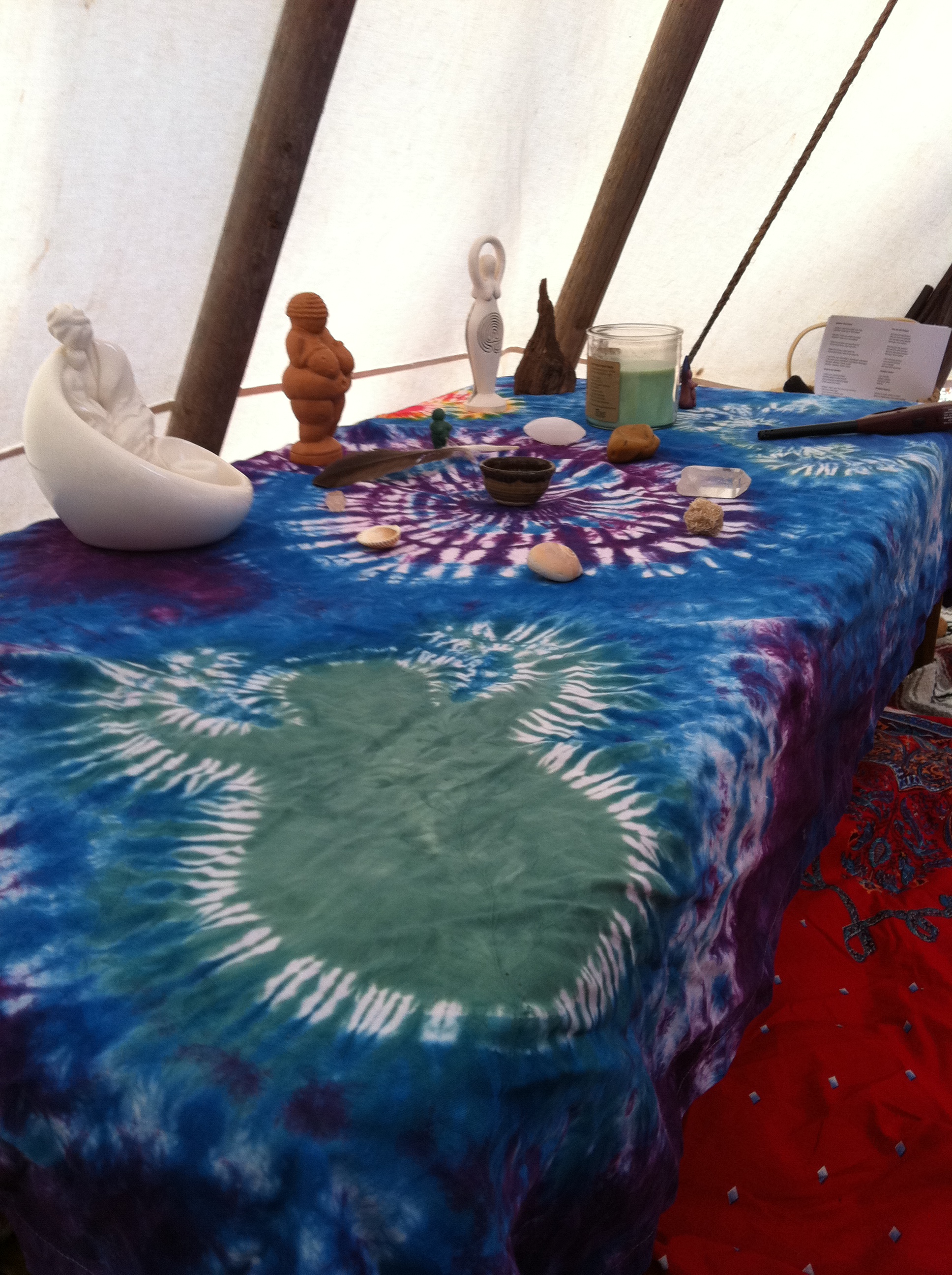
Altar during fall retreat

This Friday is our quarterly women’s retreat and, because we have multiple reasons to be coming together, it is composed of several interlocking rituals. As I prepare the ceremony outline and choose the readings and structure, two perspectives are on my mind. The first, from Ruth Barrett in her classic Women’s Rites, Women’s Mysteries:

When you are speaking an invocation in a group ritual, remember that you are the conduit between the elemental energies and the will of the women in the ritual circle. You will need to project your voice, speaking out so that everyone present can hear and feel the invocation. This is particularly critical if you are outside, where sound can easily be lost. Personal ritual invocations need not be spoken with such projection, but it is still best to speak them aloud. Speaking aloud gives the elemental forces within you an opportunity to come fully forward. It is a form of self-witnessing. How and what you hear within ritual space may be different than how and what you hear in a state of ordinary consciousness. Try invocation both ways, aloud and silent, to hear, see, and feel the differences for yourself. As you become more sensitive to ritual energy, you will feel the energy in the room shift or drop, depending on what is happening at the time. In some Wiccan traditions, invocations are passed out and read from a printed page. This can have a profound and unpleasant effect on the energy of the ritual, and the invocations can sound and feel flat. Whether you are preoccupied with memorizing exact words or speaking them from a page, there are energetic consequences. If you rely on the left, linear side of your brain completely for delivering your invocation, there won’t be much change in the energy of the ritual space. However, when you be-speak your invocation and you truly embody the essence of the Goddess and the elements, the energy builds rather than drops.

Ruth Barrett. Women’s Rites, Women’s Mysteries: Intuitive Ritual Creation (Kindle Locations 2204-2212). Kindle Edition.

I do tend to pass out readings on a printing page, just as she describes and for a while I’ve felt kind of bad about that—like if I was “better” at this, I’d remember everything, OR be able to spontaneous compose fabulous perfection on the spot. However, in the course of my Ritual and Liturgy class at OSC, I read this section in one of our lessons:

“While it is fine for some rituals to provide space for participants to speak from their hearts, for the most part there should be little extemporaneous speaking. Select poems or write words that mean exactly what you wish to convey, and practice delivering them for the best possible effect.”

Reading this made SUCH a difference to me.  Like I said, I’ve felt bad about “needing” written material to read from during rituals. I kept thinking that as I “evolve” as a priestess I will “grow up” and not need pre-selected words and readings, but will be able to spontaneously speak and guide the ritual. As I read the above quote, I realized that my process of carefully choosing and selecting opening and closing readings for my rituals as well as poems and quotes during the circles is actually legitimate and possibly very helpful.

I do appreciate that over-reading can contribute to a lack of life in the ritual and I’m gradually finding a good balance there. I know that in my personal experience of them, our women’s rituals have improved in the feeling like they are working as we’ve continued to refine our approach and choose our words and activities. We moved away from including a time for general talking and discussion and into more structure, which helps “hold” the energy and momentum of ritual, rather than letting it leak out in the form of side conversations or long personal stories. (Conversation.discussion then happens after we end the ritual and have potluck snacks and make a project together.) In another book I just finished reading, Jane Meredith explains the layers of ritual:

November 2012 188

Outdoors during overnight sagewoman ceremony.

Firstly there’s the outer layer; which is composed of the actions you take. What matters here is what you actually, physically do. It might include making altars, offerings or dedications; dancing or going out into nature. It might include cleansing in the form of a ritual bath, a fast or a time of meditation and prayer. It is the form of the ritual and functions as a container for the other aspects of ritual. When this outer layer exists on its own, it is sometimes called an empty ritual. Then there’s a second layer. This consists of what is happening within you, and it is encouraged and supported by what’s happening in the outer layer. Being willing, being true, carrying out not just the actions but the intent of your ritual or journey make up this second layer. You may find it helpful to whisper a mantra under your breath, to focus on an image or to chant or drum for a while to take you further inwards. When these first two layers are in concert, the ritual will feel satisfying and alive. There is yet a further layer. This is the mystical one, and may be different every time. It is the moment when the ritual takes off, when you slip across from one realm into another, into the sacred; into the realm of the Dark Goddess herself. In this layer you will feel the divine all around you and within you, and you will sense yourself as being in an altered, perhaps luminous space. This does not happen every time you do a ritual, no matter how well you are managing the other two layers. It is enough to work with the first two layers and invite this third one to manifest. A ritual will still be meaningful without entering the third layer; though it may be more memorable and feel more powerful when you do slip across the boundary into this realm.

Meredith, Jane (2012-05-25). Journey to the Dark Goddess: How to Return to Your Soul (pp. 42-43). NBN_Mobi_Kindle. Kindle Edition.

People have sometimes been “scarred” by past experiences with hollow, meaningless, and rote rituals they may associate with religion and have trouble understanding that a good ritual is evocative of something very different from that experienced in mainstream religion. As I explained in a previous post:

Notice that what is NOT included is any mention of a specific religion, deity, or “should do” list of what color of candle to include! I’ve observed that many people are starved for ritual, but they may so too be deeply scarred from rituals of their pasts. I come from a family history of “non-religious” people and I feel like I seem to have less baggage about ritual and ceremony than other people do. An example from the recent planning for a mother blessing ceremony: we were talking about one of the blessingway songs that we customarily sing–Call Down Blessing–we weren’t sure if we should include it for fear that it would seem too “spiritual” or metaphysical for the honoree (i.e. blessings from where?!) and I remembered another friend asking during a body blessing ritual we did at a women’s retreat, “but WHO’s doing the blessing?” As someone who does not come a religious framework in which blessings are traditionally bestowed from outside sources–i.e. a priest/priestess or an Abrahamic God–the answer felt simple, well, WE are. We’re blessing each other. When we “call down a blessing” we’re invoking the connection of the women around us, the women of all past times and places, and of the beautiful world that surrounds us. We might each personally add something more to that calling down, but at the root, to me, it is an affirmation of connection to the rhythms and cycles of relationship, time, and place. Blessings come from within and around us all the time, there’s nothing supernatural about it.

I also think, though I could be wrong, that it is possible to plan and facilitate women’s rituals that speak to the “womanspirit” in all of us and do not require a specifically shared spiritual framework or belief system in order to gain something special from the connection with other women.

via Blessingways and the role of ritual | Theapoetics.

February 2013 192

Rise Up and Call Her Name class in February.

Barrett explores this concept as well:

Sadly, many women describe their previous experience of religious ritual as meaningless. This response is usually derived from experiences of religious traditions that are male-focused, with little to no attention paid to the realities of women’s lives and experiences. When women empower themselves to ritualize passages that they deem as significant and to which they can ascribe their own meaning, like a snake they shed their old skins and emerge into a new reality, a new conscious awareness. The mundane world of the previous moment becomes transformed and they are brought closer to greater understanding of the sacred. Women who create and participate in their own life-cycle rituals are saying that their lives are important, that their stories matter, and that every human life is a gift to present and future generations.

Ruth Barrett. Women’s Rites, Women’s Mysteries: Intuitive Ritual Creation (Kindle Locations 308-312). Kindle Edition.

As I’ve also written before, in keeping with Carol Christ’s work, for me, thealogy absolutely does begin in experience. I do not think that everyone needs to share my personal experience that the Goddess path and the Pagan path are different ones and I do not think the two paths need necessarily diverge to different ends, just that they do exist separately (and, yes, there are scores of different pagan paths as well). It is important to my own mind and experience that a Wiccan path to Goddess is not the only path and I believe that an overemphasis on the Wiccan path can cause some women to turn away from explorations of feminist spirituality.

After I trained as a Cakes for the Queen of Heaven facilitator in 2007, I discovered something every powerful in the resources of the Unitarian Universalist Women and Religion organization. At the conclusion of the training, I had profound sense of THIS is what else there is for me! It was a pivotal moment. I started to realize that my strong draw towards Goddess actually had a place and a home under the UU “umbrella” and that I didn’t have to self-identify as pagan or Wiccan in order to explore a relationship with Goddess. Before, I felt like it was “Wicca or nothing” and Wicca was not a personal match for me for a variety of reasons. Cynthia Eller notes that feminists coming to neopaganism, “often had little patience for the measured pageantry and role-playing that characterized some neopagan rituals…” (page 38, emphasis mine) and this was true from my own experiences too. My brief encounters with Wicca felt “hokey” and inauthentic, my experiences with Goddess felt deeply meaningful and true in my bones. It took a long time for me to realize that it was both acceptable and possible for there to be multiple paths to Goddess. On a related side note, in an article from Brain, Child magazine, the author describes her overall experience at a Beltane ritual and says that she, “can’t deny a sense of detachment as well; the theatrical component makes me feel like I’ve been involved in some kind of interactive Medieval play rather than a genuine spiritual experience. Maybe group ritual isn’t for me.” This immediately made me think of a great series of posts by the Allergic Pagan on the subject of pagan embarrassment. Some of these embarrassing elements are part of why I’ve never embraced the pagan label and instead moved towards Goddess spirituality instead [a move for which I have UU’s to thank]. In my own experience, “measured pageantry” is the best description I’ve read of why I fail to click with it, otherwise known in my personal vernacular as: hokeylicious.

So, to read or not to read during ritual, that is the question. What do you think?

November 2012 187

Fall retreat space

November 2012 146

Categories: OSC, priestess, retreat, ritual, spirituality, thealogy, Thursday Thealogy, womanspirit, women, women's circle | 4 Comments

Thursday Thealogy: Stories

“…women 398124_10152413274040442_130771351_n
fish the dream fields every night.
The old stories are caught
and held there in their nets.

If all the woman of the world
recorded their dreams for a single week
and laid them all end to end,
we would recover
the last million years
of women’s hymns and chants
and dances,
all of women’s art and stories,
and medicines,
all of women’s lost histories.

Sing it!
Nothing
that can be remembered
with love,
can ever be lost!”

~ Dr. Clarissa Pinkola Estes

Via Deanne L’am.

In a quote from iconic author and physician Christiane Northrup, she addresses the subjugation of female power through body control: “…if you want to know where a woman’s true power lies, look to those primal experiences we’ve been taught to fear…the very same experiences the culture has taught us to distance ourselves from as much as possible, often by medicalizing them so that we are barely conscious of them anymore. Labor and birth rank right up there as experiences that put women in touch with their feminine power…” And, from Glenys Livingstone: “It is not female biology that has betrayed the female…it is the stories and myths we have come to believe about ourselves.”

I’m attracted to themes of “story power” and also identify with Carol Christ’s explanation that:

Women’s stories have not been told. And without stories there is no articulation of experience. Without stories a woman is lost when she comes to make the important decisions of her life. She does not learn to value her struggles, to celebrate her strengths, to comprehend her pain. Without stories she cannot understand herself. Without stories she is alienated from those deeper experiences of self and world that have been called spiritual or religious. She is closed in silence. The expression of women’s spiritual quest is integrally related to the telling of women’s stories. If women’s stories are not told, the depth of women’s souls will not be known” (p. 341. Emphasis mine).

Speaking of Carol Christ, I also identified with this quote from a recent post at Feminism and Religion:

I found I could not repeat the words nor stand in silence when “God, the Father, Lord, and King” was celebrated in communal worship. On the one hand my body revolted and I felt like I wanted to throw up. On the other hand, my mind told me that even if I could control the reactions of my body, the continued repetition of these symbols by others was influencing their individual actions and the actions of the culture they were legitimating through them—and these actions were hurting others. I have sometimes said that I might have been able to stay Christian if the only thing that was at stake had been the maleness of God. I do not know whether this is true, because I was never faced with this simple dilemma.

via Deciding To Leave the Religion of Your Birth–Or Not by Carol P. Christ | Feminism and Religion.

While I don’t feel like I want to throw up, I do struggle with the assumption of maleness inherent in many communal activities. I found myself balking during the graduation ceremony at the college for which I teach last month when the invocation was read and the closing benediction was offered. There was a powerful symbol system in place and assumed to apply to the entire room and it was not one I felt comfortable with. Likewise at our recently completed craft workshop. It is held at a facility with a church affiliation and the tradition is to sing a grace together before every meal. They all reference “Lord” and “God,” and are assumed to be comfortable for all in attendance. I find myself stumbling over or balking at participating in that symbol system. While I understand that Goddess prayers would cause similar stumbling–or out-and-out rejection of the workshop all together!–I would dearly love to find some acceptable UU-“generic”-style, interfaith friendly prayers and blessings to gradually replace these camp “classics.” I do have books with things like this in them, but they’re not those catchy sort of “sing for your supper” camp blessing songs. I did sell a surprising number of Goddess rings at the workshop, so maybe there would be less balking than I fear!

“Mythology is not a lie, mythology is poetry, it is metaphorical. It has been well said that mythology is the penultimate truth–penultimate because the ultimate cannot be put into words. It is beyond words. Beyond images, beyond that bounding rim of the Buddhist Wheel of Becoming. Mythology pitches the mind beyond that rim, to what can be known but not told.” ― Joseph Campbell

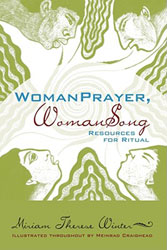
In a convenient twist, just this week a package arrived in the mail containing the book WomanPrayer, WomanSong: Resources for Ritual. (A birthday gift from my aunt, I accidentally opened it early—my birthday is tomorrow—thinking it was something I’d ordered for myself.)womanprayer This book is a compilation of songs, verses, rituals, and poems with a female-God at the center. The Bible seems to be primary source of inspiration, though revisioned using feminine pronouns and the book is clearly strongly identified with Abrahamic traditions. God = Her throughout the text and there are some powerful words to this effect:

The God of history,
the God of the Bible
the One who carries us in Her arms
after carrying us in Her womb,
breastfeeds us,
nurtures us,
teaches us how to walk,
teaches us how to soar upward
just at the eagle teaches its young
to stretch their wings and fly,
makes fruitful,
brings to birth,
clothes the lilies of the field,
clothes Eve and Adam with garments newmade,
clothes you and me
with skin and flesh
and a whole new level of meaning
with the putting on of Christ.

The God of tradition,
the canonical God,
is One who cars about people,
who values personal relationships
who walks with,
talks with,
listens to
demanding, complaining friends,
is willing to negotiate,
is patient
and merciful,
provides shelter
and a homeland,
security
and roots.

The God of scripture,
the living God,
is One who feeds the hungry,
heals the brokenhearted,
binds up all their wounds
comforts as a mother comforts,
gathers Her brood protectively
to Her safe and sheltering wing.
God-with-us
is the Word-made-flesh,
steadfast love,
mother-love,
love incarnate,
the love one has
for a child in the womb,
on whom we depend,
like a child in the womb,
in whom we live
and move
and have our being,
the Holy
and wholly Other.
So why shouldn’t we
as the Spirit moves
sometimes call God
Mother?

While appealing in some respects, I find I actually still shy away from this type of language and vision, as well. The conception of God-Mother throughout this book feels very much like a transcendent, omnipotent, and controlling Deity. Supplication, beseeching, and “wise and powerful” accolades permeate the prayers and readings. A praise and worship orientation is very different from the relational, embodied, partnership model I feel at the core of my own thealogical understanding of Divinity. Additionally, sin and forgiveness (from some kind of Divine source) is not a part of my thealogical understanding of the web of life at all and references to such feels very foreign and odd, regardless of whether female pronouns are used to do so.

Rush writing in Eller’s Living in the Lap of the Goddess writes, “the rituals being created today by various women are part of the renaissance of women’s spirituality, that is, of the ultimate holiness or life-sacredness of women and the female creative process. Within a world which for centuries has tried to brand women as ‘unclean,’ as ‘devils,’ or as ‘immoral corruptor of man,’ this healing process is a vital one.” She also states, and I deeply agree, that “reforming patriarchal religions…is not possible, just as reforming capitalism is not possible. The very institutions are contradictory to feminism. Women need to once again create new theory and practices for ourselves in order to reunite the spiritual element with the social-political” (p. 384). Much of WomanPrayer, WomenSong feels like an effort to reform a patriarchal tradition. I’ve long-bonded with the phrase from the UU Women and Religion Committee that, we don’t want a larger piece of the pie, it is still a patriarchal pie, we want to change the recipe

Some time ago, I heard a speaker on Voices of the Sacred Feminine remark that the type of paganism that people practice as adults is often a direct reaction to the type of Christianity they were exposed to as children. I was not raised Christian, but I was exposed throughout my childhood to a very specific type of fundamentalist Christian and that made a permanent impact on my (outsider’s) understanding of what Christianity means, how it is practiced, and how it feels. It took me until I was in my late twenties to actually see that there are “normal” Christians in the world as well as the variety I knew in childhood. I may have included this here before, but in past OSC work, I’ve written:

…My first “cause” in life was feminism—a sense honed by my experiences as an agnostic homeschooled teenager amidst mostly fundamentalist Christians. I could not help but stand up for women’s rights and challenge the rhetoric my peers often shared about a “woman’s [lesser] place” in life and society. Because my developing sense of feminism burgeoned in response to patriarchal religious beliefs about women—the only religious beliefs I had yet encountered—I also developed a sense that feminism was not compatible with religion, period. I chose feminism. In college in the 1990’s as a psychology major, I always chose “women’s issues” as my main area of focus and I went on to graduate school in clinical social work, doing my internship at a battered women’s shelter (I also volunteered in one during my undergraduate years). My sense of the Goddess that later emerged is very intertwined with my deep beliefs about the inherent value and worth of women, something that I do not see reflected in much of Christianity, both theology and practice…

Previous posts about Story Power are collected here: I am a Story Woman

Categories: community, feminist thealogy, nature, spirituality, thealogy, theapoetics, Thursday Thealogy, womanspirit | 5 Comments

Woodspriestess: Chorus

Birdsong 20130429-135905.jpg
Heartsong
Bees buzz
Mindbuzz
Flowers bloom
Hopebloom

Interconnected
in a deep
magical
dance of life.

20130429-135858.jpg

Tulip tree is still blooming!

Spinning souls into being,
unfurling leaves,
beating my heart
and that of
mouse
chicken
dolphin
elephant
monkey
panther…

This animating force
that dances through the cosmos
speaking through our lips
hearing through our ears
touching our skin
creating through our hands
and bodies.

The lifepulse
of reality.
The skeins
of time and mystery.

20130429-135843.jpg

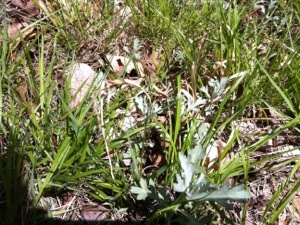
Sage is sneaking up out of the weedy grasses.

This beat
this dance
this beautiful rhythm
I waltz with it
and I sing
in its chorus…

(4/29/2013)

I’m feeling pretty beat. Wrung out. Exhausted. Tired. Strained. I still went down to the woods though and I still practiced yoga this afternoon. And, I’m still planning our women’s retreat for May 10th. These things should NOT be the first to go. I must uphold my commitment to these practices for my own well-being. Likewise with writing even this simple post—I “should” be doing something else, or should I? Doing this actually matters too.

At our craft workshop this last weekend, I lamented briefly to my husband that I hadn’t gotten everything done I’d hoped to do while there. Then, I noted that I had, in fact, finished reading two books, prepared for both of my college classes, graded 11 genograms and 4 papers, kept up with my online class (even though I had to drive up the road for the internet access), and made five new sculptures. And, oh yeah, I also ran a craft camp and took care of my three kids too. Perhaps I actually rock.

In addition, I published a brief post here and I woke from a nap humming with inspiration and wrote a blog post about Womenergy for my other blog:

…Womenergy moved humanity across continents, birthed civilization, invented agriculture, conceived of art and writing, pottery, sculpture, and drumming, painted cave walls, raised sacred stones and built Goddess temples. It rises anew during ritual, sacred song, and drumming together. It says She Is Here. I Am Here. You Are Here and We Can Do This. It speaks through women’s hands, bodies, and heartsongs. Felt in hope, in tears, in blood, and in triumph.

via Womenergy (Womanergy) | Talk Birth.

Here are some pictures of the sculptures I made while away:

20130429-135917.jpg

VBAC “Hope” mama.

20130429-135926.jpg

Cesarean “je donne” sculpture.

20130429-135933.jpg

Mamapriestess made with every scrap of remaining clay.

Experimented unsuccessfully with some A'kuba style sculptures. While I was originally excited about the potential, I am not a fan!

Experimented unsuccessfully with some A’kuba style sculptures. While I was originally excited about the potential, I am not a fan!

The opening poem was from yesterday, this was mine from today (I was lying on my back on the rocks):

April 2013 040
Hot sun
cool stone

restore me

body
mind
and soul

stilling
nurturing
holding
nourishing

granting peace
grace
and harmony.

Dog breath
on my face.
Surprise!

Categories: art, blessings, embodiment, nature, poems, spirituality, theapoetics, woodspriestess | Leave a comment

Thursday Thealogy: Death & Suffering

This post is excerpted from an OSC assignment written last year. The subject is so close to the things in my life recently that I felt compelled to dig out these previous writings.

How does thealogy envision death? How does thealogy address the problem of suffering?

The Abrahamic religions tend to associate death with that which is evil and wrong. Dominant religions traditions also often emphasize transcendence over the physical form and in these traditions the spiritual and the physical are seen as separate (with women associated with the “lower” body-based realm and men associated with the transcendent and divine)—the body and the earth is seen as a prison, rather than of value or as holding wisdom. In thealogy, on the other hand, death is another part of the endless “wheel” of life.

As the refrain of a Goddess song goes, in the womb of the mother…we find rest. daCosta notes that, “This darkness she equates with the  darkness of innate, instinctive knowing, where we are within the womb of the Goddess” (p. 115). I find a comforting feeling in the notion of coming to rest in the womb of the Goddess–whether that is very literal in terms of my body returning to the earth and being absorbed back into it, or it is more metaphysical (i.e. drop returning to the “ocean”). I also do not completely rule out the possibility of some form of personal continuation of spirit/energy/consciousness after physical death–just as the physical body doesn’t “disappear” after the body physically shuts down and dies, it seems semi-logical that our soul/our life spark/life energy, also does not disappear, but does or become something else/somewhere else.

Some time ago I had a “vision” during the day in my post-yoga routine meditation time. I “heard”—the moments of your life are beads on a April 2013 024necklace. Death is one of those beads. Why be preoccupied with one single bead of many, many beads? I recognize this as related to something I previously read in a Zen book I think—your consciousness being the string that holds the beads and each bead passing into the next bead, no need to cling to any of them or to become attached to one point. But, this yoga experience was the first in which I had conceived of death as just one more bead on the string—and, just like I wouldn’t spend a whole lot of my life energy thinking about the bead from my sixth birthday, say, why would I spend a lot of time thinking about the bead of my eventual, guaranteed death. That said, I do find it very relevant and appropriate to consider my own life choices and path in the context of my eventual death–i.e. I probably think at least once per day, “If I died tomorrow, would this matter?” Or, “what would choose to be doing now, if I knew that I was about to die?” etc., etc. I make a lot of life decisions based on not wanting to have regrets when I come to die, on wanting to live fully, vibrantly, authentically, and consciously.

In this same timeframe, I also had an epiphany—no matter WHAT happens after my own death, it still represents the end of life as I know it (there are actually many of these points in the course of an average life—our life as a twenty year old also “ends,” as does our life as the parent of a toddler, and so on). BUT, regardless, I still have to be at peace with THAT—this life as I know it coming to an end, whether or not there is any continuity of self or soul post-death.

I previously spent a significant number of years feeling very preoccupied with existential questions about death and life purpose (essentially of the, “if you’re just going to die anyway, what’s the point?” variety) and after having these two realizations, I was no longer preoccupied by the topic. I made my peace with having no concrete answers. You must come to terms with your life, making meaning, and reconciling your life’s path and purpose regardless of what, if anything, happens “next.” You must still live well and wisely your one wild and precious life on this earth at this time and in this place, because your time here in this way will definitely come to an end.

Returning to the question of “why suffering?” Carol Christ presents a primarily panentheistic representation of Goddess. But, if Goddess is essentially earth and is all around us, then how do we justify evil and suffering in this world? Should She not be able to protect us from harm and suffering?

Personally, I have never turned to religion to provide explanations of evil or suffering. Perhaps if I had a past tradition of conventional theology, I would then find thealogy lacking in this way. However, I came to Goddess traditions from a history of basically…nothing…and had made my peace with the existence of suffering and inhumane treatment of others as a feature of the “human condition” rather than ever conceiving of it as something under divine influence or power.April 2013 036
However, to scholars like Melissa Raphael, “[b]ecause Goddess religions ascribes little or no moral transcendence to the Goddess, it becomes difficult to use the Goddess as the religious justification for a struggle against evil, or to construct meaning in the face of it” (p. 208). Personally, I look to humanism or feminism (as philosophy and theory), as well as my own inner sense of “rightness” and morality, rather than religion to provides this justification. I have never needed religion for morality. I think that is an “old fashioned” seeming reason to need religion and something that I’ve always found puzzling when Christians bring it up—i.e. “well, without Christ, how can you be a moral person? How can you know right from wrong?” I just can. It doesn’t need to come from an external authority or power and needing to have some “higher authority” impose the rules upon you, basically has always seemed to me like having a less mature brain somehow. In a similar manner this is how I’ve also always accepted the existence of “bad stuff” in the world—it just is. No overarching power causes it, or controls it, it is just part of the ebb and flow of life, of nature, itself. I also do not find New Agey concepts of “everything happening for a reason” or “attracting the lessons your soul needs” relevant or appropriate most of the time. Sometimes there just are tornadoes or earthquakes or people get cancer. Those things feel awful and are bad to experience, but they are not punishments or under the control of any divine authority or power. Perhaps this is depressing or nihilistic, but that is the past belief from which I have come to Goddess thought, so the “failure” of Goddess feminism to offer explanations for these phenomena is almost a non-issue for me—a Goddess outlook on the world is more than I’ve ever had before, it is not a replacement for or a substitute for a previous (religious) system of belief. To me, Goddess religion has filled a void left by an agnostic, default worldview, if I was trying to use it to replace a more traditional Judeo-Christian system of belief, perhaps I would also find it lacking.
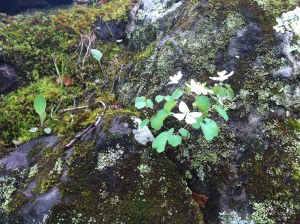
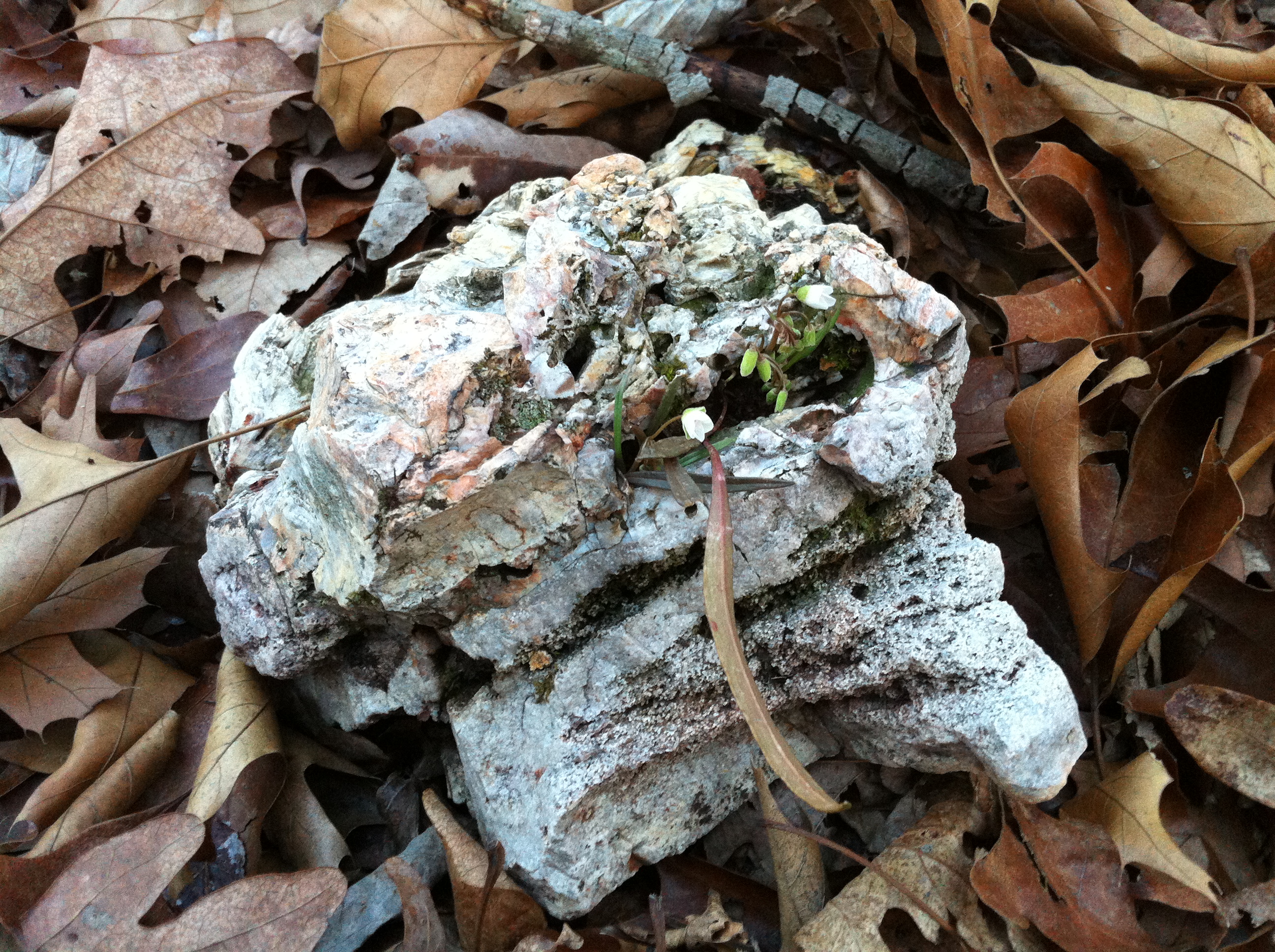
I am a sucker for things growing out of rocks. Check out this delicate little rue anemone making its life here on a big stone!Raphael also states, “…many of the things theology has associated with evil or suffering (impermanence, disease and natural disasters) are not problematic for thealogy. It would be unreasonable to attribute moral responsibility to the divine for suffering when (natural) evil is an ecological and thealogical given” (p. 208). She goes on to further explain, “It may be that if the reality of human wrong-doing and suffering does not count against the existence or worth of a reality called ‘the Goddess,’ then thealogy cannot ultimately do some of the most important work of a popular religious theory, namely, to reconcile people to existential pain and to construct meaning in the face of it” (p. 210).

As I’ve indicated, personally, I don’t feel as if I need Goddess or religion to explain these things for me, but I understand that the failure of thealogy to provide answers on these issues means that it may never attract large amounts of followers who were formerly committed to more traditional religious views of the world. What I find helpful is Carol Christ’s process philosophy outlook on thealogy that asserts divine sympathy. Goddess/God cannot prevent suffering, but suffers with those who suffer, omnipresent, while not omnipotent. It is true that thealogy doesn’t completely fill the void left by theological understandings of divinity and suffering, but I believe that may well be because traditional religious interpretations have significant issues and theological mistakes that unravel under critical thought.

In Merlin Stone’s essay about the three faces of goddess spirituality in the collection, The Politics of Women’s Spirituality (p. 66), she writes “So far, and let us hope in the future as well, feminists concerned with Goddess spirituality have seldom offered absolute or pat answers to theological questions. What has been happening is the experiencing, and at times the reporting, of these personal or group experiences: how it feels to regard the ultimate life force in our own image—as females; how it feels to openly embrace and to share our own contemplations and intuitive knowledge about the role of women on this planet; how it feels to gain a sense of direction, a motivating energy, a strength, a courage—somehow intuited as coming from  a cosmic female energy force that fuels and refuels us in our struggle against all human oppression and planetary destruction.” As I’ve written before, this makes sense to me—Goddess as life’s “fuel” and as an energy that surrounds and holds us all, but that does not “control” our behavior and does not have the ability to stop specific events from happening—events are multicausal and there are a multiplicity of forces and natural laws in the world (gravity, for example, lightning for another), that act in and upon the lives of humans without divine cause or intervention, but still as part of an overall tapestry of being (that as a whole, might be called Divinity).

Personally, I actually found Goddess most meaningfully during a time of personal suffering. While I previously connected with Goddess imagery and was interested in Goddesses and women’s spirituality from a feminist perspective that valued the symbolism in a socio-political context, I did not feel a truly personal experience of Goddess “energy” until, as I’ve also written about several times previously, I experienced pregnancy loss. That is when I felt She actually existed and when I realized that I was in relation to her as well as recognized that I wasn’t “areligious” after all, but did have a set of spiritual beliefs, perspectives, and “tools” to draw on for personal support. I was amazed to discover at this time (after an “a-religious” self-definition of the past) that I did in fact have a spiritual language and conceptualization of my own and that these were the deep resources I gathered to draw upon during a time of significant distress, fear, and challenge.

Culpepper reflects on the reframing of redemption:

“Reframing redemption necessitates renewed reflection upon the meaning of death. Rosemary Ruether is at pains to distance the notion of redemption from its eschatological interpretations. Instead, she focuses on its political implications, and rejects any formulation of the concept of salvation which views it as ‘an escape from the body and the world into eternal life’.  She offers an ecological account of immortality, which suggests the cosmic recycling of matter, not the survival of the individual in some otherworldly realm. At the heart of this rejection is a serious reappraisal of the effect that longings for immortality have had upon human self-consciousness. Our true home, this idea seems to say, lies beyond the stars. McFague is highly critical of such a view, arguing that there is no need for some postmortem existence to maintain the divine-human relationship: ‘We are with God whether we live or die, for whether our bodies are alive or return to the other form of embodiment from which they came, they are within the body of God.’  Redefining death finds a ready resonance with key aspects of thealogy. Starhawk argues that what we perceive as destruction should not be feared but acknowledged as a necessary part of the whole lifeprocess.” (Culpepper, p. 36)

According to Starhawk, paraphrased in Clack, “In thealogy, the Goddess is generally understood as the generative power of ‘all that lives and loves life…’ Therefore, when women or natural things recover their naturalness or return to the aliveness of the wild state, they are recovering their divinity in the goddess: and as the goddess is female energy, women who situate themselves inside nature, in the body of the goddess, will recover divine/natural energies and powers that will, like nature/the goddess, overcome patriarchy. For to repeat, nature/the goddess is stronger and older than patriarchy.” (Clack, p. 56)

Related past post:

The role of death in the circle of life

Rocks look at dogwoods.

Categories: feminist thealogy, Goddess, OSC, spirituality, thealogy, Thursday Thealogy | 2 Comments

Woodspriestess: Real Magic

It might look like a straight row of saplings   April 2013 014
But it is really a new way of being

Patient life
Doing what it can
Living still while
Uprooted
Crushed

Reaching out
Tenderly
Stubbornly
In experimental majesty

Seen or unseen
This is real magic…

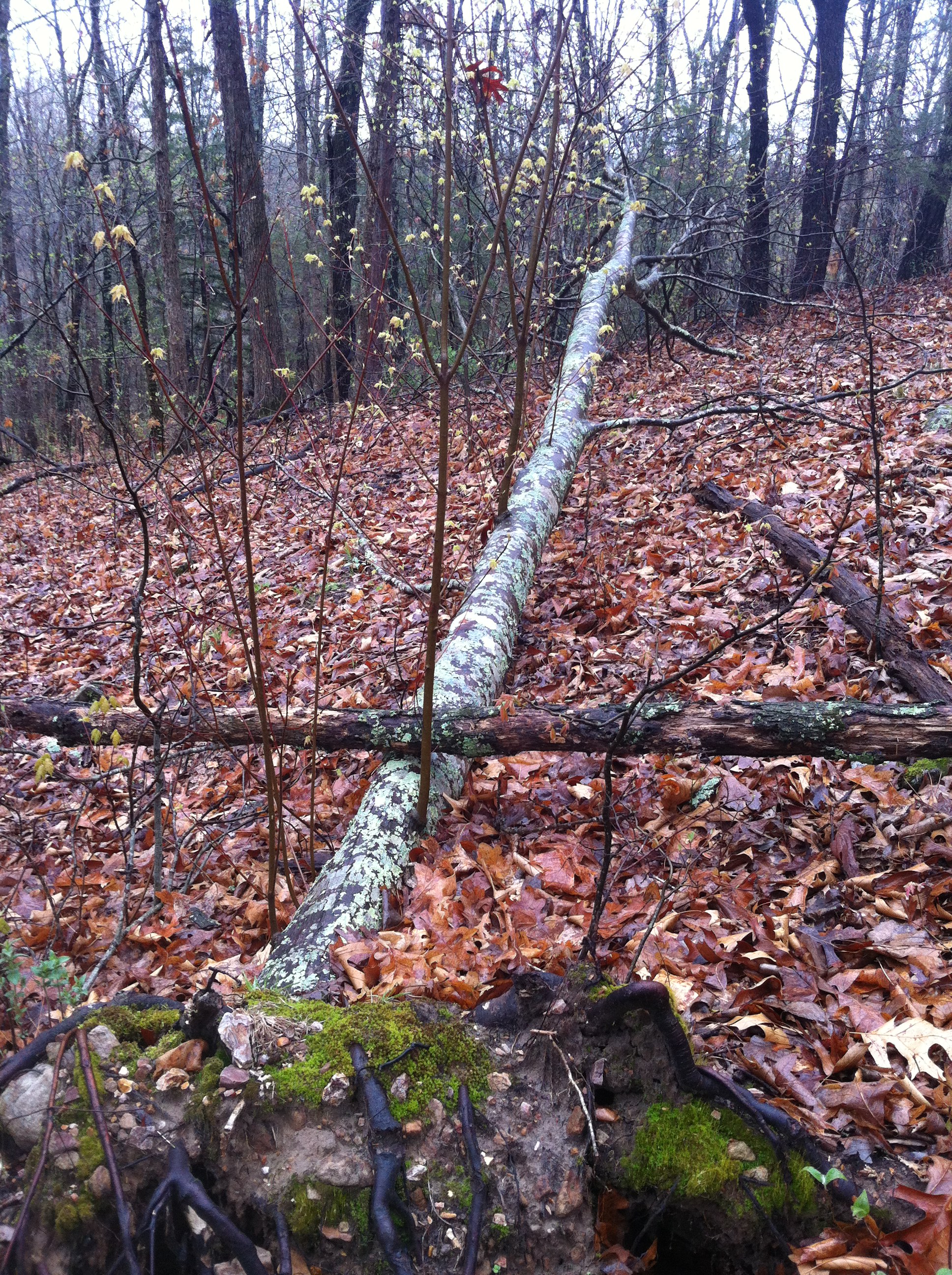
In the woods there is a maple tree that was uprooted in a storm several years ago. Rather than dying, it lives on, lying on its side on the forest floor. I’m fascinated by how it has sent out new branches, straight, strong, tall, and healthy, standing up from the trunk. If you don’t look carefully, it looks like just another row of little trees growing out there in the woods, but really they are branches standing up from their “base” of a trunk. It is leafed out all over now, small tender green leaves, looking quite happy out there lying down for a rest.

April 2013 009

The roots are still able to reach down and connect with the Earth for what it needs. The original upper branches keep the trunk propped off the ground, which keeps it from decaying (I guess).

April 2013 016

Little tree? No wait, little branch!

April 2013 011

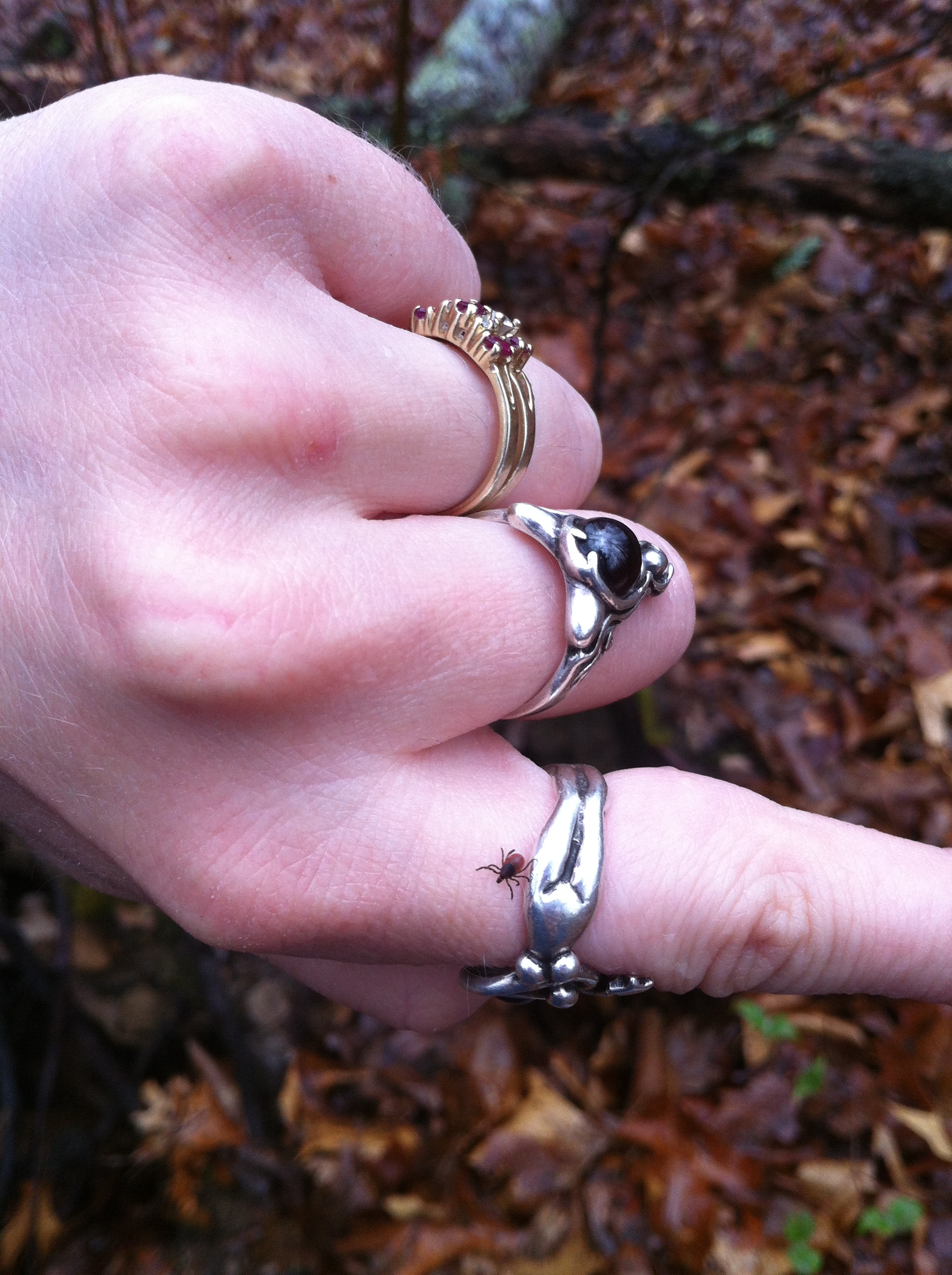
Less magical…ticks are already out to play!

It was a rainy, stormy, overcast day and I took a couple of pictures of two of my favorite trees as the rain came down on us. I’m so pleased to see them leafing out high above me.

April 2013 023

The maple that grows in the rocks.

April 2013 024

The biggest oak in this section of land.

April 2013 007

See the little leaves?!

April 2013 021

Each day April 2013 006
offers new gifts
new mysteries
new discoveries
new promise

kissed with rain
and garnished
with dogwood blossoms…


April 2013 002

Categories: nature, poems, spirituality, woodspriestess | 4 Comments

Thursday Thealogy: Theapoetics

April 2013 074

Sculpture made by my six-year-old and named, “The Cutest Goddess in the World.”

Turkeys gobble
birds sing
plum petals fall
raindrops kiss stone

take a moment and sit
hear, taste,
smell, and touch
the very field of creation.

(4/16/13)

I’m having such a hard time lately focusing enough to write coherent posts. I flit from site to site, idea to idea, and just can’t settle my mind enough to say what I want to say. I feel distracted, preoccupied, and unfocused. Maybe I need to go to the woods more often. As it is, I sit here with my little stack of books: Midwifing Death, What Dying People Want, and Sacred Dying. They came too late for me to really use them in any sort of helpful way for my mom or grandma, but at least I’ll have them in case I know anyone else who needs them. I am a tiny librarian in my own way and it is books that I turn to when I need help or want to help. They’re what I offer. Books are my first and longest-lasting love. I also sit by a pile of books waiting to be turned over as I plan my spring women’s retreat and write two assignments for my OSC class on Ritual and Liturgy. My heart doesn’t quite feel in that though either—too many variables, too much unknown…

There is so much we don’t know 20130416-140924.jpg
so many possibilities we can’t imagine
maybe that is what I touch
in the dreamtime
and the woodstime
maybe I am surrounded
in all times
and all ways
by those who have gone before me

here, in the woods
I touch
and am touched
by something
something that kisses my eyelids
with a breeze
that blesses my brow
with a raindrop
that cradles my body
with stone
that fills my senses April 2013 029
with pleasure and awareness
and that connects me
to the great, grand whole of creation

and I know that I am a part of Her
and She is a part of me
forever.

Though my individual thread might end
my part of the tapestry is eternal
and I dance right now
with the lifeblood
of purpose and connection.

(4/16/13)

A few days ago, I sat in the woods and thought about death and life and ancestors and children. While I sat and spoke into my little recorder, the plum petals fell steadily all around me like snow. It was beautiful and soothing.

April 2013 071

In my piles of books are also those which I want to put back on the shelf, but that are waiting because they had sections I marked to share. One of them—a really excellent anthology of essays by priestesses (or “sibyls”) called Voices of the Goddess—contained a section that made me think of my own theapoetical experiences. Though, I then feel self-conscious, embarrassed, or somehow “arrogant” or something for identifying with it—like, who do I think I am?!

The Goddess grants her gifts of creativity in many ways, but the personal invocation, the inspired lyrical utterance is always nearest to the surface. This poetic wellspring is part of the sibylline legacy and there is no denying it. It speaks the language of the blood and belly as well as the language of the crystalline stars. It is a weaving song that meshes heaven and earth with the underworld. Poetry is the mouthpiece of the metamemory, the deep, ecstatic memory of an oral tradition that remembered the Goddess daily in domestic and tribal rituals. Since there are not Goddess rituals or liturgies from former times, we have written our own, often drawing directly upon the raw material of personal experience…Poetry can both bless and uproot, it can extol or refute. It is the true voice of the Goddess speaking through her sibyls. Personal or prophetic, poetry is communication with a deeper level of understanding. It is a gateway for the Goddess to pass through.

–Caitlin Matthews in Voices of the Goddess

While I wouldn’t venture to call myself “prophetic,” I do experience something personally very important to me there in the woods, something I’ve previously referred to as, “Entering into radical relationship with the Goddess through art, poetry, and nature…” or, theapoetics. When I wrote about this topic for Feminism and Religion, I included this poem:

Goddess Direct

Goddess, where are you?
I am within you and around youApril 2013 037
in your heart that seeks answers
and connection

Goddess, do you exist?
Yes, I am as real as your own heartbeat.
I am here in the bird’s song
I am here in the breeze that touches your face
I am as solid as the stone you sit on

I am that which weaves the Whole.
I am that which holds the All.
I am that which flows,
dancing lightly
through the heartbeat of every form on this earth

I am within you and around you
beneath you and above you
I am your home

I am that which you seek
I am that which you know
And, I love deeply, richly, and well.

via Theapoetics By Molly | Feminism and Religion.

I still don’t think of myself as writing poetry and certainly not as a “poet.” These words are something that just comes out. Something that emerges. Something that is created in a very different manner than the rest of my writing. It actually feels like an altered state of consciousness that “writes itself” and when I go back to listen to what I said, I’m often surprised or feel like I’m listening to someone else speak. That’s theapoetics. Go sit in the woods and see what happens when you open your mouth! 🙂

Categories: Goddess, nature, poems, prayers, priestess, spirituality, theapoetics, Thursday Thealogy, womanspirit, woodspriestess, writing | 2 Comments

Sunday Sabbath: Sacred Words

woodspriestess

In November of 2010, I attended at women’s spirituality retreat in St. Louis and we did an exercise in which we each wrote a “gift” on a piece of paper (following a guided meditation) and then put them into a communal bowl and each drew out another’s woman’s gift—like she had passed it to us. I drew out “sacred words.” My friend told me she thought it was perfect for me because talking to me about her own experience of spirituality had been deeply meaningful to her. When I got home, I started looking for study programs/schools online because I knew in my heart that the time had come to deepen my personal study and experiences. I ended up applying to Ocean Seminary College and being accepted into the doctoral program in Thealogy/Goddess studies. This weekend, I finished my eleventh OSC class. I’m almost finished with two more and currently enrolled in another two. After those classes, another 11 classes remain, plus a priestess practicum and my dissertation. I really feel grateful for my experiences and classes at OSC. They have helped me clarify my own vision, purpose, and direction as well as helped me develop skills, rituals, broader understandings, and personal practices. I’ve also branched out as a writer as a direct result of my coursework there. While anchored for several years in being a birth and motherhood writer, my woodspriestess project has its roots in my Ecology and the Sacred class at OSC. Writing this blog, as well as writing for Feminism and Religion and Pagan Families, is a direct result of my work with OSC and the opportunity it has offered me to deepen my own practices and understandings. The decision to apply and then to begin classes represents one of those pivotal life moments for me. It is also entwined with my priestess path, since it was from Global Goddess members that I learned about OSC in the first place and then in doing my work at OSC I gained the confidence to see that I was already functioning in a priestess role in my community and wanted to step more fully into that place, which led me to apply for ordination as a priestess with Global Goddess…it is like a lovely big circle 🙂

I had fun times at Tagxedo making the word cloud above out of my blog and also word clouds for my mom and grandma. And, I learned that this year is the 70th anniversary of the classic Myers-Briggs Type Inventory. I have my online students take this test every session and we compare our results and the overall class dynamic. In celebration of the MBTI birthday, they have cool little wordcloud heads available with your type. Here’s mine!20130412-105737.jpg

And, I saw this quote on Facebook and liked it!
20130412-105732.jpg
And, speaking of words and wordweaving, I enjoyed this article about poetry in the schools:

Poetry builds resilience in kids and adults; it fosters Social and Emotional Learning. A well-crafted phrase or two in a poem can help us see an experience in an entirely new way. We can gain insight that had evaded us many times, that gives us new understanding and strength. William Butler Yeats said this about poetry: “It is blood, imagination, intellect running together…It bids us to touch and taste and hear and see the world, and shrink from all that is of the brain only.” Our schools are places of too much “brain only;” we must find ways to surface other ways of being, other modes of learning. And we must find ways to talk about the difficult and unexplainable things in life — death and suffering and even profound joy and transformation.

via Five Reasons Why We Need Poetry in Schools | Edutopia.

I still don’t think of myself as writing poetry and yet there it somehow is on almost every page of my blog… 😉

The trees are coming back to life!

The trees are coming back to life!

Beauty surrounds me
I am immersed in beauty
Tasting it
Hearing it
Feeling it fully
Through me
Around me
Within me…

(4/12/13)

20130414-093053.jpg

Categories: introversion, nature, OSC, priestess, sabbath, spirituality | 1 Comment

Triple Goddess

Triple Goddess February 2013 062

Is she enough?

Seed moves to bud

Bud moves to blossom

Blossom moves to flower

Flower moves to fruit

Fruit moves to seed…

An ongoing generative process of birth and re-birth, of legacy, and of love, the lives of women are multigenerational, complex, and multilayered, and yet within them perhaps the Triple Goddess archetype stands. Steady. Maiden, Mother, Crone. Maiden, Mother, Crone. Perhaps each layer there is subdivided into deeper experience, but the overall broad, blood mysteries are encompassed cleanly…

My hope rests

in the potential of women

To be all they can be

To listen to daughters

To hug friends

To care for mothers

To hold space for each other

Within the Triple Goddess is a trinity. A trinity of female power, of female experience, and of female story–honoring, and holding, and blessing April 2013 004the mysteries of women with the mysteries of the Goddess, providing a framework for our bodies’ language, our womb-deep stories and memories. Perhaps another Trinity that makes sense is the Mother, Father, and Daughter Trinity. The Daughter carrying the potential of new generations within her, the Father providing the spark to ignite the unfolding of life within, the Mother fashioning the Daughter from the very stuff of her own blood.

Is it enough?

It doesn’t have to be

Because the potential of women

Is written in the earth and stars

And it is boundless

As I walked in the woods with my daughter and thought about this concept and about my mother and my grandmother too, suddenly a fourfold Goddess also floated to mind. There must be something between—Donna Henes has already figured out and other writers have explored—the Mother stage and the Crone. But then, I reflected that my own mother—I guarantee—still strongly identifies with the Mother archetype. Once you’ve gone Mother, you can never go back. I am absolutely certain that she still identifies deeply with the Mother. And, then I thought about my grandma and I thought, heck, she probably identifies deeply with the Mother as well. My little daughter, my little Maiden, she identifies with the Mother also. While it may seem gender-essentialist, gender binary, and biologically reductionist of me, it thrills my little heart to see this in her–a heart that is deeply invested with being a mother and considers being a mother central to my being. Pregnancy, birth, lactation, are core life processes and working with women in these areas is deeply part of me, so when my little two-year-old points at her own belly and says, “baby…belly…me…grow…up,” telling me that she will grow up to have a baby of her own and then points to herself and says “Mama…ME! Babies…grow UP! Mama…ME!” I realize that she already carries that Mother image within her and sees that potential within herself now. Looking at her and looking at my mother, I see how I still identify as the Daughter. I am still the Maiden too. And, I see my mother and her mother and know that my mom still feels Daughter in this face of impending loss. And, she is both Grandmother and Daughter and Mother all at the same time. So, then I conclude that the Triple Goddess does work, because we each hold them. We contain them. So while they might not be enough for the human woman or even for biology, we may certainly contain and embody them all, sometimes all at once. And, that’s okay. There’s power in the triple image. There’s purpose in the triple image. And, there’s a genetic circularity of being in that triple image that I see reflected in my own days, my own relationships, my own roles. I am the Triple Goddess. She is the Triple Goddess. They are the Triple Goddess. We are the Triple Goddess.

Ipad Pix 090

Together at my brother’s wedding this past October.

When I recorded these thoughts as part of my final assignment for my Triple Goddess class at OSC, I was in the woods with my little girl and in the background of the recording she is saying, “Mama” and making other remarks and it seems perfectly fitting.

April 2013 008

She brought her little (nonworking) cell phone to the woods too and stood talking into and repeating part of everything I said: “Triddle…Doddess.”

April 2013 006 April 2013 007 April 2013 012

Categories: family, OSC, parenting, spirituality, thealogy, womanspirit, women | 4 Comments

Thursday Thealogy: The Motheredness of the World

My most recent post is up at Feminism and Religion on the subject of Mother Goddess imagery (and my mamapriestess art). It was written partially in response to the critique sometimes expressed that Mother Goddess imagery is “exclusive” of women who are not mothers:

I am also of the opinion that Mother Goddess imagery may well be less about women as mothers and more about the motheredness of the world. In this way, I do not find the image of the Mother Goddess is exclusive, rather I find it exceedingly appropriate. Every person and mammal on this planet—male, female, black, white, hetero/homosexual– since the dawn of humanity has had a mother. It is a truly unifying feature. And, it isn’t about the role, it is about the primal relationship. The root of life. As Naomi Wolf writes in Misconceptions while reflecting on an ordinary street scene and suddenly understanding the web of life and the universality of motherhood (even the squirrels!):

“We were all held, touched, interrelated, in an invisible net of incarnation. I would scarcely think of it ordinarily; yet for each creature I saw, someone, a mother, had given birth….Motherhood was the gate. It was something that had always been invisible to me before, or so unvalued as to be beneath noticing: the motheredness of the world.”

This understanding of the invisible net of incarnation is the foundation of my own thealogy and my ethics.

via Goddess Mother | Feminism and Religion.

Goddess imagery is also about valuing human women and their bodies:

The sociocultural value of a divine presence that validates women’s bodies cannot be overestimated. Indeed, patriarchal religion in its most destructive way seems to have grown out of the devaluation and rejection of female bodies. A religion that rejects the female body, that places the male and its association with “the mind” and the soul rather than the earthy relational connection of body, is a religion that easily moves into domination and control of women. Reclaiming Goddess, reclaims women’s bodies—names them not only as “normal,” but as “divine,” and this is profoundly threatening to traditional Judeo-Christian belief systems. Thus, the primacy of relatedness and connectedness as the core feature of the Mother Goddess model has broad reaching implications for women’s spirituality, as a direct contrast to the dominator model of patriarchy.

In Carol Christ’s classic essay, Why Women Need the Goddess, she quotes feminist theologian Mary Daly (Beyond God the Father):

“If God in ‘his’ heaven is a father ruling his people, then it is the ‘nature’ of things and according to divine plan and the order of the universe that society be male dominated. Within this context, a mystification of roles takes place: The husband dominating his wife represents God ‘himself.’ The images and values of a given society have been projected into the realm of dogmas and “Articles of Faith,” and these in turn justify the social structures which have given rise to them and which sustain their plausibility.”

In the same essay, Christ explains: “The symbols associated with these important rituals cannot fail to affect the deep or unconscious structures of the mind of even a person who has rejected these symbolisms on a conscious level…Symbol systems cannot simply be rejected, they must be replaced. When there is not any replacement, the mind will revert to familiar structures in times of crisis, bafflement, or defeat.”…

via Goddess Mother | Feminism and Religion.

Last time I wrote about a similar topic here, I received some comments asking about the role of “the God,” which is not a symbol I engage with or feel comfortable with given how steeped that name is in the oppression of women, saying that a thealogy without the God doesn’t seem very “whole.” While I would still like to address this question with more thought in a future post, as I wrote the above, it came to my mind again, because it is true that almost everything has a father as well—so, what about the “fatheredness of the world”? My thought when originally asked about “wholeness” was that I don’t have a particularly literalist conception of the Goddess and so to me, she is a name for that which holds the all, which is, ultimately unnameable, but can be experienced in a variety of direct ways. I experience it as the Goddess. And, I find political, social, cultural, and spiritual value in the naming of that subjective experience/wholeness/weaving of life as Goddess. “Goddess” as word and symbol is important, really important, because it breaks the patriarchal “hold” on defining divinity.

However, as a mother of sons and the wife of a husband, I have wrestled with questions as to whether Goddess-oriented thealogy excludes them as males in the same way that Judeo-Christian imagery primarily excludes women. I continue to return to “no,” because in their own experience of having been grown and birthed by me (well, my sons, not my husband!), the notion of a female image being fully capable of literally being able to hold both male and female within her, is exceedingly natural, appropriate, and logical to them. When we do family rituals, I do often use spiritual naturalist or spiritual humanist type of language rather than gendered divinity. Sacred Universe is a great term as are the generic labels Spirit or the Sacred or Nature.

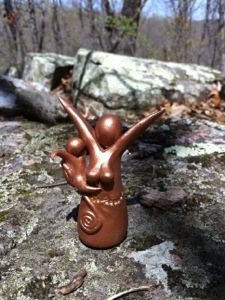
As I’ve shared a photo of previously, at my toddler daughter’s request, I recently made a “Daddy Goddess” sculpture as well to go with my many others—as I was making him, I realized I do have some room for a Green Man type of symbolism after all:

April 2013 004And, as I shared in my Feminism and Religion piece, a couple of months ago my six-year-old son made this sculpture for me…

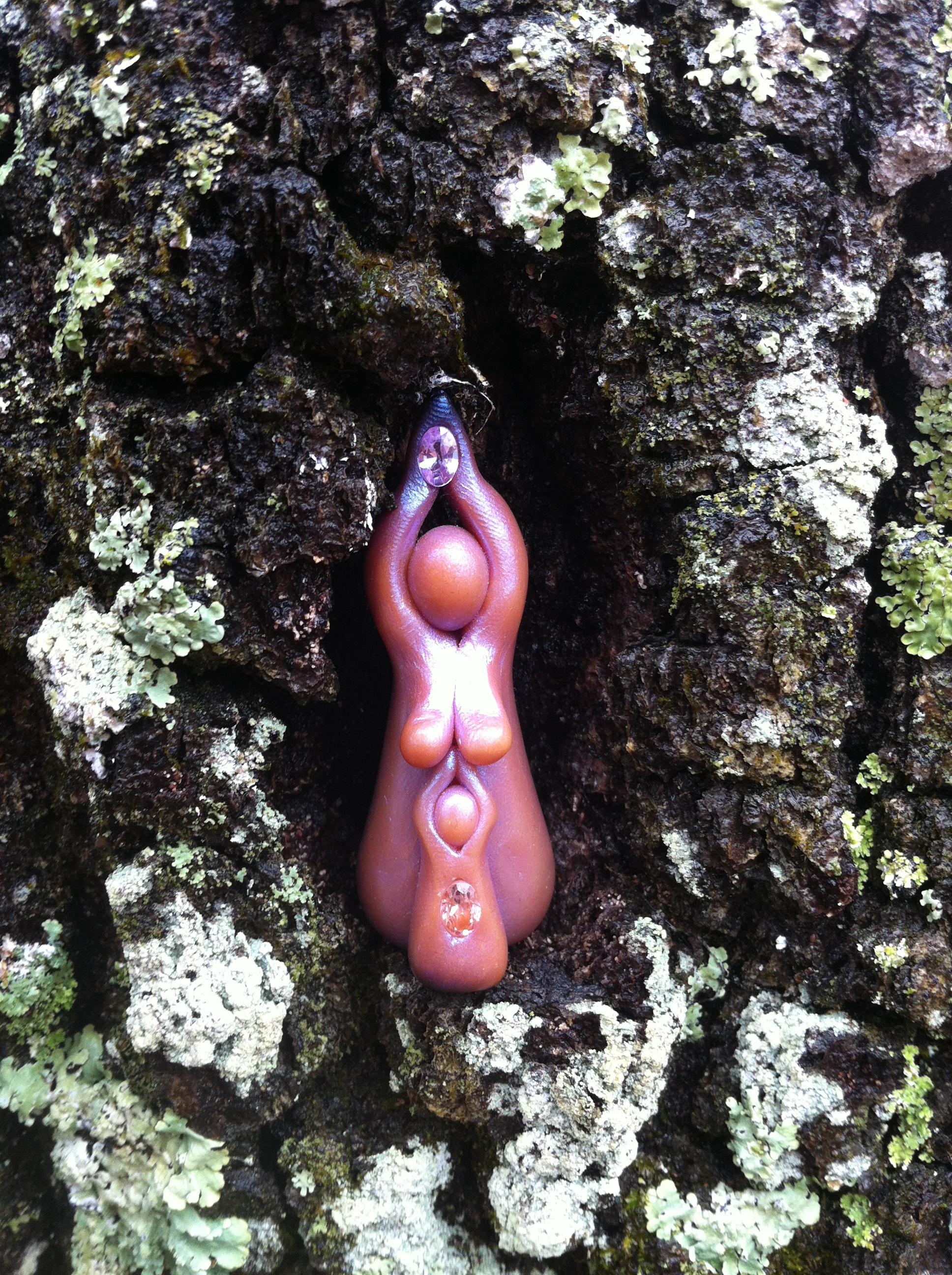
February 2013 051 “This is the Goddess of Everything,” he told me. “See that pink jewel in her belly, that is the WHOLE UNIVERSE, Mom!!

Yep. He gets it! 🙂

Categories: family, feminist thealogy, Goddess, parenting, spirituality, thealogy, Thursday Thealogy, writing | 4 Comments

Thursday Thealogy: Dreams & Daily Practices

“Form is the language of the universe singing its praises. Its rejoicing is seen everywhere–in the sun through a web of hair, in the flower and its petals, in the subtle folds of a garment, in the human body.” –Dianora Niccolini

A couple of months ago I experienced a really profound dream. I was walking down to the woods and in the sky above the priestess rocks saw a gigantic, beautiful, pulsating, pink, jeweled flower. I was awe-struck and staring at it. It was the most beautiful thing I’d ever seen. I became aware that a golden cord stretched from the center of the flower to the top of my head and I became aware that all people were connected to it by these golden cords as well. Then, in that uniquely expansive character of dreams, I somehow traveled through the center of the flower. On the other side was an immense snake of unimaginable proportion, spiraling around “the cosmic egg.” As I looked at it, I became aware that the snake was actually the whole of the universe and that along its body, in the scales, one could perceive not only each galaxy, but also a point for all times and places that ever were or will be. It is hard to describe in writing, but I still deeply remember by feelings of both awe and comprehension and this expansive awareness of reality. It was a gorgeous, trippy, and meaningful dream. I tried to draw something about it, but couldn’t do it. What I’m left with is that feeling of majesty, magnitude, and incredible connection.

In somewhat of a surprise, after the conclusion of my 31 day writing experiment, I’m very much missing my daily woodspriestess writing. “They” say it takes 30 days (or 21 or 15 or whatever) to create a habit and I created one that was pretty powerful. And, I’m realizing that it wasn’t only about the woodsvisits—I’ve been doing that since January and continue doing it today—it was the synthesis of experience with the written word. The writing itself was a practice too. I mentioned a couple of times that it sometimes felt like a burden, and it did, and I thought I was looking forward to having a “break” from having to write every day, and I do. However, I feel like there is something missing from my trips to the woods now—the writing afterward was an integrative experience or one that provided form, structure, and application of what I learned each day. Without the writing portion, I find I’m much more apt to leave and immediately “forget” what I experienced or learned that day. When I’m no longer thinking about how to shape it into written form, it loses some of its impact. During the experiment I felt bad at several points in going and only looking for things to blog about—it felt like the writing was a distraction to the experience—but, now I see how the link between experience and description provided a spiritual “container” for me, in which I could dig more deeply, look harder, and witness more. Writing offered a type of accountability. So, while I’ve enjoyed having a break from “having” to write on one hand, on the other I really actually feel a sense of loss and sadness about those missed opportunities to write and share and I’ve felt sort of at loose ends each day—like, “what about my blog post?” While I’m not going to force myself into an every day practice for the rest of the year with writing, I would truly like to continue to make it a priority. It is sad to me to notice how those things that nourish my spirit are easy to cut from my schedule when I become too busy, when in reality, they should take even more priority during those rhythms of life.

Today I also thought I might experiment with a new practice—one of drawing a card or a rune or a crone stone each day and perhaps make a daily blogging experience of that. I’m not sure I will, I’m toying with the idea—maybe a good daily pr20130403-161544.jpgoject for May—but I did draw a Crone Stone today and I got the Daydreamer. It seemed very apt, describing fantasizing about things being different—“life can be boring at times–something is missing.” It describes the image as the woman resting against a tree, dreaming of a far away plan, while the tree behind her withers from neglect. It asks the receiver to consider how we can ground the fantasy and bring the vision into reality. As I looked at it, I thought of multiple things. One was simply about my life and family and sacred space being right there in the woods—I’ve got it. The people I love are right here in front of me, waiting for me. Sacred space is right there in the woods, waiting for me. This is it. I also thought about two recent experiences—I was dreaming as I often do of having a Women’s Temple or Goddess Temple and then I looked around my own living room and had the sudden realization, I’ve already got one. And, second, I was feeling disappointed in myself for not planning a springtime ritual and having people over and doing a fabulous ceremony, but then as I laid out the spring time altar for my Rise Up class last week I had a moment of realization, oh, yeah. This IS a springtime ritual. I DID do it (but, it wasn’t for my family, it was for my friends. I’d like to do more things for my family in this capacity).

My first class at Ocean Seminary College was called Ecology and the Sacred and a theme that emerged for me as I worked through the class was of a deep hunger for daily practice. I like looking back and seeing how my current practices evolved from the desire I tried to convey in the “reflection” portions of my assignments. In the first lesson, I wrote:

I have a thealogical view of the world/universe as the body of the Goddess. Everything is interconnected in a great and ever-changing dance of life…all things as intimately connected—not as “all one,” but as all interconnected and relating to one another, in an everpresent ground of relationship and relatedness. I am currently reading the book She Changes: Re-imagining the Divine in the World by Carol Christ and the concepts from the lesson are closely related to the process philosophy she explores and that I am personally connecting to in many ways. As does she, I imagine the divine as omnipresent (rather than omnipotent) and I feel like I can see Goddess/God in the bright black eyes of a newly hatched baby chick and in the curve of my baby’s cheek against my breast. I do not feel like the Goddess is something I believe in, but a reality that I experience in daily life.

In response to my Week 1 assignment, I was asked “when you go about your everyday life activities do you have any rituals that you incorporate into them to vivify your spiritual insight with your day-to-day ecological mindfulness? If not, this may be something worth exploring.” This question stayed in my mind throughout the remaining twelve lessons of the course. In the second lesson, I wrote:

I do feel a powerfully strong urge to bring spiritual mindfulness more fully into my daily life–“practicing the presence of the Goddess” in a more explicitly developed/acknowledged manner–but I have trouble figuring out exactly how I wish to do this. I wear a Goddess ring that serves as a mindfulness touchstone for me (when I remember to look at it!) and I find listening to various spiritual CDs as I go about the mundane activities of my day brings a sense of the sacred into my everyday tasks (like laundry), but I have a hunger in me to do something more

Shortly after, I added to these thoughts:

…when engaged in these outdoor observations, I was struck by how I feel this deep sense of being part of the fabric of life most profoundly, clearly, and cleanly while outside. As Naomi Wolf said, I feel that “We were all held, touched, interrelated, in an invisible net of incarnation…”I might describe this additionally as being held in the hand of the Goddess. However, in practice, I spend much more time inside than outside. There are always so many things “to do.” Work to do, chores to catch up on, things to be done inside the house, that my experience of the natural world and that sense of being held in a net of incarnation is often postponed, in a way for, “later,” once I’m finished with all my work (which, never ends!). And, I realized today, that means my sense of the sacred or of divinity in the world is sometimes also postponed. This isn’t satisfactory! So, I continue to think about—and welcome ideas about—how to incorporate some rituals into my day a way that more meaningfully integrates my spiritual life with my everyday life…

And, about midway through the course, I wrote:

I also continue to reflect on my interest in incorporating more “ritual” into my life that honors or expresses my sense of the divine and I realized that I think I’m really simply seeking to cultivate a state of basic mindfulness in my day. So, not ritual per se, but ongoing awareness and mindful participation in the daily rhythms of life (including mindfulness of my connection within a larger environmental whole).

Thanks to the opportunity to articulate this desire, I started my first truly daily practice, some time at my living room altar:

In the course of my experiences with this class, I’ve started to spend a little time in the morning before my yoga practice in prayer/reflection/communion with my sense of the divine. Since that sense is intimately entwined with nature, I find the best way to do this is to sit looking out my window, watching the play of sunlight and shadow, and talking quietly to myself/to Goddess energy about what I envision for my day. This has been a powerfully grounding and focusing experience and something that I felt was missing in my day, something I was seeking to cultivate and have now been able to do because of the observer/reflection sense that is being honed more clearly through this course.

During week six, I also wrote: I feel emotionally embedded with the land and this daily process of energy exchange.

20130403-161720.jpg

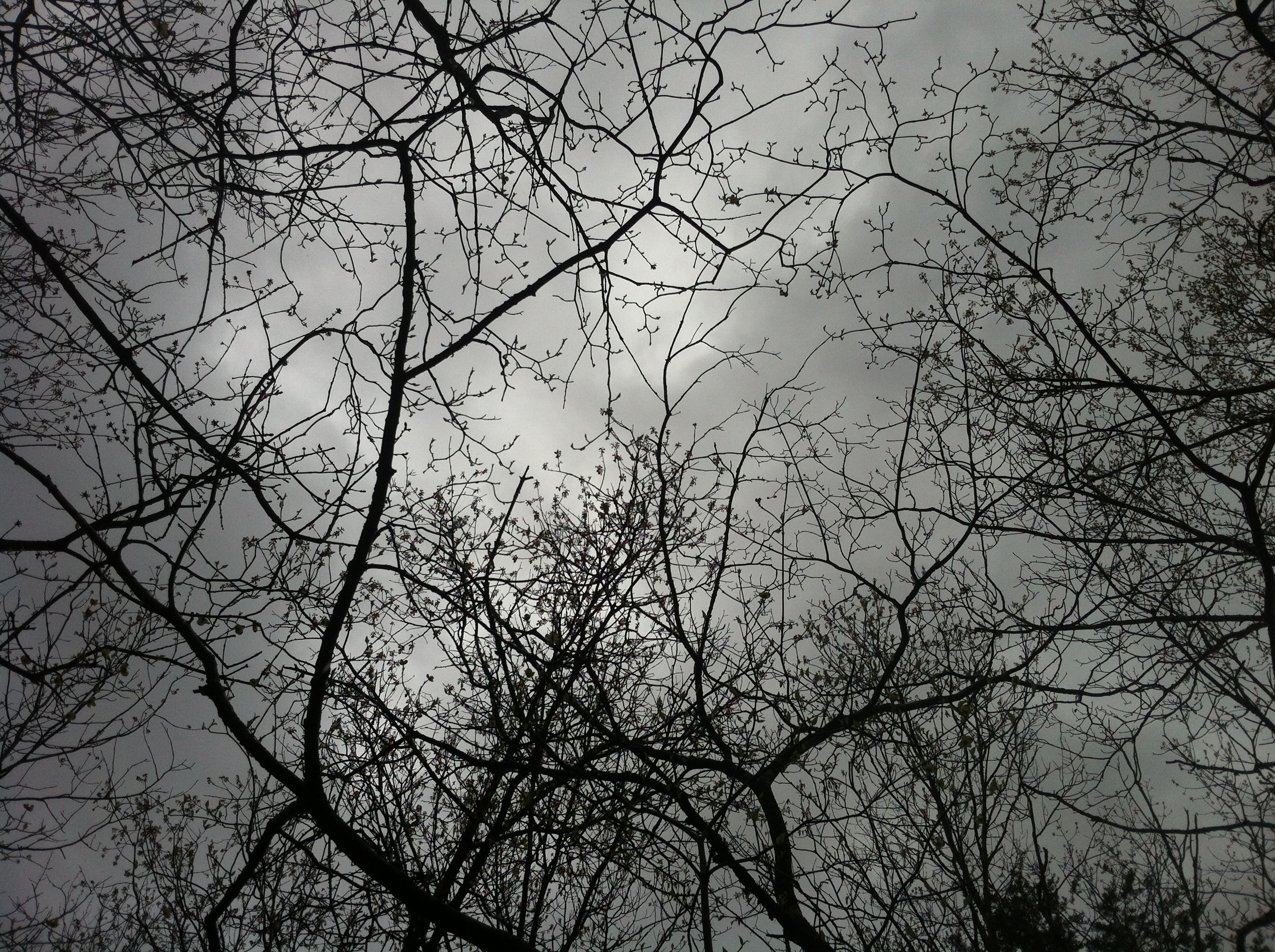
This is NOT a black and white picture, it is actually how the day looked just this Tuesday. I thought: “this looks as gray as I feel right now…”

And, I also thought about this quote by Robert Kennedy Jr. as quoted in the book Last Child in the Woods:
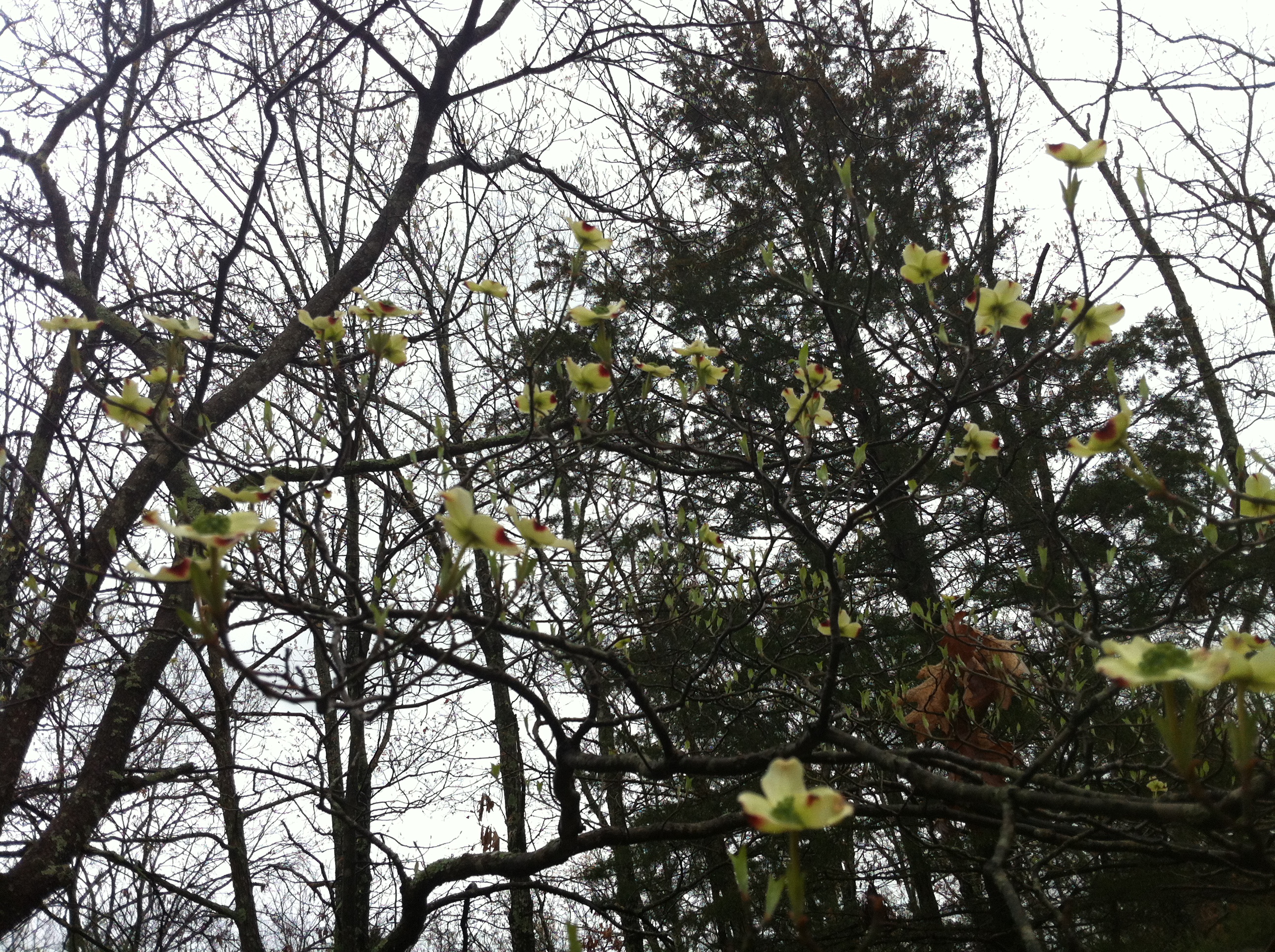
“‘We’re part of nature, and ultimately we’re predatory animals and we have a role in nature…and if we separate ourselves from that, we’re separating ourselves from our history, from the things that tie use together. We don’t want to live in a world where there are not recreational fishermen, where we’ve lost touch with the seasons, the tides, the things that connect us—-to ten thousand generations of human beings that were here before there were laptops and ultimately connect us to God.’ We shouldn’t be worshipping nature as God, he said, but nature is the way that God communicates to us most forcefully. ‘God communicates to us through each other and through organized religion, through wise people and the great books, through music and art,’ but nowhere ‘with such texture and forcefulness in detail and grace and joy, as through creation…And when we destroy large resources, or when we cut off our access by putting railroads along river banks, by polluting so that people can’t fish, or by making so many rules that people can’t get out on the water, it’s the moral equivalent of tearing the last pages out of the last Bible on Earth [emphasis mine]…Our children ought to be out there on the water…This is what connects us, this is what connects humanity, this is what we have in common. It’s not the Internet, it’s the oceans.” (page 198)

During week nine, I also got thealogical about chickens:

I’ve said before that baby chicks are one of the things that make me believe in “the Goddess.” Maybe that sounds silly, but when I sit before a nest and see the bright black eyes and soft down of a new baby chick, where before there was just an egg, I feel like I am truly in the presence of divinity. This, this is Goddess, I think whenever I see one. There is just something about the magic of a new chick that brings the miracle of the sustaining force of life to my attention in a profound way. (New babies of all kinds do it for me, but there is something extra special about chicks!) Of course, when several died, I couldn’t help but feel sad about all of that work and that wasted potential and how that little baby had come so far only to die shortly after hatching, but that, to me, is part of Goddess/Nature/Life Force too. I do not believe in a controlling/power-over deity who can give life or take it away at will or at random. I know that things just happen, that the wheel keeps turning, and that while that force that I name Goddess is ever-present and able to be sensed and felt in the world and in daily life, it/she does not have any kind of ultimate “control” over outcomes.

This was a really, really long way of saying that I want to keep writing regularly about my “woodspriestess” observations as I continue my year-long experiment with visiting the same place in the woods on daily basis. I found something I was seeking in the interplay between visit, spoken word, and written exploration and I think it is something worth continuing.

Here I bear witness to the universe singing its praises…

March 2013 071

Categories: Goddess, nature, spirituality, thealogy, Thursday Thealogy, woodspriestess | 4 Comments

Woodspriestess: Nature’s Blessings

Blessed by wind 20130403-162339.jpg
and blessed by rain
blessed by love
and blessed by pain.

Blessed by tree
and blessed by land
open heart
and open hand.

Hopeful spirit
drawing near
Goddess presence
is felt here.

Open up
open wide
rest with courage
peace inside. 20130403-162408.jpg

Breathe in deep
feel heart beat
blessed stone
beneath feet.

Listen, watch
learn and more
today, tomorrow,
from the core.

Blessings of the earth
and soul
Nature’s blessings
keep us whole.

I’m not usually a rhyming type (at least in the woods. I have a tendency to annoy my kids by singing a little ditty at home that includes the phrase, “and it was rhyming time!”), but sometimes things surprise me and rhymes emerge after all! I’ve been missing my daily writing practice a lot. I hadn’t realized in full what it had added to my daily woodspractice. I’m writing more about this for my post for tomorrow. Today, I’m taking a day off from class work and I’m doing the other things that I want to do. I read to my kids, I played with my toddler, I packed for a trip, and got dinner started. I planned a gazillion blog post ideas. I made a baked sweet potato for my lunch. I haven’t checked in with my classes once and I think that is okay. Surely I deserve a day off from classwork, right?!

I also walked my labyrinth…

20130403-161633.jpg

Visited my baby’s memorial tree:

20130403-163955.jpg

Noticed the tulips’ progress:

20130403-161648.jpg

And, I’ve been working on a little travel altar to take on my trip. (no picture yet)

20130403-161702.jpg

Categories: blessings, chants, nature, poems, spirituality, theapoetics, woodspriestess | 2 Comments

Woodspriestess: Stoneflower

March 2013 139

Like flower growing from rock
the world is full of tiny, perfect mysteries.
Secrets of heart and soul and landscape
guarded tenderly
taking root in hard crevices
stretching forth
in impossible silence.

Sleeping
resting
waiting
watching
knowing
that all one needs
is a crack in stone
and a seed of possibility…

On Friday evening, when I went for an unexpected walk through the woods with my husband and daughter, we discovered something that delighted and thrilled me and seemed like a perfect symbol of what I’ve learned from my time in the woods this March. It was rock with a small, perfect flower growing out of it. Difficult to take a picture of there in the leaves, I was so stunned by its beauty that I could hardly leave it…

March 2013 140

The rock also had this cool swirly pattern that looked like a galaxy or universe, but in the picture looks more like a face!

Over the last 31 days, I entered this woodspace in many different ways. Angry, disappointed, sad, joyful, satisfied, tired, hopeful, prayerful, celebratory, creative, grieving. And, I left each day with a sense of inner peace and stillness, of quieted mind, restful body, and connected soul, if only for a few moments. While I’ve been maintaining my daily practice since January, what I’ve learned from the last 31 days of this blogging-every-day-project—the commitment I made to write each day about the changing tapestry of the woods each and every day of March—is deeper and broader than when I was going to the woods without the accountability of writing. While at times I’ve felt like I needed a break from feeling “forced” to write and laughed at myself over the self-imposed to-dos I too often layer upon myself, I’ve learned a lot. During this month I’ve learned that it is okay to be spiky, that it is okay to have a lot to write about and not a lot to write about. I’ve learned to do it anyway. I have learned about the value of this woodspriestess time as a spiritual practice. I’ve learned to move it forward in my day, to spend longer at it, and to make it a top priority. I have learned to pay attention and that I can always see something new. I have challenged myself to always see something new, to learn something new. I have learned that lessons come from sometimes the most surprising and unwelcome of experiences. I have noticed what shares the earth with me, the things that fly, the things that crawl, the things that walk. I’ve bonded with the trees. I’ve recalled that rocks sit around developing powers and wisdom. I’ve composed words I’ve gone on to use more publicly and in ritual.

I’ve realized that the spoken poetry of the forest is its own gift, its own language, its own way of exploring the world around me and that sitting March 2013 031on a rock with a recorder instead of at a computer or with a notebook, unlocks something creative in me in a unique way. I have meditated on the crone, the maiden, and the mother. I have asked questions about hopelessness and despair. I have listened. I have received answers. I have discovered questions. I have come to a more full understanding of my own place in the tapestry of life. I have had clarity and much as everything changes, I have yet to leave the woods with less clarity than that with which I entered. I’ve discovered ways in which my children can come with me and I’ve discovered ways in which children scatter my attention. I have blessed many sculptures. I have prayed for strength, safety, and guidance. I’ve asked for blessings on my work, tasks, and rituals. I have been ragged and I have danced. I have been forlorn. I have been buoyant and exuberant. And, I have watched it all. I have seen winter drift towards spring and then back towards winter and then back towards spring again. I have planned. I have actively witnessed and engaged in that invisible web of incarnation; consciously touched my thread in Her weaving. I have listened to my breath, felt my pulse, watched my thoughts, and gazed at the sky. I have held space. I have held hopefulness. I have held children. I have created art. I have been moved to tears. I have laughed. In this microcosm of the planet, I have touched eternity. I have tasted truth. I’ve discovered a means of touching my soul. I’ve cultivated an authentic and rich spiritual home and identity. I have been sheltered. I have listened and been listened to. I have heard and been heard. I have seen and been seen. I have known and been known. I have been witnessed into being and I have witnessed so carefully. I am a woodspriestess.

Thank you for the many blessings of this time and space. Thank you for witnessing me, thank you for hearing me, thank you for seeing me, thank you for helping me.

“As long as the Earth can make a spring every year, I can. As long as the Earth can flower and produce nurturing fruit, I can, because I’m the Earth. I won’t give up until the Earth gives up.” ~ Alice Walker March 2013 033

“This little patch of earth and this little pile of stones; I can wash the dust off my face and skin, but this earth is in my bones” – Ralph McTell

“…A big rock is a good place to sit and worship, looking out at the world. That feeling you feel, when you see the woods, the ocean, a flower, is the first-fruits offering of worship. The natural world, not the [human]-made world, provides us the right proportions, the right perspective. By naming that for your children, you claim worship as a common human experience…” –Gina Bria (The Art of Family: Rituals, Imagination, and Everyday Spirituality, p. 73)

“The essence of the spiritual path lies only in the beauty of the ordinariness, in the mundane, and in the freedom of separation between the spiritual and the ordinary.” –Dr. Thynn Thynn

As I was speak-writing the above, I was suddenly jolted by seeing my dog chewing on one of my precious sculptures. I must have left her behind after taking pictures one day and not noticed. Luckily, she’s still okay!

March 2013 036I also paid special attention to the maple that grows there out of the priestess rocks, thinking of how it too was once a tiny seed that eventually split rock, strongly and intimately entwined with its landscape.

March 2013 027 And, connecting multiple experiences, today we found the tiniest and most delicate of small green plants growing in one of the drain pipes in our not-yet-fully-set-up aquaponics greenhouse.

March 2013 018

Felt like a sign that things will definitely grow here, whether we try or not!

March 2013 137

Tender green shoot in unlikely place
Tenacious tapestry of life
This weaving unfolding before my eyes
This is my religion.

Categories: nature, poems, quotes, spirituality, theapoetics, woodspriestess | 7 Comments

Woodspriestess: Women’s Circles

“I see a chain of women, each listening to each, being present to her as she waits
for her Self to be born, for her feeling values to come to form and to birth…
Woman after woman, being present, as each finds her voice”
Judith Duerk: Journey to Herself

“The calling a woman feels to gather in Sacred Space with other Sisters starts first as a low and slow warmth that begins to burn. If left unfed, it rises quickly to a raging fire of desire. It will not be denied and can only be quenched by the nourishment of Truth, Candlelight,
Song And Sisterhood”
Ayla Mellani ~ Founder of Chrysalis Woman

“You will be teachers for each other. You will come together in circles and speak your truth to each other. The time has come for women to accept their spiritual responsibility for the planet”
Sherry Anderson & Patricia Hopkins ~ The Feminine Face of God

quotes via Chrysalis Woman

In February 2010, I bought the Rise Up and Call Her Name curriculum from the UU Women and Religion store. I listened to the CD that came with the curriculum over and over during one of my darkest personal experiences, the experience of my second miscarriage, and it spoke to me deeply at a time when I needed it and when I was not able to be “heard” in any other manner. It was at this time that the shift in my life’s focus became apparent to me, from birthwork to women’s life cycle work, and priestess work. I dreamed of facilitating the series of classes, but it took me until this year to actually make that dream a reality. We’ve been having quarterly women’s retreats locally since the end of 2010 and I’ve facilitated the Cakes for the Queen of Heaven series a couple of times as well as Meetings at the Moon for mother-daughter pairs, but Rise Up kept waiting in my closet. This year, I decided to offer it as a year-long once-a-month class, rather than as a 13 week series. I thought this made sense in terms of people’s busy schedules and ability to commit. As it turns out, committing to something once a month for a year may also be asking too much of many women and only a small handful of women made the commitment. We now have just a little circle of six, but we’re doing it and it actually feels like the perfect group after all (I’m easily seduced into bigger-is-better ways of thinking about groupwork, even though smaller groups can be much more rewarding experiences!). This afternoon was our March class and it really felt like it “healed” me from my disconnect, separation, can’t listen/reach out the way I wish to, feelings from my “making a place for others” post on Wednesday. My post from Wednesday was very much an artifact of not having any time alone to regroup from several stressful, too-busy days in a row. This afternoon before the Rise Up class, my parents had my kids over and I spent some time first down in the woods visiting the rocks further down the hill, including these that form a lovely circle…

March 2013 069

On my way back to the house, just look at what popped out at me from the ground…

March 2013 071

This is one of the “stepping stones” on the way to the priestess rocks. I can’t believe I’ve never noticed her before! When I came in, I put on the Rise Up CD and worked setting up a springtime altar. When I lay out an altar, I often kind of force myself to include the “right” objects representing the four directions. This time, I decided to just put on the altar what wanted to be there and what communicated something about the purpose of the day. I loved the result! It was one of my favorite circle altars so far.

March 2013 086

Altar with addition of springtime daffodil from my mom, rearrangement of many things by toddler daughter, and eating of fig cookies as part of the “ingathering” ritual…

March 2013 077

Circle round
circle round and celebrate
circle round and sing
circle round and share stories
circle round and reach out a hand

circle

no beginning
no end

In my college classes, I often tell my students that in working with people, we need to learn to think in circles, rather than in lines. Circles are strong. Circles are steady. Circles hold the space, circles make a place for others. Circles can expand or contract as needed. Circles can be permeable and yet have a strong boundary. Linked arms in a circle can keep things out and show solidarity. Linked energy in a circle can transform the ordinary into sacred space. Hands at each other’s backs, facing each other, eye level.

In the woods, I offered this prayer for our circle:

May our circle be strong
may our circle be harmonious
may our circle be steady
and may our circle grow and change

please guide me as I priestess this circle today
please help me to see, hear, and honor those within the circle
help me to act with love in my heart, hands, and mind
help me to guard the energy of this space
help me to facilitate sacred connection

let us all act as sisters
as companions and friends
hold hands
hold the space
hold each other…

I also chose the following reading to use following the “ingathering” ritual at the opening of the Rise Up class. We did it as a responsive reading (i.e. I read each line and then the group repeated it). It felt perfect!

I am a woman,
a human being of extraordinary strength, wisdom, and grace.
My woman’s body was created in the body of a woman.
I am daughter, sister, mother
in thousands of generations of women…
I am a woman,
part of and the whole of the first circle,
the circle that transcended space and time,
the circle of women joined.
–Ann Valliant and Kathleen Klimek (in Open Mind by Diane Mariechild)

I had such a positive, happy feeling after the close of our class. I did not feel drained or as if I’d been doing too much or giving away too much of my energy. I felt nourished, healed, connected, and satisfied. In February, when I took my annual computer-off retreat, I had the realization that a lot of the scattered and distracted feelings I experience are more often related to children and parenting than to technology (I’d been blaming technology, but with the technology off, I realized it was actually the kids!). And, today I had a similar realization—that perhaps I often feel drained by people contact as well as scattered, distracted, and unable to fully connect, because I’m usually trying to do that and mother at the same time. While mothering is fulfilling too and my kids are certainly extremely important to me, oh my goodness it was just a delight to spend time with these friends today just us, with no kids asking us for anything. It was much easier to see and be seen, to hear and be heard, when there were no other needs to fulfill but our own!

Right as everyone was leaving, I remembered I’d wanted to offer aura photographs via a little app I’d gotten for my phone quite a few months ago… March 2013 091 I would not really place a lot of stock into its authenticness, but it was really fun and actually surprisingly on target!

After everyone left, I headed back down to the woods with my husband and daughter. We went on a spontaneous ramble through the woods and made many cool discoveries that I will have to write about in a later post…

March 2013 094

stepping out on an adventure…

Categories: community, friends, nature, prayers, priestess, ritual, spirituality, womanspirit, women, women's circle, woodspriestess | Leave a comment

Top Thirteen Most Influential People in Goddess Spirituality

Earlier this month I was very interested to see a series of posts on Raise the Horns about the top 25 most influential people in the birth of paganism. When I read Mankey’s post, it reinforced my own conception of Goddess spirituality as having a distinctly different lineage and flavor than much of contemporary paganism. His list, while extensive, useful, and accurate, involves a distinct lack of Goddess scholars, highlighting to me that Goddess spirituality IS a different movement and isn’t actually just a Goddess-oriented branch of contemporary paganism. Indeed, almost everyone on his list I’d either never heard of, not read, or don’t enjoy their writing. I immediately started to draft a list of my own and came up with 13 women, which seemed delightfully appropriate. We in the Goddess feminist community have our own path, herstory, and lineage, one that really only began in the 1970’s in direct connection to the feminist movement, rather than the pagan movement.

Not necessarily in a particular order, here is my own list of the top thirteen most influential people in the development and articulation of Goddess Spirituality as its own distinct path. (I’ve been scrambling to finish collecting my thoughts in time to post this list while it is still Women’s History Month!) Only one of my own picks also appears on Mankey’s list. December 2012 097

  1. Carol Christ–this feminist scholar is the most skillful and intelligent thealogian of the present day. Christ’s influence on my own ideas and concepts has been profound. Her work is academic, focused, and deep, and she wrestles with heavy questions. I particularly enjoy her books Rebirth of the Goddess and She Who Changes. A brilliant, thoughtful, amazing writer, Christ’s essay Why Women Need the Goddess remains, in my opinion, one of the most important and influential articles of our time.
  2. Merlin Stone–author of the classic When God was a Woman, this professor of art history changed the landscape and understanding of ancient cultures and their relationship to the Goddess (and, yes she drew on the work of Murray and Graves, but moved into feminist thealogy rather than pagan practice).
  3. Riane Eisler—author of The Chalice and the Blade, she made a significant contribution to the understanding of the history and development of patriarchy as well as offering a solution in the form of a partnership model of society.
  4. Marija Gimbutas—scholar and archaeologist and author of several books chronicling Goddess figurines from around the world, including The Language of the Goddess, her work has come under scrutiny and criticism, but remains a potent contribution to the lineage of the Goddess movement.
  5. Starhawkthe first of two on my list who bridge the gap between more “classic” paganism and feminist spirituality, Starhawk had a huge impact on the development of a female-oriented spiritual tradition. Her book The Spiral Dance was the first introduction to the Goddess for many women. In keeping with what I find to be a personal lack of click with a lot of pagan authors, I did not particularly enjoy The Spiral Dance and actually read it much later than most of the other books about feminist spirituality that I reference in this post, but regardless of personal taste, her influence on the Goddess movement is profound.
  6. Z. Budapest—considered by many to be one of the first mothers of the feminist spirituality movement in the U.S., like Starhawk, Z’s writings are not my personal favorite resources because of their heavy Wiccan orientation, but they are undeniably classics in Goddess circles. Z has taken heat from many pagans for her position on transgender people.
  7. Patricia Mongahan–recently departed author of Goddess-specific resource books like The Goddess Path and Wild Girls, Patricia’s writing is more practical and less scholarly/thealogy-oriented than some of my other favorite authors. March 2013 086
  8. Monica Sjoo—radical artist, ecofeminist, and Goddess scholar, Sjoo wrote The Great Cosmic Mother and one of my other favorites, a critique of New Age spiritual paths called New Age Armageddon. Her classic and awesome painting God Giving Birth narrowly avoided ended up in Court on the charge of “obscenity and blasphemy.”
  9. Hallie Iglehart—while less well-known and influential than some of the other women on my list, Hallie was personally very impactful to my own Goddess path, since her books were some of the first, personal and experientially-oriented Goddess-specific books that I read. She is the author of Womanspirit, a synthesis of feminism and religion, and of The Heart of the Goddess, a visually stunning collection of Goddess images and meditations/reflections.
  10. Cynthia Eller—while Eller’s book focused on debunking the “myth of matriarchal prehistory” made her lose popularity among many in the Goddess community (see her clarifying comments here), her scholarly engagement with the complexities of articulating the concepts of feminist spirituality and of thealogy is challenging, illuminating, and offers the opportunity to dig deeply into one’s own perspectives. Her book Living in the Lap of the Goddess is a thorough exploration of women’s spirituality and the Goddess movement.
  11. Charlene Spretnak–another rocking writer with a thorough grasp of the sociopolitical and cultural context, value, and purpose of Goddess spirituality, her classic anthology The Politics of Women’s Spirituality is one of the best and deepest explorations of the concepts, personal experiences, philosophies, and thealogies of why Goddess.
  12. Karen Tatethrough her weekly radio show, Voices of the Sacred Feminine, I would venture to say that Tate is one of the most influential and dedicated “Goddess advocates” of the present day.
  13. Elizabeth Fisher and Shirley Ranck—authors of germinal religious education curriculums focused on feminist spirituality and woman-honoring traditions, originally published by the UU Women and Religion program, their work with Rise Up and Call Her Name andCakes for the Queen of Heaven continues to change the lives of women around the country by introducing them to a vision of what the world could be like if the divine was imaged as female.

Also deserving of mention are:

  • SageWoman Magazine (and her editors)—this specifically Goddess-women oriented publication is a treasure and a delight.
  • Feminism and Religion blog–daring to explore the intersection of religion, scholarship, activism, and community, FAR is not specifically Goddess-oriented, but includes Goddess scholars amongst their contributors and weaves a beautiful, living, organic tapestry of the multifaceted web of feminist spirituality in the present day.

I find that feminist spirituality can be distinguished from paganism because of the inclusion of a core sociopolitical orientation and distinct sociocultural critique. Feminist spirituality to me is the intersection of religion and politics. It is religious feminism. It may or may not include literal experience of or perception of the Goddess, but it names the female and the female body as sacred, worthy, and in need of defense and uses Goddess symbols, metaphors, stories, and experiences as primary expressions of divinity and the sacred.

After originally writing this list, I thought of many more women I should have included and I kept meaning to do a part two follow-up article. I’ve yet to finish that, but this is who I would add…

Six More Influential Women: 1

  1. Shekhinah Mountainwater (pictured at right): tremendous personal influence on my life and work.Original creator of Womanrunes and author of one of my all-time favorite goddess spirituality books, Ariadne’s Thread.
  2. Diane Stein–I particularly enjoy her anthology The Goddess Celebrates and also her book, Casting the Circle.
  3. Vicki Noble–her book Shakti Woman is a powerful and important read.
  4. Barbara Ardinger–if I had to choose a favorite book for ritual resources and goddess spirituality, her book A Woman’s Book of Rituals and Celebrations would be one of those at the top! I also enjoy interacting with her as a sister blogger at Feminism and Religion.
  5. Barbara Walker–author of several goddess-oriented sourcebooks, The Essential Handbook of Women’s Spirituality is another of my favorite resources.
  6. Nancy Vedder-Shults–I first “met” Nancy through hearing her music at a Cakes for the Queen of Heaven training. Her CD, Chants for the Queen of Heaven, was my first-ever purchase of goddess-specific music (I didn’t even know there was such a thing until hearing her songs!). Later, I continued to enjoy her contributions to SageWoman magazine and now through direct interaction on the Feminism and Religion blog.

 Other cool books/honorable mentions:

March 2013 058

Save

Categories: books, feminism, feminist thealogy, Goddess, resources, spirituality, thealogy, womanspirit | 74 Comments

Create a free website or blog at WordPress.com.