resources

Winter Solstice Ritual Ideas

SunInviting Our Light to Shine

When you celebrate the winter solstice,
May your light shine.
When you share love,
May your light shine.
When you work for peace,
May your light shine.
When you teach a child about justice,
May your light shine.
When you comfort someone who is ill,
May your light shine.
When you grieve the loss of a loved one,
May your light shine.
When you are challenged to change,
May your light shine.
When you (add your own intention here),
May your light shine.
Bless yourself with the light.
Your light will shine.
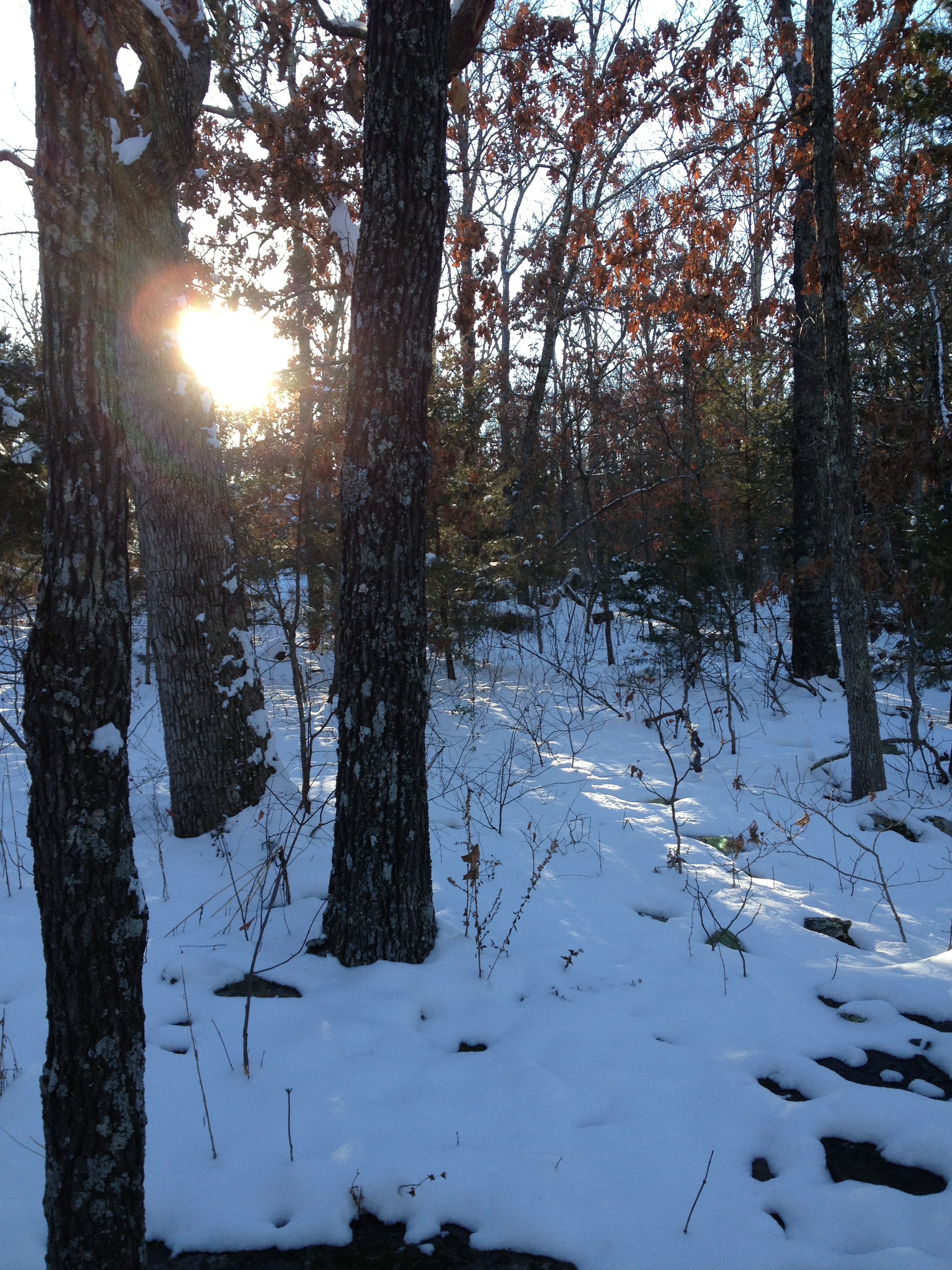
via December Ritual: Winter Solstice by Diann L. Neu | WATER – Women’s Alliance for Theology, Ethics and Ritual.

I have not yet finalized my own plans for our family’s winter solstice ritual tomorrow night. I feel somewhat paralyzed about it and I think I’ve finally figured out that it is because I have too many ideas. I have so many saved plans and possibilities (a 32 page word document to be exact) and I’m having trouble choosing and thus forming a coherent ritual structure that will appeal to everyone. I’m trying to keep clearly in focus the fact that my kids need to enjoy this too and I know that that means more doing and less talking. But, dang it, I want to do some soulful year-in-review reflection and new year planning. I’m going to save some of those ideas for New Year’s Eve, I think, even if I have to complete them alone and maybe save some for our women’s retreat in January. (Note to self: this is a lot of stuff to be working on once. Duh. No wonder you feel a little fried!) I don’t want to do “too much,” but I also want to do “enough” (and enough means to me that I feel satisfied and fulfilled with the experience and not like I’m cutting corners because I’m worried about boring the kids and not frazzled because I’m cramming in too much…hence, my paralysis, because I’m not sure these are compatible wishes!)

So, I thought I’d share my collection of resources that I’m using to prepare for this ritual. I’m posting early today, because I want to make sure anyone who is interested knows that there is a free online solstice ritual tonight from Shiloh Sophia (there is a cool little workbook that comes with it and it is full of the kinds of things I think I envision my own ritual holding—the year-in-review stuff—but that I know from past experience is too much for kids to handle without getting bored. Maybe I can accept that this is something I work on alone at night, instead of expecting it to be a community/family experience): Winter Solstice Super Power Ritual LIVE Event | Shiloh Sophia Studios

I’m also excited about this free, downloadable meditation (which may again be best for my solitary self rather than sharing with ALL THE PEOPLE): Winter Holiday Transformation Guided Journey

And, a lovely short ritual from WATER, already excerpted above: December Ritual: Winter Solstice by Diann L. Neu | WATER – Women’s Alliance for Theology, Ethics and Ritual

My own She is Crone poem appears in the Winter Solstice edition of The Oracle from Global Goddess: Winter Solstice 2013 | Global Goddess

Some assorted other delicious links for you (and me):

I previously shared this helpful link for family celebrations: Pagan Family Sabbats and Esbats | Rituals for moms, dads, and kids to celebrate the 8 Pagan Sabbats and Esbats

I love this exploration of the symbolic meaning of the winter solstice from Glenys Livingstone:

Winter Solstice is the time for the lighting of candles, for embracing the miracle of being, for choosing a joyful response to the awesome fact of existence, for celebrating the Gift of Birth. Birthing is not often an easy process – for the birthgiver nor for the birthed one: it is a shamanic act requiring strength of bodymind, attention and focus of the mother, and courage to be of the new young one. Birthgiving is the original place of “heroics” … many cultures of the world have never forgotten that: perhaps therefore better termed as “heraics2” . Patriarchal adaptations of the story of this Seasonal Moment usually miss the Creative Act of birthgiving completely – pre-occupied as they often are with the “virgin” nature of the Mother being interpreted as an “intact hymen”, and the focus being the Child as “saviour”: even the Mother gazes at the Child in Christian icons, while in more ancient images Her eyes are direct and expressive of Her integrity as Creator.

Winter Solstice and Early Spring rituals may be a contemplation of the Creativity of the Cosmos – Cosmogenesis … how it All unfolds. When told from within a “Mother-mind” – a mind that connects the biological creativity of the female body to Cosmic Creativity, to our “Navel” lineage, to the Nativity of every being, then we are all the Holy Ones. And we all – female and male – may know the skill and care required for “birthing” the New, whether that is physical, psychological or however one categorizes it. In Earth-based religious practice, the ubiquitous icon of Mother and Child – Creator and Created – expresses something essential about the Universe itself … the “motherhood” we are all born within (not simply a “brotherhood”). It expresses the essential Communion experience that this Cosmos is, the innate and holy Care that it takes, and the reciprocal nature of it: that is, how one is always Creator and Created at the same time. We cannot touch without being touched at the same time. We may realize that Cosmogenesis – the entire Unfolding of the Cosmos – is essentially relational: our experience tells us this is so.

The Early Spring/Imbolc celebration is traditionally a time of dedication to the nurturance of the New Young Being. Once again, this is no wimpy task: it 20131028-184958.jpgis for the brave and courageous, whether one is committing to the new being in another or in one’s self. The Great Goddess Brigid of the Celtic peoples is traditionally invoked for such a task. She has been understood for millennia as the One Who tends the Flame of Being: a Brigid-ine commitment is one that is unwavering in its devotion to the central truth of each unique particular self. The stories of Old speak of Brigid in three primary capacities – that may need spelling out in our times, as they are almost forgotten skills: She is imagined as Blacksmith, Physician and Poet … all three.

Blacksmith is one who takes the unshapely lump of raw metal, melts it, then takes the fiery hot form and shapes it … this is no stereotypical “feminine” act: the Goddess of Old is not bound by such patriarchal dualisms. She is spiritual warrior, shaman – this is Her eternal Virgin quality, never separate from the Mother quality or the Old One quality, and no need to characterize such power as “masculine” or dissociate it from “nursery” activity.

Physician is one who understands the “physics” of being, of matter … how a body relates within itself and within its context, functions harmoniously and thus may heal/whole. In this role, Brigid is scientist, healer … none of it separate. Her physics is biologically connected – an understanding of dwelling within a whole and seamless Universe.

Poet of Old is one who speaks the metaphors, the stories of cultural knowledge, the sacred language of Creativity – one who “spells” what may be so. It is a power of spirit: the voice enabled by air, resonant with the winged ones – the birds – whose perspective transcends boundaries. The ancients knew Poetry as a sacred and powerful task – that with our words, we do create what is so. Brigid’s “motherhood statements” are statements of the Mother/Creator, Who once again is never separate from Her whole self – the Young One and the Old One – represented in the Triple Spiral dynamic.

The coming into Being that Winter Solstice and Early Spring celebrates, is an awesome thing. It takes courage and daring. It has taken courage and daring – always. In these times of change, it is perhaps particularly so. Our times require the melting down of so much that no longer works, that will not carry us through. These times require the re-shaping and speaking of new realities – an aboriginal magic of new connections, with what is already present within us, if we can but plumb it, open to it deep within. This is a great seasonal moment to get with the plot of Creativity, to align ourselves with our Native Wisdom …the Wisdom that in fact brings us all into being. We may re-spond to the gift of being by receiving it graciously – and thus become re-sponsible. Though we may feel inadequate, we are not – and we need to begin…

Winter-Spring Earth Wisdom | PaGaian Cosmology

And, I breathed deeply when I read this great suggestion from Tracie Nichols:

Get back in your body. I use this meditation to do that.

Listen for which part of your body would like to speak. If it doesn’t show up immediately, listen some more. Still got nothing? Stop checking your phone and listen again. It WILL make itself known.

Open with a kind and loving statement (see mine above for inspiration) so you are consciously committing to listening and letting your body know how much you love and respect her/him.

Record your conversation with whatever method of creative expression you like best. Journal. Poetry. Art. Dance. Music. Whatever works for you.

Say “Thank you!”

Decide if any action needs to be taken, and take it.

via How not to implode during the holiday chaos… » Tracie Nichols.

My “productive” mode says: keep working, design a fabulous ritual! But, my hungry belly that hasn’t yet had breakfast says: feed me. Please! So, that’s what I’m going to do 🙂

May you enjoy a rich, peaceful solstice with your own family and loved ones! May you be blessed by light and may you find wisdom and solace in dark, deep, places. Do not get so distracted by the promise of the light that you forget the great value in endarkenment as well.
Categories: blessings, community, endarkenment, family, holidays, liturgy, parenting, prayers, priestess, resources, ritual, self-care, spirituality | 2 Comments

Let’s Hear it for the Men!

A lot of my work focuses on women and has for many years. I don’t actually feel any particular need to rationalize, explain, or justify this—working with women is December 2013 011something that has held deep meaning, relevance, enjoyment, passion, and purpose for me ever since I started working in a battered women’s shelter as a volunteer when I was seventeen years old. My age has since doubled and the type of work I do with women has morphed, expanded, shifted, and changed texture over time, but it is a strong, defining, consistent thread that is tightly woven through my professional life, my academic work, my volunteer work, my teaching, and my spiritual path. I’ve noticed, however, that people occasionally misinterpret my focus on women and my enjoyment in creating rituals for women, for honoring “women’s mysteries,” and for exploring thealogy and the Goddess, as well as helping women with birth and breastfeeding, somehow indicates that I don’t value men. My enjoyment of priestessing women’s circles is not a statement about men, it is a statement about something I like to do with my time and life energy. I also value and appreciate my husband, my sons, my dad, and the other men in my life. I have family full moon rituals each month with my husband and our kids (two sons, one daughter). My dad, husband, and sons enjoy our annual family winter solstice ritual. My husband and I work together making our goddess jewelry and I love that this collaborative project represents a harmonizing of our energies, efforts, and time.

I agree with Melissa Raphael’s remark that, “Thealogy has no wish to simply reproduce the masculinist account of divine sovereignty and redemptive power in feminized form” (p. 201). To me this is one of the most beneficial and beautiful elements of Goddess feminism.” And, from Judith Laura’s book, Goddess Matters, she describes Goddess as “she who flows through all” and contrasts this with “God as manipulator.” Goddess is “She what connects us, not only like a link in a chain but also like an electrical current.”

These things said, I’ve been meaning for several months now to give a shout-out to the male bloggers that I very much enjoy. I subscribe to a lot of blogs. I like a lot of writers, but there are only a handful from whom I read every post they write as soon as they post it. These three guys definitely make that list:

  • John Beckett writes Under the Ancient Oaks on Patheos. He initially appealed to me because he is associated with a UU church and we have that in common. I continued to read him though because he is very logical, solid, practical, and even-handed in his writing and interaction with others, with a nice dash of interesting polytheistic stuff thrown in. One of his recent posts about pagan unity is a good example of the practical style I find so appealing about his blog:

I prefer a Big Tent approach to Paganism – a big tent with four main posts. Some of us are right in the middle, some cling tightly to only one post, while others are in one of the corners. Some people are close enough for me to see them but not close enough for me to tell if they’re actually under the tent or if they’re standing outside. What about Green Christians? I think they’re outside, but their fundamentalist brethren over in the next camp think they’re standing right in the middle of us. What about the Kabbalists? I think they’re in, but many of them say they’re only in the Jewish tent. The Hindus are over in that corner – some of them are insistent they’re in our tent and others are just as insistent they’re not.

Complicated? Yep. Messy? Sure is. Living, growing, reproducing organisms are like that.

The problem with big tents is, well, they’re big. Try to embrace the whole tent and you can find yourself bouncing back and forth between pouring libations to Zeus, protesting fracking, organizing the Beltane picnic and meditating on The Fool. Those are all worthwhile things to do, but they can lead to a personal religion that is the proverbial mile wide and an inch deep. That’s a problem – if you’ve been reading Under the Ancient Oaks for any time at all you know one of my favorite soapboxes is the need for spiritual depth.

via Pagan Unity.

  • John Halstead writes The Allergic Pagan (as well as another blog at Witches and Pagans and for Humanistic Paganism). He’s willing to tackle somewhat controversial issues and engage in intelligent conversation and debate. He never fails to make me think and is just a really smart guy with a lot of interesting stuff to say. I recently shared this quote in a different post, but trust me that he has lots of posts that rank as thought-provoking favorites:

This is your Goddess,” my wife said to me smiling.

“It’s the slimy side of her,” I responded.

“This is life,” she replied.

It’s strange when a seemingly mundane moment is transformed into a sacred one. I looked at my Mormon wife standing in the ocean, holding a shell, and I heard her speak the words of a true priestess: “This is your Goddess. This is life.”

via My Goddess is gross.

  • Jason Mankey is the often light-hearted and funny, but not afraid to be serious and occasionally blunt, author of Raise the Horns at Patheos. I love the way he writes about ritual, modern paganism, personal practices, and the way he digs into holiday origins. One of his recent posts that really spoke to me was this one:

In our own practice becoming a High Priestess and Priest was not something we aspired to. It came about because people viewed the two of us that way. I’ll admit to even being uncomfortable with the title on occasion. I have a thirst for knowledge and history and write pretty good rituals, but there are many Witches and Pagans who know so much more than I ever will. That a few people think of me in such august company is flattering, but I often feel like I don’t belong. (I got weirded out when one of our coven members referred to me as “a spiritual leader,” I’m much more comfortable just being the guy who drinks cider and listens to 80′s hair metal.)

Even with my occasional reservations about the title I feel like I’ve earned it, and I know my wife has earned her title of High Priestess. How do you know you’ve earned the right to call yourself a High Priestess or High Priest? You’ve earned the title when someone asks you to officiate their handfasting or wedding. You’ve earned the title when every eye in the circle glances your way looking for instruction or guidance. You’ve earned the title when your High Priestess deems you ready for elevation. It’s an honor that finds you, and it finds you when you are ready.

via Becoming a High Priestess.

When I first began writing this post back in October, Teo Bishop would definitely have been on my list as well. I really enjoyed his contemplative, gentle, personal, enriching style of writing. If you follow pagan bloggers at all, you’ve probably surmised that something happened and it involved Teo Bishop. If you follow me and read my other blog, you also know that I, personally, spend virtually zero time talking about “current events” and/or controversies within either of my primary fields. I call this dissecting of current events a “putting out fires” mode of blogging and I just don’t like to do it myself. It seems reactive in a way that bothers me, and reminds me a bit too much of the dominating, semi-oppressive energy that can spread so fast in other areas/topics (dare I mention Miley Cyrus, for example?). So, I’ll just say that I read Teo’s blog Bishop in the Grove for at least two years. This month he decided to discontinue Bishop in the Grove as he moves in a different direction with his spiritual path. His new path doesn’t hold a lot of interest for me, though his same contemplative writing style is still engaging, he’s no longer speaking in a spiritual language that I find compelling. He should still get a shout-out though, because I’m pretty sure it was his blog that introduced me to interesting pagan men’s blogs I love to read and learn from.

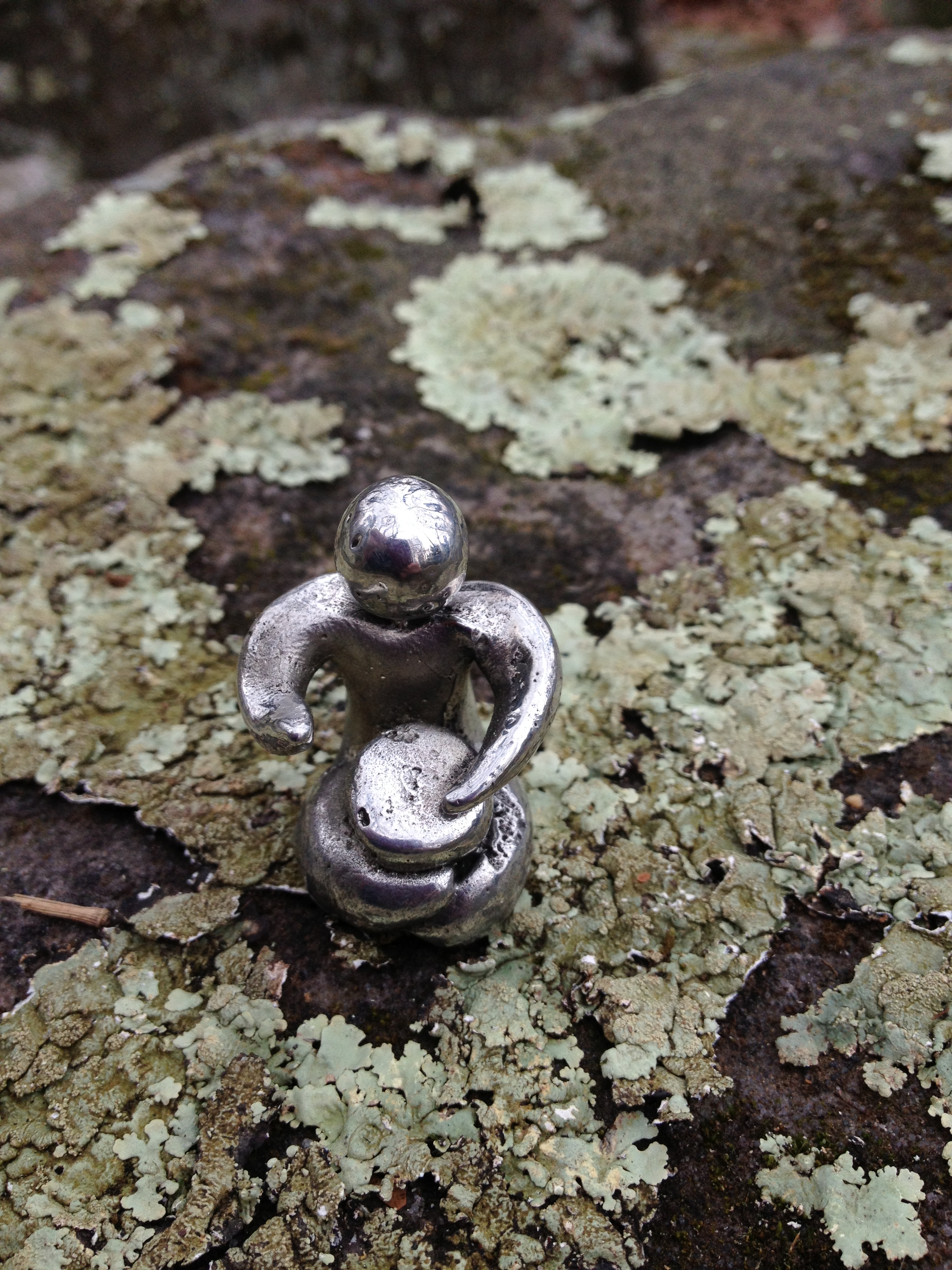
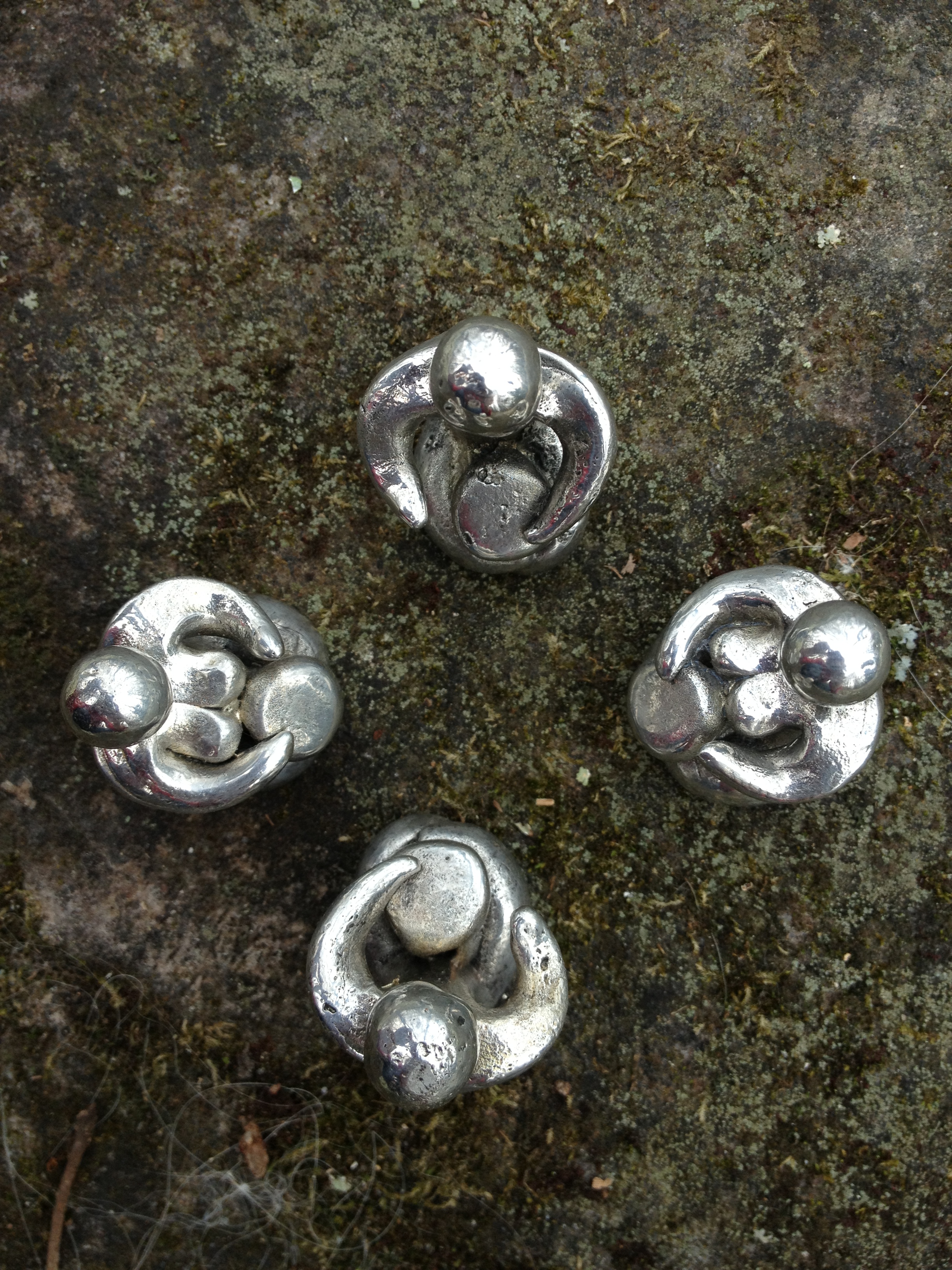
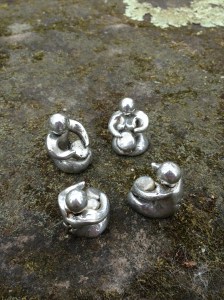
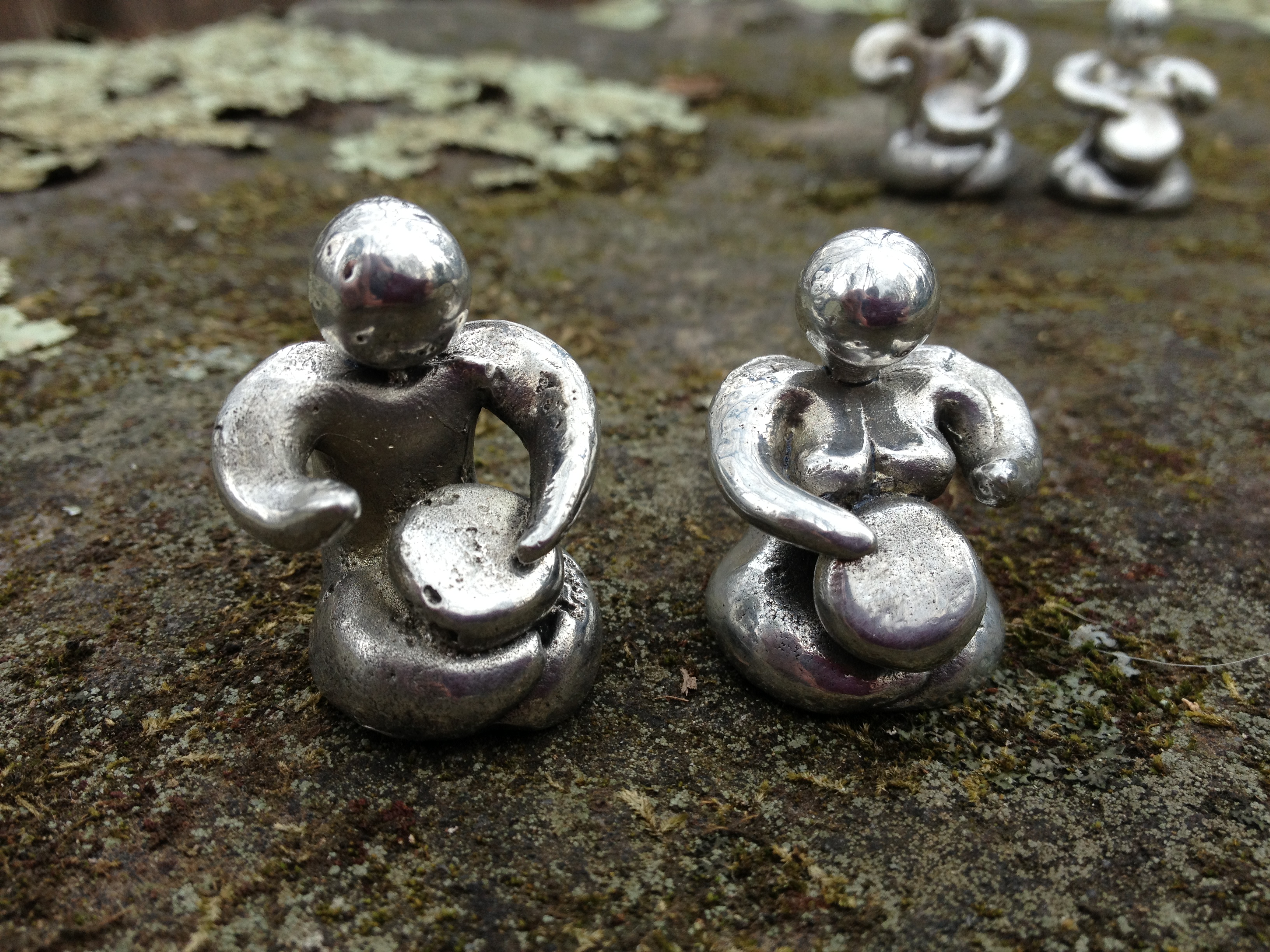
In keeping with the collaborative energy with my husband that I mentioned at the beginning of this post, we’ve been painstakingly finishing up our first ever free-standing pewter casting that is male! While I made a polymer clay “daddy goddess” sculpture before when requested by my toddler daughter, most of my artwork is Goddess/female-centric. After one night of full-moon drumming with my husband and boys, I knew the time had come to introduce some masculine energy into my art and the result was this little drumming team: December 2013 006

The casts are still on the rough side and we’re having a terrible time getting their hands to work correctly. Many, many, many of these little guys have been plopped back into the melting pot for another rebirth (my husband often turns them face down, so he doesn’t have to watch their little “faces” looking up at him as they dissolve). We’re keeping these two sets, but probably need to start over with another sculpt altogether as well as a fresh mold because we do anything more with this design idea. December 2013 005I felt like they were a symbol of our own work together, as well as the harmony possible between men and women in the rest of the world.

December 2013 009

They work together and I like them!

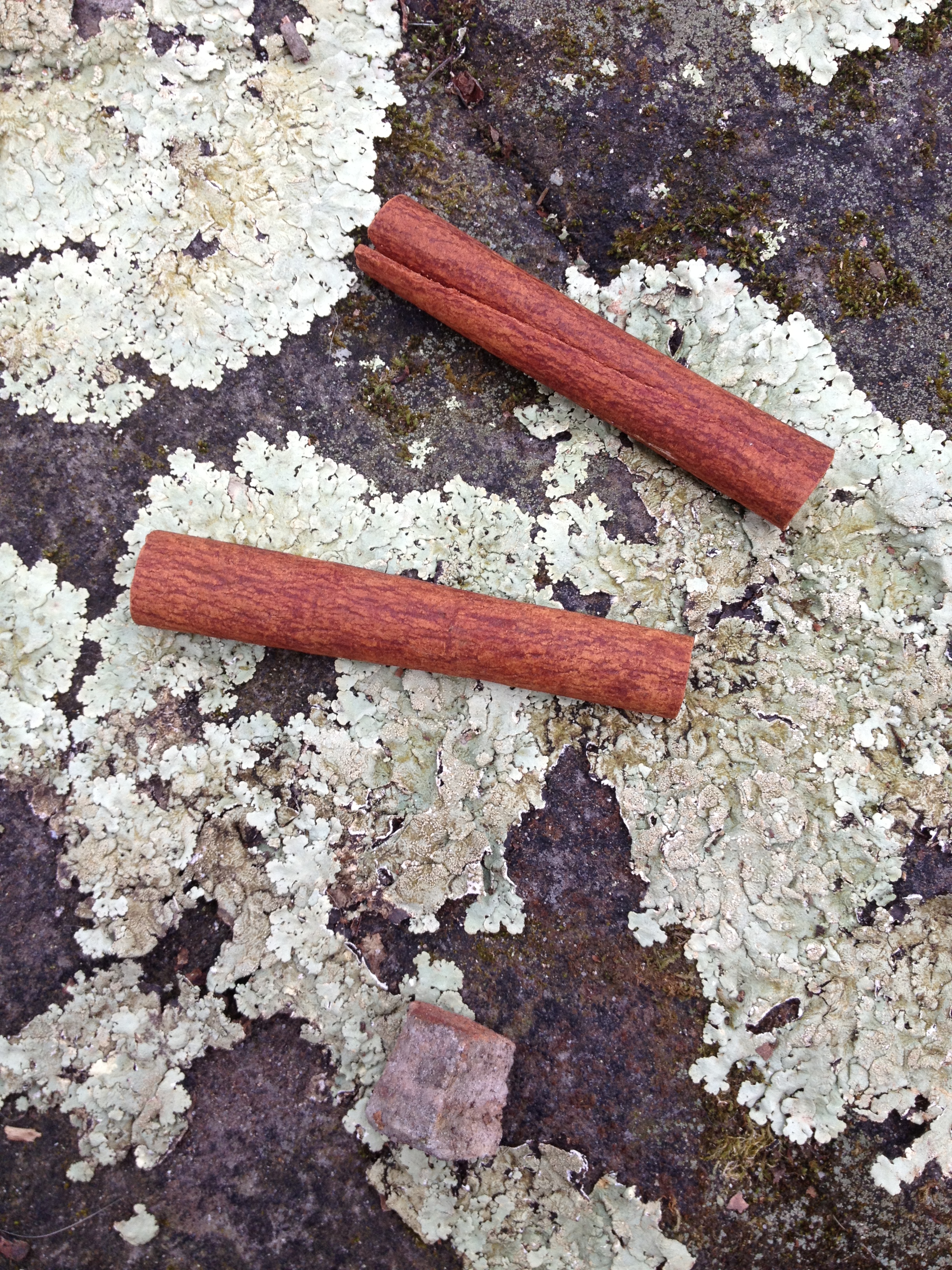
This morning when I went to the woods to take these pictures, the cinnamon sticks I offered up last night were sitting there on the rock in this arrangement evocative of an “equal” sign. I thought that was pretty cosmic.

December 2013 012

Categories: art, community, feminism, feminist thealogy, resources, spirituality, women | 6 Comments

Winter Solstice Playlist

December 2013 064

I was trying to take a different picture in the woods tonight and I believe this is actually a picture of my hair? Thought it seemed oddly suitable for tonight’s post.

Recently I told this little story on my Facebook page about my toddler daughter—I have a Goddess playlist that I usually listen to when I take a shower (among other times). A couple of weeks ago when I got out, the song playing was The Dark by Mary Grigolia from the Rise Up and Call Her Name CD. I really took comfort from this song during my miscarriages and it still feels meaningful to me. The refrain is: “it is dark, dark, dark inside.” My little girl came in and listened for a minute and said: “why her not turn lights on her house? Her say it dark inside!” Anyway, I got a comment asking me to please share my playlist. That is definitely on my to-do list, but tonight I feel like sharing my winter solstice playlist instead! We have a lot of plans and activities coming up in the next couple of weeks and it is time to break out my winter solstice playlist rather than my goddess playlist. A couple of years ago after one too many renditions of God Rest Ye Merry Gentlemen, I decided I had to locate some holiday music that was more in keeping with our family’s own spirituality. So, I searched and I looked and I found the Dolmen’s Winter Solstice album on Amazon music as well as Jaiya’s Winter Solstice album. Some I like a lot better than others (I like upbeat things better than soulful wailing, generally), but here they all are anyway:

My favorite ones are definitely those by the Dolmen, especially Golden Sickel Sunrise, Frosty Solstice Morn, and Bringing the Outside In. The Jaiya ones are more wail-y as well as more traditional (i.e. “God send ye a happy new year”). Invocation to Mother Holle by Ruth Barrett is more of a chant and so might work for a group.

As I was typing this I decided to buy Kellianna’s song Brighid’s Flame on itunes. It isn’t quite a solstice song, but it is about winter and so I’m adding it to my playlist! 🙂

Other suggestions gratefully welcomed. This is all I have!

Categories: chants, family, music, resources, spirituality | 2 Comments

Women’s Mysteries, Women’s Circles

December 2013 024

“Women united in close circles can awaken the wisdom in each other’s hearts.” ~The 13 Indigenous Grandmothers (via The Girl God)

“Feminism catches fire when it draws upon its inherent spirituality. When it does not, it is just one more form of politics, and politics never fed our deepest hungers.” –Carol Lee Flinders (in The Millionth Circle)

Show up or choose to be present.
Pay attention to what has heart and meaning.
Tell the truth without blame or judgment.
Be open to outcome, not attached to outcome.

–Angela Arrien (in The Millionth Circle)

“Women’s mysteries, the blood mysteries of the body, are not the same as the physical realities of menstruation, lactation, pregnancy, and menopause; for physiology to become mystery, a mystical affiliation must be made between a woman and the archetypal feminine. A woman must sense, know or imagine herself as Woman, as Goddess, as an embodiment of the feminine principle…Under patriarchy this connection has been suppressed; there are no words or rituals that celebrate the connection between a woman’s physiological initiations and spiritual meaning.”

–Jean Shinoda Bolen

The final quote above comes from a very helpful resource for priestesses, the Women’s Mysteries Teacher’s Journal, which is available for free online!

I read and enjoyed two relevant blog posts this week as well, the first about women’s capacity to push each other’s buttons and how it can be easier to work with “victims” than “leaders.” Important to consider…

The process of working with one’s own buttons can be very useful in feminist life. From my own experience and from following the news in feminist and Goddess movement I know how easily women’s groups can break up, often due to strong women pushing each other’s buttons. Have you noticed how we find it easier working with the victims of patriarchy and patriarchal religions, than with the leaders of feminist groups? How we find it easier to help, than to cooperate? In this we might fall into a trap of patriarchy and assume the role of a patriarch rather then a feminist leader.

via Buttons and Hooks by Oxana Poberejnaia | Feminism and Religion.

And, the second this priestess pep talk:

She supports and believes in you utterly. All you have to do is trust Her, and keep on showing up.

Because You are Enough.

Always.

Completely.

You are born of magic, a daughter of the Goddess.

You are a Priestess charged with sharing Her blessings, Her beauty, Her power with the world as it manifest through you, you unique thing you, and it is your DUTY to get out there and create that vision, that life, she is inspiring you with…”

via The How to Be a Priestess Pep Talk

I’ve mentioned that I’m looking forward to the new anthology coming out from Goddess Ink and I very much enjoy the snippets from the book they shared on their Facebook page (I also pre-ordered the book!)

Goddess Ink
From “The Kohanot: Keepers of the Flame” by D’vorah Grenn: “How do we move forward from here? Being a priestess can be exhausting. Without proper shielding and protection, women can find their precious energies only going out, and too rarely being replenished. We must continually find new and effective ways to guard against becoming depleted. Every day, we witness the positive, transformative effects of “restoring women to ceremony,“ to use Lynn Gottlieb’s phrase, another reason it is vital that we continue our work. But to do so, we must protect our spirits, psyches, hearts and time25; those who have been spiritual leaders for some time are well aware of the pitfalls of not doing so. Since others rely on our strength and clarity, this is not a task to be postponed or ignored. We must carry and pass on the knowledge of how to take better care of ourselves, along with our spiritual teachings.”

How do you replenish yourself and protect your energy? In this last week as I’ve worked to finish all my grading for the end of the school session, I’ve been aware of how I tend to let self-care go first—I haven’t practiced yoga in four days, keep getting to the woods at 11:00 at night instead of in the morning, staying up until 2:00 a.m., etc. I feel okay about the out-of-balance because I know it is a very short term push that will end soon, but I think I/we must be mindful of this not becoming a regular habit or pattern of being.

There is also this good one about the priestess path and the idea of mastery…

Goddess Ink
From “Models of Leadership” by Ruth Barrett: “A woman on the priestess path must be vigilant in examining the unconscious tendencies and unexamined habits she has learned from her culture. Another unexamined tendency, which is crucial to recognize, is that American culture is in all-out war against mastery. I use the word “mastery” as it is used in the martial arts. Mastering the physical, psychological and energetic skills required to achieve, for instance, a black belt in Aikido is a path that requires discipline, openness to learning and the patience and persistence to work through plateaus. The black belt is not a goal, it is a journey. The journey is the destination. A sensei (master) of a martial arts black belt is still a student. Mastery is a path, not a title or a credential. It is the process of recognizing and achieving potential. So it is with the priestess path. The more I know, the more I know there is to learn and I must endeavor to have an open beginner’s mind.”

The snow is finally melting and this afternoon I went on a dinner date with my husband (as well as finished up shopping for stocking stuffers and for our solstice dinner. Lots of plans for fun food!). I didn’t get to the woods until about 9:30 and enjoyed the company of the full moon for a time in a much warmer-today woods. We did a very small mini-ritual on the back deck together as well, just with our candles, checking in on the intentions we set during the last full moon, making new intentions, and closing with a short prayer.
December 2013 022

Categories: community, feminist thealogy, night, priestess, quotes, resources, ritual, self-care, spirituality, women, women's circle, woodspriestess | 2 Comments

Runes of the Goddess

Some time ago I wrote a post in which I described reading the book Runes of the Goddess while on vacation in California. While there, I picked up smooth beach rocks and brought them home to create my own set of runes based on this book.

To the set, I followed my intuition and incorporated one additional stone from Lady of the Nothern Light: A Feminist Guide to the Runes by Susan Gitlin-Emmer: Ansuz: Mouth. (This book was recommended to me in the comments section of my previous runes post and it is a good resource as well.)

July 2013 024Ansuz, or mouth, is the Goddess as source of all speech: song, history, poetry and the magic in naming and words. She is the source of inspiration, the ways in which Her daughters partake in Her divinity. This is an especially important rune for artists, writers and storytellers, because it means that they are able to hear Her voice clearly. If you are using your creativity in some project, this rune is telling you your vision is true, that it comes from your deepest source. What you are working on is important and it is your job to bring it into being. If Ansuz comes to you in a reading, listen carefully for the voice of the Goddess; She has something to say to you. Listen for Her voice within you. Use Ansuz in your spellwork when you need to hear Her voice and when you need Her to hear you. Ansuz is the power of all naming. Think of the many thousands of names for the Goddess. Speak your own names of power. Remember that She is the source of all being, and honor Her with all you say. Know that all history is fluid, including your own. You can rewrite the stories you tell yourself about yourself, reshape your personal mythology. Call on Her and the power of Ansuz to shape the words of your spells and incantations. Know that speech can call things into being. We cannot conceive of that which we lack the words to describe. Words can limit what we see as possible. Invent new language. Remind others of its power. Sing Her songs in your rituals. Honor and invoke her with poetry.

While it seemed a little simplistic, all I did was draw the runes onto the beach rocks with sharpies and they turned out very nicely
July 2013 023

What I do with my Womanrunes is a type of divination too, but it is pretty simplistic compared to the artform described in Runes of the Goddess. Author PMH Atwater uses a set of 16 runes based on the ancient Elder Futhark runes and she calls them Goddess runes. Each time they are used, the whole set is cast and interpreted. Rather than relying on a single stone for guidance, the whole cast is interpreted based on the pattern and relationships to each other as well as their relationship to the questioner and the question asked. (There are two question stones, one for a male questioner and one for a female questioner. The questioner holds the appropriate stone while thinking/asking their question and then casts them all. The rest of the runes are considered, in part, based on their relationship to where the question stone falls in the spread. In my set of beach rock runes, pictured above, the red stone with no symbol in the upper right is the female stone and the one next to it is the male stone.)

These are two of my first castings in July, one for my husband and one for me). It definitely takes practice to figure out how to interpret them as a whole. July 2013 021 July 2013 018

Categories: divination, Goddess, resources | 1 Comment

Calling the Circle: The Shadow

This post is the fourth in a series, prompted by the book Calling the Circle by Christina Baldwin:

Studying the circle is an imperative aspect of circle work. We can’t keep shadow out of circles in business, or circles in church, or circles in the family; the Gifts for Sagewomen.shadow is not isolatable. When we come into circle and sit down in contained space, pretty soon we see the contents of our shadow reflected back to us around the rim. If we are in a circle that does not acknowledge, respect, and ritualize the existence of shadow in the group, the projections of our ‘not-I’ material accumulate and accumulate until everybody’s closet explodes.

What causes the collapse of circles full of well-intentioned human beings is not the presence of shadow but the repression and denial of shadow, the insistence that it is not among us. Denial of shadow eventually fills the interpersonal field with so much unrecognized and unresolved energy that it is released through explosion or through gradual erosion and undermining of healthy norms.

Most people do not enter the circle thinking about shadow. We enter the circle hoping for light, for shelter, for more efficiency, for a humane way to get things done. But if we do not look at shadow, we create a repeating scenario. Time after time, there is a circle of ‘good’ people who come together with the best intentions and dedication to accomplish a good thing. We are nice to each other. We are often polite and unconsciously conforming. Sometimes one or two people commandeer more leadership, attention, or time in the group than others want, but we don’t know what to do and so we let them. If we are irritated, our dissatisfaction goes underground, covered up with more niceness, or we begin withdrawing our hopes that this will be the circle that really nurtures and protects our fragility or accomplishes our goals. If we are invested in the group, we get angry in our disappointment and begin trying to make others behave. If we aren’t invested, we drift off, showing up less and less often, looking for another, better situation. Sometimes we end up talking with others about a ‘problem person,’ usually not feeling good about our behind-the-scenes behavior but not knowing what else to do.

Personalities polarize between those who seem oblivious to what ‘they’ are doing to the cohesion of the circle and those who are intensely responsive to this discomfort and keep trying to manage ‘the other(s)’ In many of these instances, the concept of the shadow is never introduced into the group, and people do not have the opportunity to live out healthier alternatives for dealing with conflicting energies…our perception needs to shift from polarities of innocence and guilt—‘Look what he/she/they did to me’—to consider what is happening to us, the collective, interconnected body of the circle, and how we continually learn from each other.

Later in the book, Baldwin address the fear involved with healthy participation in a circle and how people may unknowingly act to sabotage it:

  • Someone may obsessively blame the form, coming up with explanation after explanation for why the circle won’t work… [Note: in women’s circles, I see this expressed in a related form of, “women are so hard to work with” and complaints about backstabbing, etc., etc.]
  • Someone may declare that other members of the circles are not safe or trustworthy and refuse to contribute fully until a number of conditions are met. These terms, however, are highly subjective and constantly shifting. No group can prove itself ‘safe’ by the definition of one member; it can only prove itself healthy and responsive to the needs of different people over time.
  • Someone may consistently undermine the self-esteem of others—being hypercritical, reframing other people’s statements, competing verbally, or being overly helpful in a condescending manner.
  • Someone may demand emotional attention that doesn’t fit in the context of the circle; for example, crying until the entire group has stopped to comfort him/her, or raging until the entire group has stopped to placate him/her, or insisting on excessive processing interaction after interaction.
  • Someone may declare him/herself so ‘different’ that s/he can’t identify with the rest of the group–or s/he removes him/herself from peer collegiality through feeling superior or inferior.
  • The entire group may stay locked in the honeymoon phase for a year or more, avoiding the usual breakouts into differentiation. Nope…no shadow here…only incomplete engagement.

She goes on to explain that ALL of us are “guilty” of exhibiting some or many of these behaviors over the years…

“I believe that the thought that women together can change the world is emerging into the minds and hearts of many of us, and that the vessel for personal and planetary evolution is the circle with a spiritual center.” ~Jean Shinoda Bolen

Other posts in this series:

Categories: priestess, quotes, readings, resources, women, women's circle | 1 Comment

Ritual Recipe: Women’s Summer Retreat

July 2013 021

My husband picked these summer wildflowers for our circle’s altar 🙂

Friday afternoon was our quarterly women’s retreat and I’d like to share the outline of our process as well as some reflections in case they are helpful for others…

Summer retreat outline

1. Choose bindis (I got some nice fresh ones that are not stuck to the paper!)

2. Circle up and group hum. We do this at every women’s ritual to unify our energy, to harmonize, to focus our intention and to bring our minds and bodies solidly into the ritual space. I feel like this simple action is what “casts the circle” for our group and is a point of continuity from ritual to ritual that we all value.

3. Invocation (slightly modified from Gathering for Goddess by Melusine Mihaltses):

South: We call on Fire with our flesh. Rub your hands together fast and furious, feel the heat you have generated. Now place this heat upon your chest. Feel the heat upon your heart.

We have invoked the powers of Fire.

(group together) Welcome Fire!

West: We call on Water with the moisture found on our lips, lick your lips, wet them with your saliva. Feel how this element lives within you.

We have invoked the powers of Water.

Welcome Water!

North: We call on Earth with the solidity of our own bodies, give your neighboring sister an embrace. All embrace each other.

We have invoked the powers of Earth.

Welcome Earth!

East: We call on Air with our breath, panting and sighs, inhales and exhales. Altogether, breath audibly.

We have invoked the powers of Air

Welcome Air!

4. Candle lighting with reading by volunteer:

…Make a sacred fire
and throw on it all that you would use to harm yourself.
Make kindling from shame.

Let your dance be wild,
your voice be honest
and your heart untamed.

Be cyclical,
don’t make sense..

Initiate yourself.
Initiate yourself.

By Aisha Wolfe

5. Quick centering guided meditation using Elemental Connecting by Traci Nichols.

July 2013 013

Summer altar

6. We’re a bit past the summer solstice date, but the energetic theme and the season are still the same, so I shared some summer solstice information and reflections. Each woman took a turn to add a symbol of what she’s been womanifesting to the altar as well as discuss any responses to the questions…

It’s now that we Celebrate the womanifestation of the seed dream/s we conceived at Winter Solstice. Much like the Mother Mysteries associated with this time, we are giving our full attention, time and creativity to nurturing, sustaining and protecting our dreams, while reveling in the abundance of all that we are the creatrix of.

With all of this heightened activity and energy, we may find ourselves bumping up against the shadow of the Mother Archetype. With the full activation of our Fire energy that Summer Solstice generates, we can experience “burn out” by over-giving, over-nurturing, over-protecting, and/or over-doing. So remember to “Mother yourself” as you are caring for your creations. Seek out and create support systems that sustain YOU, as you work to sustain your hopes, dreams and all that you love.

The LIGHT of Summer Solstice not only activates us to “tend the fire” of our creative dreams, we can also feel the heat and challenge of spiritual tests we may be going through at this time. Honoring where we are in our spiritual journey, as well as all of what is being brought to “greater light” and asking for “healing” and “transformation” –

via Shine Your Light! – Chrysalis Woman – Returning to the Mother and Each Other.

QUESTIONS TO ASK YOURSELF:

What seed dream have I nurtured since Winter Solstice that is now in full radiance?

Do I Mother myself as I Mother my creations? How do I create support structures for myself that sustain me during times of high activity? Do I experience “burn out” during this time of year due to overwhelm or have I cared for myself in order to feel my full radiance and vitality?

What part of my soul’s growth is being “lit up” this season? What am I being asked to shine a light on in order to heal or transform?

Is my life a reflection of the abundance that is being mirrored to me by the Mother Earth? Does my life flow like Her rivers? Is it abundant like Her gardens? Is it buzzing with loving community? Does it illuminate others with the radiance of the sun? If not, how can I shift in my relationship to abundance so that I can fully and completely shine my radiant light?

via Shine Your Light! – Chrysalis Woman – Returning to the Mother and Each Other.

7. Dance! With jingly hip scarves and scarves in our hands, we raised some energy! This was new for us. After dancing to the African drumming on the Rise Up curriculum CD during our last Rise Up class, we re-visited the action during this retreat. My mom planned out a simple, circle dance and then we did a small spiral dance too. It was fun!

8. For this retreat, we also tried something new for the middle “working” part of the retreat in that I asked each woman to bring an offering to the circle as a sort of group-prepared “potpourri.” Women read stories, shared wisdom and articles, and we made a fun project (see more soon).

9. Shamanic drumming journey CD (15 minutes) followed by journaling and brief discussion. This was also new for the group and had interesting results. Our experiences varied widely, but most had a powerful experience. I think if we did this more often, we’d be more comfortable with the feel of a “journey” and would relax into more easily.

10. Then as my own potpourri contribution and reflection, I read my recent Outraged Ancestral Mother Prayer

11. Closing reading:

…May this day of longest light become for each of us a day of longest gratitude.

A day of longest peace.

A day of longest creativity.

A day of longest hope.

Hold up to the sun your heart, and feel fully present in your life.

May it be so.

via Teo Bishop: Summer Solstice 2013: Hold Up to the Sun Your Heart.

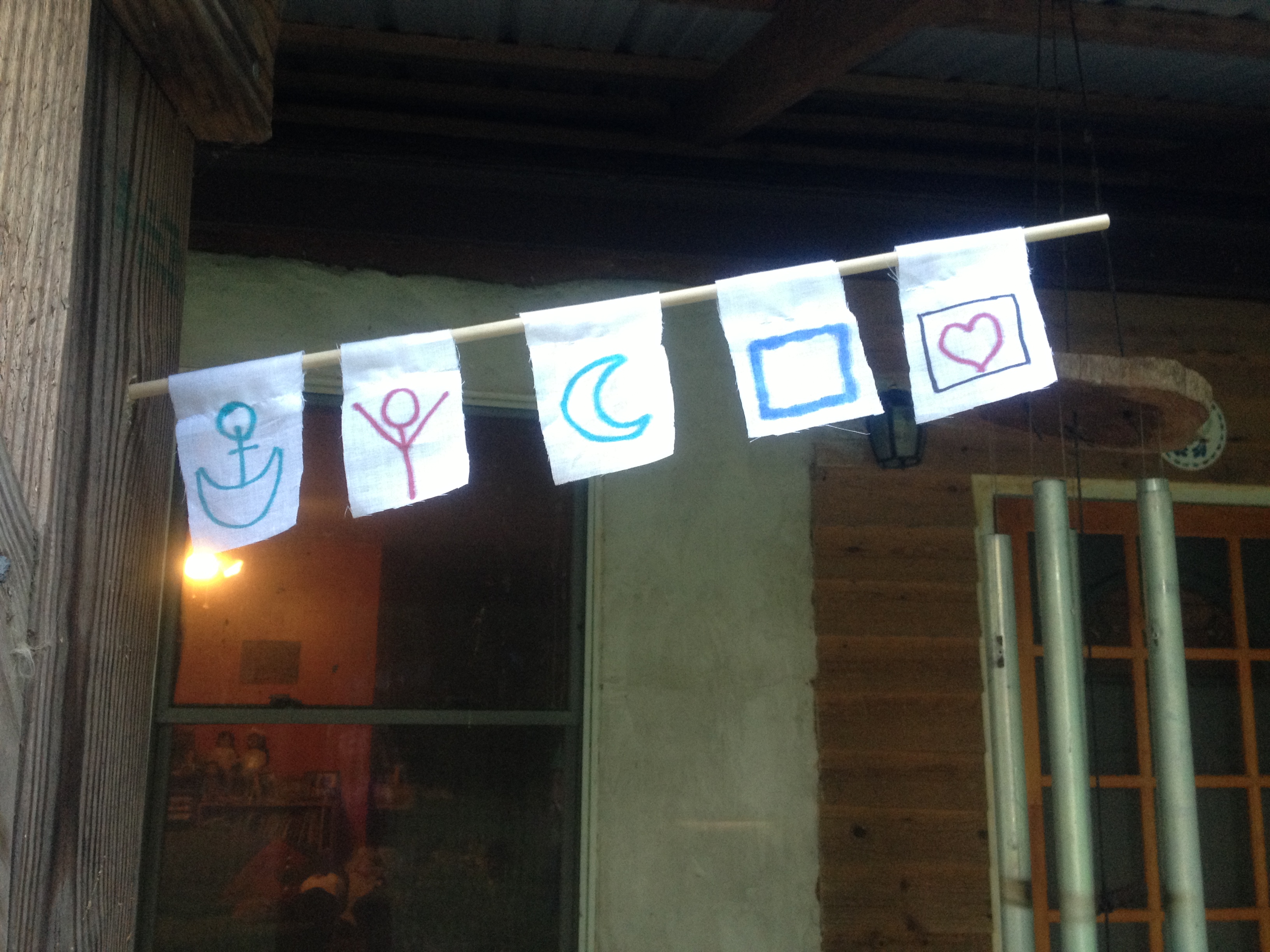
Then, joining hands, we sang Woman Am I together and headed for the kitchen for tasty potluck snacks! I’d originally planned to make a project using some nifty new mooncharmcrescent moon charms I bought recently. My vision for what exactly we were going to do with them wasn’t very clear and so it was great that one of my friends had brought a surprise project to do as her potpourri offering. Perhaps by next time, I’ll have a charming plan in place! My friend had sewed a set of 40 tiny white prayer flags for each of us upon which we drew our Womanrunes symbols with Sharpies. She also brought us each a dowel upon which we can mix or match the womanrunes and stick it in a garden, a plant, or elsewhere to be a rotating sort of “prayer branch.” She suggested either choosing the runes whose meanings match that which we desire OR randomly selecting a set and seeing what messages want to be carried on the breeze. We can switch them out in a semi-infinite array of mini prayer flag action. It was a really good idea and I was excited that she brought something like that to offer to the circle. When my husband got home, he drilled a little hole in one of the beams of our front porch and we stuck my new prayer flag system into it (flying five randomly selected womanrunes).

July 2013 023

July 2013 024

Isn’t that fun?!

I’ve been feeling a little discouraged about my retreats lately, primarily because there are a lot more women on the email list than actually show up and so I always feel like I’m doing something “wrong” or am not planning interesting enough things to attract them. I also take it kind of personally—there is a vulnerability in preparing an offering such as this and each time I do it I actually feel like I’m preparing a gift for my friends. When they decline the invite, it feels, in part, like a rejection of the gift I’m offering. Cognitively, I know (or, I hope!), this isn’t true, but emotionally that is how it usually registers. This summer retreat was a beautiful experience that felt just as I wish for these retreats to feel—nurturing, affirming, and celebratory—like a blessingway for all of us with no one needing to be pregnant!

Things I was reminded of after this experience:

  • There is nothing like having friends who are willing to lie on your living room floor and listen to a shamanic drumming CD without laughing or saying you’re ridiculous.
  • Small IS good—I already know from my years as a breastfeeding support group leader that I’m a sucker for bigger-is-better thinking (I tell my own students: don’t let your self-esteem depend on the size of your group!!!!!). When the group is small or RSVPs are minimal, it starts to feel like a personal “failing” or failure to me somehow. However, the reality is that there is a quality of interaction in a small group that is not really possible in a larger group. At this retreat there were seven women. While there was an eighth friend I really wished would come and who we missed a lot, the size felt pretty perfect. I reflected that while some part of me envisions some kind of mythically marvelous “large” group, ten is probably the max that would fit comfortably in our space as well as still having each woman be able participate fully. Twelve would probably be all right and maybe we could handle fifteen. I also need to remember not to devalue the presence of the women who DO come. They matter and they care and by lamenting I want more, it can make them feel like they’re not “enough.”
  • Retreats like this provide an opportunity to explore/experiment with ideas and activities that we usually do not allow ourselves time for in everyday life—I know that I often “run out of time” for more spiritual/contemplative/relaxing pursuits.
  • Circling together in a woman-to-woman atmosphere allows for a type of healing and connection through shared experience that is qualitatively different from getting together to casually chat and socialize. Shared experiences matter and are in some ways more satisfying than shared conversation (most women do plenty of chatting–we can benefit from some being and experiencing together).
  • The potpourri thing was a good idea. While my husband said it sounded like a nightmare idea to him—he hates being responsible for bringing something to a group setting—I felt like it created a sense of investment and shared responsibility for our circle. It was fun for each woman to be at the center for a while and to share her contribution with the rest of us.
  • I find great value in interacting with my friends in a woman-to-woman context, rather than a mother-to-mother context. So often when I’m with my friends we are in a space of “co-mothering” (i.e. mothering together and “friending” at the same time). While this can work and be fun, a lot of times it is actually kind of unfulfilling—there are constant distractions and I often feel I’m doing neither well–not paying full attention to my kids OR to my friends, and it is a scattered, distracted, stop-and-start, unfinished sort of mode of interacting (I think this is particularly a feature of having a toddler. If I only had my bigger kids, it probably would be a less scattering experience to co-mother). There was a time earlier in this year when I felt like the sense of unfulfillment or frustration I often experienced during friend conversations had to do with my friendships themselves and it took a post-retreat revelation in the spring to realize that it actually had to do with trying to have a substantive visit with friends with all of our kids present!
  • That said, perhaps it is somewhat ironic that my own mother is a regular part of this women’s circle—apparently, she can’t escape her kid, ME. But, this too is of important value—despite the close proximity of our homes, we rarely actually have the chance to interact in a woman-to-woman context, rather than as busy adult daughter and grandmother co-strategist. Also, along the same lines of my first point, I also feel lucky to have a mom who is willing to plan ritual dances and lie on the floor with me listening to shamanic drums!

20121112-141438.jpg

Categories: community, friends, liturgy, priestess, resources, retreat, ritual, spirituality, womanspirit, women, women's circle | 7 Comments

Womanrunes: The Two Circles

Womanrunes: The Two Circles. Rune of Merging. Joining or Dividing. June 2013 041

We come together with others in a dance of being so intricate as to be unfathomable. We enter their spheres, they enter ours. Linked, connected, drawing apart. Remaining cells linked forever in the overall body of humanity. Meiosis and mitosis. Separation and connection—always balancing these twin forces. Recognizing when sinking in to another is a thing of holy beauty and recognizing when pulling away is the same. Holding hands, linking arms, forming interlocking circles of strength. A chain stretching across time and space, carried lightly on wings of eternity, and nestled, curled and connected in the womb of an ancient mother.

Interdependence cannot be denied. It is essential to survival and strength.

The same day I drew this stone, I also drew a card from my Goddess Oracle deck. I drew Diana (my daughter’s middle namesake) and I loved her message:

It is time to hunt for what brings you strength.

I definitely feel myself in a place of change and transition. Our family’s roles and structure are evolving and shifting with my husband quitting his job. The urge towards the shift of focus that began for me in 2009 is reaching greater clarity and urgency and I feel ready to make some more dramatic changes…

June 2013 043

June 2013 044

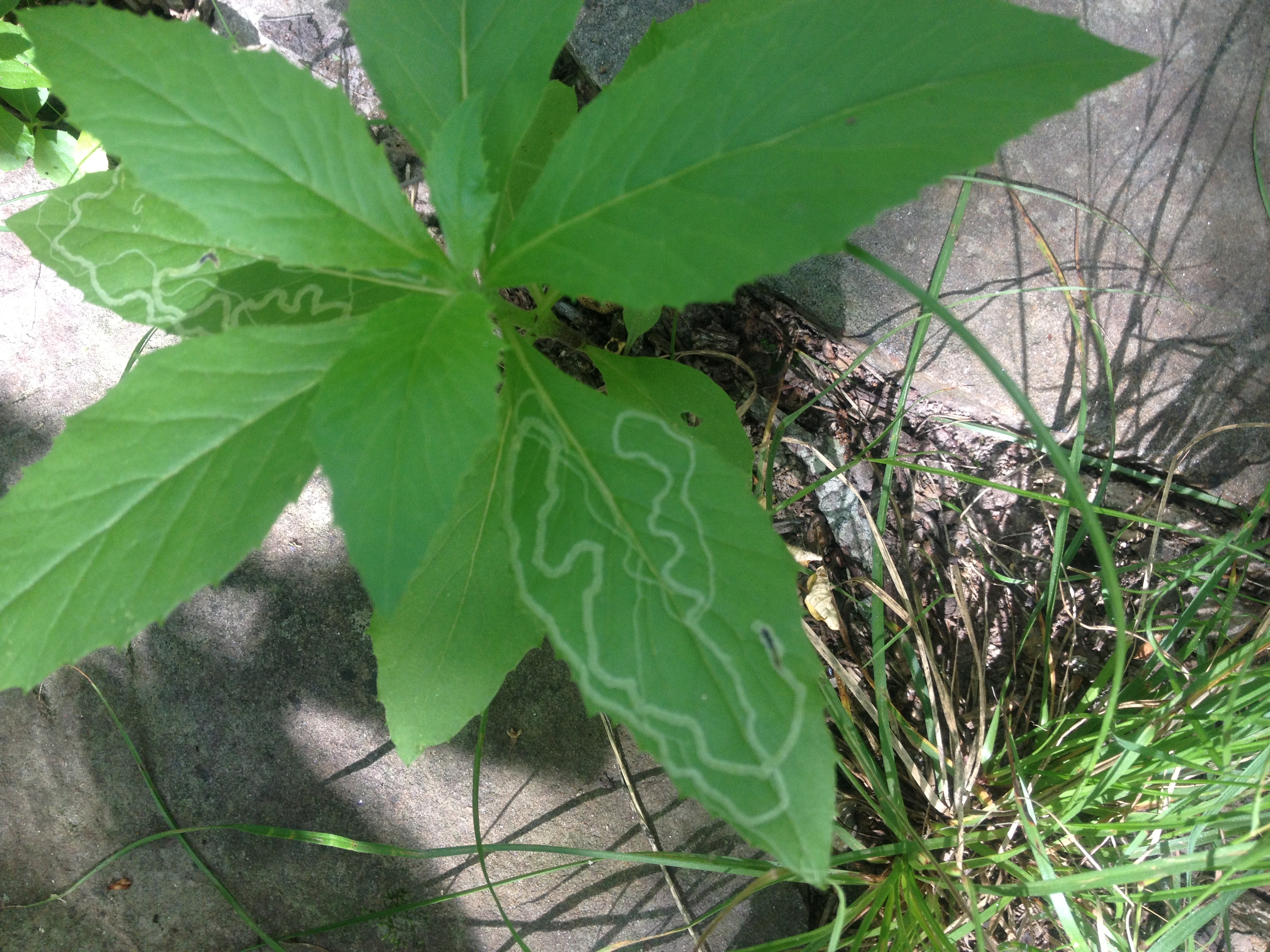
Pattern left by a bug-artist on the leaves today.

Update: this project evolved into a real book!

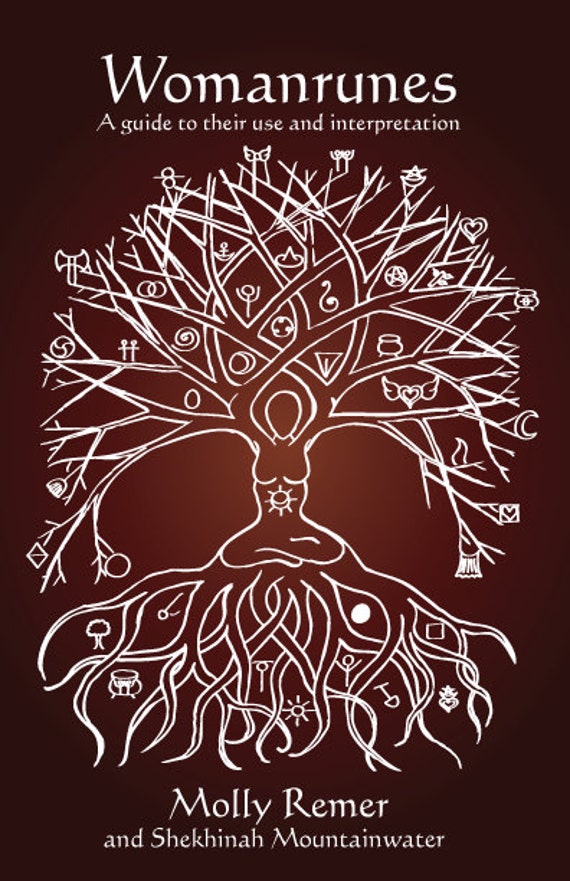
The first post in my Womanrunes series is available here. The runes and the names of them come from Shekhinah Mountainwater’s Womanrunes system for which there are no written interpretations available other than the name and one word meanings. I’m engaging in a semi-daily practice of drawing one and then going down to the woods with it to see what it “tells” me–basically, creating what I wish I had, which is a more developed interpretation of the meaning of each womanrunestone.


Categories: resources, Womanrunes | 1 Comment

Calling the Circle: The Wobble

This post is the third in a series, prompted by the book Calling the Circle by Christina Baldwin: 2013-06-24 20.47.27

There is a ‘wobble’ that always occurs in human relationships. With this wobble our sense of direction and our purpose are lose, the communion of coming together is broken, many we face the differences each of us has carried into the group. One real gift of circle is its tenacious ability to hold us in a container of combined social and spiritual contract while we work through the wobbles to genuine community…PeerSpirit circling can help us manage these wobbles differently. But in order to learn how to take our place at the rim of the circle, we need first to understand how to honor center…

I very, very much like this notion of a “wobble” in human relationships. We’ve all experienced it. I think that life would change a good deal if I remembered to recognize wobbly experiences for just what they are: oh yeah, this. A wobble. I recognize that. I know that this happens. Too often group endeavors fail because we mistake normal wobbles for permanent problems.

Later in the book, Baldwin returns to the notion of the wobble:

“The intention…is to serve as connective tissue…The purpose of the group is what remains, and yet, when wobbles occur, which they will, the members of the circle have agreements to call upon, and a container to hold them, so that they can come back to purpose and continue on.”

And, she quotes this awesome little reading from Starhawk that I then used during our spring women’s ritual:

Community.

Somewhere, there are people
To whom we can speak with passion
Without having the words catch in our throats.
Somewhere a circle of hands will open to receive us,
Eyes will light up as we enter, voices will celebrate with us
Whenever we come into our own power.
Community means strength that joins our strength
To do what needs to be done.
Arms to hold us when we falter.
A circle of healing. A circle of friends.
Someplace where
We can be free.

–Starhawk, Dreaming the Dark quoted in Calling the Circle.

On a somewhat related topic, I also saved a quote to share about why a healthy and beneficial women’s spirituality circle is not the same as our other encounters with women, in which we may be used to primarily bond through chatting and sharing various woes:

To hold the group and space as sacred is one of the most important guidelines, and the guideline that may bring up the most questions or protests. It goes against our habits as women and against our identification with the small self; we are quite used to creating intimacy through sharing our wounds and problems. The Temple Group is not a place for processing wounds, analyzing ourselves, solving problems, complaining about our lovers, healing our addictions or sharing the stories of the personality. Many women’s circles (and support groups or sharing circles) are focused mostly on the personality. The Temple Group is, in a way, impersonal because it focuses on the larger vast nature of our true self. In the Temple Group we focus not so much on our identity as separate women, but on the whole group as one feminine divine body and expression. The impersonal guideline may sound uncaring at first, but as you explore new ways of being intimate and nourish each other as women, beyond the words, you discover that those are infinitely more fulfilling and caring than the personality talking and processing.

2013-06-25 11.41.49

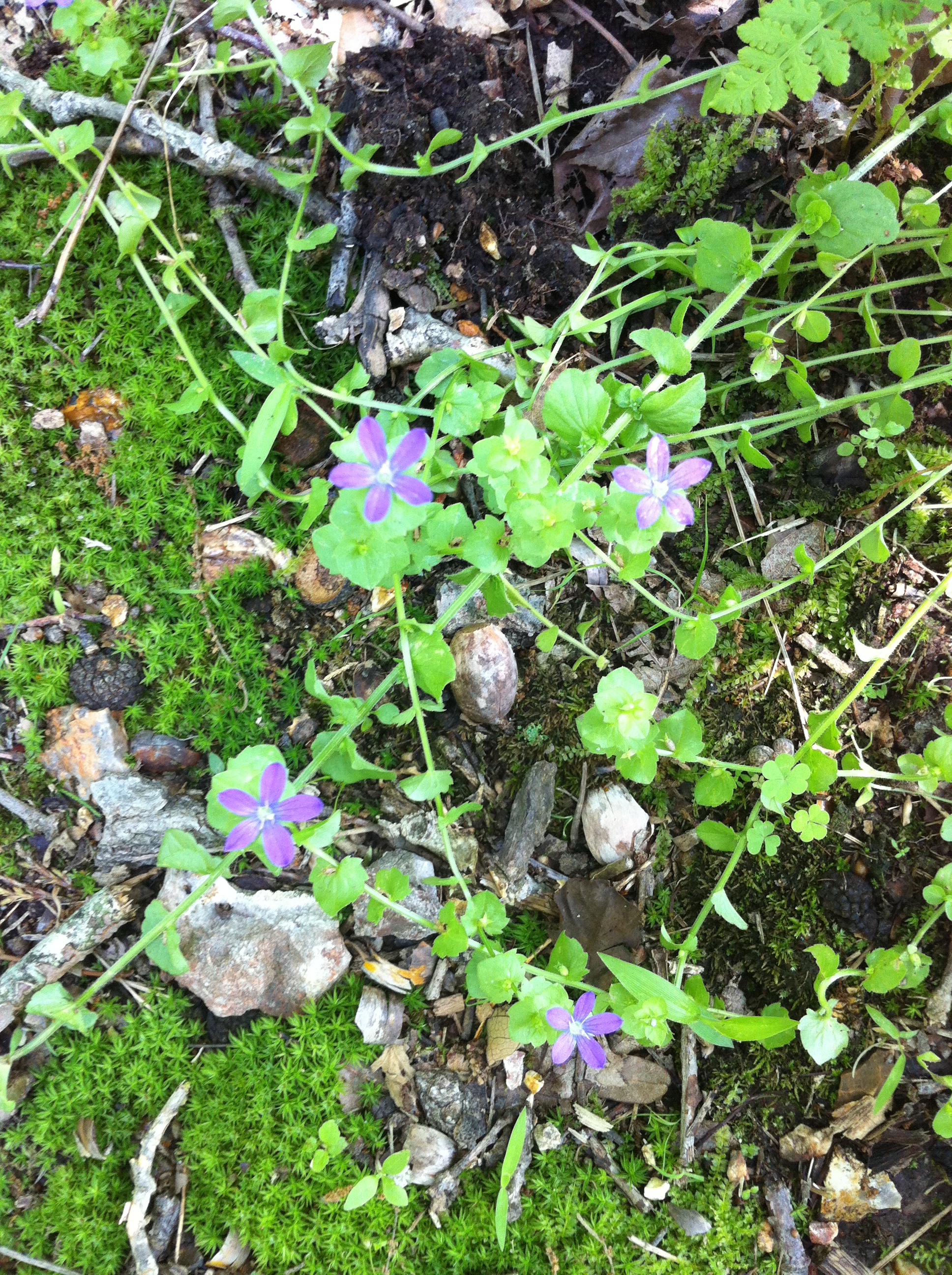
Surprise forget-me-nots (?) that suddenly showed up outside our greenhouse this week! 🙂

–From Create Your Own Women’s Temple (p. 61) from Awakening Women

When we first began meeting regularly for women’s retreats and rituals, I noticed that we did fall into a pattern of being focused on the “personality,” often having moments during which women cried and shared various hurts and disappointments or “vented.” As our group has deepened and evolved, I feel as if we’ve moved beyond this type of “story-telling-as-sharing” and into a shared, community experience of the now and what is happening in the sacred space we’ve created together in that moment. We’re not perfect and we keep learning and growing, but the circle experience is pretty powerful.

Other posts in series:
Calling the Circle: Circles
Calling the Circle: Context

Categories: community, priestess, resources, ritual, spirituality, women, women's circle | Tags: | 2 Comments

Woodspriestess: Summer Solstice

Hot nature. June 2013 037
Humid thickness
of life
breath
and passion.

Sticky spirit
melting senses
sleepy mind
moving through
watery air.

Mosquitoes whine
ticks lurk
Summer is here.

She’s heavy
weighty
watery June 2013 007
thick
green.

Summer has come to the woods
Summer has bitten my thigh
Summer whines in my ear
Summer waits
for my ideas to bear fruit
rich, juicy, sweet.

(6/11/13)

The Summer Solstice issue of The Oracle is out and contains a slightly revised version of my Womanenergy post:

Womenergy moved humanity across continents, birthed civilization, invented agriculture, conceived of art and writing, pottery, sculpture, and drumming, painted cave walls, raised sacred stones and built Goddess temples. It rises anew during ritual, sacred song, and drumming together. It says She Is Here. I Am Here. You Are Here and We Can Do This. It speaks through women’s hands, bodies, and heartsongs. Felt in hope, in tears, in blood, and in triumph. June 2013 013

Womenergy is the chain of the generations, the “red thread” that binds us womb to womb across time and space to the women who have come before and those who will come after. Spinning stories, memories, and bodies, it is that force which unfolds the body of humanity from single cells, to spiraled souls, and pushes them forth into the waiting world.

via Womenergy by Molly | Global Goddess.

And, I was touched by this post and its Call:

Along the way, you will meet up with sisters who have answered their own calls. After years of trudging alone to the single note of our own call, we begin to sense first, then to see their dirt-smudged, tear-streaked faces. Their scars look comfortingly similar to our own. We are a ragtag tribe of outcasts, moon howling, spiritual homesteaders. The notes of our own call begin to merge and blend, and we become a symphony of stragglers, circling in sacred ritual- we are never truly alone. Our wounds are treasure maps tracing our stories back to the moment we said no, enough, no more, now, this time, my time. They bind us, these wounds, these calls, one to another on this dark wooded path.

To answer The Call is to choose a life outside what anyone else deems worthy, understandable, logical. We are heralded by some as over-emotional, ridiculous, dramatic, eccentric, strange, weird, unnatural. Others like us will recognize themselves in our journey, our June 2013 038words, our artwork, our altars, our homegrown vegetables and homespun clothes. They will feel they are home when they smell lavender at our neck and see sage on our tables.

Our legacy is red, and burns with a passion we cannot contain so that it seeps out and stains our daughters and sons, marking them for a new way of life that emerges- because we were brave enough to answer a Call.

via Her Strange Angels: Call to the Wild Wood ~ A Blessing for the Solstice.

And, I was super psyched to get two new books free on Kindle this weekend:

From Lisa Micheals:


And from Rachael of the Moontimes blog!

I also appreciated this timely reminder from Chrysalis Woman:

It’s now that we Celebrate the womanifestation of the seed dream/s we conceived at Winter Solstice. Much like the Mother Mysteries associated with this time, we are giving our full attention, time and creativity to nurturing, sustaining and protecting our dreams, while reveling in the abundance of all that we are the creatrix of.
With all of this heightened activity and energy, we may find ourselves bumping up against the shadow of the Mother Archetype. With the full activation of our Fire energy that Summer Solstice generates, we can experience “burn out” by over-giving, over-nurturing, over-protecting, and/or over-doing. So remember to “Mother yourself” as you are caring for your creations. Seek out and create support systems that sustain YOU, as you work to sustain your hopes, dreams and all that you love.

via Shine Your Light! – Chrysalis Woman – Returning to the Mother and Each Other.

I feel like I’m in one of these stages right now and working it through.

I’m still working on our own simple family ritual for summer solstice. It will involve many drums! 🙂

P.S. I have a good friend named Summer and I had to smile as I transcribed my “Summer” poem, because I imagined her biting my thigh and whining in my ear! (Really, it was a mosquito!) ;-D

Categories: holidays, nature, poems, resources, spirituality, theapoetics, womanspirit, woodspriestess, writing | 3 Comments

Top Thirteen Most Influential People in Goddess Spirituality

Earlier this month I was very interested to see a series of posts on Raise the Horns about the top 25 most influential people in the birth of paganism. When I read Mankey’s post, it reinforced my own conception of Goddess spirituality as having a distinctly different lineage and flavor than much of contemporary paganism. His list, while extensive, useful, and accurate, involves a distinct lack of Goddess scholars, highlighting to me that Goddess spirituality IS a different movement and isn’t actually just a Goddess-oriented branch of contemporary paganism. Indeed, almost everyone on his list I’d either never heard of, not read, or don’t enjoy their writing. I immediately started to draft a list of my own and came up with 13 women, which seemed delightfully appropriate. We in the Goddess feminist community have our own path, herstory, and lineage, one that really only began in the 1970’s in direct connection to the feminist movement, rather than the pagan movement.

Not necessarily in a particular order, here is my own list of the top thirteen most influential people in the development and articulation of Goddess Spirituality as its own distinct path. (I’ve been scrambling to finish collecting my thoughts in time to post this list while it is still Women’s History Month!) Only one of my own picks also appears on Mankey’s list. December 2012 097

  1. Carol Christ–this feminist scholar is the most skillful and intelligent thealogian of the present day. Christ’s influence on my own ideas and concepts has been profound. Her work is academic, focused, and deep, and she wrestles with heavy questions. I particularly enjoy her books Rebirth of the Goddess and She Who Changes. A brilliant, thoughtful, amazing writer, Christ’s essay Why Women Need the Goddess remains, in my opinion, one of the most important and influential articles of our time.
  2. Merlin Stone–author of the classic When God was a Woman, this professor of art history changed the landscape and understanding of ancient cultures and their relationship to the Goddess (and, yes she drew on the work of Murray and Graves, but moved into feminist thealogy rather than pagan practice).
  3. Riane Eisler—author of The Chalice and the Blade, she made a significant contribution to the understanding of the history and development of patriarchy as well as offering a solution in the form of a partnership model of society.
  4. Marija Gimbutas—scholar and archaeologist and author of several books chronicling Goddess figurines from around the world, including The Language of the Goddess, her work has come under scrutiny and criticism, but remains a potent contribution to the lineage of the Goddess movement.
  5. Starhawkthe first of two on my list who bridge the gap between more “classic” paganism and feminist spirituality, Starhawk had a huge impact on the development of a female-oriented spiritual tradition. Her book The Spiral Dance was the first introduction to the Goddess for many women. In keeping with what I find to be a personal lack of click with a lot of pagan authors, I did not particularly enjoy The Spiral Dance and actually read it much later than most of the other books about feminist spirituality that I reference in this post, but regardless of personal taste, her influence on the Goddess movement is profound.
  6. Z. Budapest—considered by many to be one of the first mothers of the feminist spirituality movement in the U.S., like Starhawk, Z’s writings are not my personal favorite resources because of their heavy Wiccan orientation, but they are undeniably classics in Goddess circles. Z has taken heat from many pagans for her position on transgender people.
  7. Patricia Mongahan–recently departed author of Goddess-specific resource books like The Goddess Path and Wild Girls, Patricia’s writing is more practical and less scholarly/thealogy-oriented than some of my other favorite authors. March 2013 086
  8. Monica Sjoo—radical artist, ecofeminist, and Goddess scholar, Sjoo wrote The Great Cosmic Mother and one of my other favorites, a critique of New Age spiritual paths called New Age Armageddon. Her classic and awesome painting God Giving Birth narrowly avoided ended up in Court on the charge of “obscenity and blasphemy.”
  9. Hallie Iglehart—while less well-known and influential than some of the other women on my list, Hallie was personally very impactful to my own Goddess path, since her books were some of the first, personal and experientially-oriented Goddess-specific books that I read. She is the author of Womanspirit, a synthesis of feminism and religion, and of The Heart of the Goddess, a visually stunning collection of Goddess images and meditations/reflections.
  10. Cynthia Eller—while Eller’s book focused on debunking the “myth of matriarchal prehistory” made her lose popularity among many in the Goddess community (see her clarifying comments here), her scholarly engagement with the complexities of articulating the concepts of feminist spirituality and of thealogy is challenging, illuminating, and offers the opportunity to dig deeply into one’s own perspectives. Her book Living in the Lap of the Goddess is a thorough exploration of women’s spirituality and the Goddess movement.
  11. Charlene Spretnak–another rocking writer with a thorough grasp of the sociopolitical and cultural context, value, and purpose of Goddess spirituality, her classic anthology The Politics of Women’s Spirituality is one of the best and deepest explorations of the concepts, personal experiences, philosophies, and thealogies of why Goddess.
  12. Karen Tatethrough her weekly radio show, Voices of the Sacred Feminine, I would venture to say that Tate is one of the most influential and dedicated “Goddess advocates” of the present day.
  13. Elizabeth Fisher and Shirley Ranck—authors of germinal religious education curriculums focused on feminist spirituality and woman-honoring traditions, originally published by the UU Women and Religion program, their work with Rise Up and Call Her Name andCakes for the Queen of Heaven continues to change the lives of women around the country by introducing them to a vision of what the world could be like if the divine was imaged as female.

Also deserving of mention are:

  • SageWoman Magazine (and her editors)—this specifically Goddess-women oriented publication is a treasure and a delight.
  • Feminism and Religion blog–daring to explore the intersection of religion, scholarship, activism, and community, FAR is not specifically Goddess-oriented, but includes Goddess scholars amongst their contributors and weaves a beautiful, living, organic tapestry of the multifaceted web of feminist spirituality in the present day.

I find that feminist spirituality can be distinguished from paganism because of the inclusion of a core sociopolitical orientation and distinct sociocultural critique. Feminist spirituality to me is the intersection of religion and politics. It is religious feminism. It may or may not include literal experience of or perception of the Goddess, but it names the female and the female body as sacred, worthy, and in need of defense and uses Goddess symbols, metaphors, stories, and experiences as primary expressions of divinity and the sacred.

After originally writing this list, I thought of many more women I should have included and I kept meaning to do a part two follow-up article. I’ve yet to finish that, but this is who I would add…

Six More Influential Women: 1

  1. Shekhinah Mountainwater (pictured at right): tremendous personal influence on my life and work.Original creator of Womanrunes and author of one of my all-time favorite goddess spirituality books, Ariadne’s Thread.
  2. Diane Stein–I particularly enjoy her anthology The Goddess Celebrates and also her book, Casting the Circle.
  3. Vicki Noble–her book Shakti Woman is a powerful and important read.
  4. Barbara Ardinger–if I had to choose a favorite book for ritual resources and goddess spirituality, her book A Woman’s Book of Rituals and Celebrations would be one of those at the top! I also enjoy interacting with her as a sister blogger at Feminism and Religion.
  5. Barbara Walker–author of several goddess-oriented sourcebooks, The Essential Handbook of Women’s Spirituality is another of my favorite resources.
  6. Nancy Vedder-Shults–I first “met” Nancy through hearing her music at a Cakes for the Queen of Heaven training. Her CD, Chants for the Queen of Heaven, was my first-ever purchase of goddess-specific music (I didn’t even know there was such a thing until hearing her songs!). Later, I continued to enjoy her contributions to SageWoman magazine and now through direct interaction on the Feminism and Religion blog.

 Other cool books/honorable mentions:

March 2013 058

Save

Categories: books, feminism, feminist thealogy, Goddess, resources, spirituality, thealogy, womanspirit | 74 Comments

Woodspriestess: Spirit in Practice

March 2013 004Gathered here in the mystery of the hour

Gathered here in one strong body

Gathered here in the struggle and the power

Spirit, draw near.

–Gathered Here, Hymn #389 in Singing the Living Tradition (UU Hymnal)

Tomorrow, I’m presenting the service at my tiny local UU church. I’ve spent probably a lot more time than I should have getting ready for my presentation. I’m using the first part of the Spirit in Practice curriculum which is part of the vast treasure-trove of resources available from Tapestry of Faith via the UUA. My goals for this presentation are threefold:

  • To connect us to a sense of larger UU identity
  • To give us a taste for the resources available at our fingertips via Tapestry of Faith
  • To help us understand that “spiritual practices” are appropriate, desirable, and meaningful for UU’s too

Our local fellowship leans very heavily towards the secular humanist and academic in regard to its services and shies away from anything “spiritual” in nature (for more on this broad UU habit of avoiding matters of the sacred and how that hurts our communal, religious experience, see the wonderful article, Imagineers of Soul from UU World magazine). I really, really want to offer the possibility tomorrow that we can both be rational, logical, social justice-oriented UUs and have a shared spiritual experience. As Christine Robinson explains:

Why do people come to church? It is not to learn. People don’t even go to museums to learn. It’s not to be entertained. People don’t even go to Disneyland just to be entertained. They come to church, especially they come to church, to quench a thirst, find meaningfulness, to have an authentic experience, or, in a more traditional religious language, to connect with mystery and see their everyday lives reflected in the mirror of eternity. Churches, then, and the lay and ordained people who lead them, are Imagineers of Soul, sorcerer’s apprentices in the art of quenching thirst, filling voids, opening the doors of meaning.

We do lots of things as church people, of course: teach the children, comfort the dying, change the world. When we do these things as religious people, they evoke the “holy”and if they don’t, we’ve failed at the only thing the church can uniquely do. And the truth is, we fail a lot, sticking to the safely secular, avoiding reverence, skirting awe, and missing opportunities to conjure up a sense of the spiritual. That failure comes in spite of the fact that significant lay and ministerial voices have been saying for two generations that we Unitarian Universalists are missing something important if we take a secular, hands off the spirit approach to our life together.

One of the reasons I stopped attending church regularly was because too often it was missing the “imagineers of soul” connection and was instead an intellectual discussion. I love intellectual discussions just fine, but I live 22 miles from church AND I greatly value weekend time with my family. It became so if I had to choose between listening to a presentation about foxes or hanging out at home, I’d choose home every time. What I hope to explore tomorrow is the role and value of regular spiritual practices in both group and individual life.

Today when I went to the woods, I sat on a rock and sang the song I’m going to use tomorrow over and over, louder and louder. I’m a terrible singer, but I’m no longer willing to let embarrassment over that win and stop me from trying. I’ve also learned with my women’s circle that after we get through that first, awkward, discordant, confusing round, we actually end up sounding pretty awesome. Too often, groups stop singing after the first run through and what builds is a collective sense of, “we can’t do this,” or “don’t bother, we’re hopeless!” Tomorrow, I plan to “make” us go through Gathered Here at least four times–I hope to demonstrate to the group how much better we get with just a tiny bit of practice and that also singing together is a powerful, communal experience that can solidify and strengthen our sense of having a shared “faith tradition” (rather than solely a shared tendency to vote Democrat). And, that we individually don’t have to be “good singers,” but that in community we can even sound kind of beautiful.

I’ll don’t know if the group will appreciate my offering tomorrow, but I have to try. Maybe next time, I’ll actually talk them into making UU prayer beads 😉

The other thing I thought of today was how my woodspriestess daily practice has been steadily been moving up in priority in my days. That is part of having a robust daily practice. I have to do it. Name it as valuable and take regular action to bring it into life. If I put things off until “later,” I end up staggering out to the woods at 11:30 p.m. with a flashlight and a sense of obligation. Now, I do it first, regardless of what the rest of my to-do list says. Seriously, if I “don’t have time” to take five minutes to restore my soul in the woods each day, what kind of life am I living?! When I first became a student at OSC and was taking the Ecology and the Sacred course, one of the things that I was hungering for was a regular, spiritual practice. That class helped me evolve in several ways and I feel I’ve finally found the kind of integration between theory and practice that I was seeking (I have ways I’d like to take it deeper too. More on that some other day).

The things that are holy and sacred in this life are neither stored away on mountaintops nor locked away in arcane secrets of the saints. I doubt that any church has a monopoly on them either. What holiness there is in this world resides in the ordinary bonds between us and in whatever bonds we manage to create between ourselves and the divine.
—Patrick O’Neill, “ Unitarian Universalist Views of the Sacred

On a not-totally-related  note, something that interests me, but that I have little experience with is “augurs,” or the reading of natural “signs” and learning from them. It is almost like a form of divination in a sense, or a type of listening to a response to a prayer, or the receiving of a message from the world. Today as I reached the rocks, I saw this little arrangement on the ground. I didn’t touch or adjust it. It doesn’t intuitively mean anything to me, but the shape of the sticks and the “arrangement” of the items in what looks like a deliberate sort of way, caught my eye. If I was good at this augur stuff, I could probably have learned something else today!

March 2013 002

Categories: resources, ritual, spirituality, UU, woodspriestess | 2 Comments

New Moon Ritual

This is part of an assignment for a class in Ritual and Liturgy at OSC.

Sept 2012 3 050The altar is laid outdoors in sight of the new moon. It contains one candle for each direction as well as a central candle. Symbols are present for each direction as well: a stone and a glass globe for Earth, a feather for air, a bowl and a shell for water, a chalice for fire. Also on the altar is a Goddess of Willendorf and a handmade “Moontime” Goddess sculpture. The altar cloth is a deep green. There is also a candle for each participant.

Participants circle up and place hands on each other’s backs and do a group hum of, “Om” and then toning with a bell.

Using the bell, each person names themselves and is called into the ritual circle (name repeated three times and then bell chimes)

The invocation chosen acknowledges the power of the various phases of the moon as the candles are lit in the appropriate directions (modified by a sun invocation by Luisah Teish in Jump Up):

East: In the East we call upon the power of the New Moon, the bright sliver of renewal. Here we ask for new beginnings and we commit to renewing ourselves.

South: In the South, we call upon the power of the Full Moon, the steady, energetic light that illuminates the world. Here we ask for strength to be with us, and we commit to using our strength for the good of the community.

West: In the West, we call upon the power of the Waning Moon, the deep light that calms the mind at the end of the day. Here we ask for a sense of satisfaction, and we pledge to take care of ourselves.

North: In the North we call upon the power of the Dark Moon and Night Sky, the time of incubation that permits us to rest. Here we ask for the vision of dreams, and we agree to meet our inner wisdom in that place.
Each participant takes a turn lighting their personal candle and sharing something they’re thankful for from the past cycle and then naming something they’d like to bring into this energy of new beginnings.

We will start a CD of flute music (Womanspirit) and engage in a dancing gratefulness prayer described in SageWoman magazine (number 64, page 10).

After the dance, we will join hands again and say a closing prayer to open up the circle:

Open up the circle of healing and trust.

To the South, innocence and joy,

To the East, new beginnings,

To the North, cool winds of reason,

To the West, nighttime for dreaming,

Up above, the source of light, the Sky,

Beneath our feet, the womb of life, Mother Earth,

Open up the circle of healing and trust.

Then, we’ll have time for a family drum circle!

September 2012 3 055

Categories: family, friends, invocations, liturgy, readings, resources, ritual, spirituality, womanspirit, women's circle | 1 Comment

Desert Priestess Book

desertpriestess

Desert Priestess: a memoir (Amazon affiliate link included)

I absolutely loved this book! Written by Anne Key, Desert Priestess: a memoir, is a memoir of her three years as the priestess at the Sekhmet Goddess Temple in Nevada. The memoir is beautifully written in a very honest manner with the narrative including her self-doubts and follies as well as her priestessly moments. After I finished it, I felt like my heart was yearning to take a pilgrimage to the desert, as well as to further deepen and refine my own priestess path! I highlighted several sections of the Kindle version of the text to share:

Writing about her role as a priestess, Anne explains:

…And I can only say that, as priestess, I worked so very hard to open my heart to each person who came, to meet each in perfect love and perfect trust of the structure and beauty of our desert wreath. To do this, I realized that I had to be not only sure of my purpose and strong in my stance but that I also had to see each person as an integral and necessary part of our circle. To do that, I had to be clear about myself and my intentions and I had to stay connected to the Divine…

I realized early in my tenure as priestess that I must stay connected to the Divine to allow things to come through me instead of from me. Everything depended on that: my ability to lead ritual, my ability to stay centered, my ability to understand those who came to the temple, my ability to see my way out of difficult issues. Striving to stay connected to the Divine made another point painfully apparent: I had to be clear, to the depths of my soul. I had to understand what I was, where my limits were, and accept totally who I was. I had to be able to be fully and totally present at each moment of ritual, wide open to everything, and firmly, firmly rooted. This was a real challenge…

Key, Anne (2011-03-29). Desert Priestess: a memoir (p. 45). Goddess Ink. Kindle Edition.

Another very good section of Desert Priestess was Key’s exploration of why it matters to call the Divine “Goddess”:

I lecture at various academic venues on Goddess Spirituality, and I continue to be amazed at the answer to my question: “Does your god have a gender?” While the wording would seem to make the question rhetorical, people almost always answer: “No, my god does not have a gender.” Given the statistic that over 75 percent of people living in the United States claim Christianity as their faith, when I lecture I assume that most of my audience is Christian. When I ask them to describe their god, to tell me what that god looks like in art, many times someone will mention a long white beard, which firmly answers the gender inquiry. But even if they don’t go as far as to mention a beard, when I ask them if their god is a woman, they are shocked and absolutely, defiantly sure that their genderless god is not a woman. We women who create life, the highest of all divine acts, cannot be considered a god.

Between my experiences at the temple and in academia, it has become clear to me that most women in twenty-first-century American culture never see themselves as divine. And it is no wonder. The most predominant images of women in the modern media are as accoutrements to products such as cars or purses. This to me is one of the greatest gifts of the goddess temples, because images of the Female Divine are important. They are important because they begin the process of consecrating women’s bodies as divine. When we as women begin to see our bodies as a reflection of the Divine, then our bodies are removed from the sole category of “object of the male gaze” to corporealized divinity, the embodiment of the Divine.

When women come into the temple, they see themselves, and they see themselves venerated. They see themselves in various shapes and colors, from the round and almond-eyed Madre del Mundo to the black and slim Sekhmet to the brown and regal Virgen de Guadalupe. We women have lived our lives trying to see ourselves in the image of the Christian God, living with the cognitive dissonance of the sound of Charlton Heston’s voice as God, in Michelangelo’s beefy finger, and in the picture tacked on the wall in Sunday school of a man’s aged and ageless face whose white beard melts into the clouds. We live in this culture of the image of God as white and male. As if this were not enough to get the point across, most of those who represent God in the Christian religion—the priests, preachers, and pastors—are men. And if women do represent the Christian God, there is almost always a controversy involved. Still, we women have persevered to find ourselves in the Divine and to see ourselves as divine, and even more courageously to represent the Divine. A sigh of relief automatically escapes me and the cognitive dissonance melts away when I am in the presence of an image of the Divine that is female. Images of the Female Divine are important because they embody the divine qualities of the feminine. The roles of mother, healer, guide, protector, lover, provider, and nurturer combine with the qualities of compassion, justice, truth, fertility, strength, and love to present women in multiple dimensions…

Key, Anne (2011-03-29). Desert Priestess: a memoir (pp. 50-52). Goddess Ink. Kindle Edition.

Sculptures hanging out in the sunshine!

Sculptures hanging out in the sunshine!

She goes on to make this important point: “It is of course no small wonder why graven images are so tightly controlled by religious traditions.” (p. 52) Sometimes I feel like this is what I’m tapping into when I make my own goddess sculptures—a resistance to tight control over graven images and over personalization of divinity as female in essence!

Later, Anne writes about creating a sisterhood of priestesses and she describes their vow to each other in a lovely way:

As sisters, we are one another’s truth tellers. We are one another’s loving and honest mirrors. We advise, even when we are not queried. And we let go so that each may fly on her own wings. Our sisters are our bonds with the deepest mysteries. As sisters, we are the ones who bleed, we are the ones who birth, we are the ones who nourish, we are the ones who weave the web, and we are the ones who cut the cord. As women, as sisters, as priestesses, we stand at the doorways of life and death, bonded by the cycles of our bodies and our lives.

Key, Anne (2011-03-29). Desert Priestess: a memoir (p. 57). Goddess Ink. Kindle Edition.

She also writes about creating ritual and liturgy in a desert climate:

At the beginning of each ceremony, we honored the four directions and an element associated with each: east and air; south and fire; west and water; north and earth. Many times when the directions are called, they are written with a wet, lush environment in mind: cool breeze, deep black earth, rushing rivers, dense forests. But these images did not reflect the desert land, a dry, thriving environment.

I wrote a call of directions specifically for this land, for this place, for this temple:

Winds of the mind, open free.

Breath of life, breathe in me.

Red flame of truth, burning pure.

Spark of life, ignite me.

Water of my soul, blood of earth.

Spring of life, wash me.

Bones of rock, sand, and earth.

Roots of life, ground me.

Key, Anne (2011-03-29). Desert Priestess: a memoir (pp. 90-91). Goddess Ink. Kindle Edition.

And, finally, another section I marked was in her description of feeding sweet little birds outside her window, only to see them snapped out of the air and eaten by a hawk. She says,  “Of course, I would have preferred that the hawks eat the mice. Much as I loved the cute little mice, the mess they left in our kitchen cupboards was disgusting and infuriating. But the birds! The little birds had done nothing but entertain us.” (Amen!) But, then she goes to make the best point ever about nature: “Obviously, this cycle was not about me, or what I thought was cute” (p. 116).

I really recommend this book! It is of particular interest to priestesses and to those interested in Goddess Temples and women’s spirituality in general, but I also think it would be interesting to people who like memoirs and stories about women’s lives and simple, yet profound, adventures.

Categories: books, nature, priestess, quotes, resources, reviews, spirituality, womanspirit, women | 2 Comments

Book Review: Living Goddess Spirituality, a Feminine Divine Priestessing Handbook

A woman who connects with Goddess, connects with a most vital, ancient, powerful inner part of herself and she is awakened. It is this awakened state that is so empowering to women and downright frightening and dangerous to a patriarchal society.” –B. Melusine Mihaltses

Living Goddess Spirituality: A Feminine Divine Priestessing Handbook is a wonderful book! Containing lots of good resources and thoughtful commentary, the book explores twelve goddesses and associated rituals and workshop ideas for women’s spirituality circles. It also includes a chapter on priestess initiation and guidelines for starting a Goddess study circle.

I have a couple of small critiques in that some of the print is extremely tiny, some material is repeated from the author’s previous book, there is quite a bit of repetitiveness in general, and not all suggestions are fully developed (i.e. for each goddess there are multiple “workshops” suggested which include things like making various items. However, no further information or instructions for most of these things are included).

I don’t usually connect strongly with individual goddess imagery, but the way in which Living Goddess Spirituality is written brought in the significance of many different goddess images and I found myself learning and thinking about specific goddesses in different ways. I also loved all the different chants, ritual outlines, and invocations included. Really great pictures and some beautiful art enhance the book.

Great circle resource and a good resource for Goddess Priestesses!

Two chants I particularly enjoyed and that were new to me:

Eight Beads Chant
Girlseed
Bloodflower
Fruitmother
Spinmother
Midwoman
Earthcrone
Stonecrone
Bone…

Earth, Moon, Magick…
In the Earth, deep within
There is a Magick, I draw it in.
In her Caves, in the Trees
Hear her Heartbeat, Pulsing through me.
When I Rise, I feel her Love
with feet Grounded, I’m soaring high above,
In the Earth, deep within
There is a Magick, I draw it in
Ancient Moon, my Soul reveres
With my Singing, I call you here.
When this flame, ignites tonight,
Priestess dancing, Under the moonlit night…
In the Earth, deep within
There is a Magick
I draw it in…
There is a Magick, I draw it in (3x)

Additional lines for a familiar, favorite drum circle song:

Mother I Feel You…

Mother I feel you under my feet,
Mother I hear your heartbeat
Mother I feel you under my feet,
Mother I hear your heartbeat

heya heya heya yah heya heya ho
heya heya heya heya heya ho

Mother I hear you in the River song,
eternal waters flowing on and on.
Mother I hear you in the River song,
eternal waters flowing on and on

heya heya heya yah heya heya ho
heya heya heya heya heya ho

Mother I see you when the Eagles fly,
Flight of the Spirit gonna take us higher
Mother I see you when the Eagles fly,
Flight of the Spirit gonna take us higher

heya heya heya yah heya heya ho
heya heya heya heya heya ho

(Adapted from my quick review on Goodreads)

Disclosure: Amazon affiliate links in image/book title.

Categories: chants, Goddess, poems, priestess, readings, resources, reviews, ritual, spirituality, womanspirit, women's circle | Leave a comment

Create a free website or blog at WordPress.com.