Goddess

Theapoetics

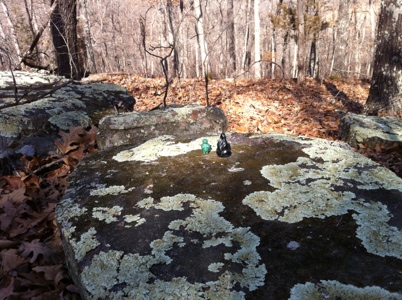
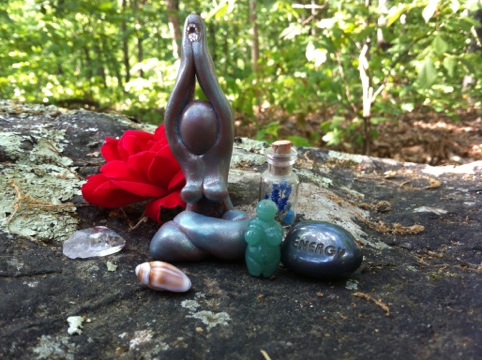
20120619-163448.jpg

Paying attention…

One of my favorite verses in my life with children and as a conscious observer of the rhythms and flow of life is:

Instructions for living a life:
Pay attention.
Be astonished.
Tell about it. -Mary Oliver

These experiences remind me of a quote about the need for, or role of, “theapoetics”: “[Stanley Hopper] recommends we replace theology, the rationalistic interpretation of belief, with theopoetics, finding God[dess] through poetry and fiction, which neither wither before modern science nor conflict with the complexity of what we know now to be the self” (in Original Self by Thomas Moore).

I also have a favorite passage from Susan Griffin about the earth in which she exclaims, “We are stunned by this beauty.” That is exactly how I feel. This relationship to the planet is what used to make me feel that a conception of deity was unnecessary—isn’t it enough to just marvel at what is, right here in front of us? The majesty and the miracle of the natural world. I am stunned by this beauty. I am stunned by the realization that we are all suspended in space, spinning timelessly through the universe on this beautiful planet, so small in the vastness of all that surrounds us, and yet so big that it is literally our whole world. Sometimes when I have a bad day or feel overwhelmed by the swirl of daily tasks I remember that old saying about, “sometimes I go about pitying myself when all the while I am being carried by a great wind across the sky.” If we really stopped to think about this—to sense how we are carried by the great wind, I think the whole world would change, how people relate to each other and to the environment would be transformed. Stop, look, listen, breathe, and feel how we spin. Together.
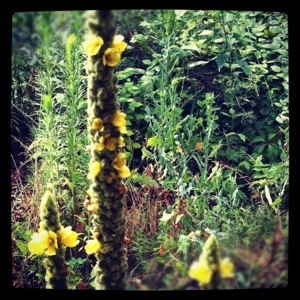
20120619-162746.jpg

Mullein by the back porch

Categories: Goddess, spirituality, thealogy, theapoetics | 5 Comments

Ecofeminism

20120615-182229.jpgI consider myself to be a generally well-educated person as well as informed about feminism, social justice, and ecological issues. However, I had never actually heard the word “ecofeminism” until it was referenced in one of my courses at Ocean Seminary College. As such, when enrollment for the spring session of courses opened, I immediately signed up for an ecofeminism class as one of my electives.

In short, the foundation of ecofeminism is the perspective that the basic issues of ecological concern around the globe—water, wood, food, health care, climate change, environmental justice—are intimately intertwined with the status of women, their value and treatment. Many of the issues of domination, control, degradation, and oppression that affect women on this planet, also impact the health of the planet itself.

Ecofeminism is a diverse field of study with varying philosophies and approaches, all sharing the concept that there is a connection between, “unjustified domination of women and nature.” From a religious and spiritual perspective, I’ve always been interested by how women are associated with nature, the earthy, the mundane, the body; matters of the flesh and soil. Matter and mother are intimately connected. One of the ways in which patriarchal religion controls women is by asserting that women are connected to the body and the flesh, rather than to the (superior) realm of the mind and the spirit. As Carol Christ notes in her book, She Who Changes, “Feminist theologians have long recognized that women have been viewed as secondary or subordinate in dualistic anti-body traditions that follow Plato in making a sharp distinction between God and the unchanging soul on the one hand, and the changing body and nature on the other. In dualistic philosophies created by men, the rational soul of man is associated with the unchanging immortal realm of (a male) God, while woman is identified with the body, nature, and death.” [and sin!]…one set of qualities—the unchanging, the rational, the soul, the male—is valued more highly than the other—the changing, the natural, the body, the female. In such traditions God must be imaged as male because maleness is associated with the unchangeable realm of soul and spirit. God cannot be imaged as female because femaleness is associated with the changing body, nature, and death.”

In Karen Warren’s book Ecofeminist Philosophy she explains, “just as women’s bodies and labor are colonized by a combination of capitalism and patriarchy (or capitalist patriarchy), so is nature” (p. 26). I have previously written that patriarchy is built and maintained on the bodies of women. It is also built and maintained on the control of nature and natural resources. As someone with a special interest in the power of language and story to shape our world, I was most fascinated by the exploration of the connection between sexist-naturist language, emphasizing that, “Animalizing women in a patriarchal culture where animals are seen as inferior to human, thereby reinforces and authorizes women’s inferior status…similarly language that feminizes nature in a patriarchal culture, where women are viewed as subordinate and inferior, reinforces and authorizes the domination of nature” (p. 27). Language is used as a tool of social control and to reinforce patriarchal messages about ownership of body and resources. Exploitation of nature is justified by feminization of natural places and things and exploitation of women is justified by naturalizing their characteristics, roles, or value.

I also appreciate the observation that the root issue is, “’a social system in which the power of the Blade is idealized—in which both men and women are taught to equate true masculinity with violence and dominance…” (p. 21). These are primarily cultural and social structures, not biological imperatives. When domination of the earth, its resources, and its women is equated with a holy responsibility or sacred mandate, positions that uphold the rights of women and the sanctity of the earth have difficulty gaining ground.

Goddess worship and the symbol of the Goddess plays an important role in re-conceptualizing and restructuring the role of women, the value of nature, and the social order. “Many spiritual ecofeminists invoke the notion of ‘the Goddess’ to capture the sacredness of both nonhuman nature and the human body…the symbol of the Goddess ‘aids the process of naming and reclaiming the female body and its cycles and processes.” Rather than something to dominate and control, the earth becomes the body of the Goddess and is acknowledged as both literal and spiritual home and is something inseparably linked to personal well-being—planetary health and personal health become synonymous—and both treated with reverence and respect.

In another book about ecofeminism, Reweaving the World: The Emergence of Ecofeminism, Charlene Spretnak notes that there are two paths to ecofeminism the first originating in the study of politics and history (patriarchy and dominance of women) and the second path is “exposure to nature-based religion, usually that of the Goddess” (p. 5). I identify with both of these paths.

Spretnak also observes that ecofeminists ask, “…surely you’ve noticed that Western conquest and degradation of nature are based on fear and resentment; we can demonstrate that that dynamic is linked closely to patriarchal fear and resentment of of the elemental power of the female” (p. 11).

Ecofeminism also draws on an ethic of care, finding philosophical issue analysis to be, “…sterile and inadequate, a veiled attempt, yet again, to distance oneself from wonder and awe, from the emotional involvement and caring that the natural world calls forth” (p. 12).

In reflecting on this material I recalled a quote I used for post recently about menstruation: womb ecology reflects world ecology.

Categories: feminism, feminist thealogy, Goddess, thealogy, women | 3 Comments

Getting Started…

Recently I was asked by a friend where to get started learning about the Goddess. And, of course I had recommendations! To start, you might be interested in Carol Christ’s classic essay, Why Women Need the Goddess.

Good books to look into are:

  • When God was a Woman by Merlin Stone
  • Rebirth of the Goddess by Carol Christ
  • Dance of the Dissident Daughter by Sue Monk Kidd.

Also, check out Karen Tate’s amazing radio show Voices of the Sacred Feminine.

Sage Woman magazine is a great publication.

I enjoy this blog about feminism and religion too (lots of varied writers, including Carol Christ who I recommend above, and also me!).

There is some good historical and basic information here from Temple of the Goddess.

If you google for more resources, I suggest looking up things like “women’s spirituality” and “thealogy” (with an “a”) and “goddess spirituality.” Otherwise, you end up with stuff that is focused more on paganism and Wicca, which are not the same thing. I spent some time looking into pagan/wiccan resources and finding that there was something big missing for me in those traditions. It wasn’t until I started looking into “women’s spirituality” that I discovered that there is a whole other area of study, focused on the Goddess, that IS a great match for me. I finally made the connection when I trained as a Cakes for the Queen of Heaven facilitator (Cakes is a religious education curriculum originally published by the UU church and now offered by the UU Women and Religion organization. It is a great introduction to thealogy and to women’s spirituality).

20120613-142142.jpg

Categories: feminist thealogy, Goddess, resources, thealogy, women | Leave a comment

Our Mother Prayer, Version 2

This version of the Our Mother prayer is from Patricia Lynn Reilly:

Our Mother, who art within us,
We celebrate your many names.
Your wisdom come. Your will be done,
Unfolding from the depths of us.
Each day You give us all that we need.
You remind us of our limits and we let go.
You support us in our power and we act with courage.
For you are the dwelling place within us,
the empowerment around us, and the celebration among us.
As it was in the very beginning, may it be now.

20120611-112754.jpg

Categories: Goddess, liturgy, prayers, readings, ritual, spirituality, theapoetics | 1 Comment

Our Mother Prayer

Our Mother who is within us
we celebrate your many names.
Your wisdom come.
Your will be done,
unfolding from the depths within us.
Each day you give us all that we need.
You remind us of our limits
and we let go.
You support us in our power
and we act with courage.
For you are the dwelling place within us
the empowerment around us
and the celebration among us
now and for ever. Amen

–Text by Miriam Therese Winter

via herchurch.

Goddess rosary

Categories: feminist thealogy, Goddess, liturgy, prayers, thealogy | 1 Comment

Everyday Goddess

20120307-162108.jpg

This is a photo of the back cover art from a wonderful back issue of Sage Woman magazine. I love how the women in the painting are holding classic, ancient Goddess figures from ancient times 🙂

I’d marked these two poems in the 2011 We’Moon datebook:

What Does a Goddess Look Like?

She is tuberous terracotta, she is golden twins,

sacred violins, nappy triangles tucked

at meeting of thigh and belly

snakes swing in the air

arms raised in prayer

She is a silken hair-robed majesty standing on a sea shell

Our great mother deconstructed into male fantasies and re-gathered:

milk, water, mixed with blood in barreled belly folded flesh

round red vase

She is old and rests on rock, feet braced apart,

hunched in grief, arched in anger, hands smashing stones

against the iron feet of thunder gods

She is women laughing, spilling wine, chopping onions

licking licorice, looking backwards savoring salt, satisfied, she is

mother pulling patience from the air, bedraggled hair, she is

woman stacking shocks of corn, woman making love in dreadlocks

sweeping floors sweating summer heat.

What does a goddess look like?

She looks like you, She looks like me

She looks like us in sacred conversation.

–Yvonne Pearson

Uprising

They are coming to life,

They are coming!

They are singing back to us.

And they are dancing!

Mama mia!

The Venus of Willendorf has hip

rocked open the entrance doors

of Vienna’s Natural History Museum.

She’s waltzing down the Strasse,

pendulous breasts swinging.

Her hands which have rested on them

for millennia are arcing

through the air

like two ecstatic love birds.

Meanwhile in Malta’s Hypogeum, The Sleeping Lady is waking

from labyrinthine dreams, pregnant with power for healing.

She is opening her eyes, rolling her vast thighs over

the platform sides. Snakes are spiraling from her ankles to the ceiling.

In every corner of the planet, they are breaking out of their prisons–

archaeological sites where there are no sacred rites,

vaults and glass boxes in temperature controlled rooms

where they are seldom seen and there is no touching.

They are growing back their missing limbs,

repainting themselves in the colour of life.

And they are dancing.

It is harvest time. The moon is full and fat and buttery.

She is spreading her liminal light along the pathways

where hundreds of them are streaming—

cavorting, cackling and mischieving.

Every woman who has a besom has snatched it from the closet

And is flying out the back door to greet them.

And now the Venus of Laussel and Dolni Vestonice

have joined to make an archway.

With a shimmy and a shindig, Sheila-Na-Gig

(dauntless icon of fecundity and pleasure)

jostles through first, snapping her purse

revealing and concealing her treasure.

They are all here.

Grain goddesses, crowned snake goddesses,

uterine egg-shaped goddesses,

bird-faced goddesses, birth-giving goddesses.

Dancing for our lives. Dancing for our future.

Dancing for the Earth. Dancing for the Great Mother.

–Debra Hall (this poem is offered as a prayer of liberation and healing For Aung Sun Kyi and the women of Burma)

Categories: art, Goddess, poems, quotes, readings, theapoetics | Leave a comment

Goddess Mantra

Earth Air Fire Snow
To the Goddess I now go
With my love I ask of thee
release the holy fire in me
permanently
permanently
p e r m a n e n t l y

From this site. Repeat in threes.

This morning I read this blog post: Still Practicing Her Presence By Barbara Ardinger « Feminism and Religion. One of the suggestions was to have a mantra. I did a little searching online and the mantra above caught my eye.

Categories: Goddess, poems, prayers, spirituality | Leave a comment

Blog at WordPress.com.