feminist thealogy

Thursday Thealogy: Death & Suffering

This post is excerpted from an OSC assignment written last year. The subject is so close to the things in my life recently that I felt compelled to dig out these previous writings.

How does thealogy envision death? How does thealogy address the problem of suffering?

The Abrahamic religions tend to associate death with that which is evil and wrong. Dominant religions traditions also often emphasize transcendence over the physical form and in these traditions the spiritual and the physical are seen as separate (with women associated with the “lower” body-based realm and men associated with the transcendent and divine)—the body and the earth is seen as a prison, rather than of value or as holding wisdom. In thealogy, on the other hand, death is another part of the endless “wheel” of life.

As the refrain of a Goddess song goes, in the womb of the mother…we find rest. daCosta notes that, “This darkness she equates with the  darkness of innate, instinctive knowing, where we are within the womb of the Goddess” (p. 115). I find a comforting feeling in the notion of coming to rest in the womb of the Goddess–whether that is very literal in terms of my body returning to the earth and being absorbed back into it, or it is more metaphysical (i.e. drop returning to the “ocean”). I also do not completely rule out the possibility of some form of personal continuation of spirit/energy/consciousness after physical death–just as the physical body doesn’t “disappear” after the body physically shuts down and dies, it seems semi-logical that our soul/our life spark/life energy, also does not disappear, but does or become something else/somewhere else.

Some time ago I had a “vision” during the day in my post-yoga routine meditation time. I “heard”—the moments of your life are beads on a April 2013 024necklace. Death is one of those beads. Why be preoccupied with one single bead of many, many beads? I recognize this as related to something I previously read in a Zen book I think—your consciousness being the string that holds the beads and each bead passing into the next bead, no need to cling to any of them or to become attached to one point. But, this yoga experience was the first in which I had conceived of death as just one more bead on the string—and, just like I wouldn’t spend a whole lot of my life energy thinking about the bead from my sixth birthday, say, why would I spend a lot of time thinking about the bead of my eventual, guaranteed death. That said, I do find it very relevant and appropriate to consider my own life choices and path in the context of my eventual death–i.e. I probably think at least once per day, “If I died tomorrow, would this matter?” Or, “what would choose to be doing now, if I knew that I was about to die?” etc., etc. I make a lot of life decisions based on not wanting to have regrets when I come to die, on wanting to live fully, vibrantly, authentically, and consciously.

In this same timeframe, I also had an epiphany—no matter WHAT happens after my own death, it still represents the end of life as I know it (there are actually many of these points in the course of an average life—our life as a twenty year old also “ends,” as does our life as the parent of a toddler, and so on). BUT, regardless, I still have to be at peace with THAT—this life as I know it coming to an end, whether or not there is any continuity of self or soul post-death.

I previously spent a significant number of years feeling very preoccupied with existential questions about death and life purpose (essentially of the, “if you’re just going to die anyway, what’s the point?” variety) and after having these two realizations, I was no longer preoccupied by the topic. I made my peace with having no concrete answers. You must come to terms with your life, making meaning, and reconciling your life’s path and purpose regardless of what, if anything, happens “next.” You must still live well and wisely your one wild and precious life on this earth at this time and in this place, because your time here in this way will definitely come to an end.

Returning to the question of “why suffering?” Carol Christ presents a primarily panentheistic representation of Goddess. But, if Goddess is essentially earth and is all around us, then how do we justify evil and suffering in this world? Should She not be able to protect us from harm and suffering?

Personally, I have never turned to religion to provide explanations of evil or suffering. Perhaps if I had a past tradition of conventional theology, I would then find thealogy lacking in this way. However, I came to Goddess traditions from a history of basically…nothing…and had made my peace with the existence of suffering and inhumane treatment of others as a feature of the “human condition” rather than ever conceiving of it as something under divine influence or power.April 2013 036

However, to scholars like Melissa Raphael, “[b]ecause Goddess religions ascribes little or no moral transcendence to the Goddess, it becomes difficult to use the Goddess as the religious justification for a struggle against evil, or to construct meaning in the face of it” (p. 208). Personally, I look to humanism or feminism (as philosophy and theory), as well as my own inner sense of “rightness” and morality, rather than religion to provides this justification. I have never needed religion for morality. I think that is an “old fashioned” seeming reason to need religion and something that I’ve always found puzzling when Christians bring it up—i.e. “well, without Christ, how can you be a moral person? How can you know right from wrong?” I just can. It doesn’t need to come from an external authority or power and needing to have some “higher authority” impose the rules upon you, basically has always seemed to me like having a less mature brain somehow. In a similar manner this is how I’ve also always accepted the existence of “bad stuff” in the world—it just is. No overarching power causes it, or controls it, it is just part of the ebb and flow of life, of nature, itself. I also do not find New Agey concepts of “everything happening for a reason” or “attracting the lessons your soul needs” relevant or appropriate most of the time. Sometimes there just are tornadoes or earthquakes or people get cancer. Those things feel awful and are bad to experience, but they are not punishments or under the control of any divine authority or power. Perhaps this is depressing or nihilistic, but that is the past belief from which I have come to Goddess thought, so the “failure” of Goddess feminism to offer explanations for these phenomena is almost a non-issue for me—a Goddess outlook on the world is more than I’ve ever had before, it is not a replacement for or a substitute for a previous (religious) system of belief. To me, Goddess religion has filled a void left by an agnostic, default worldview, if I was trying to use it to replace a more traditional Judeo-Christian system of belief, perhaps I would also find it lacking.

I am a sucker for things growing out of rocks. Check out this delicate little rue anemone making its life here on a big stone!Raphael also states, “…many of the things theology has associated with evil or suffering (impermanence, disease and natural disasters) are not problematic for thealogy. It would be unreasonable to attribute moral responsibility to the divine for suffering when (natural) evil is an ecological and thealogical given” (p. 208). She goes on to further explain, “It may be that if the reality of human wrong-doing and suffering does not count against the existence or worth of a reality called ‘the Goddess,’ then thealogy cannot ultimately do some of the most important work of a popular religious theory, namely, to reconcile people to existential pain and to construct meaning in the face of it” (p. 210).

As I’ve indicated, personally, I don’t feel as if I need Goddess or religion to explain these things for me, but I understand that the failure of thealogy to provide answers on these issues means that it may never attract large amounts of followers who were formerly committed to more traditional religious views of the world. What I find helpful is Carol Christ’s process philosophy outlook on thealogy that asserts divine sympathy. Goddess/God cannot prevent suffering, but suffers with those who suffer, omnipresent, while not omnipotent. It is true that thealogy doesn’t completely fill the void left by theological understandings of divinity and suffering, but I believe that may well be because traditional religious interpretations have significant issues and theological mistakes that unravel under critical thought.

In Merlin Stone’s essay about the three faces of goddess spirituality in the collection, The Politics of Women’s Spirituality (p. 66), she writes “So far, and let us hope in the future as well, feminists concerned with Goddess spirituality have seldom offered absolute or pat answers to theological questions. What has been happening is the experiencing, and at times the reporting, of these personal or group experiences: how it feels to regard the ultimate life force in our own image—as females; how it feels to openly embrace and to share our own contemplations and intuitive knowledge about the role of women on this planet; how it feels to gain a sense of direction, a motivating energy, a strength, a courage—somehow intuited as coming from  a cosmic female energy force that fuels and refuels us in our struggle against all human oppression and planetary destruction.” As I’ve written before, this makes sense to me—Goddess as life’s “fuel” and as an energy that surrounds and holds us all, but that does not “control” our behavior and does not have the ability to stop specific events from happening—events are multicausal and there are a multiplicity of forces and natural laws in the world (gravity, for example, lightning for another), that act in and upon the lives of humans without divine cause or intervention, but still as part of an overall tapestry of being (that as a whole, might be called Divinity).

Personally, I actually found Goddess most meaningfully during a time of personal suffering. While I previously connected with Goddess imagery and was interested in Goddesses and women’s spirituality from a feminist perspective that valued the symbolism in a socio-political context, I did not feel a truly personal experience of Goddess “energy” until, as I’ve also written about several times previously, I experienced pregnancy loss. That is when I felt She actually existed and when I realized that I was in relation to her as well as recognized that I wasn’t “areligious” after all, but did have a set of spiritual beliefs, perspectives, and “tools” to draw on for personal support. I was amazed to discover at this time (after an “a-religious” self-definition of the past) that I did in fact have a spiritual language and conceptualization of my own and that these were the deep resources I gathered to draw upon during a time of significant distress, fear, and challenge.

Culpepper reflects on the reframing of redemption:

“Reframing redemption necessitates renewed reflection upon the meaning of death. Rosemary Ruether is at pains to distance the notion of redemption from its eschatological interpretations. Instead, she focuses on its political implications, and rejects any formulation of the concept of salvation which views it as ‘an escape from the body and the world into eternal life’.  She offers an ecological account of immortality, which suggests the cosmic recycling of matter, not the survival of the individual in some otherworldly realm. At the heart of this rejection is a serious reappraisal of the effect that longings for immortality have had upon human self-consciousness. Our true home, this idea seems to say, lies beyond the stars. McFague is highly critical of such a view, arguing that there is no need for some postmortem existence to maintain the divine-human relationship: ‘We are with God whether we live or die, for whether our bodies are alive or return to the other form of embodiment from which they came, they are within the body of God.’  Redefining death finds a ready resonance with key aspects of thealogy. Starhawk argues that what we perceive as destruction should not be feared but acknowledged as a necessary part of the whole lifeprocess.” (Culpepper, p. 36)

According to Starhawk, paraphrased in Clack, “In thealogy, the Goddess is generally understood as the generative power of ‘all that lives and loves life…’ Therefore, when women or natural things recover their naturalness or return to the aliveness of the wild state, they are recovering their divinity in the goddess: and as the goddess is female energy, women who situate themselves inside nature, in the body of the goddess, will recover divine/natural energies and powers that will, like nature/the goddess, overcome patriarchy. For to repeat, nature/the goddess is stronger and older than patriarchy.” (Clack, p. 56)

Related past post:

The role of death in the circle of life

Rocks look at dogwoods.

Categories: feminist thealogy, Goddess, OSC, spirituality, thealogy, Thursday Thealogy | 2 Comments

Thursday Thealogy: The Motheredness of the World

My most recent post is up at Feminism and Religion on the subject of Mother Goddess imagery (and my mamapriestess art). It was written partially in response to the critique sometimes expressed that Mother Goddess imagery is “exclusive” of women who are not mothers:

I am also of the opinion that Mother Goddess imagery may well be less about women as mothers and more about the motheredness of the world. In this way, I do not find the image of the Mother Goddess is exclusive, rather I find it exceedingly appropriate. Every person and mammal on this planet—male, female, black, white, hetero/homosexual– since the dawn of humanity has had a mother. It is a truly unifying feature. And, it isn’t about the role, it is about the primal relationship. The root of life. As Naomi Wolf writes in Misconceptions while reflecting on an ordinary street scene and suddenly understanding the web of life and the universality of motherhood (even the squirrels!):

“We were all held, touched, interrelated, in an invisible net of incarnation. I would scarcely think of it ordinarily; yet for each creature I saw, someone, a mother, had given birth….Motherhood was the gate. It was something that had always been invisible to me before, or so unvalued as to be beneath noticing: the motheredness of the world.”

This understanding of the invisible net of incarnation is the foundation of my own thealogy and my ethics.

via Goddess Mother | Feminism and Religion.

Goddess imagery is also about valuing human women and their bodies:

The sociocultural value of a divine presence that validates women’s bodies cannot be overestimated. Indeed, patriarchal religion in its most destructive way seems to have grown out of the devaluation and rejection of female bodies. A religion that rejects the female body, that places the male and its association with “the mind” and the soul rather than the earthy relational connection of body, is a religion that easily moves into domination and control of women. Reclaiming Goddess, reclaims women’s bodies—names them not only as “normal,” but as “divine,” and this is profoundly threatening to traditional Judeo-Christian belief systems. Thus, the primacy of relatedness and connectedness as the core feature of the Mother Goddess model has broad reaching implications for women’s spirituality, as a direct contrast to the dominator model of patriarchy.

In Carol Christ’s classic essay, Why Women Need the Goddess, she quotes feminist theologian Mary Daly (Beyond God the Father):

“If God in ‘his’ heaven is a father ruling his people, then it is the ‘nature’ of things and according to divine plan and the order of the universe that society be male dominated. Within this context, a mystification of roles takes place: The husband dominating his wife represents God ‘himself.’ The images and values of a given society have been projected into the realm of dogmas and “Articles of Faith,” and these in turn justify the social structures which have given rise to them and which sustain their plausibility.”

In the same essay, Christ explains: “The symbols associated with these important rituals cannot fail to affect the deep or unconscious structures of the mind of even a person who has rejected these symbolisms on a conscious level…Symbol systems cannot simply be rejected, they must be replaced. When there is not any replacement, the mind will revert to familiar structures in times of crisis, bafflement, or defeat.”…

via Goddess Mother | Feminism and Religion.

Last time I wrote about a similar topic here, I received some comments asking about the role of “the God,” which is not a symbol I engage with or feel comfortable with given how steeped that name is in the oppression of women, saying that a thealogy without the God doesn’t seem very “whole.” While I would still like to address this question with more thought in a future post, as I wrote the above, it came to my mind again, because it is true that almost everything has a father as well—so, what about the “fatheredness of the world”? My thought when originally asked about “wholeness” was that I don’t have a particularly literalist conception of the Goddess and so to me, she is a name for that which holds the all, which is, ultimately unnameable, but can be experienced in a variety of direct ways. I experience it as the Goddess. And, I find political, social, cultural, and spiritual value in the naming of that subjective experience/wholeness/weaving of life as Goddess. “Goddess” as word and symbol is important, really important, because it breaks the patriarchal “hold” on defining divinity.

However, as a mother of sons and the wife of a husband, I have wrestled with questions as to whether Goddess-oriented thealogy excludes them as males in the same way that Judeo-Christian imagery primarily excludes women. I continue to return to “no,” because in their own experience of having been grown and birthed by me (well, my sons, not my husband!), the notion of a female image being fully capable of literally being able to hold both male and female within her, is exceedingly natural, appropriate, and logical to them. When we do family rituals, I do often use spiritual naturalist or spiritual humanist type of language rather than gendered divinity. Sacred Universe is a great term as are the generic labels Spirit or the Sacred or Nature.

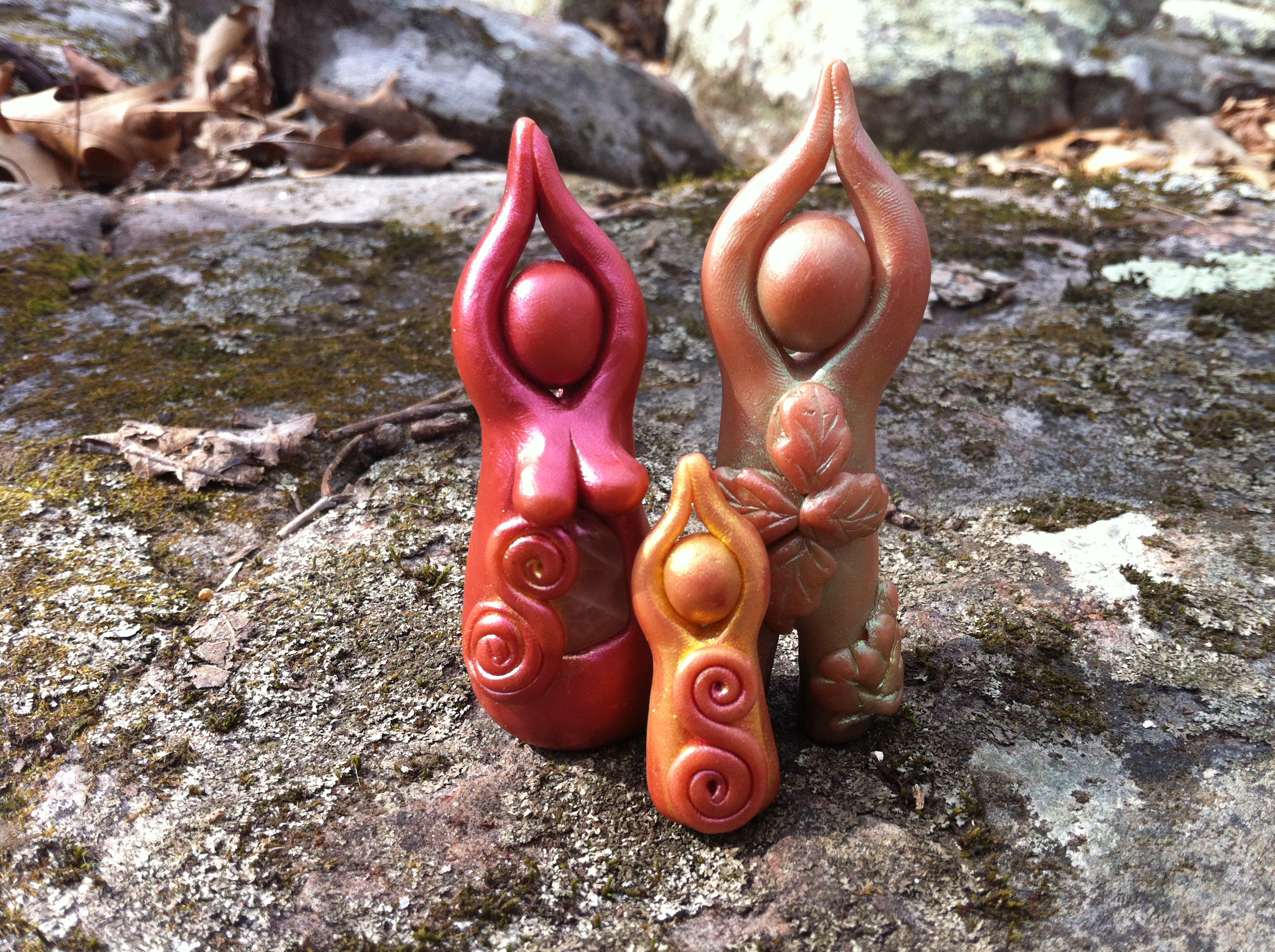
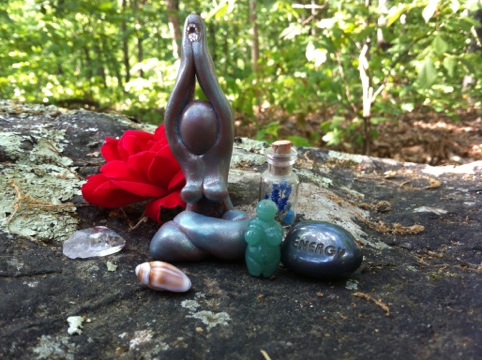
As I’ve shared a photo of previously, at my toddler daughter’s request, I recently made a “Daddy Goddess” sculpture as well to go with my many others—as I was making him, I realized I do have some room for a Green Man type of symbolism after all:

April 2013 004And, as I shared in my Feminism and Religion piece, a couple of months ago my six-year-old son made this sculpture for me…

February 2013 051 “This is the Goddess of Everything,” he told me. “See that pink jewel in her belly, that is the WHOLE UNIVERSE, Mom!!

Yep. He gets it! 🙂

Categories: family, feminist thealogy, Goddess, parenting, spirituality, thealogy, Thursday Thealogy, writing | 4 Comments

Top Thirteen Most Influential People in Goddess Spirituality

Earlier this month I was very interested to see a series of posts on Raise the Horns about the top 25 most influential people in the birth of paganism. When I read Mankey’s post, it reinforced my own conception of Goddess spirituality as having a distinctly different lineage and flavor than much of contemporary paganism. His list, while extensive, useful, and accurate, involves a distinct lack of Goddess scholars, highlighting to me that Goddess spirituality IS a different movement and isn’t actually just a Goddess-oriented branch of contemporary paganism. Indeed, almost everyone on his list I’d either never heard of, not read, or don’t enjoy their writing. I immediately started to draft a list of my own and came up with 13 women, which seemed delightfully appropriate. We in the Goddess feminist community have our own path, herstory, and lineage, one that really only began in the 1970’s in direct connection to the feminist movement, rather than the pagan movement.

Not necessarily in a particular order, here is my own list of the top thirteen most influential people in the development and articulation of Goddess Spirituality as its own distinct path. (I’ve been scrambling to finish collecting my thoughts in time to post this list while it is still Women’s History Month!) Only one of my own picks also appears on Mankey’s list. December 2012 097

  1. Carol Christ–this feminist scholar is the most skillful and intelligent thealogian of the present day. Christ’s influence on my own ideas and concepts has been profound. Her work is academic, focused, and deep, and she wrestles with heavy questions. I particularly enjoy her books Rebirth of the Goddess and She Who Changes. A brilliant, thoughtful, amazing writer, Christ’s essay Why Women Need the Goddess remains, in my opinion, one of the most important and influential articles of our time.
  2. Merlin Stone–author of the classic When God was a Woman, this professor of art history changed the landscape and understanding of ancient cultures and their relationship to the Goddess (and, yes she drew on the work of Murray and Graves, but moved into feminist thealogy rather than pagan practice).
  3. Riane Eisler—author of The Chalice and the Blade, she made a significant contribution to the understanding of the history and development of patriarchy as well as offering a solution in the form of a partnership model of society.
  4. Marija Gimbutas—scholar and archaeologist and author of several books chronicling Goddess figurines from around the world, including The Language of the Goddess, her work has come under scrutiny and criticism, but remains a potent contribution to the lineage of the Goddess movement.
  5. Starhawkthe first of two on my list who bridge the gap between more “classic” paganism and feminist spirituality, Starhawk had a huge impact on the development of a female-oriented spiritual tradition. Her book The Spiral Dance was the first introduction to the Goddess for many women. In keeping with what I find to be a personal lack of click with a lot of pagan authors, I did not particularly enjoy The Spiral Dance and actually read it much later than most of the other books about feminist spirituality that I reference in this post, but regardless of personal taste, her influence on the Goddess movement is profound.
  6. Z. Budapest—considered by many to be one of the first mothers of the feminist spirituality movement in the U.S., like Starhawk, Z’s writings are not my personal favorite resources because of their heavy Wiccan orientation, but they are undeniably classics in Goddess circles. Z has taken heat from many pagans for her position on transgender people.
  7. Patricia Mongahan–recently departed author of Goddess-specific resource books like The Goddess Path and Wild Girls, Patricia’s writing is more practical and less scholarly/thealogy-oriented than some of my other favorite authors. March 2013 086
  8. Monica Sjoo—radical artist, ecofeminist, and Goddess scholar, Sjoo wrote The Great Cosmic Mother and one of my other favorites, a critique of New Age spiritual paths called New Age Armageddon. Her classic and awesome painting God Giving Birth narrowly avoided ended up in Court on the charge of “obscenity and blasphemy.”
  9. Hallie Iglehart—while less well-known and influential than some of the other women on my list, Hallie was personally very impactful to my own Goddess path, since her books were some of the first, personal and experientially-oriented Goddess-specific books that I read. She is the author of Womanspirit, a synthesis of feminism and religion, and of The Heart of the Goddess, a visually stunning collection of Goddess images and meditations/reflections.
  10. Cynthia Eller—while Eller’s book focused on debunking the “myth of matriarchal prehistory” made her lose popularity among many in the Goddess community (see her clarifying comments here), her scholarly engagement with the complexities of articulating the concepts of feminist spirituality and of thealogy is challenging, illuminating, and offers the opportunity to dig deeply into one’s own perspectives. Her book Living in the Lap of the Goddess is a thorough exploration of women’s spirituality and the Goddess movement.
  11. Charlene Spretnak–another rocking writer with a thorough grasp of the sociopolitical and cultural context, value, and purpose of Goddess spirituality, her classic anthology The Politics of Women’s Spirituality is one of the best and deepest explorations of the concepts, personal experiences, philosophies, and thealogies of why Goddess.
  12. Karen Tatethrough her weekly radio show, Voices of the Sacred Feminine, I would venture to say that Tate is one of the most influential and dedicated “Goddess advocates” of the present day.
  13. Elizabeth Fisher and Shirley Ranck—authors of germinal religious education curriculums focused on feminist spirituality and woman-honoring traditions, originally published by the UU Women and Religion program, their work with Rise Up and Call Her Name andCakes for the Queen of Heaven continues to change the lives of women around the country by introducing them to a vision of what the world could be like if the divine was imaged as female.

Also deserving of mention are:

  • SageWoman Magazine (and her editors)—this specifically Goddess-women oriented publication is a treasure and a delight.
  • Feminism and Religion blog–daring to explore the intersection of religion, scholarship, activism, and community, FAR is not specifically Goddess-oriented, but includes Goddess scholars amongst their contributors and weaves a beautiful, living, organic tapestry of the multifaceted web of feminist spirituality in the present day.

I find that feminist spirituality can be distinguished from paganism because of the inclusion of a core sociopolitical orientation and distinct sociocultural critique. Feminist spirituality to me is the intersection of religion and politics. It is religious feminism. It may or may not include literal experience of or perception of the Goddess, but it names the female and the female body as sacred, worthy, and in need of defense and uses Goddess symbols, metaphors, stories, and experiences as primary expressions of divinity and the sacred.

After originally writing this list, I thought of many more women I should have included and I kept meaning to do a part two follow-up article. I’ve yet to finish that, but this is who I would add…

Six More Influential Women: 1

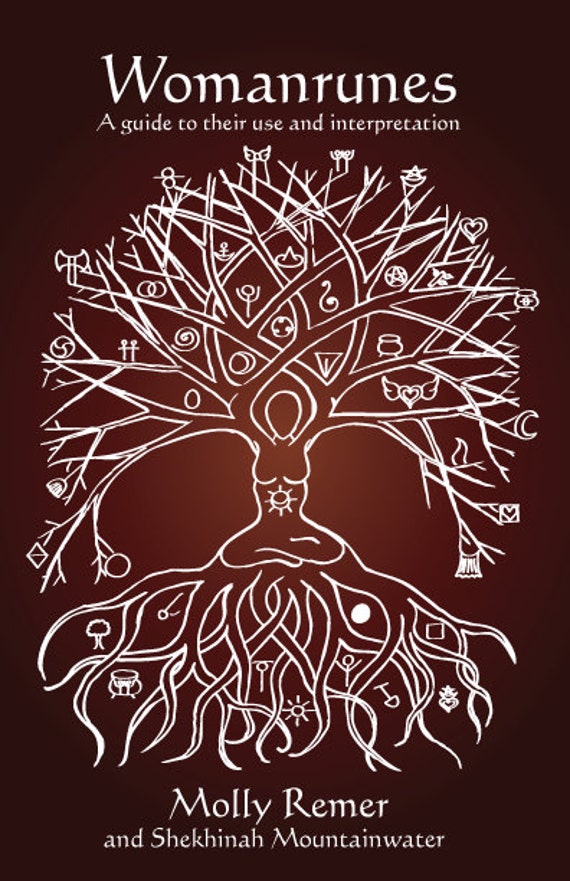
  1. Shekhinah Mountainwater (pictured at right): tremendous personal influence on my life and work.Original creator of Womanrunes and author of one of my all-time favorite goddess spirituality books, Ariadne’s Thread.
  2. Diane Stein–I particularly enjoy her anthology The Goddess Celebrates and also her book, Casting the Circle.
  3. Vicki Noble–her book Shakti Woman is a powerful and important read.
  4. Barbara Ardinger–if I had to choose a favorite book for ritual resources and goddess spirituality, her book A Woman’s Book of Rituals and Celebrations would be one of those at the top! I also enjoy interacting with her as a sister blogger at Feminism and Religion.
  5. Barbara Walker–author of several goddess-oriented sourcebooks, The Essential Handbook of Women’s Spirituality is another of my favorite resources.
  6. Nancy Vedder-Shults–I first “met” Nancy through hearing her music at a Cakes for the Queen of Heaven training. Her CD, Chants for the Queen of Heaven, was my first-ever purchase of goddess-specific music (I didn’t even know there was such a thing until hearing her songs!). Later, I continued to enjoy her contributions to SageWoman magazine and now through direct interaction on the Feminism and Religion blog.

 Other cool books/honorable mentions:

March 2013 058

Save

Categories: books, feminism, feminist thealogy, Goddess, resources, spirituality, thealogy, womanspirit | 74 Comments

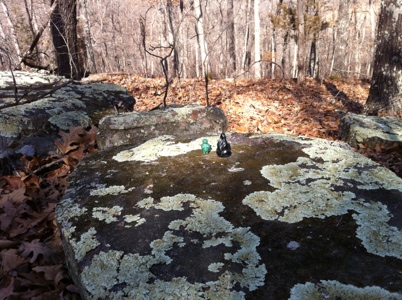
Woodspriestess: Sensory

20130316-165127.jpg

The chair rock has a couple of nice little “shelf” nook on the side of it. I’m always tempted to leave things on it, but I make a habit of not leaving things in or (usually) taking things from the woods. Sometimes I set something on the shelf just during the time that I am out there.

Breathe deep
Breathe peace

Open hands
Open heart
Open mind
Open spirit

This is both my prayer
And my vow

Resting in sheltering stone
Listening to bird song
Feeling the breeze
Seeing the trees against sky
Tasting the very center of life.

A thealogy of embodiment is the subject of my dissertation, so I was very interested to read the Allergic Pagan’s smart and thought-provoking follow-up post to his thoughts about objectivity. He draws the conclusion that it is the body that bridges the gap between the subjective and objective. While I focused on subjective experience and the Goddess in my prior post about objectivity, I actually do find that the Goddess can be interpreted/understood through science as well—some people call it evolution, others call it Goddess and others call it God…subjective experience need not exclude scientific concepts/understanding. As in my breastmilk example from that post, I can understand the experience both objectively and subjectively and, just as John notes, this intersection occurs within the body. I also believe theapoetical language can include both as well. I’m going to explore the question of the place of the God within thealogy in my Thursday Thealogy post next week. I tend to come from the notion that Goddess holds all—and, that Goddess-language is simply a consciously chosen name for unnameable forces of life, the weaving that holds the world, a weaving including but not limited to females and males of all kinds.

Today, rather than standing or sitting on the priestess rocks, I visited the chair rock instead. It is super comfortable and I used to come here to sit after my miscarriages and then during my pregnancy with my daughter and then this is where I brought her one-month-old self to introduce her to the Earth. I used to sit here with her in a pouch or the Ergo and feel our bodies breathing in harmony, chest to chest.

20130316-164909.jpg

20130316-165137.jpg

The scenery looks different when considered from the chair rock rather than the priestess rocks. Here is a “slingshot” tree” and behind the big mother tree that I like so much (and that I keep hoping is still alive!)

As I’ve previously referenced, Gloria Orenstein refers to endarkenment as, “a bonding with the Earth and the invisible that will reestablish our sense of interconnectedness with all things, phenomenal and spiritual, that make up the totality of our life in our cosmos. The ecofeminist arts do not maintain that analytical, rational knowledge is superior to other forms of knowing. They honor Gaia’s Earth intelligence and the stored memories of her plants, rocks, soil, and creatures. Through nonverbal communion with the energies of sacred sites in nature, ecofeminist artists obtain important knowledge about the spirit of the land, which they can then honor through creative rituals and environmental pieces” (Reweaving the World, p. 280). This speaks to me because of my theapoetical experiences of the presence of “the Goddess” in my own sacred spot in the woods behind my house, where I go to the priestess rocks to pray, reflect, meditate, do ritual, think, and converse with the spirits of that place.

Categories: embodiment, endarkenment, family, feminist thealogy, Goddess, nature, pregnancy loss, spirituality, thealogy, theapoetics, womanspirit, woodspriestess | 1 Comment

Thursday Thealogy: Objectivity & Personal Experience

20130314-173059.jpg

Tree Sisters

“What is life? It is the flash of a firefly in the night. It is the breath of a buffalo in the winter time. It is the little shadow which runs across the grass and loses itself in the Sunset.” –Crowfoot in The Earth Speaks

“To go into the dark with a light is to know the light. To know the dark, go dark. Go without sight and find that the dark, too, blooms and sings, and is traveled by dark feet and dark wings.” –Wendell Berry in The Earth Speaks

As I mentioned last week, I wanted to call your attention to a great post at about objectivity at The Allergic Pagan. Among other interesting stuff, John writes:

Take for example the idea that the earth revolves around the sun. We laugh at the thought that anyone would think the sun was revolving around the earth. But, in point of fact, that is our most immediate experience of the world: The sun rises east, moves over our heads, sets in the west, and then rises again in the east. But we say that what is “really” happening is the earth is rotating and revolving around the sun. That explanation is the most mathematically parsimonious, because is most easily accounts for the movement of the earth, the sun, and the other celestial spheres. But is it the most “accurate” one? Accurate to what? Certainly not accurate to our everyday experience…

…Objectivity is a myth. It is a good myth and it functions well for many things. But it is a myth nonetheless….

…For once I would love to hear someone say, “Oh, that’s just objective“, instead of, “Oh, that’s just subjective.” Subjectivity is not less than objectivity. In fact, I think objectivity is a less complete account of the world that the subjective one. We gain a certain power to control our environment when we attempt to bracket our subjectivity; but we also lose something. We lose the reality of our own experience, and we lose the sense of our own participation in that reality….

The Sun Also Riseth: The limits of objectivity (UPDATED) | The Allergic Pagan.

When I applied to Ocean Seminary College, I included the following explanation as part of my letter:

In recent months I have come to the conclusion that I need to follow my intuition as to what feels right to me, rather than to try to find answers in books or articles. What feels right in my heart and in my bones. Goddess feels right to me—authentic in a way that no other spiritual framework ever has. While I do not usually interpret Goddess in a literal sense, I do still feel Her presence in my life—call it an energy, call it the sacred feminine, call it the divine, call it source, call it soul, call it spirit, call it the great mystery…I perceive forces in the world larger than myself and I choose to put a feminine form to that energy—to name it and know it as Goddess. It only seems logical to me that SHE gave birth to the world, to reality—women are the birth givers and they are made in HER image.

I come to Goddess spirituality from a childbirth education and activism background. I am deeply committed to women’s birth rights and to me it has always seemed very logical that ancient peoples would have revered that which created the earth—which gave birth to the earth—the primary life force of the planet, as female. Though it could perhaps be viewed as an unnecessary personification, it just makes plain sense to me to vision the divine as feminine. Side note about personification and tying it to John’s post about objectivity, whenever I type the word I am reminded of a story I read somewhere in which a husband asks a wife, “why must you take everything so personally?” And she responds with something like, “this is my life, how could I not take it personally? It makes sense to relate to the world in a personal way.”)

And, still thinking about the value of subjective experience and the limits of objectivity, as I wrote in an article for Restoration Earth and later republished on my own blog:

How many generations of women have pushed out their babies and fed them at the breast without knowing the exact mechanics of reproduction, let alone milk production. There are all kinds of historical myths and “rules” about breastmilk and breastfeeding and even ten years ago we used to think the inner structure of the breast was completely different from what we think it is like now. Guess what? Our breasts still made milk and we still fed our babies, whether or not we knew exactly how the milk was being produced and delivered. Body knowledge, in this case, definitely still trumped scientific knowledge. I love that feeling when I snuggle down to nurse my own baby—my body is producing milk for her regardless of my conscious knowledge of the patterns or processes. And, guess what, humans cannot improve upon it. The body continues to do what the human mind and hand cannot replicate in a lab. And, has done so for millennia. I couldn’t make this milk myself using my brain and hands and yet day in and day out I do make it for her, using the literal blood and breath of my body, approximately 32 ounces of milk every single day for the last [two years]. That is beautiful.

via Breastfeeding as a Spiritual Practice | Talk Birth.

A couple of months ago, while discussing biology, physics, botany and more with a friend, she commented to the effect of, “Once we know how it works, it isn’t amazing any more.” But, I said, isn’t it? And, do we ever really know how something “really works,” when we constantly are learning new things about the way things “really are”? Can we ever truly boil it down to “just the facts” or is there something invisible, ineffable also there? A creative, interlacing energy in which we are embedded all the time? Back to nursing babies, objectively my body is converting blood into milk to feed my offspring. A biological, hormonally programmed response to having reproduced. That’s hella cool too. But, subjectively, it’s love made flesh, it is embodied motherhood, it is biological synchronicity, it is pure magic. I don’t have to know how it works, I just have to do it. Some of the most important aspects of my life can’t be objectively determined and why should they be able to be? I take it personally.

One of the things that continues to keep me involved with Goddess spirituality is the value of direct experience. As Charlene Spretnak explains, “We would not have been interested in ‘Yahweh with a skirt,’ a distant, detached, domineering godhead who happened to be female. What was cosmologically wholesome and healing was the discovery of the Divine as immanent and around us. What was intriguing was the sacred link between the Goddess in her many guises and totemic animals and plants, sacred groves, and womb like caves, in the moon-rhythm blood of menses, the ecstatic dance–the experience of knowing Gaia, her voluptuous contours and fertile plains, her flowing waters that give life, her animal teachers…” (p. 5)

In Merlin Stone’s essay about the three faces of goddess spirituality she states, “So far, and let us hope in the future as well, feminists concerned with Goddess spirituality have seldom offered absolute or pat answers to theological questions. What has been happening is the experiencing, and at times the reporting, of these personal or group experiences: how it feels to regard the ultimate life force in our own image—as females; how it feels to openly embrace and to share our own contemplations and intuitive knowledge about the role of women on this planet; how it feels to gain a sense of direction, a motivating energy, a strength, a courage—somehow intuited as coming from a cosmic female energy force that fuels and refuels us in our struggle against all human oppression and planetary destruction.” She goes on to articulate a thealogical perspective that holds a lot of truth for me:

“Some say they find this force within themselves; others regard it as external. Some feel it in the ocean, the moon, a tree, the flight of a bird, or in the constant stream of coincidences (or noncoincidences) that occur in our lives. Some find access to it in the lighting of a candle, chanting, meditating—alone or with other women. From what I have so far read, heard, or experienced myself, I think it is safe to say that all women who feel they have experience Goddess spirituality in one way or another also feel that they have gained an inner strength and direction that temporarily or permanently has helped them to deal with life. Most women interested or involved in feminist concepts of spirituality do not regard this spirituality as an end in itself but as a means of gaining and giving strength and understanding that will help us to confront the many tangible and material issues of the blatant inequities of society as we know it today.” (p. 66-67)

This is one of the greatest strengths of spiritual feminism or Goddess traditions—women are capable of defining their own experiences. This means that the Goddess is hard to pin down. She means many different things to different people. I think that fluidity of definition is a powerful attribute that leaves the Goddess path open to many, many women. This fluidity is why it is possible for us to see Jewitches and Goddess Christians and spiritual feminists who connect to the symbol/metaphor, but not a literalist interpretation. The Goddess can hold it all.

When addressing the idea of the Goddess’ ability to elude definitional capture, it is also important to look at the notion of “believing in” the Goddess. Whether or not people “believe” in her might actually be an irrelevant question. I steer away from using the word myself and find I share the tendency of many spiritual feminists to prefer the explanation that they experience the Goddess.

This does not mean the Goddess is fictional, she can be experienced directly, but that she is not believed in in the conventional theological sense. “Most spiritual feminists explain this by saying it is only a question of semantics: everyone experiences goddess, but not everyone chooses to call her that” (p. 140). I identify with this, as I wrote above, having reached a point in my life where I consciously chose to name/label/identify those larger natural powers of the world as “Goddess.”

In Judith Laura’s book, Goddess Matters, she describes Goddess as “she who flows through all” and contrasts this with “God as manipulator.” Goddess is: “She what connects us, not only like a link in a chain but also like an electrical current.”

And, why personalize this or anthropomorphize it anyway? Because society is so very deeply rooted in the lens of patriarchal theology. This doesn’t dissolve because we say, “the Universe” or “the Mystery”—the white bearded old man in the sky remains our collective cultural image of Divinity (as something to which we can be in relation) unless we consciously and deliberately offer, reinforce, and promote other imagery.

As Christ quoted in Edelson remarks, “The real importance of the symbol of Goddess is that it breaks the power of the patriarchal symbol of God as male over the psyche” (p. 313). This is part of what I mean when I say that my interest in Goddess is first political and then later personal/religious. Both have great value to me and I do believe that whether or not someone believes in Goddess as literal or metaphorical, Her importance and value as a symbol within feminism, politics, and culture cannot be overestimated.

In the book Women’s Rituals by Barbara Walker, she makes this point: “Theology, or ‘God-knowledge,’ is a pseudoscience invented by men to define and describe the God whom they simultaneously call indefinable and indescribable. Real science studies objective phenomena. Theology studies a collective male fantasy. Much theological effort goes into hiding the fact that God is not an objective phenomenon but a construct of men’s imaginations, based on their own sense of what they are, what they wish to be, or what they think they ought to be” (p. 135). To this I would add, OR, what they wish to control and what type of social and political structures they wish to justify or wars they wish to engage in. Walker describes theaology thusly, “Thealogy, or ‘Goddess-knowledge,’ may be reinstated, after its long eclipse, as a similar collective image developed by women critical of the ethical shortcomings of patriarchal culture” (p. 135). Walker goes on to says, “Theologians established their God with a pretense of his objective existence. Thealogians need not to resort to such hypocrisy. It is possible to deal with the image of divinity as the collective self-expression that it really is, as a symbol of women’s true knowledge, and as the arbiter of moral instruction represented by humanity’s most ancient mothers” (p. 136).

So what, then, is Goddess? Walker shares the conclusions of a variety of women summarized here:

Goddess is love. Power. Nature. Femaleness. Feminine morality (rooted in care and relationship). Irresistible force. The universe. Creativity that drives me. Oldest power of the universe. Everything from born from her. The earth. The moon. Anger at patriarchal domination and oppression. Sense of what the world needs to relieve suffering. My own sentience. The trinity of Maiden, Mother, Crone. Light and dark. Body-oriented spirituality. Self-worth, liberation from inner shame (“original sin of being born female”). Each person contains her divine spark. “Cauldron-womb, the eternal matrix from which everything comes and to which everything returns…” Loving creativity. Mother. (pp 136-139)

We take her personally.

20130314-173111.jpg

In the woods this morning with my little pal again!

Categories: feminist thealogy, Goddess, spirituality, thealogy, Thursday Thealogy, womanspirit, women, women's circle | 9 Comments

Woodspriestess: Saving the World?

Today marks the beginning of a 30 day experiment in daily writings/photos about my sacred space in the woods. I made a New Year’s resolution of sorts to visit the same spot every day for a year and to take at least one photo and to explore through that process my relationship to the environment around me and its seasonal evolution.

First a picture…

March 2013 038
It started snowing again today and one of our cats, Big Mama, followed me down to the priestess rocks. I noticed her delicate little footprints in the snow on top of one of the rocks. Another thing I noticed and have remarked on before to my husband, is how there is a little trail of naturally occurring “stepping stones” that make a path through the woods to the rocks. When we first moved here, one of the things I wrote on my to-do list was, “make a sacred spot in the woods” and I imagined putting stepping stones down to said place. Well, come to find out, no “making” of a sacred space necessary…it was already there…AND, no need to put down my own stepping stones either. They, too, were already there. Metaphor for life? Or, just life.

March 2013 040

The path naturally appears/is uncovered as the stones there keep the light snowfall from sticking to them.

Some posts may be very brief, or photo-only, but I’m actually kicking off my experiment with some heavy thinking today…

I’ve been feeling depressed and discouraged lately after reading some really horrifying articles about incredible, unimaginable violence and brutality against women in Paupa New Guinea who are accused of being witches as well as a book about human trafficking around the world (I wrote about this in a post for Pagan Families last week). Then, I finished listening to David Hillman on Voices of the Sacred Feminine recently, in which he issues a strong call to action to the pagan community and to “witches” in the U.S. to do something about this violence, essentially stating that it is “your fault” and that instead of wasting energy on having rituals to improve one’s love life (for example), modern witches should be taking to the streets and bringing these abusers to justice. And, he asserts, the fact that they don’t, shows that they don’t really “believe”—believe in their own powers or in their own Goddess(es). This brought me back to a conversation I had with a friend before our last women’s circle gathering…does this really matter that we do this or is it a self-indulgence? We concluded that it does matter. That actively creating the kind of woman-affirming world we want to live in is a worthy, and even holy, task. I don’t have time to fully go into it all right now, but I also think the legacy of the sixteenth century “witchcraze” is powerful and the attitudes that drove it are alive and well in the world today. There is a lot of fear still bound up in that word and perhaps that is why people fail to respond to Hillman’s challenge to take to the streets.

I asked the woods today and they responded…

What can I do to save the world?

Saving the world is a Christ complex
an illusion of superiority
a delusion of grandeur.
Or is it?

Is it instead
a description
of what it is like to care?

Be awake
Be sensitive
Be present

Keep reading
Keep reading
Keep reaching
Keep laughing

Raise sons and daughters
who love themselves
and each other
and the earth

Say no to violence
in home
in thought
in act
in deed.

Say no to microaggressions
and to micro-spending decisions that support oppression
Say yes to micro-acts on the side of love
Say yes to not giving up on macro vision
and big picture thinking

Always be willing to dig deep
to think hard
to feel strongly

Rise up
stand tall
say no
be counted
hug often
hold your babies
hold your friends

Circle often
stand together
refuse to give up
when defeated, rally once more.
Persist in a vision of the way things could be
and take action
to bring that vision into reality.

Hug well
laugh often
live much

Speak your truth
tell your story
stand up for the silenced
speak for the voiceless
believe that hope still has a place

Hold steady
hold strong
hold the vision
hold each other.

When I came back inside, I added another Kiva loan to the three I already have going. I chose a women’s cooperative in Pakistan with a craft business. I paid for the loan using my profits from selling my own goddess art. I also signed up to sponsor a woman in the Congo via Woman to Woman International. Maybe this isn’t “enough,” but it is something. I work hard to support women in my own community in a variety of ways.  I write all over the place…maybe that isn’t “real” help, or maybe it is, but I can’t stop doing it.

Categories: feminism, feminist thealogy, Goddess, nature, spirituality, thealogy, women, women's circle, woodspriestess, writing | 4 Comments

Women’s Voices

December 2012 115The voices of women are rising again
we are mothers, daughters,
lovers, leaders, teachers
authors, priestesses, even warriors
and we will not be silenced.
we will speak for the vulnerable
we will speak for the oppressed
and we will speak for ourselves.
The world will be saved,
not by a dying man,
but by women’s stories…

(1/10/13)

‎I listened to David Hillman speak on a recent episode of Voices of the Sacred Feminine and he mentioned that when political and religious tides were turning in the ancient world, those who wanted to dominate and control didn’t go for the leaders of countries, for political heads of states, or for those in powerful jobs, they went for the priestesses. They went for women who held the cultural stories and ritual language of the people. They went for the healers and nurturers and those who took care of others. They destroyed temples and sacred images and books. They almost succeeded in total eradication of the role of priestess from the world and worked really hard to take midwives and wisewomen out completely as well.

I addressed a similar topic in my Stigmatization of the Witch class at OSC with regard to the question of why sexuality and the woman as healer became such a threat to European Medieval society:

Allan-statue(sacredsource)
Many women accused as “witches” were past their childbearing years—thus, had used up their usefulness as a sexual commodity and because many of them were widowed/not controlled by a man, they threatened the very fabric of the patriarchal community. Women in general were associated with the “evils” of sexuality, sex in itself being viewed as sinful rather than sacred. Many of the women accused were midwives and healers. Birth was purposefully denigrated and made “unclean” as a means of subjugating women and dominant religious traditions sought “purification” and “rebirth” in patriarchal traditions—transcending the body and the “unclean” birth from a lowly female body, to a spiritual birth from a father figure. No mother/woman required! Midwives/witches’ association with the “dirty” and original-sinful act of birth, made them natural suspects for other mysterious and powerful events (such as infant death or personal disfigurement). It would seem much more logical that the power to give life, to express the might of creation, should really have been viewed as one of the holiest and most profoundly meaningful acts in society—it seems much more logical and natural to celebrate women as life-givers and sustainers of society, but this was actually purposefully inverted and fear rather than celebration came to surround the mysteries and potent powers of a woman’s reproductive life.  In some ways, perhaps “womb envy” was one of the driving forces behind the witch hunt phenomenon…

Likewise with the healing abilities of the accused—the ability to heal was a special power that gave women authority and influence over the community members. I was interested by the Barstow’s remarks that the women accused were, “…uppity women—women given to speaking out, to a bold tongue and independent spirit….spirit, quarrelsomeness, a refusal to be put down. They talked back to their neighbors, their ministers, even to their judges and executioners.” (p. 27) What if other women, who saw these women as important figures, felt like they could also be independent and speak their minds? Society would fall apart!

I am reminded of a poem I received once in a card from the National Association of Mother’s Centers:

One Woman Awake
Awakens another,
The second awakens her next door neighbor.
And three awake can rouse the town,
And turn the whole place upside down.
And many awake
Can raise such a fuss
That it finally awakens the rest of us.
One woman up,
With dawn in her eyes,
Multiplies.

It is not uncommon for a society not to want to risk the threat of awakened women turning the whole place upside down.

“We’re volcanoes. When we women offer our experience as our truth, as human truth, all the maps change. New mountains form.”

– Ursula Le Guin

‎”I hear the singing of the lives of women. The clear mystery, the offering, and the pride.”

– Muriel Rukeyser

Categories: feminist thealogy, OSC, priestess, quotes, women | 4 Comments

Endarkenment « Feminism and Religion

My third guest post at the Feminism and Religion blog centered around the idea of Endarkenment. Here is an excerpt:

Mandala drawing from last pregnancy

It is from this dark space that we emerge—whether from our own mothers or from the more mysterious cosmic “sea” of soul—and it is to darkness that we return when we close our eyes for the final time…

I find that within Goddess circles the idea of “the dark” remains commonly associated with that which is evil, negative, bad, or unpleasant. The Dark Mother, while acknowledged and accepted, is often at the same time equated with death, destruction, challenge, trials, and obstacles. While I recognize that the concept of a dark, demonic, and destructive mother might too have a place in goddess traditions…I also think this is unnecessarily limiting and that the idea of the “Dark” in general is in need of re-visioning. It is not just with regard to the role or place of death within the wheel of life or the Goddess archetype that Goddess as Dark Mother and destroyer can be honored or recognized, but the Dark as a place of healing and rest can also be explored.

via Endarkenment By Molly Remer « Feminism and Religion.

The post received a lot of comments and some people definitely disagreed with my remark that in “Goddess circles” the dark is associated with that which is negative. I’d love to hear your thoughts as well!

Categories: feminist thealogy, Goddess, spirituality, thealogy, writing | 4 Comments

How the UU Church Introduced Me to the Goddess

Two blogs that I enjoy reading—Bishop in the Grove and Love, Joy, Feminism—both recently wrote about their personal experiences attending Unitarian Universalist Churches and the sense of community/value they found there. It made me think about the role of the UU Church in my own life and I decided it was time to give a shout-out to the UU Church and how it introduced me to the Goddess and to religion in a form that I not only could find palatable, but also deliciously meaningful and enriching. My first cause in life was feminism—a sense honed by my experiences as an agnostic homeschooled teenager amidst mostly fundamentalist Christians. I could not help but stand up for women’s rights and challenge the rhetoric my peers often shared about a “woman’s [lesser] place” in life and society. Because my developing sense of feminism burgeoned in response to patriarchal religious beliefs about women—the only religious beliefs I had yet encountered—I also developed a sense that feminism was not compatible with religion, period.

In college in the 1990’s as a psychology major, I always chose “women’s issues” as my main area of focus and I went on to graduate school in clinical social work, doing my internship at a battered women’s shelter (I also volunteered in one during my undergraduate years). My sense of the Goddess that later emerged is very intertwined with my deep beliefs about the inherent value and worth of women. After finishing graduate school in 2000, I started to have lots of “searching/seeking” conversations in the car with my husband–trying to find something to “plug into” and saying, “maybe I need to get religious?” But, there was no religion I could find that fit me/matched me and I decided it probably didn’t exist. As time passed, I continued to seek/discuss/ponder and a different friend mentioned her UU church and it being a “perfect spiritual home for her”–I dismissed it because of the word “church,” but in 2005, I took the infamous Beliefnet quiz and got a 100% match for Unitarian Universalism. Lo and behold–my beliefs about social justice and about the inherent dignity and worth of each human being, as well as about the deep mystery and wonder of the natural world were “pluggable” after all! By this time, we had moved and so I started attending my very, very tiny local UU fellowship.

Cakes “Gaia” logo

In 2003, my good friend had taken a women’s studies class in college and lent me the books When God was a Woman and The Chalice and the Blade and we began to have discussions about the Goddess and to explore our feelings about religion and meaning. She was the first person I was ever able to speak to deeply about spirituality. I was raised as a fourth generation “non-religious” person—my parents, grandparents, and great-grandparents all had/have no religious or church affiliation. My friend and I talked a lot about Wicca and paganism and as I read more books, I realized something was missing for me in most pagan literature. I eventually discovered the “missing” element, for me, was the Goddess emphasis of feminist spirituality.

After beginning to attend the small local UU church that I jokingly refer to as the Church of Democracy and Evolution, I discovered the fabulous Women and Religion subgroup within the larger UU world and started to realize that my strong draw towards Goddess actually had a place and a home under the UU “umbrella” and that I didn’t have to self-identify as pagan or Wiccan in order to explore a relationship with Goddess. I trained as a Cakes for the Queen of Heaven facilitator in 2008 and discovered something every powerful in these resources. At the conclusion of the training, I had profound sense of THIS is what else there is for me! It was a pivotal moment.

After the empowering and transformative births of my sons in 2003 and 2006, I became deeply enmeshed in birthwork—expanding my senses of women’s issues and social justice into birth activism and birth education. Then, in 2009, my third son died during my second trimester of pregnancy. My birth-miscarriage experience with him was a powerful and transforming experience as well and I was left with a sense of openness to change. A receptivity to larger forces and powers in the world.  Indeed, it felt like a spiritual experience of sorts. After his birth and in my journey through grief, I experienced a sense of myself as inherently worthy and valuable—that I didn’t need to do anything special to be a worthwhile human being. I also had the revelation shortly after his birth that the power of women that is so present in birth, is present in women, period. I realized that this sense of “birth power” could be found in women’s spirituality and I found myself irresistibly drawn to more and more reading and study of feminist spirituality and Goddess thealogy. However, reading wasn’t enough. I felt the thread of Goddess that had danced at the edges of my life for so long, had finally become a distinct and extremely important presence in my life and I felt a call to more formally dedicate myself to a Goddess path.

On my son’s due date on May 3, 2010, which was also my 31st birthday, I did a small, private ceremony in the little stone labyrinth in my front yard in which I formally declared to myself and to the nature around me that I was now committed to practicing the presence of the Goddess in my everyday life. In May of 2011 and May of 2012, I renewed that commitment in another private ritual. Also in May of 2010, I went to a healer for “somatic re-patterning” (or, as I call it, “reprogramming my brain!”) and let go of the remaining neural pathways doubting my own worth and value. During our session, she told me that my healing gift is in words (not in physical touch or treatment) and that I live my spirituality, I don’t have to explain it. She also told me that something big was shifting inside of me and that I was opening up it a new direction. She asked if I perceived that shift in my life and I said, YES, knowing that it was this new sense of connection to the feminine divine.

In November of 2010, I attended at women’s spirituality retreat at a UU church in St. Louis and we did an exercise in which we each wrote a “gift” on a piece of paper (following a guided meditation) and then put them into a communal bowl and each drew out another’s woman’s gift–she was sharing it with us. I drew out “sacred words.” My friend told me she thought it was perfect for me because talking to me about her own experience of spirituality had been deeply meaningful to her. When I got home, I started looking for study programs/schools online because I knew in my heart that the time had come to deepen my personal study/experiences. After this retreat, I also started planning and facilitating quarterly women’s spirituality retreats locally. And, in January 2011, I gave birth to my own baby girl. She was born at home into my own hands, alone, under my own power and with my heart full of hope and joy and the promise of new beginnings.

In March of 2011 I started working on my D. Min degree in Thealogy/Goddess Studies at Ocean Seminary College and in July of 2012 I became ordained as a priestess with Global Goddess. Without my tentative steps into the UU church, I do not know that I’d be where I am right now. As is kind of the tagline of the program, I can honestly say that, “Cakes changed my life!”  😉

Categories: feminism, feminist thealogy, Goddess, spirituality, UU, women | 3 Comments

The Web of Life

This essay is modified from one written for my Ecofeminism class at Ocean Seminary College.

Carol Christ’s understanding of “profound connection of all beings in the web of life,” (p. 58) is integral to my own understanding of the world, ethics, feminism, and spirituality. I very often return to the idea from Naomi Wolf of the “great invisible web of incarnation of which we are all a part,” indeed it forms the very foundation of my personal thealogy. My introduction to Goddess spirituality as a viable spiritual path distinct from Wicca came from my involvement with the UU Church, which holds an awareness of the web of life as one of its six core principles: “Respect for the interdependent web of all existence of which we are a part.” UU’s also draw from “seven sources,” one of which is: “Direct experience of that transcending mystery and wonder, affirmed in all cultures, which moves us to a renewal of the spirit and an openness to the forces which create and uphold life” and another of which is: “Spiritual teachings of earth-centered traditions which celebrate the sacred circle of life and instruct us to live in harmony with the rhythms of nature.” (http://www.uua.org/beliefs/principles/)  I find that direct experience for me comes most clearly and cleanly through nature and thus identified with Starhawk’s explanation in Reweaving the World that, “we must preserve the wilderness that’s left because that’s the place we go for renewal, where we can most strongly feel the immanence of the Goddess” (p. 82). This is dramatically true for me and in August I explored my relationship with the Goddess in the woods in a guest post on the Feminism and Religion blog about Theapoetics, based on earlier work I did with OSC.

As I just used in my prior post, I again thought of this quote: “When you grow, care for, cook, and eat a vegetable, you become emotionally attached to that vegetable for life. You eat with your heart, not with your mind.” –Liz Snyder (quoted in “Home Grown: Helping Your Child Develop a Love of Gardening” in Natural Life Magazine, May/June 2011). While this is about vegetables, I think we could say the same about animals and also about people. The direct relationship and connection is the key. I really do feel like the relational context of our lives is the fundamental core of the human experience. We cannot not be in relationship to the things around us, not just in terms of other humans, but plants, trees and animals. We are even in relationship with the sun, the wind, and the rain. And, the net that holds the whole, is what I name as Goddess/Divinity. Everything is interconnected and does not exist without connection/relationship. Connection is strength, not weakness, and it is central.  Goddess ethics are “discovered within the web of life” rather than imposed from without.  If we acted with our hearts and with love rather than with “logic” and if a corresponding ethic of care underlaid our beliefs, actions, and social structures, the overall functioning of society would change for the better.

As I read these final chapters in Reweaving the World, particularly Christ’s quote from Alice Walker about being a part of everything, “not separate at all,” I also thought about one of my long ago observations from my Ecology and the Sacred class:

My reflection was about how quickly the woods close in around human-made structures. When we built our house, it felt like we had scarred the land—we cleared some trees and had to dig for the septic tank and so forth. The ground looked stripped, some trees were damaged (or cut down), and our house was kind of plopped down there in the middle of the scar. We moved in to our house four years ago and you can no longer see these environmental scars—indeed, it feels at times like we have to hold the woods back from taking the area back over and reclaiming the land. A variety of grasses and wildflowers grow in the cleared areas and trees stretch out all around our house. I reflect upon how if we no longer lived here, our house would be swallowed up by the forest within only a handful of years. This is reassuring to me in a strange way. No matter how we have altered the landscape by our human presence and “meddling” with our ecosystem, Nature is waiting to reclaim and transform what we have attempted to mold and make our own.I also reflected about how we, as human inhabitants of this patch of ground, are part of the woods and the forest ecosystem. I guess in some ways I feel like we have “invaded” here, carving out a large footprint. But, while standing on our back deck, and looking all around me at the trees, grasses, and flowers, closing in…pressing in almost…on our house, I felt a sudden sense that we and our home were a part of these woods. We live here in our—albeit excessively large–“nest,” much like any other animal inhabits its nest or burrow within the forest. And, we are within it too, not on top of or apart from it.

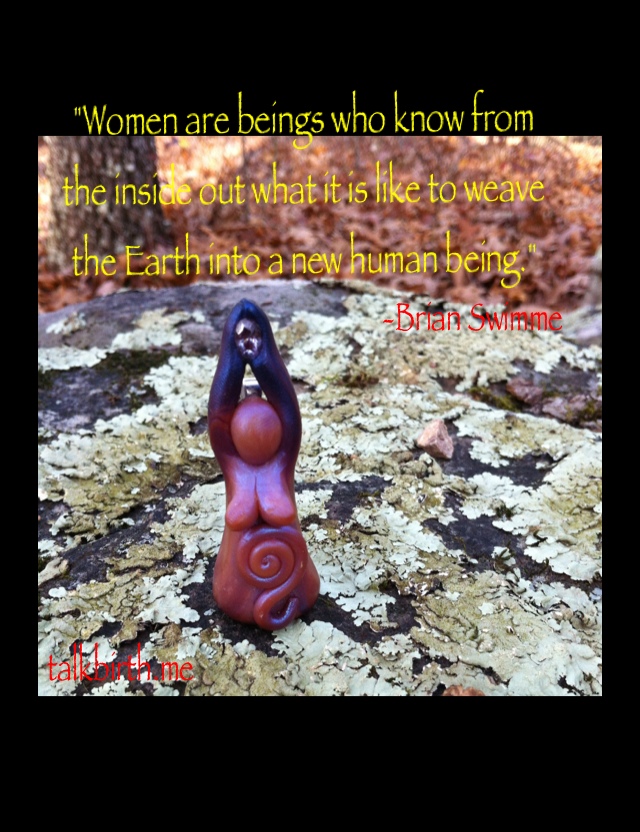
This idea that I was a legitimate part of nature and the woods as well was an important epiphany for me. Likewise, as I read Christ’s essay and I had another epiphany about interconnectedness and “all being one.” I’ve always struggled somewhat with the phrase, “we are all one,” but as I read her words, I had this new sense of clarity about it—we are all one weaving. A favorite example from earlier in this course is in Brian Swimme’s description of the Great Birth (Big Bang) in his essay in Reweaving the World: “From a single fireball the galaxies and stars were all woven. Out of a single molten planet the hummingbirds and pterodactyls and gray whales were all woven. What could be more obvious than this all-pervasive fact of cosmic and terrestrial weaving? Out of a single group of microorganisms, the Krebs cycle was woven, the convoluted human brain was woven, the Pali Canon was woven, all part of the radiant tapestry of being. Show us this weaving? Why, it is impossible to point to anything that does not show it, for this creative, interlacing energy envelops us entirely. Our lives in truth are nothing less than a further unfurling of this primordial ordering activity…Women are beings who know from the inside out what it is like to weave the Earth into a new human being” (Reweaving the World, p. 21. Emphasis mine).

I also greatly enjoyed Starhawk’s essay in Reweaving the World. As I read it and her passionate exploration of the earth-based tradition of paganism, I thought of a question I recently saw touched upon by a pagan blogger I enjoy, Bishop in the Grove, of whether or not pagans are still earth-based?  Explaining based on other posts and conversations Bishop asks:

“Lastly, are we “earth-based” anymore? It came up in response to Gus’s later statements about the political landscape that there are a wide-variety of Pagans, many of whom no longer identify as “earth-based.” This struck a chord with some people, and I’ve already received some feedback on Facebook which voiced appreciation for pointing out that some Pagans are more centered around deity.I think this one is worthy of a little unpacking. Do a little research, and you’ll see that the roots of the Neopagan movement were very much in the dirt, if you will. Earth-centered, or at the very least earth-aware spirituality has, up until fairly recently, been synonymous with Paganism. How exactly did we get to a place where someone could consider themselves a Pagan and not be “earth-based?” www.bishopinthegrove.com/archives/huffpost-live-paganism-roundtable-followup/

What would Starhawk make of this question I wonder, since her paganism is clearly deeply earth-based, indeed the earth is the foundation of her work, life, activism, teaching, and spirituality?! Starhawk reminds us that environmental issues are women’s issues, “for women sicken, starve, and die from toxins, droughts, and famines, their capacity to bear new life is threatened by pollution and they bear the brunt of care for the sick and the dying as well as for the next generation…unless we understand all the interconnections we are vulnerable to manipulation” (p. 83)

Starhawk passionately explains that earth-based principles call us to action: “earth-based spirituality makes certain demands. That is, when we start to understand that the Earth is alive, she calls us to act to preserve her life. When we understand that everything is interconnected, we are called to a politics and set of actions that come from compassion, from the ability to literally feel with all living beings on the Earth. That feeling is the ground upon which we can build community and come together and take action and find direction” (p. 74).

Categories: feminist thealogy, Goddess, nature, spirituality, thealogy, writing | 1 Comment

Community Empathy

This post is modified from a lesson for one of my classes at Ocean Seminary College. I received a lovely compliment on it from one of my fellow students and given the current contentious political climate, I felt like it might be a good time to share it here. The assignment was to consider empathy in the broader social context and how such empathy might impact social barriers.

“I have been reflecting recently that it is a lot easier to love another person than it is to trust that person. I feel compassion for people I have never met. You can have compassion for me without trusting me. Empathy and compassion are the foundation of morality and of our ability to live together.” –UU President Peter Morales in UU World magazine

Morales goes on to explain that compassion and love alone are not enough, you have to act. I think this is the core. If larger social environments were to act with empathy and compassion as the root, we would see a peaceful and harmonious world. When I was an undergraduate, I took a social psychology class and had a brief disagreement with the professor who stated that human society/relationships were based on competition as the defining feature. I said I thought that cooperation was more important—witness things like traffic and how almost everyone cooperates by following the laws. Or, with trash, and how we have a whole (albeit flawed and environmentally damaging) cooperative system of dealing with it—i.e. you pay and some guys come and pick it up for you. So on and so forth. He was adamant that I was wrong and so I yielded—he was the professor after all and I couldn’t “compete” with that!—however, it has always lingered with me and I still think cooperation trumps competitiveness if we’re thinking of the glue that holds human communities together. (Maybe it was just my secret thealogical/partnership model orientation peeking its head above the surface of my consciousness.)

I thought of this example again when I was considering empathy in the broader social context. I do NOT think it is unrealistic, naïve, or idealistic to think that we have the potential to create a world in which empathy and compassion form the basis of social operations at the community and national level. On the surface, it might sound naïve, but I believe we already have a social structure with cooperation as a root, why not add empathy too? The motives for cooperating might be selfish (i.e. I’ll stay on my side of the road rather than swerving all over because someone else might hit me), but the fact remains that many of our day-to-day social operations are founded in our human ability to cooperate with each other in our very large social context. Without cooperation it just wouldn’t work. I’m amazed by how our financial system works and our government works (such as it is) and our school system works, because billions of people have agreed to cooperate with each other in this way—the cooperation is often below the conscious level and these systems are FAR from perfect, but they continue to function and I assert that at a basic level the larger social environment functions on a basis of cooperation. I believe empathy and compassion could possibly become this “unconscious” and default as well and that we would then have a basic ethic of care as the foundation of human behavior and society. I’m not sure I’m fully making myself clear in this—it was making sense in my head, but is difficult to articulate fully. My basic thought process is that, we’ve got one already, why not the other…

I also thought of this quote: “When you grow, care for, cook, and eat a vegetable, you become emotionally attached to that vegetable for life. You eat with your heart, not with your mind.” –Liz Snyder (quoted in “Home Grown: Helping Your Child Develop a Love of Gardening” in Natural Life Magazine, May/June 2011). While this is about vegetables, I think we could say the same about animals and also about people. The direct relationship and connection is the key. I really do feel like the relational context of our lives is the fundamental core of the human experience. We cannot not be in relationship to the things around us, not just in terms of other humans, but plants, trees and animals. We are even in relationship with the sun, the wind, and the rain. And, the net that holds the whole, is what I name as Goddess/Divinity. Everything is interconnected and does not exist without connection/relationship. Connection is strength, not weakness, and it is central. Goddess ethics are “discovered within the web of life” rather than imposed from without. If we acted with our hearts and with love rather than with minds and logic and an ethic of care underlaid our beliefs, actions, and social structures, the overall functioning of society would change for the better.

In an article called 3 Surprises About Change in Experience Life magazine, author Chip Heath notes:

“We are frequently blind to the power of situations…people have a systemic tendency to ignore the situational forces that shape other people’s behavior…[this is referred to as] ‘Fundamental Attribution Error.’ The error lies in our inclination to attribute people’s behavior to the way they are rather than to the situation they’re in. But many times it is the situation–not the person–that is causing the trouble. Change your situation and you are better equipped to change your behavior.”

Shifting the environment, creates individual change. And, individual change has the potential to create change at the environmental level. I’m a systems thinker and just as people are constantly being impacted by a network of larger systems, people are constantly impacting systems and making changes within them…

20121102-152718.jpg

Categories: feminist thealogy, writing | 1 Comment

More Guest Posts!

This week I had another guest post published and the Feminism and Religion blog. Lots of powerful voices there and I’m really proud to be included amongst them!
Who is She? The Existence of an Ontological Goddess

I do feel Her presence directly in my life—call it an energy, call it the sacred feminine, call it the divine, call it source, call it soul, call it spirit, call it the great mystery…I perceive a web of relatedness and love within the world and I choose to put a feminine form to that energy—to name it and know it as Goddess…

And then, based on a blog post here by the same name, my essay about The Role of Death in the Circle of Life was published in the Fall Equinox issue of The Oracle.

While looking up something else, I came across the Wikipedia entry for Goddess movement and appreciated this explanation of who/what Goddess is:

Another point of discussion is whether the Goddess is immanent, or transcendent, or both, or something else. Starhawk (1988) speaks of the Goddess as immanent (infusing all of nature) but sometimes also simultaneously transcendent (existing independently of the material world). Many Goddess authors agree and also describe Goddess as, at one and the same time, immanently pantheistic and panentheistic. The former means that Goddess flows into and through each individual aspect of nature—each tree, blade of grass, human, animal, planet; the latter means that all exist within the Goddess (Starhawk 1979, Laura 1997, Christ 1997).

Starhawk (1979:77) also speaks of the Goddess as both a psychological symbol and “manifest reality. She exists and we create Her” (italics hers). Laura (1997:175) describes Goddess as being interactive. Possibly building on Mary Daly’s (1973 and 1978) suggestion that the divine be understood not as a Being (noun), but as Be-ing (verb), Carol P. Christ (2003), shows the similarities between Goddess theology and process theology, and suggests that Goddess theologians adopt more of the process viewpoint.

Categories: feminist thealogy, Goddess, spirituality, thealogy, writing | Leave a comment

The Central Value of Relationship

This post was originally published in The Oracle, the publication of Global Goddess and is based on a lesson I completed during one of my classes at Ocean Seminary College.

According to one of my favorite Goddess scholars, Carol Christ, the central ethical vision of Goddess religion is that all beings are embedded in a web of interconnected relatedness. All beings are part of the web of life. Everything is in relation—indeed it is possible to have relationships with the sun, sky, wind, and rainbow, as well as to other people, animals, plants, and the Divine. Everything is interconnected and does not exist without connection/relationship. Connection is strength, not weakness, and it is central.

As Christ explains, “The rituals and symbols of Goddess religion…[bring] experience and deep feeling to consciousness so that they can shape our lives; helping us broaden and deepen our understanding of our interdependence to include all beings and all people; binding us to others and shaping communities in which concern for the earth and all people can be embodied.” This connection is celebrated ritually through:

  • Invoking the four directions in ritual
  • Earth-honoring practices
  • Invoking the four elements in ritual and including symbolic representations of them
  • Visioning the Earth as the body of the divine
  • Venerating the Divine Female, which celebrates rather than denigrates women, the body, the earth, and the natural cycles of life
  • Wheel of the year orientation/celebration

These things are the mythos of Goddess religion and the ethos that results is:

  • Women who have pride in being female and pride in and love for their bodies.
  • Men who respect women as inherently valuable
  • A planet that is treated responsibly and with care
  • People who act as if they are a part of rather than apart from it—damaging the earth becomes no longer acceptable
  • Nurturing life and caregiving are acts that are valued
  • Motherhood and children and parenting are treated as worthwhile and meaningful activities and this is reflected in cultural, social, and political practices (such as in paid maternity leave of adequate duration)

Goddess ethics are “discovered within the web of life” rather than imposed from without. This has been true for me as a non-religious person for much of my life, who later discovered Unitarian Universalism and through that Goddess spirituality. I’ve never seen the need to have religion define for me what is a good, moral action and what is not (my experience is that many people with Christian backgrounds can’t understand how this is possible). What feels right and good and moral and ethical can be learned through living and in the context of family and relationship, it is does not have to be doctrine. Some people would argue that you cannot trust your “feelings” as to moral action, but I find more evidence to support the idea that ignoring your feelings and doing what you’re told instead has historically created a good deal of harm.

Also according to Christ there is “no self that is not created in relationship with another.” I used to struggle somewhat with this notion—my inherent understanding of the world was of the central value of human relationship, but if this is true, then without my relationships who am I? Relatedness as central originally seemed to me to make humans your “god.” I spent what feels like years trying to figure out who I was independent of other people and it is basically impossible to do so, BUT, this also gives other people too much credit or responsibility for my identity. I was consumed with needing to find my core self, my true self, and I chafed at the notion of “no self” or “selflessness” from Buddhist traditions. I have since learned that defining myself in the context of relationships to other people is too narrow a lens, I left out many other pieces of the web of connection. I exist in relation to the world, not just other people, and that includes Goddess power/energy. I name the holding web as Goddess.

It is profoundly disordered to think you can exist independently of others, but I also believe that you can be in relation to yourself, in a sense, in a healthy and strong way.

Interestingly, it was through my discovery of women’ spirituality and Goddess that I finally was able to regain a sense of myself as inherently worthy and valuable and NOT have this worth tied to doing for others, because I found that I could be related/relational TO the web or larger whole rather than just other people, whose affection towards or need of me may be transient. I used to feel so buffeted by the whims of others, rather than having a solid sense of being held in the hand of the Goddess (embedded in the web of relatedness). My sense of related embeddedness allows me to still be intimately engaged with and related to, while still not dependent on others for self-concept/identity/definition. My sense of self can come from within a relationship to my perceived place in a larger whole or web of existence. I feel I have reached a point where I can value all relatedness/relationships, rather than identity seeking through relationship or role exclusively with other people.

My favorite quote about the concept of existing in the context of relationship comes from another of Christ’s books, She Who Changes:

“Martin Buber, there can be no ‘I’ without a ‘thou,’ no self apart from relationship. Martin Buber said that before speech is developed, the hand of the infant reaches out for its mother (or other nurturer).’ In other words, before Descartes could formulate a thought, and certainly before he knew that he thought, he reached out his hand in relationship. The existence of the other is as certain as the existence of the self. Long before infants learn to speak, they come into relationship with others besides the mother, and with the physical world, with cribs, toys, sunbeams, shadows of leaves blowing in the wind. The existence of a world and the existence of others can be doubted only by someone who imagines that he or she could exist apart from relationships. According to process philosophy, a person who imagines he has no relationships is to be pitied-or committed to a mental institution. His thoughts on this matter certainly should not have become the foundation of modern western thought.” (Christ, 74)

I have learned a lot about the fundamental truth of relatedness through my own experiences as a mother and the quote above brings chills to my body. Relationship is our first and deepest urge. The infant’s first instinct is to connect with others. Before an infant can verbalize or mobilize, she reaches out a hand to her mother. I have most definitely seen this with my own babies. Mothering is a profoundly physical experience. The mother’s body is the baby’s “habitat” in pregnancy and for many months following birth. Through the mother’s body is how the baby learns to interpret and to relate to the rest of the world and it is to mother’s body that she returns for safety, nurturance, and peace. Birth and breastfeeding exist on a continuum as well, with mother’s chest becoming baby’s new “home” after having lived in her womb for nine months. These thoroughly embodied experiences of the act of giving life and in creating someone else’s life and relationship to the world are profoundly meaningful. With my last baby, I actively introduced her to the world—taking her out one morning and touching her feet to the earth and introducing her to the planet.

With my baby, I also see so clearly how she sees herself reflected in my eyes—loved and worthy and wonderful and true and beautiful. She looks to me, in my eyes, to gauge safety and danger as well as worth and respect. She sees me seeing her and what I see is SO GOOD. (And, I also see her seeing me and I’m pretty great myself!)

Molly is a certified birth educator, writer, and activist who lives with her husband and children in central Missouri. She is a breastfeeding counselor, a professor of human services, and doctoral student in women’s spirituality at Ocean Seminary College. She was recently ordained as a Priestess with Global Goddess. Molly blogs about birth, motherhood, and women’s issues at http://talkbirth.me and about thealogy and the Goddess at http://goddesspriestess.com

References: Carol P. Christ. She Who Changes: Re-imagining the Divine in the World. Kindle Edition.

20120912-161657.jpg

Categories: feminist thealogy, Goddess, spirituality, thealogy, women, writing | 3 Comments

Ecofeminism

20120615-182229.jpgI consider myself to be a generally well-educated person as well as informed about feminism, social justice, and ecological issues. However, I had never actually heard the word “ecofeminism” until it was referenced in one of my courses at Ocean Seminary College. As such, when enrollment for the spring session of courses opened, I immediately signed up for an ecofeminism class as one of my electives.

In short, the foundation of ecofeminism is the perspective that the basic issues of ecological concern around the globe—water, wood, food, health care, climate change, environmental justice—are intimately intertwined with the status of women, their value and treatment. Many of the issues of domination, control, degradation, and oppression that affect women on this planet, also impact the health of the planet itself.

Ecofeminism is a diverse field of study with varying philosophies and approaches, all sharing the concept that there is a connection between, “unjustified domination of women and nature.” From a religious and spiritual perspective, I’ve always been interested by how women are associated with nature, the earthy, the mundane, the body; matters of the flesh and soil. Matter and mother are intimately connected. One of the ways in which patriarchal religion controls women is by asserting that women are connected to the body and the flesh, rather than to the (superior) realm of the mind and the spirit. As Carol Christ notes in her book, She Who Changes, “Feminist theologians have long recognized that women have been viewed as secondary or subordinate in dualistic anti-body traditions that follow Plato in making a sharp distinction between God and the unchanging soul on the one hand, and the changing body and nature on the other. In dualistic philosophies created by men, the rational soul of man is associated with the unchanging immortal realm of (a male) God, while woman is identified with the body, nature, and death.” [and sin!]…one set of qualities—the unchanging, the rational, the soul, the male—is valued more highly than the other—the changing, the natural, the body, the female. In such traditions God must be imaged as male because maleness is associated with the unchangeable realm of soul and spirit. God cannot be imaged as female because femaleness is associated with the changing body, nature, and death.”

In Karen Warren’s book Ecofeminist Philosophy she explains, “just as women’s bodies and labor are colonized by a combination of capitalism and patriarchy (or capitalist patriarchy), so is nature” (p. 26). I have previously written that patriarchy is built and maintained on the bodies of women. It is also built and maintained on the control of nature and natural resources. As someone with a special interest in the power of language and story to shape our world, I was most fascinated by the exploration of the connection between sexist-naturist language, emphasizing that, “Animalizing women in a patriarchal culture where animals are seen as inferior to human, thereby reinforces and authorizes women’s inferior status…similarly language that feminizes nature in a patriarchal culture, where women are viewed as subordinate and inferior, reinforces and authorizes the domination of nature” (p. 27). Language is used as a tool of social control and to reinforce patriarchal messages about ownership of body and resources. Exploitation of nature is justified by feminization of natural places and things and exploitation of women is justified by naturalizing their characteristics, roles, or value.

I also appreciate the observation that the root issue is, “’a social system in which the power of the Blade is idealized—in which both men and women are taught to equate true masculinity with violence and dominance…” (p. 21). These are primarily cultural and social structures, not biological imperatives. When domination of the earth, its resources, and its women is equated with a holy responsibility or sacred mandate, positions that uphold the rights of women and the sanctity of the earth have difficulty gaining ground.

Goddess worship and the symbol of the Goddess plays an important role in re-conceptualizing and restructuring the role of women, the value of nature, and the social order. “Many spiritual ecofeminists invoke the notion of ‘the Goddess’ to capture the sacredness of both nonhuman nature and the human body…the symbol of the Goddess ‘aids the process of naming and reclaiming the female body and its cycles and processes.” Rather than something to dominate and control, the earth becomes the body of the Goddess and is acknowledged as both literal and spiritual home and is something inseparably linked to personal well-being—planetary health and personal health become synonymous—and both treated with reverence and respect.

In another book about ecofeminism, Reweaving the World: The Emergence of Ecofeminism, Charlene Spretnak notes that there are two paths to ecofeminism the first originating in the study of politics and history (patriarchy and dominance of women) and the second path is “exposure to nature-based religion, usually that of the Goddess” (p. 5). I identify with both of these paths.

Spretnak also observes that ecofeminists ask, “…surely you’ve noticed that Western conquest and degradation of nature are based on fear and resentment; we can demonstrate that that dynamic is linked closely to patriarchal fear and resentment of of the elemental power of the female” (p. 11).

Ecofeminism also draws on an ethic of care, finding philosophical issue analysis to be, “…sterile and inadequate, a veiled attempt, yet again, to distance oneself from wonder and awe, from the emotional involvement and caring that the natural world calls forth” (p. 12).

In reflecting on this material I recalled a quote I used for post recently about menstruation: womb ecology reflects world ecology.

Categories: feminism, feminist thealogy, Goddess, thealogy, women | 3 Comments

Getting Started…

Recently I was asked by a friend where to get started learning about the Goddess. And, of course I had recommendations! To start, you might be interested in Carol Christ’s classic essay, Why Women Need the Goddess.

Good books to look into are:

  • When God was a Woman by Merlin Stone
  • Rebirth of the Goddess by Carol Christ
  • Dance of the Dissident Daughter by Sue Monk Kidd.

Also, check out Karen Tate’s amazing radio show Voices of the Sacred Feminine.

Sage Woman magazine is a great publication.

I enjoy this blog about feminism and religion too (lots of varied writers, including Carol Christ who I recommend above, and also me!).

There is some good historical and basic information here from Temple of the Goddess.

If you google for more resources, I suggest looking up things like “women’s spirituality” and “thealogy” (with an “a”) and “goddess spirituality.” Otherwise, you end up with stuff that is focused more on paganism and Wicca, which are not the same thing. I spent some time looking into pagan/wiccan resources and finding that there was something big missing for me in those traditions. It wasn’t until I started looking into “women’s spirituality” that I discovered that there is a whole other area of study, focused on the Goddess, that IS a great match for me. I finally made the connection when I trained as a Cakes for the Queen of Heaven facilitator (Cakes is a religious education curriculum originally published by the UU church and now offered by the UU Women and Religion organization. It is a great introduction to thealogy and to women’s spirituality).

20120613-142142.jpg

Categories: feminist thealogy, Goddess, resources, thealogy, women | Leave a comment

Blog at WordPress.com.