women’s circle

Calling the Circle: The Shadow

This post is the fourth in a series, prompted by the book Calling the Circle by Christina Baldwin:

Studying the circle is an imperative aspect of circle work. We can’t keep shadow out of circles in business, or circles in church, or circles in the family; the Gifts for Sagewomen.shadow is not isolatable. When we come into circle and sit down in contained space, pretty soon we see the contents of our shadow reflected back to us around the rim. If we are in a circle that does not acknowledge, respect, and ritualize the existence of shadow in the group, the projections of our ‘not-I’ material accumulate and accumulate until everybody’s closet explodes.

What causes the collapse of circles full of well-intentioned human beings is not the presence of shadow but the repression and denial of shadow, the insistence that it is not among us. Denial of shadow eventually fills the interpersonal field with so much unrecognized and unresolved energy that it is released through explosion or through gradual erosion and undermining of healthy norms.

Most people do not enter the circle thinking about shadow. We enter the circle hoping for light, for shelter, for more efficiency, for a humane way to get things done. But if we do not look at shadow, we create a repeating scenario. Time after time, there is a circle of ‘good’ people who come together with the best intentions and dedication to accomplish a good thing. We are nice to each other. We are often polite and unconsciously conforming. Sometimes one or two people commandeer more leadership, attention, or time in the group than others want, but we don’t know what to do and so we let them. If we are irritated, our dissatisfaction goes underground, covered up with more niceness, or we begin withdrawing our hopes that this will be the circle that really nurtures and protects our fragility or accomplishes our goals. If we are invested in the group, we get angry in our disappointment and begin trying to make others behave. If we aren’t invested, we drift off, showing up less and less often, looking for another, better situation. Sometimes we end up talking with others about a ‘problem person,’ usually not feeling good about our behind-the-scenes behavior but not knowing what else to do.

Personalities polarize between those who seem oblivious to what ‘they’ are doing to the cohesion of the circle and those who are intensely responsive to this discomfort and keep trying to manage ‘the other(s)’ In many of these instances, the concept of the shadow is never introduced into the group, and people do not have the opportunity to live out healthier alternatives for dealing with conflicting energies…our perception needs to shift from polarities of innocence and guilt—‘Look what he/she/they did to me’—to consider what is happening to us, the collective, interconnected body of the circle, and how we continually learn from each other.

Later in the book, Baldwin address the fear involved with healthy participation in a circle and how people may unknowingly act to sabotage it:

  • Someone may obsessively blame the form, coming up with explanation after explanation for why the circle won’t work… [Note: in women’s circles, I see this expressed in a related form of, “women are so hard to work with” and complaints about backstabbing, etc., etc.]
  • Someone may declare that other members of the circles are not safe or trustworthy and refuse to contribute fully until a number of conditions are met. These terms, however, are highly subjective and constantly shifting. No group can prove itself ‘safe’ by the definition of one member; it can only prove itself healthy and responsive to the needs of different people over time.
  • Someone may consistently undermine the self-esteem of others—being hypercritical, reframing other people’s statements, competing verbally, or being overly helpful in a condescending manner.
  • Someone may demand emotional attention that doesn’t fit in the context of the circle; for example, crying until the entire group has stopped to comfort him/her, or raging until the entire group has stopped to placate him/her, or insisting on excessive processing interaction after interaction.
  • Someone may declare him/herself so ‘different’ that s/he can’t identify with the rest of the group–or s/he removes him/herself from peer collegiality through feeling superior or inferior.
  • The entire group may stay locked in the honeymoon phase for a year or more, avoiding the usual breakouts into differentiation. Nope…no shadow here…only incomplete engagement.

She goes on to explain that ALL of us are “guilty” of exhibiting some or many of these behaviors over the years…

“I believe that the thought that women together can change the world is emerging into the minds and hearts of many of us, and that the vessel for personal and planetary evolution is the circle with a spiritual center.” ~Jean Shinoda Bolen

Other posts in this series:

Categories: priestess, quotes, readings, resources, women, women's circle | 1 Comment

Ritual Recipe: Women’s Summer Retreat

July 2013 021

My husband picked these summer wildflowers for our circle’s altar 🙂

Friday afternoon was our quarterly women’s retreat and I’d like to share the outline of our process as well as some reflections in case they are helpful for others…

Summer retreat outline

1. Choose bindis (I got some nice fresh ones that are not stuck to the paper!)

2. Circle up and group hum. We do this at every women’s ritual to unify our energy, to harmonize, to focus our intention and to bring our minds and bodies solidly into the ritual space. I feel like this simple action is what “casts the circle” for our group and is a point of continuity from ritual to ritual that we all value.

3. Invocation (slightly modified from Gathering for Goddess by Melusine Mihaltses):

South: We call on Fire with our flesh. Rub your hands together fast and furious, feel the heat you have generated. Now place this heat upon your chest. Feel the heat upon your heart.

We have invoked the powers of Fire.

(group together) Welcome Fire!

West: We call on Water with the moisture found on our lips, lick your lips, wet them with your saliva. Feel how this element lives within you.

We have invoked the powers of Water.

Welcome Water!

North: We call on Earth with the solidity of our own bodies, give your neighboring sister an embrace. All embrace each other.

We have invoked the powers of Earth.

Welcome Earth!

East: We call on Air with our breath, panting and sighs, inhales and exhales. Altogether, breath audibly.

We have invoked the powers of Air

Welcome Air!

4. Candle lighting with reading by volunteer:

…Make a sacred fire
and throw on it all that you would use to harm yourself.
Make kindling from shame.

Let your dance be wild,
your voice be honest
and your heart untamed.

Be cyclical,
don’t make sense..

Initiate yourself.
Initiate yourself.

By Aisha Wolfe

5. Quick centering guided meditation using Elemental Connecting by Traci Nichols.

July 2013 013

Summer altar

6. We’re a bit past the summer solstice date, but the energetic theme and the season are still the same, so I shared some summer solstice information and reflections. Each woman took a turn to add a symbol of what she’s been womanifesting to the altar as well as discuss any responses to the questions…

It’s now that we Celebrate the womanifestation of the seed dream/s we conceived at Winter Solstice. Much like the Mother Mysteries associated with this time, we are giving our full attention, time and creativity to nurturing, sustaining and protecting our dreams, while reveling in the abundance of all that we are the creatrix of.

With all of this heightened activity and energy, we may find ourselves bumping up against the shadow of the Mother Archetype. With the full activation of our Fire energy that Summer Solstice generates, we can experience “burn out” by over-giving, over-nurturing, over-protecting, and/or over-doing. So remember to “Mother yourself” as you are caring for your creations. Seek out and create support systems that sustain YOU, as you work to sustain your hopes, dreams and all that you love.

The LIGHT of Summer Solstice not only activates us to “tend the fire” of our creative dreams, we can also feel the heat and challenge of spiritual tests we may be going through at this time. Honoring where we are in our spiritual journey, as well as all of what is being brought to “greater light” and asking for “healing” and “transformation” –

via Shine Your Light! – Chrysalis Woman – Returning to the Mother and Each Other.

QUESTIONS TO ASK YOURSELF:

What seed dream have I nurtured since Winter Solstice that is now in full radiance?

Do I Mother myself as I Mother my creations? How do I create support structures for myself that sustain me during times of high activity? Do I experience “burn out” during this time of year due to overwhelm or have I cared for myself in order to feel my full radiance and vitality?

What part of my soul’s growth is being “lit up” this season? What am I being asked to shine a light on in order to heal or transform?

Is my life a reflection of the abundance that is being mirrored to me by the Mother Earth? Does my life flow like Her rivers? Is it abundant like Her gardens? Is it buzzing with loving community? Does it illuminate others with the radiance of the sun? If not, how can I shift in my relationship to abundance so that I can fully and completely shine my radiant light?

via Shine Your Light! – Chrysalis Woman – Returning to the Mother and Each Other.

7. Dance! With jingly hip scarves and scarves in our hands, we raised some energy! This was new for us. After dancing to the African drumming on the Rise Up curriculum CD during our last Rise Up class, we re-visited the action during this retreat. My mom planned out a simple, circle dance and then we did a small spiral dance too. It was fun!

8. For this retreat, we also tried something new for the middle “working” part of the retreat in that I asked each woman to bring an offering to the circle as a sort of group-prepared “potpourri.” Women read stories, shared wisdom and articles, and we made a fun project (see more soon).

9. Shamanic drumming journey CD (15 minutes) followed by journaling and brief discussion. This was also new for the group and had interesting results. Our experiences varied widely, but most had a powerful experience. I think if we did this more often, we’d be more comfortable with the feel of a “journey” and would relax into more easily.

10. Then as my own potpourri contribution and reflection, I read my recent Outraged Ancestral Mother Prayer

11. Closing reading:

…May this day of longest light become for each of us a day of longest gratitude.

A day of longest peace.

A day of longest creativity.

A day of longest hope.

Hold up to the sun your heart, and feel fully present in your life.

May it be so.

via Teo Bishop: Summer Solstice 2013: Hold Up to the Sun Your Heart.

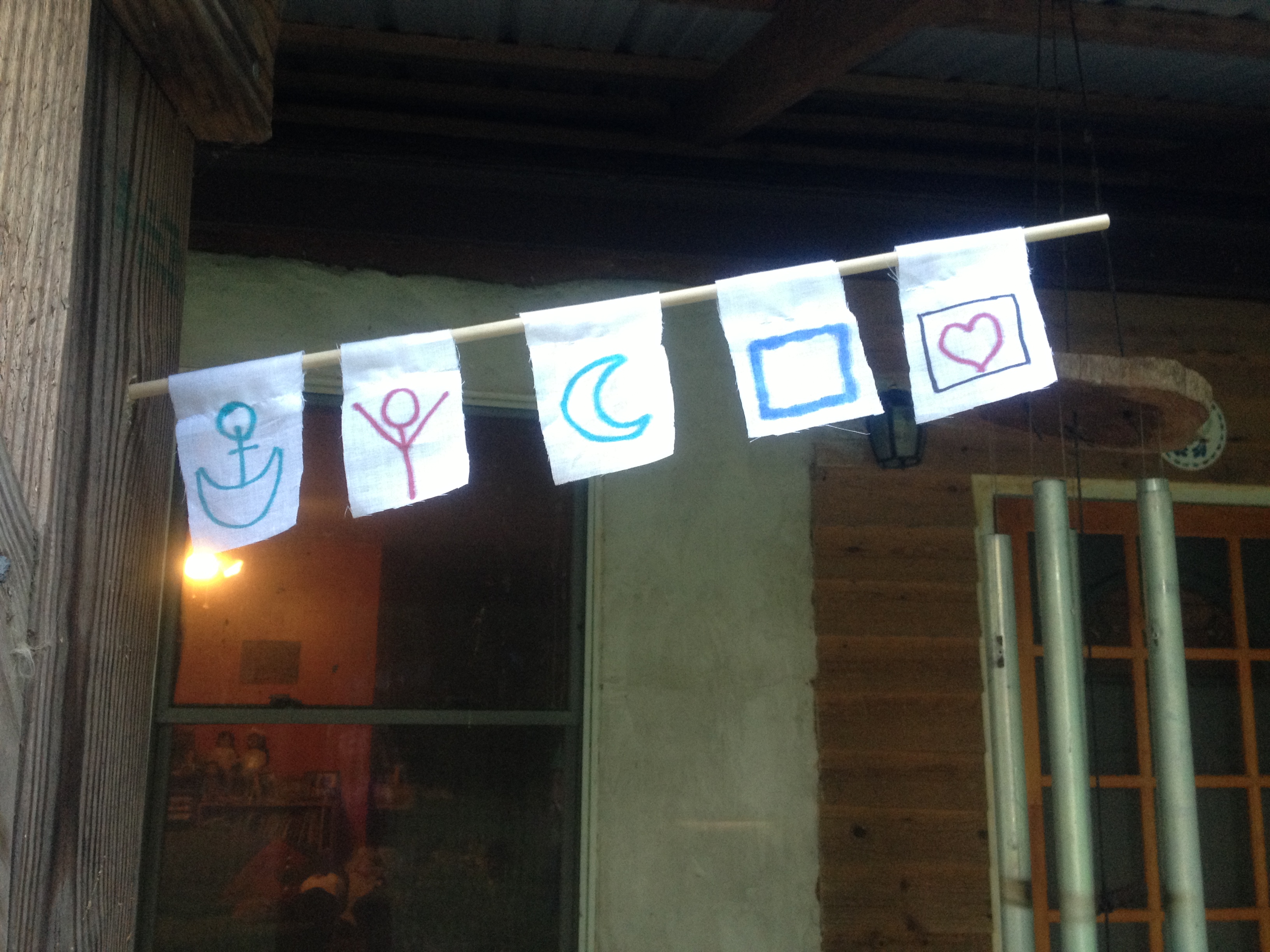
Then, joining hands, we sang Woman Am I together and headed for the kitchen for tasty potluck snacks! I’d originally planned to make a project using some nifty new mooncharmcrescent moon charms I bought recently. My vision for what exactly we were going to do with them wasn’t very clear and so it was great that one of my friends had brought a surprise project to do as her potpourri offering. Perhaps by next time, I’ll have a charming plan in place! My friend had sewed a set of 40 tiny white prayer flags for each of us upon which we drew our Womanrunes symbols with Sharpies. She also brought us each a dowel upon which we can mix or match the womanrunes and stick it in a garden, a plant, or elsewhere to be a rotating sort of “prayer branch.” She suggested either choosing the runes whose meanings match that which we desire OR randomly selecting a set and seeing what messages want to be carried on the breeze. We can switch them out in a semi-infinite array of mini prayer flag action. It was a really good idea and I was excited that she brought something like that to offer to the circle. When my husband got home, he drilled a little hole in one of the beams of our front porch and we stuck my new prayer flag system into it (flying five randomly selected womanrunes).

July 2013 023

July 2013 024

Isn’t that fun?!

I’ve been feeling a little discouraged about my retreats lately, primarily because there are a lot more women on the email list than actually show up and so I always feel like I’m doing something “wrong” or am not planning interesting enough things to attract them. I also take it kind of personally—there is a vulnerability in preparing an offering such as this and each time I do it I actually feel like I’m preparing a gift for my friends. When they decline the invite, it feels, in part, like a rejection of the gift I’m offering. Cognitively, I know (or, I hope!), this isn’t true, but emotionally that is how it usually registers. This summer retreat was a beautiful experience that felt just as I wish for these retreats to feel—nurturing, affirming, and celebratory—like a blessingway for all of us with no one needing to be pregnant!

Things I was reminded of after this experience:

  • There is nothing like having friends who are willing to lie on your living room floor and listen to a shamanic drumming CD without laughing or saying you’re ridiculous.
  • Small IS good—I already know from my years as a breastfeeding support group leader that I’m a sucker for bigger-is-better thinking (I tell my own students: don’t let your self-esteem depend on the size of your group!!!!!). When the group is small or RSVPs are minimal, it starts to feel like a personal “failing” or failure to me somehow. However, the reality is that there is a quality of interaction in a small group that is not really possible in a larger group. At this retreat there were seven women. While there was an eighth friend I really wished would come and who we missed a lot, the size felt pretty perfect. I reflected that while some part of me envisions some kind of mythically marvelous “large” group, ten is probably the max that would fit comfortably in our space as well as still having each woman be able participate fully. Twelve would probably be all right and maybe we could handle fifteen. I also need to remember not to devalue the presence of the women who DO come. They matter and they care and by lamenting I want more, it can make them feel like they’re not “enough.”
  • Retreats like this provide an opportunity to explore/experiment with ideas and activities that we usually do not allow ourselves time for in everyday life—I know that I often “run out of time” for more spiritual/contemplative/relaxing pursuits.
  • Circling together in a woman-to-woman atmosphere allows for a type of healing and connection through shared experience that is qualitatively different from getting together to casually chat and socialize. Shared experiences matter and are in some ways more satisfying than shared conversation (most women do plenty of chatting–we can benefit from some being and experiencing together).
  • The potpourri thing was a good idea. While my husband said it sounded like a nightmare idea to him—he hates being responsible for bringing something to a group setting—I felt like it created a sense of investment and shared responsibility for our circle. It was fun for each woman to be at the center for a while and to share her contribution with the rest of us.
  • I find great value in interacting with my friends in a woman-to-woman context, rather than a mother-to-mother context. So often when I’m with my friends we are in a space of “co-mothering” (i.e. mothering together and “friending” at the same time). While this can work and be fun, a lot of times it is actually kind of unfulfilling—there are constant distractions and I often feel I’m doing neither well–not paying full attention to my kids OR to my friends, and it is a scattered, distracted, stop-and-start, unfinished sort of mode of interacting (I think this is particularly a feature of having a toddler. If I only had my bigger kids, it probably would be a less scattering experience to co-mother). There was a time earlier in this year when I felt like the sense of unfulfillment or frustration I often experienced during friend conversations had to do with my friendships themselves and it took a post-retreat revelation in the spring to realize that it actually had to do with trying to have a substantive visit with friends with all of our kids present!
  • That said, perhaps it is somewhat ironic that my own mother is a regular part of this women’s circle—apparently, she can’t escape her kid, ME. But, this too is of important value—despite the close proximity of our homes, we rarely actually have the chance to interact in a woman-to-woman context, rather than as busy adult daughter and grandmother co-strategist. Also, along the same lines of my first point, I also feel lucky to have a mom who is willing to plan ritual dances and lie on the floor with me listening to shamanic drums!

20121112-141438.jpg

Categories: community, friends, liturgy, priestess, resources, retreat, ritual, spirituality, womanspirit, women, women's circle | 7 Comments

Collaborative Orisha Poem

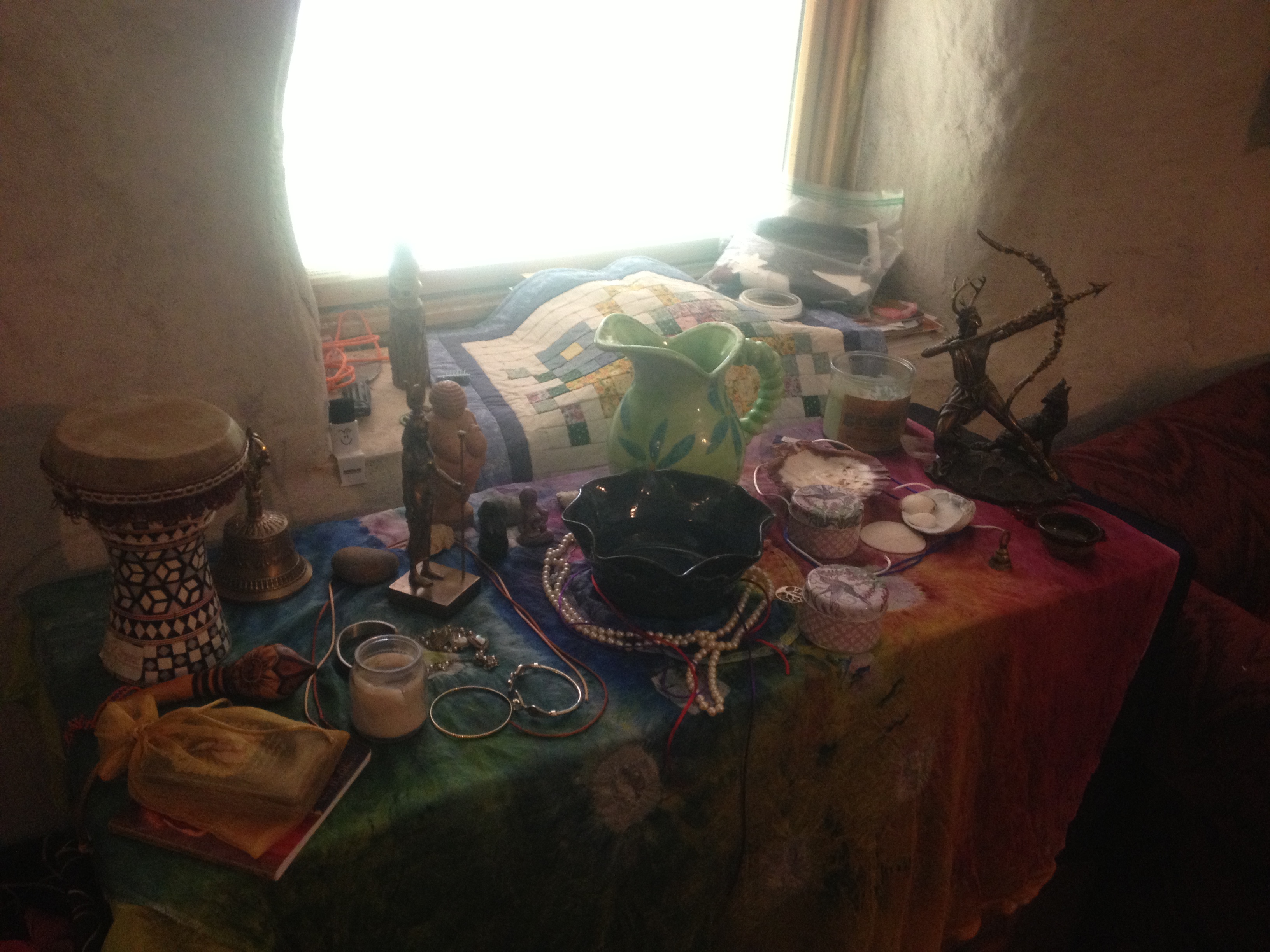
Orisha altar. A little cluttered! (there are three different areas, one for each orisha)

Orisha altar. A little cluttered! (there are three different areas, one for each orisha)

Spirit of change
destiny sweeping
good vibrations
respect
and thunder.

Float freely
release
and encourage.

Momentum building
crescendo

Water wisdom.

At our last session of Rise Up, we were talking about the Yoruban Orishas, specifically Yemaya, Oshun, and Oya. After dancing together to honor the orishas, we looked into a bowl of water and each spoke aloud what had come to us following the dance. I wrote down what we said and the result was just what was supposed to happen: we’d created a collaborative poem about the orishas. I thought it was a neat experience 🙂 We did a double session of Rise Up this last time and I think it was too much to try to do at once since we kind of lost our steam. Next week, I had planned to do our next Rise Up class followed by our summer retreat, but now I think we should do only the retreat and keep Rise Up on a different day. It took a lot out of me to try to do two classes back to back and I could tell the rest of the group wasn’t really “feeling it” either. I have a tendency to always want to multitask and to double-up to be efficient, but sometimes there is a price to be paid for efficiency and in this case it was a lack of “steam” or connection during our time together. The dancing was fun and invigorating, but I felt like during other portions of the class people started to get bored or otherwise unfocused. I also left out some details about what to bring for our collaborative project and so that was confusing for people too and I kept losing my place in terms of what to do next, because the two classes blended together in my head and I couldn’t remember what went with what. I’d also had a bad morning with my kids (described on my other blog) and that dramatically impacted my ability to be present with our circle. In general, I felt like I basically failed with this particular session, though I try to remember that success or failure of a group endeavor does not rest with only one person, there is a collective responsibility to the usness of a group and a group is a living system with a personality and life of its own. At least our group poem worked pretty well! 🙂

Categories: blessings, community, friends, invocations, poems, priestess, spirituality, womanspirit, women's circle | Leave a comment

Priestess Prayer

Here I am Goddessgarb 223
this is me
I am woman
giving birth to myself.

The priestess within
is shrugging off old ideas, old habits, and old patterns of behavior.
She’s stepping out, stepping strong, standing tall
lifting arms to the sky
gathering women
drawing down the moon
visioning the future
priestessing the temple
of her own hearth and woods.

I actually wrote this immediately after my little “pregnant with myself” poem from a couple of days ago. That post got long and so I saved the addendum for today, which is the one year-anniversary of my ordination as a priestess with Global Goddess!

ordination1

Wireless meets woodspace for my ordination ceremony last year.

ordination4


A couple of months ago, I wrote another priestess prayer and I saved it to offer on this day:

I walk a priestess path Goddessgarb 175
may I walk with presence
may I walk with purpose
may I walk with potency
may I stand in my personal power
may I protect
may I make possible
may I trust the unfolding of the path in front of me
the pattern of my days and life
the people I love

may the past inform me
and may I greet the present
with patient participation

may I protect the web of life
may I pay careful attention
may I pace myself
may I plan and pray
may I play and persevere
and may the plain promise of priestesshood
remain planted firmly in my person.

So, I didn’t fully get it until I got to “past,” but then I had to keep going with the “P” alliteration 😉 This morning on Facebook I coincidentally read the following quote:

A priestess has a foot in each world. She works with the *as above, so below*…*as within, so without* mysteries. She works ceaselessly to balance humanity and honors Nature. A priestess is not a witch, yet honors those who practice their craft with true integrity. A priestess is sovereign unto her Self. She is the female counterpart of priest…a holy woman who officiates sacred rites. She is an emissary of the Divine Feminine here on earth. And so it is. ♥

WellSprings Women added: “I like to think that each one of us is a priestess as we each help to hold a part of the space open for the others. Can you own that for yourself no matter where you are in your journey?”

I liked this reminder, because I so very often place pressure on myself to be perfect and I’ve noticed that accepting the priestess call has added another layer of something-at-which-I-try-to-be-perfect-and-when-I’m-not-I-feel-like-a-terrible-person-who-doesn’t-deserve-the-name. So, I liked this quote also:

“She walks not away from the fire…but toward it…because not only can she handle the HEAT…she contains it…and her fire wills forth the work that is meant to be in the world…” ~Anni Daulter Goddessgarb 050 Goddessgarb 101 Goddessgarb 130

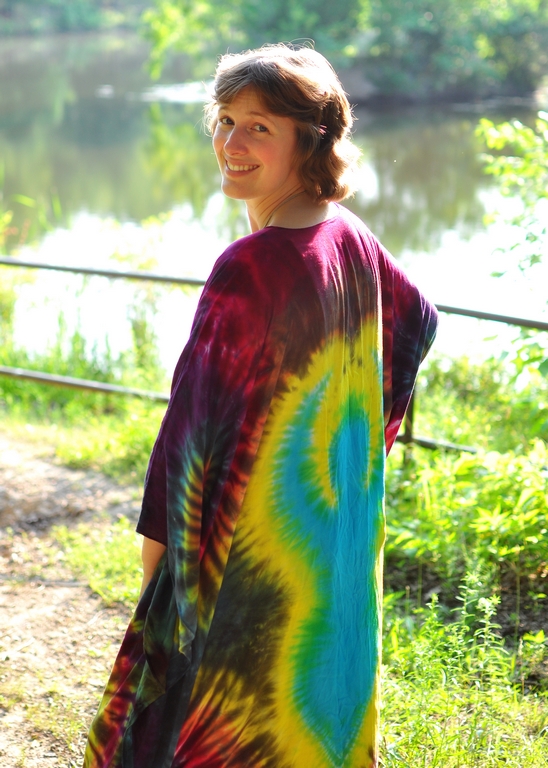
I have a dear friend who is is wonderfully creatively gifted and she made me a new goddess priestess robe recently! You’ve already seen it featured in recent posts. I love it! She recently opened a new online shop called Goddess Garb and another friend (who is also creatively gifted) did a photo shoot to model the robes and sarongs last week (along with another friend who is graceful and lovely and who looked wonderful in the robes—you can see her in the gallery here :)). I got some of the pictures and thought they went well with this priestess prayer priestess-aversary post. My goddess-garb making friend is really important to me and was actually very instrumental in helping me feel I could “own” the priestess role and that I could step into it fully—she believed in me and saw me and what I was trying to do for our community of women and offered me reinforcement and encouragement when I needed it that what I’m doing for women matters and is worthwhile. So, when I wear her artwork, I feel that affirmation and encouragement. I also feel magical!

Happy Priestess-aversary to me!

Goddessgarb 231


Categories: community, friends, poems, prayers, priestess, spirituality, women's circle | 5 Comments

Calling the Circle: The Wobble

This post is the third in a series, prompted by the book Calling the Circle by Christina Baldwin: 2013-06-24 20.47.27

There is a ‘wobble’ that always occurs in human relationships. With this wobble our sense of direction and our purpose are lose, the communion of coming together is broken, many we face the differences each of us has carried into the group. One real gift of circle is its tenacious ability to hold us in a container of combined social and spiritual contract while we work through the wobbles to genuine community…PeerSpirit circling can help us manage these wobbles differently. But in order to learn how to take our place at the rim of the circle, we need first to understand how to honor center…

I very, very much like this notion of a “wobble” in human relationships. We’ve all experienced it. I think that life would change a good deal if I remembered to recognize wobbly experiences for just what they are: oh yeah, this. A wobble. I recognize that. I know that this happens. Too often group endeavors fail because we mistake normal wobbles for permanent problems.

Later in the book, Baldwin returns to the notion of the wobble:

“The intention…is to serve as connective tissue…The purpose of the group is what remains, and yet, when wobbles occur, which they will, the members of the circle have agreements to call upon, and a container to hold them, so that they can come back to purpose and continue on.”

And, she quotes this awesome little reading from Starhawk that I then used during our spring women’s ritual:

Community.

Somewhere, there are people
To whom we can speak with passion
Without having the words catch in our throats.
Somewhere a circle of hands will open to receive us,
Eyes will light up as we enter, voices will celebrate with us
Whenever we come into our own power.
Community means strength that joins our strength
To do what needs to be done.
Arms to hold us when we falter.
A circle of healing. A circle of friends.
Someplace where
We can be free.

–Starhawk, Dreaming the Dark quoted in Calling the Circle.

On a somewhat related topic, I also saved a quote to share about why a healthy and beneficial women’s spirituality circle is not the same as our other encounters with women, in which we may be used to primarily bond through chatting and sharing various woes:

To hold the group and space as sacred is one of the most important guidelines, and the guideline that may bring up the most questions or protests. It goes against our habits as women and against our identification with the small self; we are quite used to creating intimacy through sharing our wounds and problems. The Temple Group is not a place for processing wounds, analyzing ourselves, solving problems, complaining about our lovers, healing our addictions or sharing the stories of the personality. Many women’s circles (and support groups or sharing circles) are focused mostly on the personality. The Temple Group is, in a way, impersonal because it focuses on the larger vast nature of our true self. In the Temple Group we focus not so much on our identity as separate women, but on the whole group as one feminine divine body and expression. The impersonal guideline may sound uncaring at first, but as you explore new ways of being intimate and nourish each other as women, beyond the words, you discover that those are infinitely more fulfilling and caring than the personality talking and processing.

2013-06-25 11.41.49

Surprise forget-me-nots (?) that suddenly showed up outside our greenhouse this week! 🙂

–From Create Your Own Women’s Temple (p. 61) from Awakening Women

When we first began meeting regularly for women’s retreats and rituals, I noticed that we did fall into a pattern of being focused on the “personality,” often having moments during which women cried and shared various hurts and disappointments or “vented.” As our group has deepened and evolved, I feel as if we’ve moved beyond this type of “story-telling-as-sharing” and into a shared, community experience of the now and what is happening in the sacred space we’ve created together in that moment. We’re not perfect and we keep learning and growing, but the circle experience is pretty powerful.

Other posts in series:
Calling the Circle: Circles
Calling the Circle: Context

Categories: community, priestess, resources, ritual, spirituality, women, women's circle | Tags: | 2 Comments

Calling the Circle: Context

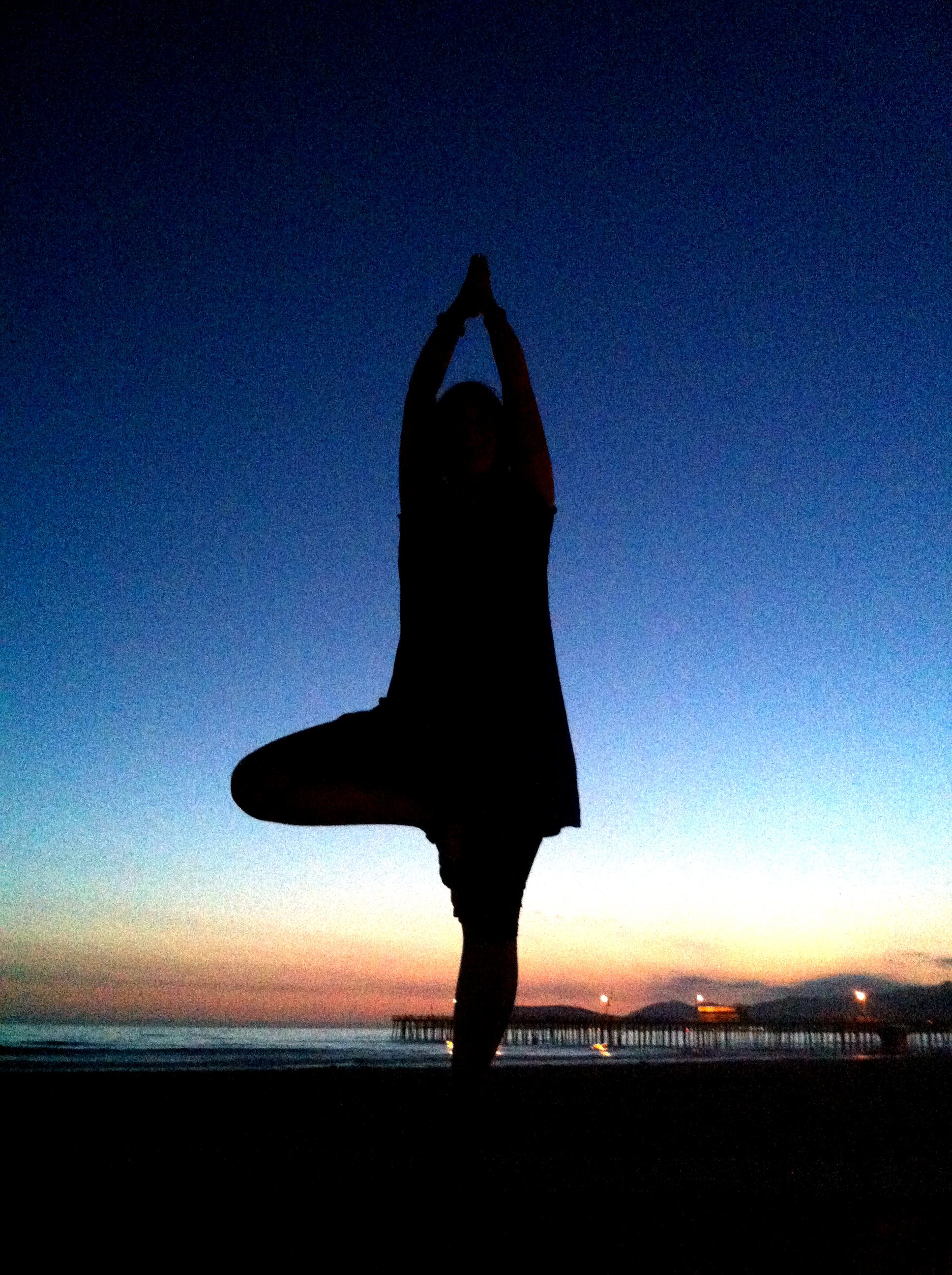
sil12

Does standing on the wall at Pismo Beach at dusk make sense? Yes, if the context is one of trying to get some silhouette pictures! 😉

This post is the second in a series, prompted by the book Calling the Circle by Christina Baldwin:

Context is the social, political, cultural, and spiritual force that shapes the life of a person. Every person lives within society’s context–whether we live comfortably in the middle of this collective force or straining at the edge. In every society there are seekers whose role is to push the borders of accepted experience and whose thoughts and actions expand the cultural context. Ideas and social norms pass through a culture, coming first from the edge and, as they are accepted, moving to center and becoming the ‘norm.’ …

Context is the collective atmosphere inside which something is seen and understood

Context is amazingly important. Pushing the context is how a culture changes, both in expansion and in reaction against expansion. As groups of ethnic and racial minorities, women, homosexuals, the physically challenged, and others have struggled for social rights, each group has expanded the contextual edge, insisting that the culture make room, rewrite laws, and get used to living with these changes. (p. 21)

One of the college classes I teach in human services is called, “working with groups.” However, in all of my classes we talk about systems theory and our core person-in-environment outlook. Every person is inextricably embedded it a network of larger systems and we cannot full understand people without understanding their systemic context. Essentially, behavior is logical to context and human behavior is very often group behavior, no matter how much Western culture likes to point fingers at individuals and individual responsibility. When considering the issue of past social atrocities like those committed by the Nazis, I think about the concept of fundamental attribution error–people’s tendency to ascribe the behavior of others to personal flaws rather than context/environment. We all like to think that we wouldn’t have been a Nazi, or that we wouldn’t drink the Kool-Aid, or that we wouldn’t be the person in the experiment who keeps increasing the electric shock…but, in reality, these situations all involved regular people, who were powerfully influenced by group dynamics. Those dynamics continue to be afoot in the modern world.

As I’ve written before, the sociocultural value of a divine presence that validates women’s bodies cannot be overestimated. Indeed, I believe that patriarchal religion in its most destructive way grew out of the devaluation and rejection of female bodies. A religious context that rejects the female body, that places the male and its association with “the mind” and the soul rather than the earthy relational connection of body, is a religion that easily moves into domination and control of women. Reclaiming Goddess, reclaims women’s bodies—names them not only as “normal,” but as “divine,” and this is profoundly threatening to traditional Judeo-Christian belief systems. In Carol Christ’s classic essay, Why Women Need the Goddess, she quotes feminist theologian Mary Daly (Beyond God the Father):

If God in ‘his’ heaven is a father ruling his people, then it is the ‘nature’ of things and according to divine plan and the order of the universe that society be male dominated. Within this context, a mystification of roles takes place: The husband dominating his wife represents God ‘himself.’ The images and values of a given society have been projected into the realm of dogmas and “Articles of Faith,” and these in turn justify the social structures which have given rise to them and which sustain their plausibility.

As I wrote in a prior post for Feminism and Religion:

…as Rush describes in Politics on page 384: “It stands to reason after so many centuries of brutal religious persecution, that women today should have a deep fear of conceptualizing our own spirituality. Women who try are severely penalized…Because of all this, it is essential that we do create our own spiritual practices. Our spiritual beliefs define what we respect, what we love—and what we ultimately perceive as our highest values. For a feminist, or for any woman, to perpetuate a patriarchal religion and to worship a male god is for her to deify her oppression” [emphasis mine]. This is powerful stuff, the impact of which cannot be denied or ignored. The symbolic value of ritual is extremely important as well. To many women traditional religious rituals and symbols have lost meaning and feel hollow or emotionless. I feel that women’s spirituality rituals bring heart, soul, and passion back to what has become rote in modern practice. Women’s rituals usually honor women’s bodies and women’s feelings and the phases of a woman’s life. They also typically use feminine images of divinity and Goddess language and imagery, which is a powerful antidote to the patriarchal culture in which we live. While on the surface or from afar, a woman’s ritual may seem like an innocently simple affair, in the context of patriarchy it is a radical and subversive act and statement for change.

via Do Women’s Circles Actually Matter? By Molly Remer | Feminism and Religion.

Categories: feminism, feminist thealogy, spirituality, thealogy, womanspirit, women's circle | 2 Comments

Calling the Circle: Circles

IMG_7764

My sister at Moonstone Beach in California

Everything the Power of the World does is done in a circle.

The sky is round, and I have heard that the

earth is round like a ball, and so are all the stars.

The wind, in its greatest power, whirls.

Birds make their nests in circles,

for theirs is the same religion as ours.

The sun comes forth and goes down again in a circle.

The moon does the same, and both are round.

Even the seasons form a great circle in their changing,

and always come back again to where they were

The life of a [person] is a circle from childhood to childhood

and so it is in everything where power moves.

–Black Elk, Black Elk Speaks  (quoted in Calling the Circle)

One of the books I got for my birthday this year was Calling the Circle by Christina Baldwin. A lot of the concepts from this book were very familiar, not only from the group dynamics material in my clergy classes, but also from the classes that I teach in working with groups and working with communities. That said, sometimes it is hard to actually remember and use the principles of working effectively with people in real life, no matter how familiar I am with the concepts and principles in the academic sense. Rather than type a bunch of quotes up together into one post, I decided to run a series of posts over the next couples of weeks, each highlighting something I enjoyed from this book. The first was early in the book and caught my eye because after my grandmother’s death, one of my friends received a message to pass on to my mom that was, “remember the circles.” So, reading this passage felt like a continuation of that message. 🙂

IMG_7773

Beach rocks at Moonstone Beach in California.

Categories: books, spirituality, women's circle | 4 Comments

Thursday Thealogy: Ritual Guidelines

Why Rituals Work | Scientific American  May 2013 009

“There are real benefits to rituals, religious or otherwise.Recent research suggests that rituals may be more rational than they appear. Why? Because even simple rituals can be extremely effective.

Rituals performed after experiencing losses – from loved ones to lotteries – do alleviate grief, and rituals performed before high-pressure tasks – like singing in public – do in fact reduce anxiety and increase people’s confidence.

What’s more, rituals appear to benefit even people who claim not to believe that rituals work.

While anthropologists have documented rituals across cultures, this earlier research has been primarily observational. Recently, a series of investigations by psychologists have revealed intriguing new results demonstrating that rituals can have a causal impact on people’s thoughts, feelings, and behaviors.”

~ excerpt from “Why Rituals Work” by Francesca Gino and Michael I. Norton for Scientific American magazine

Shared by ☾ Katharine Krueger ~ Occupy Menstruation
Girls’ Empowerment and Coming of Age http://JoYW.org/

In my Ritual and Liturgy class at OSC, we discussed some simple guidelines for effective ritual. The guidelines from a handout by Deanne Quarrie, and my brief thoughts on each, are as follows:

1. Remember the intention

This is of vital importance. You have to have a purpose and passion, otherwise it becomes hollow, meaningless or rote (many women’s experience of ritual from their childhood fall into the hollow category!

2. Let the myth inspire you.

I am probably less skilled with this guideline than I could be. I do not find that I personally connect with many myths/archetypes, and so I don’t use them very much when planning rituals.  In our fall ritual which involved a Sagewoman ceremony, I drew on the story of Innana’s descent with the woman each passing through several Gates of Initiation and leaving behind items from their pasts that no longer served them.

3. Use your intuition.

Another vital element, I draw on intuition a lot when leading rituals—perhaps I’ve planned something that is taking longer than I thought and so I may rearrange or eliminate another element without ever mentioning it to the group (if you mention it, they feel like they’ve “missed out” on something or feel pressured to “hurry up”). I make additions or subtractions from guided meditations as I go, depending on intuition to guide me. I let intuition lead at the beginning of the meditations as we begin, spontaneously leading the participants through conscious muscle relaxation and breath work before launching into the actually scripted meditation.

4. A ritual should benefit all and harm none.

Of course! I think it is also important to remember though that we can come into circle with and hold sacred space with people who are not necessarily our best friends. Perhaps we have been hurt in the past by someone, in ritual together we can birth new relationship and leave that hurt behind us. Also, the purpose of a ritual should always hold positive intent and be focused on positive change and not revenge or anything like that.

5. Keep it simple.

I have a tendency to overplan and sometimes that can make a ritual drag on/lose energy. By only included what is necessary and essential to the intention, we reduce the chances of energy leaking/flagging or of people getting tired or bored.

6. Stay balanced.

While it is important to balance the energies of the ritual, I also find it important to balance the activities of the ritual—some energy raising with singing and drumming and some time for inner work and reflection through visualization and meditation. Some scripted words and readings and some spontaneous sharing of here-and-now experiencing.

7. Keep in touch with your feelings and with the other people. May 2013 014

This one connects to Intuition above. It is important to feel the climate of the group, the energy of the group, and the responses of other people. I constantly keep my intuitive “radar” tuned to whether the ritual is “working” or not—how are people feeling in this circle and at this time. Also, I try to remember to encourage people to share feelings rather than intellectualizations.

8. Honor the power of words.

In a recent past post, I already excerpted my thoughts on this one…from one of the articles for class: “While it is fine for some rituals to provide space for participants to speak from their hearts, for the most part there should be little extemporaneous speaking. Select poems or write words that mean exactly what you wish to convey, and practice delivering them for the best possible effect.” Reading this made SUCH a difference to me.  I’ve always felt bad about “needing” written material to read from during rituals. I kept thinking that as I “evolve” as a priestess I will “grow up” and not need pre-selected words and readings, but will be able to spontaneously speak and guide the ritual. As I read this, I realized that my process of carefully choosing and selecting opening and closing readings for my rituals as well as poems and quotes during the circles is actually legitimate and possibly very helpful!

9. Keep the imagination alive and 10. Attend to detail.

In attending a large Goddess festival last fall, one of the things I learned is about the importance of creating ambiance, which includes environmental factors/settings that contribute to the sense of magic and timelessness or otherworldliness/altered consciousness. I’ve been holding rituals in my own living room for a long time. After attending the festival, we held our late fall ritual outside in a tipi at night. There is something so magical about a firelit, nighttime ceremony. It really matters! We set up our Gates with candles and then entered the tipi where my large drum was located with (electric) candles all around it. Choosing elements specifically with ambiance in mind makes a huge difference in the feeling and function of a ritual.

Categories: OSC, priestess, ritual, Thursday Thealogy, women's circle | Leave a comment

Womanrunes: The Sun

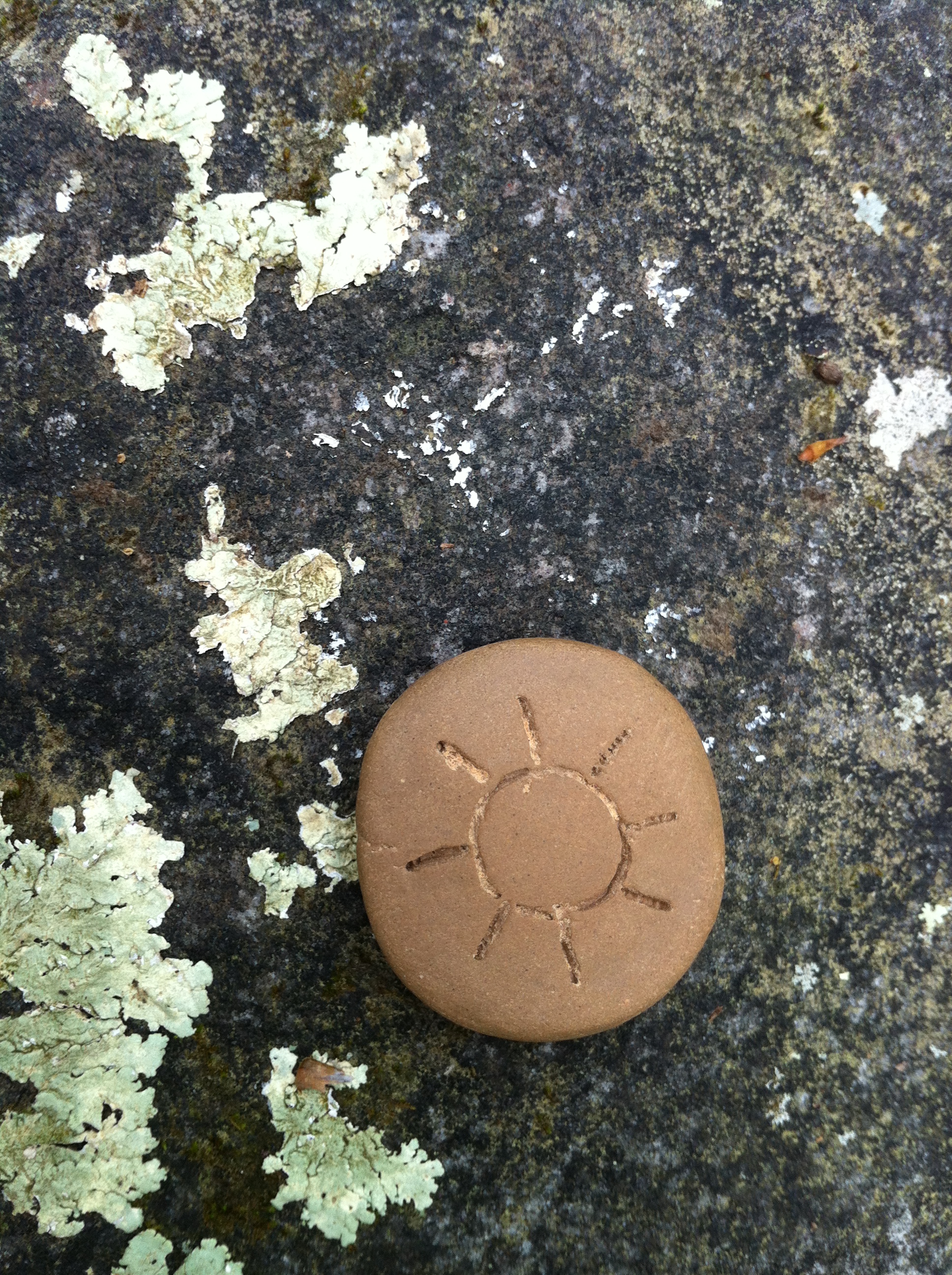
Womanrunes: The Sun. Rune of Healing. Rejuvenation, Recreation, Play, Radiance. May 2013 002

When you draw this stone, you know the time has come to be healed. Not healing as in forgetting, or in letting go, but in accepting, opening, changing, and growing. An integration of difficult changes you may have experienced in life. Healing may be physical, it may be emotional, it may be spiritual, it may be relational. Consider in which ways you need healing and rejuvenation. In interpersonal relationships? Physical health? Emotional well-being? Mental health? In your relationship with yourself? In your relationship with your body and with the earth?

Healing is both possible in all there is and available, sourced, through all there is. Healing comes in sharing silences, and sharing stories, and in sharing songs. Healing comes in creation, in offering to others, in opening your heart to the circle with women, in silence with another, in connection with your partner. It is also found in being playful; laughing together. This stone also reminds us that trying again is always worthwhile. Draw upon the resources of the earth. Draw upon the resources of your sister. Draw upon the resources of your own heart. And, in quiet spaces and laughing faces, you will be healed.

Yesterday, as I was getting ready to set up the altar for our women’s ritual/retreat, I decided to draw my womanrune for the day. I drew it as I was looking at the altar space and thinking about how to make it a “healing altar,”  to bring the energy of renewal in for my mom who gave so much of herself during my grandma’s dying process. I drew the stone and saw the sun on it and immediately knew it was a “healing” rune and it felt like a “blessing” upon this retreat. I was also struggling with a crisis of confidence because several people cancelled at the last moment and the night before I’d been feeling like I shouldn’t bother trying to do this kind of thing any more. I explained to my husband that each time I I plan a retreat I really feel like I’m offering a “gift” to my friends–so, when people don’t come, it is like they are saying, “take that back, we don’t want it!” There is a tenderness and a vulnerability to trying to serve my community in this way. After drawing the womanrune, I then went on a divination feeding frenzy and drew cards from all of my different decks! They were all remarkably connected and had good insights to share about “surrender” and letting things flow and also about new beginnings and new projects, but the best was the Seven of Wands from the Motherpeace Tarot deck which opened with: May 2013 003

“The priestess is challenged by her group…

…anxiety, doubt, and fear may be clouding her ability to stand up for herself…”

This retreat was a combination of rituals. We had a Maiden turning 12 and so we had a coming of age ritual for her. My mom is turning 60 this month and so it was also a surprise birthday ritual for her with an emphasis on healing. We also had a tea ceremony, a yoga practice, and a guided meditation.

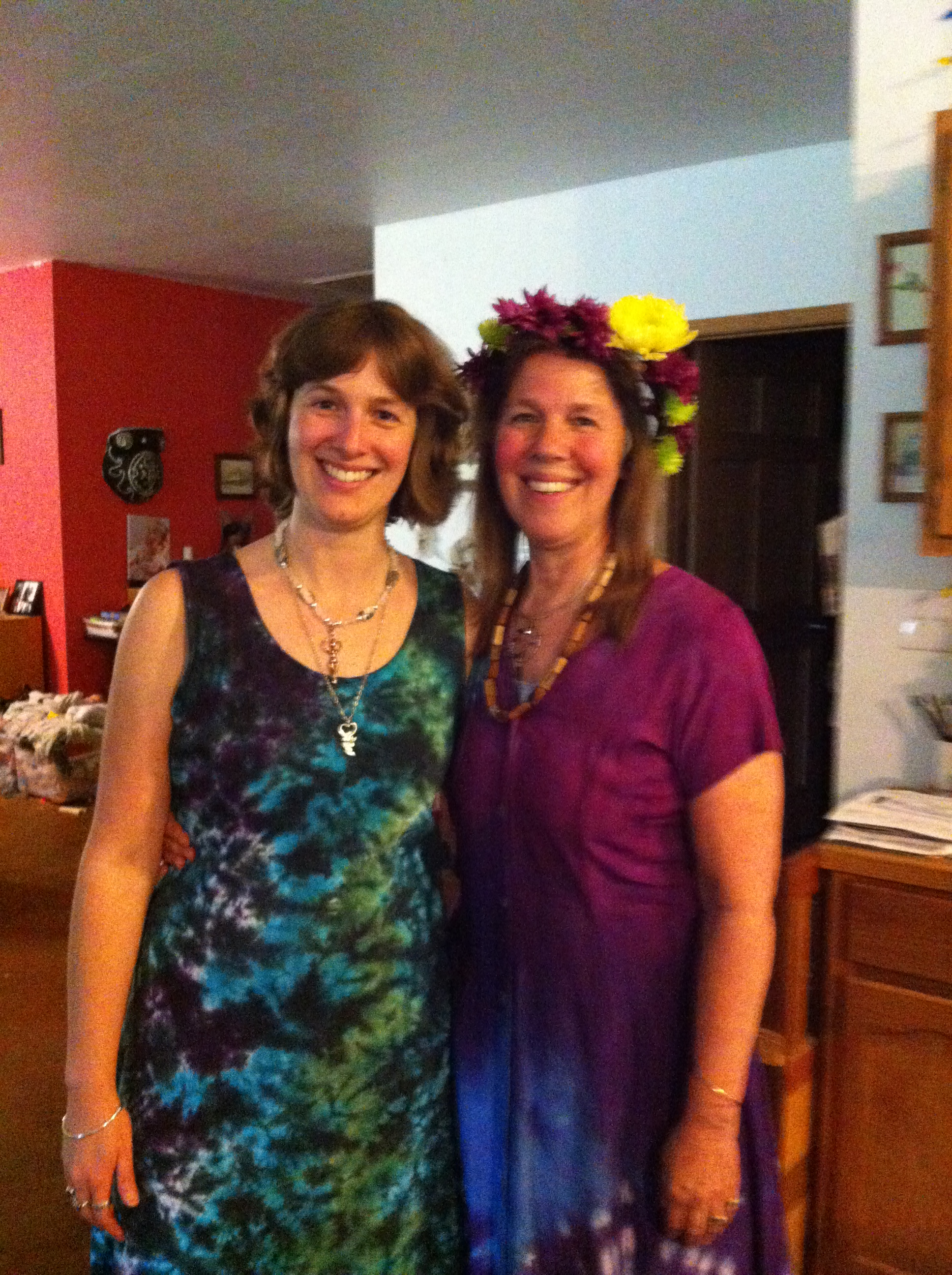
My mom went through a lot in the final stages of my grandma’s life. She born witness to her mother’s final journey and it was really, really hard, but she did it. I wanted to hold this ritual for her so she might know that we see her. She offered a deep gift of love and we came together in this space because we wanted to help her rest and restore and to give her back some of the care she shared so graciously with her mom. After she was seated with flowers in her hair and her feet in a footbath, I offered her the body blessing of renewal I wrote for her:

Gratitude body blessing

Head

May your mind be blessed, so that you may be at peace that you were enough.

Eyes

May your eyes be blessed, you saw her through. May 2013 014

Nose

May your nose be blessed, breathe easy now.

Lips

May your lips be blessed, you spoke with love.

Chest

May your heart be blessed, you have loved and been loved.

Hands

May your hands be blessed, you have reached out when you were needed.

Belly/womb area

May your center be blessed, so that you may honor all you have created.

Feet

May your feet be blessed, so that you may continue to walk your own true path, knowing that you do not walk alone—there are those that support and care for you. You do not walk alone.

May 2013 027

My mama!

May 2013 020

Aromatherapy footbath for maiden!

May 2013 008

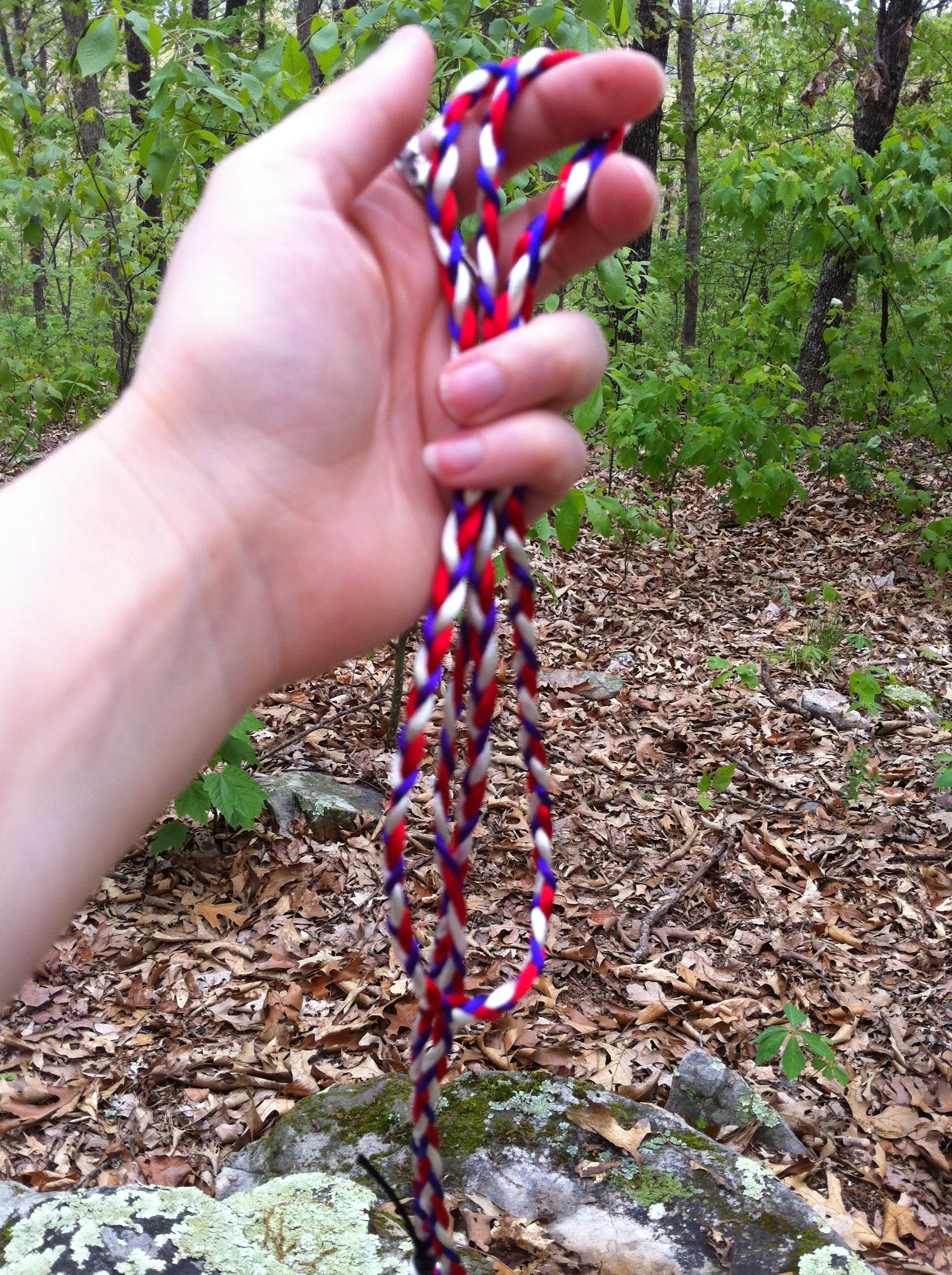
Triple Goddess cord that I braided for the Maiden to step over as a symbolic threshold into womanhood. I wrote a blessing that goes with it and will post that in a separate post in the future, hopefully.

May 2013 001

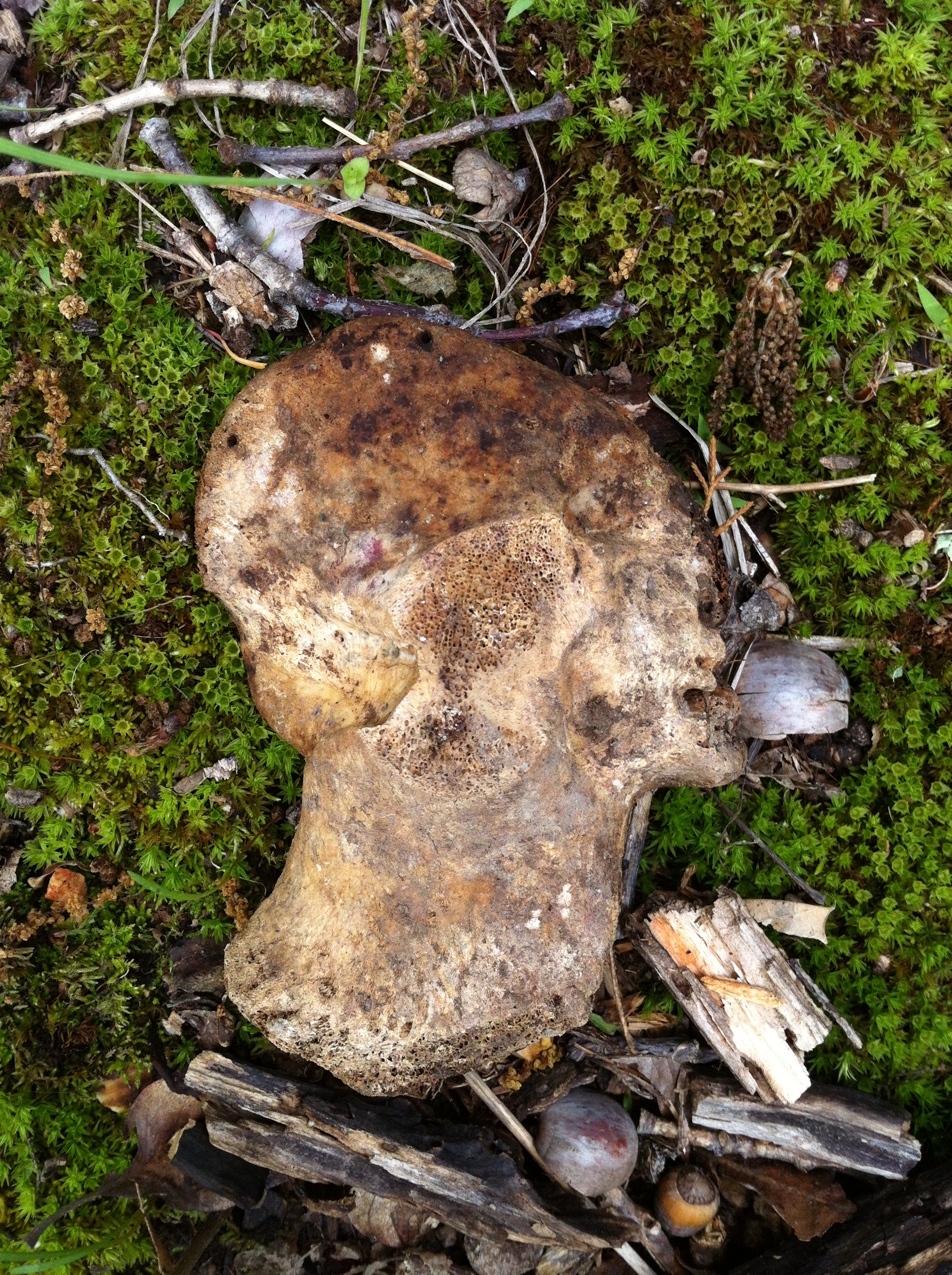
This interesting, unidentified bone was sitting right in the middle of my path on the way down to the woods shortly before our ritual.

May 2013 012

My toddler went with me to bless the ritual items and yelled and complained the whole time. My nine year old was also yelling out the door at me, “you have NINE MINUTES left, Mom! Mooooooom!!!! NINE MINUTES.” I kept going anyway. Such is the mamapriestess life.

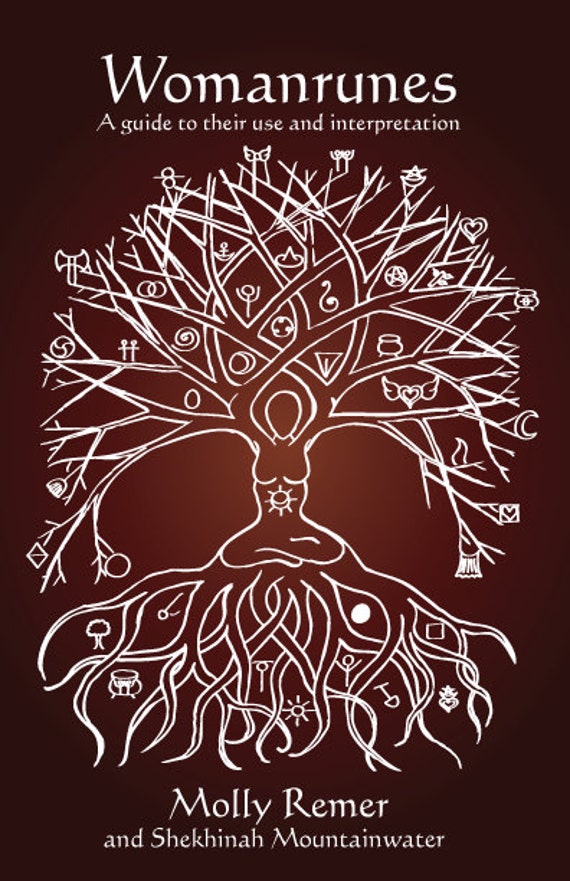
Update: this project evolved into a real book!

The first post in my Womanrunes series is available here. The runes and the names of them come from Shekhinah Mountainwater’s Womanrunes system for which there are no written interpretations available other than the name and one word meanings. I’m engaging in a semi-daily practice of drawing one and then going down to the woods with it to see what it “tells” me–basically, creating what I wish I had, which is a more developed interpretation of the meaning of each womanrunestone.

Categories: blessings, friends, ritual, spirituality, Womanrunes, womanspirit, women's circle | 1 Comment

Thursday Thealogy: Rituals–to read, or not to read…

November 2012 151

Altar during fall retreat

This Friday is our quarterly women’s retreat and, because we have multiple reasons to be coming together, it is composed of several interlocking rituals. As I prepare the ceremony outline and choose the readings and structure, two perspectives are on my mind. The first, from Ruth Barrett in her classic Women’s Rites, Women’s Mysteries:

When you are speaking an invocation in a group ritual, remember that you are the conduit between the elemental energies and the will of the women in the ritual circle. You will need to project your voice, speaking out so that everyone present can hear and feel the invocation. This is particularly critical if you are outside, where sound can easily be lost. Personal ritual invocations need not be spoken with such projection, but it is still best to speak them aloud. Speaking aloud gives the elemental forces within you an opportunity to come fully forward. It is a form of self-witnessing. How and what you hear within ritual space may be different than how and what you hear in a state of ordinary consciousness. Try invocation both ways, aloud and silent, to hear, see, and feel the differences for yourself. As you become more sensitive to ritual energy, you will feel the energy in the room shift or drop, depending on what is happening at the time. In some Wiccan traditions, invocations are passed out and read from a printed page. This can have a profound and unpleasant effect on the energy of the ritual, and the invocations can sound and feel flat. Whether you are preoccupied with memorizing exact words or speaking them from a page, there are energetic consequences. If you rely on the left, linear side of your brain completely for delivering your invocation, there won’t be much change in the energy of the ritual space. However, when you be-speak your invocation and you truly embody the essence of the Goddess and the elements, the energy builds rather than drops.

Ruth Barrett. Women’s Rites, Women’s Mysteries: Intuitive Ritual Creation (Kindle Locations 2204-2212). Kindle Edition.

I do tend to pass out readings on a printing page, just as she describes and for a while I’ve felt kind of bad about that—like if I was “better” at this, I’d remember everything, OR be able to spontaneous compose fabulous perfection on the spot. However, in the course of my Ritual and Liturgy class at OSC, I read this section in one of our lessons:

“While it is fine for some rituals to provide space for participants to speak from their hearts, for the most part there should be little extemporaneous speaking. Select poems or write words that mean exactly what you wish to convey, and practice delivering them for the best possible effect.”

Reading this made SUCH a difference to me.  Like I said, I’ve felt bad about “needing” written material to read from during rituals. I kept thinking that as I “evolve” as a priestess I will “grow up” and not need pre-selected words and readings, but will be able to spontaneously speak and guide the ritual. As I read the above quote, I realized that my process of carefully choosing and selecting opening and closing readings for my rituals as well as poems and quotes during the circles is actually legitimate and possibly very helpful.

I do appreciate that over-reading can contribute to a lack of life in the ritual and I’m gradually finding a good balance there. I know that in my personal experience of them, our women’s rituals have improved in the feeling like they are working as we’ve continued to refine our approach and choose our words and activities. We moved away from including a time for general talking and discussion and into more structure, which helps “hold” the energy and momentum of ritual, rather than letting it leak out in the form of side conversations or long personal stories. (Conversation.discussion then happens after we end the ritual and have potluck snacks and make a project together.) In another book I just finished reading, Jane Meredith explains the layers of ritual:

November 2012 188

Outdoors during overnight sagewoman ceremony.

Firstly there’s the outer layer; which is composed of the actions you take. What matters here is what you actually, physically do. It might include making altars, offerings or dedications; dancing or going out into nature. It might include cleansing in the form of a ritual bath, a fast or a time of meditation and prayer. It is the form of the ritual and functions as a container for the other aspects of ritual. When this outer layer exists on its own, it is sometimes called an empty ritual. Then there’s a second layer. This consists of what is happening within you, and it is encouraged and supported by what’s happening in the outer layer. Being willing, being true, carrying out not just the actions but the intent of your ritual or journey make up this second layer. You may find it helpful to whisper a mantra under your breath, to focus on an image or to chant or drum for a while to take you further inwards. When these first two layers are in concert, the ritual will feel satisfying and alive. There is yet a further layer. This is the mystical one, and may be different every time. It is the moment when the ritual takes off, when you slip across from one realm into another, into the sacred; into the realm of the Dark Goddess herself. In this layer you will feel the divine all around you and within you, and you will sense yourself as being in an altered, perhaps luminous space. This does not happen every time you do a ritual, no matter how well you are managing the other two layers. It is enough to work with the first two layers and invite this third one to manifest. A ritual will still be meaningful without entering the third layer; though it may be more memorable and feel more powerful when you do slip across the boundary into this realm.

Meredith, Jane (2012-05-25). Journey to the Dark Goddess: How to Return to Your Soul (pp. 42-43). NBN_Mobi_Kindle. Kindle Edition.

People have sometimes been “scarred” by past experiences with hollow, meaningless, and rote rituals they may associate with religion and have trouble understanding that a good ritual is evocative of something very different from that experienced in mainstream religion. As I explained in a previous post:

Notice that what is NOT included is any mention of a specific religion, deity, or “should do” list of what color of candle to include! I’ve observed that many people are starved for ritual, but they may so too be deeply scarred from rituals of their pasts. I come from a family history of “non-religious” people and I feel like I seem to have less baggage about ritual and ceremony than other people do. An example from the recent planning for a mother blessing ceremony: we were talking about one of the blessingway songs that we customarily sing–Call Down Blessing–we weren’t sure if we should include it for fear that it would seem too “spiritual” or metaphysical for the honoree (i.e. blessings from where?!) and I remembered another friend asking during a body blessing ritual we did at a women’s retreat, “but WHO’s doing the blessing?” As someone who does not come a religious framework in which blessings are traditionally bestowed from outside sources–i.e. a priest/priestess or an Abrahamic God–the answer felt simple, well, WE are. We’re blessing each other. When we “call down a blessing” we’re invoking the connection of the women around us, the women of all past times and places, and of the beautiful world that surrounds us. We might each personally add something more to that calling down, but at the root, to me, it is an affirmation of connection to the rhythms and cycles of relationship, time, and place. Blessings come from within and around us all the time, there’s nothing supernatural about it.

I also think, though I could be wrong, that it is possible to plan and facilitate women’s rituals that speak to the “womanspirit” in all of us and do not require a specifically shared spiritual framework or belief system in order to gain something special from the connection with other women.

via Blessingways and the role of ritual | Theapoetics.

February 2013 192

Rise Up and Call Her Name class in February.

Barrett explores this concept as well:

Sadly, many women describe their previous experience of religious ritual as meaningless. This response is usually derived from experiences of religious traditions that are male-focused, with little to no attention paid to the realities of women’s lives and experiences. When women empower themselves to ritualize passages that they deem as significant and to which they can ascribe their own meaning, like a snake they shed their old skins and emerge into a new reality, a new conscious awareness. The mundane world of the previous moment becomes transformed and they are brought closer to greater understanding of the sacred. Women who create and participate in their own life-cycle rituals are saying that their lives are important, that their stories matter, and that every human life is a gift to present and future generations.

Ruth Barrett. Women’s Rites, Women’s Mysteries: Intuitive Ritual Creation (Kindle Locations 308-312). Kindle Edition.

As I’ve also written before, in keeping with Carol Christ’s work, for me, thealogy absolutely does begin in experience. I do not think that everyone needs to share my personal experience that the Goddess path and the Pagan path are different ones and I do not think the two paths need necessarily diverge to different ends, just that they do exist separately (and, yes, there are scores of different pagan paths as well). It is important to my own mind and experience that a Wiccan path to Goddess is not the only path and I believe that an overemphasis on the Wiccan path can cause some women to turn away from explorations of feminist spirituality.

After I trained as a Cakes for the Queen of Heaven facilitator in 2007, I discovered something every powerful in the resources of the Unitarian Universalist Women and Religion organization. At the conclusion of the training, I had profound sense of THIS is what else there is for me! It was a pivotal moment. I started to realize that my strong draw towards Goddess actually had a place and a home under the UU “umbrella” and that I didn’t have to self-identify as pagan or Wiccan in order to explore a relationship with Goddess. Before, I felt like it was “Wicca or nothing” and Wicca was not a personal match for me for a variety of reasons. Cynthia Eller notes that feminists coming to neopaganism, “often had little patience for the measured pageantry and role-playing that characterized some neopagan rituals…” (page 38, emphasis mine) and this was true from my own experiences too. My brief encounters with Wicca felt “hokey” and inauthentic, my experiences with Goddess felt deeply meaningful and true in my bones. It took a long time for me to realize that it was both acceptable and possible for there to be multiple paths to Goddess. On a related side note, in an article from Brain, Child magazine, the author describes her overall experience at a Beltane ritual and says that she, “can’t deny a sense of detachment as well; the theatrical component makes me feel like I’ve been involved in some kind of interactive Medieval play rather than a genuine spiritual experience. Maybe group ritual isn’t for me.” This immediately made me think of a great series of posts by the Allergic Pagan on the subject of pagan embarrassment. Some of these embarrassing elements are part of why I’ve never embraced the pagan label and instead moved towards Goddess spirituality instead [a move for which I have UU’s to thank]. In my own experience, “measured pageantry” is the best description I’ve read of why I fail to click with it, otherwise known in my personal vernacular as: hokeylicious.

So, to read or not to read during ritual, that is the question. What do you think?

November 2012 187

Fall retreat space

November 2012 146

Categories: OSC, priestess, retreat, ritual, spirituality, thealogy, Thursday Thealogy, womanspirit, women, women's circle | 4 Comments

Woodspriestess: Women’s Circles

“I see a chain of women, each listening to each, being present to her as she waits
for her Self to be born, for her feeling values to come to form and to birth…
Woman after woman, being present, as each finds her voice”
Judith Duerk: Journey to Herself

“The calling a woman feels to gather in Sacred Space with other Sisters starts first as a low and slow warmth that begins to burn. If left unfed, it rises quickly to a raging fire of desire. It will not be denied and can only be quenched by the nourishment of Truth, Candlelight,
Song And Sisterhood”
Ayla Mellani ~ Founder of Chrysalis Woman

“You will be teachers for each other. You will come together in circles and speak your truth to each other. The time has come for women to accept their spiritual responsibility for the planet”
Sherry Anderson & Patricia Hopkins ~ The Feminine Face of God

quotes via Chrysalis Woman

In February 2010, I bought the Rise Up and Call Her Name curriculum from the UU Women and Religion store. I listened to the CD that came with the curriculum over and over during one of my darkest personal experiences, the experience of my second miscarriage, and it spoke to me deeply at a time when I needed it and when I was not able to be “heard” in any other manner. It was at this time that the shift in my life’s focus became apparent to me, from birthwork to women’s life cycle work, and priestess work. I dreamed of facilitating the series of classes, but it took me until this year to actually make that dream a reality. We’ve been having quarterly women’s retreats locally since the end of 2010 and I’ve facilitated the Cakes for the Queen of Heaven series a couple of times as well as Meetings at the Moon for mother-daughter pairs, but Rise Up kept waiting in my closet. This year, I decided to offer it as a year-long once-a-month class, rather than as a 13 week series. I thought this made sense in terms of people’s busy schedules and ability to commit. As it turns out, committing to something once a month for a year may also be asking too much of many women and only a small handful of women made the commitment. We now have just a little circle of six, but we’re doing it and it actually feels like the perfect group after all (I’m easily seduced into bigger-is-better ways of thinking about groupwork, even though smaller groups can be much more rewarding experiences!). This afternoon was our March class and it really felt like it “healed” me from my disconnect, separation, can’t listen/reach out the way I wish to, feelings from my “making a place for others” post on Wednesday. My post from Wednesday was very much an artifact of not having any time alone to regroup from several stressful, too-busy days in a row. This afternoon before the Rise Up class, my parents had my kids over and I spent some time first down in the woods visiting the rocks further down the hill, including these that form a lovely circle…

March 2013 069

On my way back to the house, just look at what popped out at me from the ground…

March 2013 071

This is one of the “stepping stones” on the way to the priestess rocks. I can’t believe I’ve never noticed her before! When I came in, I put on the Rise Up CD and worked setting up a springtime altar. When I lay out an altar, I often kind of force myself to include the “right” objects representing the four directions. This time, I decided to just put on the altar what wanted to be there and what communicated something about the purpose of the day. I loved the result! It was one of my favorite circle altars so far.

March 2013 086

Altar with addition of springtime daffodil from my mom, rearrangement of many things by toddler daughter, and eating of fig cookies as part of the “ingathering” ritual…

March 2013 077

Circle round
circle round and celebrate
circle round and sing
circle round and share stories
circle round and reach out a hand

circle

no beginning
no end

In my college classes, I often tell my students that in working with people, we need to learn to think in circles, rather than in lines. Circles are strong. Circles are steady. Circles hold the space, circles make a place for others. Circles can expand or contract as needed. Circles can be permeable and yet have a strong boundary. Linked arms in a circle can keep things out and show solidarity. Linked energy in a circle can transform the ordinary into sacred space. Hands at each other’s backs, facing each other, eye level.

In the woods, I offered this prayer for our circle:

May our circle be strong
may our circle be harmonious
may our circle be steady
and may our circle grow and change

please guide me as I priestess this circle today
please help me to see, hear, and honor those within the circle
help me to act with love in my heart, hands, and mind
help me to guard the energy of this space
help me to facilitate sacred connection

let us all act as sisters
as companions and friends
hold hands
hold the space
hold each other…

I also chose the following reading to use following the “ingathering” ritual at the opening of the Rise Up class. We did it as a responsive reading (i.e. I read each line and then the group repeated it). It felt perfect!

I am a woman,
a human being of extraordinary strength, wisdom, and grace.
My woman’s body was created in the body of a woman.
I am daughter, sister, mother
in thousands of generations of women…
I am a woman,
part of and the whole of the first circle,
the circle that transcended space and time,
the circle of women joined.
–Ann Valliant and Kathleen Klimek (in Open Mind by Diane Mariechild)

I had such a positive, happy feeling after the close of our class. I did not feel drained or as if I’d been doing too much or giving away too much of my energy. I felt nourished, healed, connected, and satisfied. In February, when I took my annual computer-off retreat, I had the realization that a lot of the scattered and distracted feelings I experience are more often related to children and parenting than to technology (I’d been blaming technology, but with the technology off, I realized it was actually the kids!). And, today I had a similar realization—that perhaps I often feel drained by people contact as well as scattered, distracted, and unable to fully connect, because I’m usually trying to do that and mother at the same time. While mothering is fulfilling too and my kids are certainly extremely important to me, oh my goodness it was just a delight to spend time with these friends today just us, with no kids asking us for anything. It was much easier to see and be seen, to hear and be heard, when there were no other needs to fulfill but our own!

Right as everyone was leaving, I remembered I’d wanted to offer aura photographs via a little app I’d gotten for my phone quite a few months ago… March 2013 091 I would not really place a lot of stock into its authenticness, but it was really fun and actually surprisingly on target!

After everyone left, I headed back down to the woods with my husband and daughter. We went on a spontaneous ramble through the woods and made many cool discoveries that I will have to write about in a later post…

March 2013 094

stepping out on an adventure…

Categories: community, friends, nature, prayers, priestess, ritual, spirituality, womanspirit, women, women's circle, woodspriestess | Leave a comment

Thursday Thealogy: Making a Place for Others

20130328-174807.jpg

I went to the woods intending to take a picture of the setting sun, but I’d accidentally hit the reverse-image button, so my own face was looking at me instead. So, I thought…that’s most real!

 “…in listening you become an opening for that other person…Indeed, nothing comes close to an evening spent spellbound by the stories of women’s inner lives.”–Sacred Circles

This morning my attention was caught by this blog post’s exploration of becoming most real:

Becoming most real means becoming aware of what we are doing and feeling all the time. It means noticing not only our imagined or desired reality —the one we’re cooking up in our mind to soothe our discomforts and fears — but also the reality that actually exists, the one that is most real…

[during a stressful experience]…But then I asked, “What is most real?”

I noticed that I was feeling tense and stressed. That I knew already. But I also noticed that I was struggling to change things, trying to force myself to feel relaxed. And that was the key. Because then I went from being lost in the struggle to being aware of the struggle. I went from identifying with the struggling to identifying with my deeper self that sees the struggle. For a moment I was grounded in the unflickering flame of my true self. For a moment I achieved the very aim of yoga.

You can practice being most real by asking yourself, “What am I trying to feel right now, and what am I actually feeling right now?” These two are related: What you are trying to feel right now, or more specifically, the fact that you are trying, is what you are actually doing; it is most real. Most real is not the state you are trying to achieve but the state you are in. That’s where you’ll find the greatest vitality, peace, and happiness.

via Misadventures of a Garden State Yogi (book review).

I’m three quarters of the way through a year-long OSC class based on the book Twelve Steps to a Compassionate Life. We’re examining and practicing compassion to ourselves and in personal relationships, community relationships, and to non-humans. The subject of the sixth month  was, “making a place for others.” What does this mean? The author explains…

I began to notice how seldom we “make place for the other” in social interaction. All too often people impose their own experience and beliefs on acquaintances and events, making hurtful, inaccurate, and dismissive snap judgments, not only about individuals but about whole cultures. It often becomes clear, when questioned more closely, that their actual knowledge of the topic under discussion could comfortably be contained on a small postcard. Western society is highly opinionated. Our airwaves are clogged with talk shows, phone-ins, and debates in which people are encouraged to express their views on a wide variety of subjects. This freedom of speech is precious, of course, but do we always know what we are talking about?

Armstrong, Karen (2010-12-28). Twelve Steps to a Compassionate Life (Kindle Locations 1476-1481). Random House, Inc.. Kindle Edition.

Previously used in: Plucking out the heart of mystery

I spent all month working with this idea and very often, I suck at it. One of the roles of a priestess is to hold the space for others, and I do find I am able to do that in a ceremony environment and also in a support group setting, but it pretty much ends there. This isn’t really new for me, when I worked in battered women’s shelters, I remember coming home and being aware I was monopolizing the airspace with my husband and saying, “I spend so much time listening to other people and their pain, that then when I get home I just need a space too and I no longer feel like I can give it to anyone else.” So, I feel as if my closest family members rarely get to experience my ability to hold a space for others, because they’re sort of forced into that role for me instead.

I’m really feeling exhausted this week. Worn out and beaten down. Incapable of keeping up. Dropping balls. Forgetting things. Having to leave things undone, unreplied to, unfinished, let go. Bad mother, bad wife, bad friend, bad person. I know from past experience that this isn’t a permanent feeling. It is directly related to not enough time at home alone and too much outward directed energy with no time to refuel and recollect my energy. Next week looks much the same. Some of it is self-imposed. A lot of it is related to other people’s expectations of me (or perceived expectations). I keep feeling as if I’m making the wrong choices, doing the wrong things, letting myself get scattered and fragmented and overwhelmed and panicky. And, as I write it all out, I then feel like I can see how my thinking is disordered and I feel judged.

What’s been on my mind today is listening to other people; making a place for others. I’ve been thinking about seeing and being seen, hearing and being heard, knowing and being known. About witnessing each other. But, is there really any way to see and to truly be seen or is it all so filtered through our own lenses and our own interpretations of experience that we all just bump around into each other’s “ice cubes” rather than actually connecting? (See Charlotte Joko Beck for the “ice cube” thing.) I’m such a self-monitor, the watching of myself becomes painful, and I feel inauthentic or critical of my own responses and being. I want to be able to connect authentically, to reach out and engage with others deeply, to have the same sense of understanding of other people as I have of myself and this patch of earth I live on. Today, in the woods I thought: this is just all so relentless. And, then I thought: yes, it IS relentless. Life is relentless. That is what makes it beautiful. I sometimes feel as if I’m becoming more and more distant and disconnected from people even as “connection” takes a prominent position in my thealogy and my values, and yet it feels so hard, and I feel so tired. And I want for everyone to get along and I want for everyone to be friends and I want for everyone to understand each other, I want for everyone to be seen and to be heard and to be known. I want this for myself and for others and yet, I can’t do it. Sometimes I feel separated from others by glass. The way I share my own feelings and taste my own experiences is through the written word. Companionship lately ends up making me want to run away (again, I know logically that this isn’t actually true, it is symptom of not having the two hours to myself that I need. Once I have some two hours I’ll be back and not at the verge of tears all of the time anymore). I want to separate right now. Separate so that I can write about connection…

What is real?

20130328-174757.jpg

Sun on its way down.
I had a weird moment here in which I laid my head on my knee, where my phone was resting–both my eyes were open and because one of them was looking at the reflection of the trees/sky in the shiny front of the phone and the other was actually looking at the ground, it was like I could see the trees and sky superimposed on the leaves/rocks and it was very surreal. Since I was writing about perception and thinking, again, about subjective experience, it seemed like a fitting moment–one I wished it was possible to photograph too!

Feel your breath
feel your pulse
notice the butterfly
watch the hawk
hear the spring peepers
witness the sunset
listen for howling
give thanks for that relentless, hot, hunger
that fuels you
celebrate your own passion
and your refusal to stop trying
feel tears prick your eyes
feel tiredness sweep your body.
wind in your hair
life at your back and at your shoulders
hope on your lips
love is in your hands…

I can’t make a place for others unless I’m willing to make a place for myself.

Categories: family, friends, introversion, nature, Thursday Thealogy, women's circle, woodspriestess | 3 Comments

Sunday Sabbath: Revolution

“We need rituals of memory…because a political movement, the public policy and tactics of our movement, does not come from our ideas, but from the bloody and joyful substance of our lives. We need to be conscious about what our lives have been, to grieve and to honor our strength, in order to break out of the past into the future.” –Minnie Bruce Pratt

“I believe the lasting revolution comes from deep changes in ourselves which influence our collective life.” –Anais Nin

“I want a women’s revolution like a lover. I lust for it. I want so much this freedom, this end to struggle and fear and lies we all exhale, that I could die just with the passionate uttering of that desire.” –Robin Morgan

“To dance is to reach for a world that doesn’t exist,
To sing the heartsong of a thousand generations,
To feel the meaning of a moment in time.”

– Beth Jones

Social change has been on my mind a LOT lately. Ever since I wrote about human trafficking in a post for Pagan Families, I’ve been consumed with and disturbed by the seemingly endless human atrocities around the world every day, often against women and children, but against men as well. I’ve handled it both by writing about it and by acting.

I recently became a regular contributor to the Feminism and Religion blog, which is humbling because the women there all seem so smart and I worry about not measuring up! In my first post as an official contributor rather than a guest, I continued to wrestle with my questions about the value of women’s circles and about one’s ability to “change the world”: Do Women’s Circles Actually Matter? I was again both humbled and proud (do those two work together?!) to see the post getting a lot of shares on Facebook today thanks to Journey of Young Women sharing a photo, poem, and link to the post.

And, I kept talking about this changing the world stuff on Pagan Families as well: Hold to the vision…

Finally, I was amazed, inspired, and awe-struck by the beautiful mothers that I have the privilege to help and so I wrote some stuff for them too:

International Women’s Day: Mama, You’re Amazing!

International Women’s Day: Prayer for Mothers

“In the heart of the Goddess nests the world
and within it
something beautiful is incubating
waiting
watching
resting
knowing that change will crack it open…*”

–Molly Remer

20130317-232936.jpgI went to the woods quickly before I left for town today. It rained heavily all night and the woods were heavy and wet. As I stood there, I kept hearing the sound of rushing water and thought perhaps I could hear the river running. But, I decided it couldn’t be the river, too far away and plus, how full could it be after one night of rain? I sometimes think I can hear a river from our back deck as well and usually decide it is the wind in the trees or perhaps distant highway traffic noise.

However, then when I went to leave for town this is the sight that greeted me!

20130317-233015.jpg

This is a usually dry river bed crossing. I rarely see the water high enough that a whole chunk of road is covered too. No wonder I heard rushing! I was on my way to a mother blessing ceremony and had to back up and take the long way into town.

I have a specific birth bracelet that I usually wear to mother blessings and so it was one of my pictures for today 🙂 (I also note my horribly dry winter skin. Need lotion, stat!)

20130317-232952.jpg

The ceremony was a really lovely one for a special mama who has been on a long, difficult journey during this pregnancy. It was truly beautiful to spend the afternoon in sacred space with my friends. As our project following the ceremony and potluck, we painted stones for the honoree to use to line a flower garden path. Paint is not my medium, but I tried…

20130317-233022.jpg

“She’s turning her life into something sacred: Each breath a new birth. Each moment, a new chance. She bows her head, gathers her dreams from a pure, deep stream and stretches her arms toward the sky.” –Monique Duval

P.S. Dang! I really wrote this on Sunday, March 17 (well, most of it was actually written in advance on the 16th to allow me the digital sabbath today), but then when I did the final edit (finally finding the author to the above quote!) and hit publish, it had just passed midnight and says it was posted on the 18th. I’m not going to consider this a strike against my posting-every-day experiment…

Categories: sabbath, womanspirit, women's circle, woodspriestess, writing | Leave a comment

Thursday Thealogy: Objectivity & Personal Experience

20130314-173059.jpg

Tree Sisters

“What is life? It is the flash of a firefly in the night. It is the breath of a buffalo in the winter time. It is the little shadow which runs across the grass and loses itself in the Sunset.” –Crowfoot in The Earth Speaks

“To go into the dark with a light is to know the light. To know the dark, go dark. Go without sight and find that the dark, too, blooms and sings, and is traveled by dark feet and dark wings.” –Wendell Berry in The Earth Speaks

As I mentioned last week, I wanted to call your attention to a great post at about objectivity at The Allergic Pagan. Among other interesting stuff, John writes:

Take for example the idea that the earth revolves around the sun. We laugh at the thought that anyone would think the sun was revolving around the earth. But, in point of fact, that is our most immediate experience of the world: The sun rises east, moves over our heads, sets in the west, and then rises again in the east. But we say that what is “really” happening is the earth is rotating and revolving around the sun. That explanation is the most mathematically parsimonious, because is most easily accounts for the movement of the earth, the sun, and the other celestial spheres. But is it the most “accurate” one? Accurate to what? Certainly not accurate to our everyday experience…

…Objectivity is a myth. It is a good myth and it functions well for many things. But it is a myth nonetheless….

…For once I would love to hear someone say, “Oh, that’s just objective“, instead of, “Oh, that’s just subjective.” Subjectivity is not less than objectivity. In fact, I think objectivity is a less complete account of the world that the subjective one. We gain a certain power to control our environment when we attempt to bracket our subjectivity; but we also lose something. We lose the reality of our own experience, and we lose the sense of our own participation in that reality….

The Sun Also Riseth: The limits of objectivity (UPDATED) | The Allergic Pagan.

When I applied to Ocean Seminary College, I included the following explanation as part of my letter:

In recent months I have come to the conclusion that I need to follow my intuition as to what feels right to me, rather than to try to find answers in books or articles. What feels right in my heart and in my bones. Goddess feels right to me—authentic in a way that no other spiritual framework ever has. While I do not usually interpret Goddess in a literal sense, I do still feel Her presence in my life—call it an energy, call it the sacred feminine, call it the divine, call it source, call it soul, call it spirit, call it the great mystery…I perceive forces in the world larger than myself and I choose to put a feminine form to that energy—to name it and know it as Goddess. It only seems logical to me that SHE gave birth to the world, to reality—women are the birth givers and they are made in HER image.

I come to Goddess spirituality from a childbirth education and activism background. I am deeply committed to women’s birth rights and to me it has always seemed very logical that ancient peoples would have revered that which created the earth—which gave birth to the earth—the primary life force of the planet, as female. Though it could perhaps be viewed as an unnecessary personification, it just makes plain sense to me to vision the divine as feminine. Side note about personification and tying it to John’s post about objectivity, whenever I type the word I am reminded of a story I read somewhere in which a husband asks a wife, “why must you take everything so personally?” And she responds with something like, “this is my life, how could I not take it personally? It makes sense to relate to the world in a personal way.”)

And, still thinking about the value of subjective experience and the limits of objectivity, as I wrote in an article for Restoration Earth and later republished on my own blog:

How many generations of women have pushed out their babies and fed them at the breast without knowing the exact mechanics of reproduction, let alone milk production. There are all kinds of historical myths and “rules” about breastmilk and breastfeeding and even ten years ago we used to think the inner structure of the breast was completely different from what we think it is like now. Guess what? Our breasts still made milk and we still fed our babies, whether or not we knew exactly how the milk was being produced and delivered. Body knowledge, in this case, definitely still trumped scientific knowledge. I love that feeling when I snuggle down to nurse my own baby—my body is producing milk for her regardless of my conscious knowledge of the patterns or processes. And, guess what, humans cannot improve upon it. The body continues to do what the human mind and hand cannot replicate in a lab. And, has done so for millennia. I couldn’t make this milk myself using my brain and hands and yet day in and day out I do make it for her, using the literal blood and breath of my body, approximately 32 ounces of milk every single day for the last [two years]. That is beautiful.

via Breastfeeding as a Spiritual Practice | Talk Birth.

A couple of months ago, while discussing biology, physics, botany and more with a friend, she commented to the effect of, “Once we know how it works, it isn’t amazing any more.” But, I said, isn’t it? And, do we ever really know how something “really works,” when we constantly are learning new things about the way things “really are”? Can we ever truly boil it down to “just the facts” or is there something invisible, ineffable also there? A creative, interlacing energy in which we are embedded all the time? Back to nursing babies, objectively my body is converting blood into milk to feed my offspring. A biological, hormonally programmed response to having reproduced. That’s hella cool too. But, subjectively, it’s love made flesh, it is embodied motherhood, it is biological synchronicity, it is pure magic. I don’t have to know how it works, I just have to do it. Some of the most important aspects of my life can’t be objectively determined and why should they be able to be? I take it personally.

One of the things that continues to keep me involved with Goddess spirituality is the value of direct experience. As Charlene Spretnak explains, “We would not have been interested in ‘Yahweh with a skirt,’ a distant, detached, domineering godhead who happened to be female. What was cosmologically wholesome and healing was the discovery of the Divine as immanent and around us. What was intriguing was the sacred link between the Goddess in her many guises and totemic animals and plants, sacred groves, and womb like caves, in the moon-rhythm blood of menses, the ecstatic dance–the experience of knowing Gaia, her voluptuous contours and fertile plains, her flowing waters that give life, her animal teachers…” (p. 5)

In Merlin Stone’s essay about the three faces of goddess spirituality she states, “So far, and let us hope in the future as well, feminists concerned with Goddess spirituality have seldom offered absolute or pat answers to theological questions. What has been happening is the experiencing, and at times the reporting, of these personal or group experiences: how it feels to regard the ultimate life force in our own image—as females; how it feels to openly embrace and to share our own contemplations and intuitive knowledge about the role of women on this planet; how it feels to gain a sense of direction, a motivating energy, a strength, a courage—somehow intuited as coming from a cosmic female energy force that fuels and refuels us in our struggle against all human oppression and planetary destruction.” She goes on to articulate a thealogical perspective that holds a lot of truth for me:

“Some say they find this force within themselves; others regard it as external. Some feel it in the ocean, the moon, a tree, the flight of a bird, or in the constant stream of coincidences (or noncoincidences) that occur in our lives. Some find access to it in the lighting of a candle, chanting, meditating—alone or with other women. From what I have so far read, heard, or experienced myself, I think it is safe to say that all women who feel they have experience Goddess spirituality in one way or another also feel that they have gained an inner strength and direction that temporarily or permanently has helped them to deal with life. Most women interested or involved in feminist concepts of spirituality do not regard this spirituality as an end in itself but as a means of gaining and giving strength and understanding that will help us to confront the many tangible and material issues of the blatant inequities of society as we know it today.” (p. 66-67)

This is one of the greatest strengths of spiritual feminism or Goddess traditions—women are capable of defining their own experiences. This means that the Goddess is hard to pin down. She means many different things to different people. I think that fluidity of definition is a powerful attribute that leaves the Goddess path open to many, many women. This fluidity is why it is possible for us to see Jewitches and Goddess Christians and spiritual feminists who connect to the symbol/metaphor, but not a literalist interpretation. The Goddess can hold it all.

When addressing the idea of the Goddess’ ability to elude definitional capture, it is also important to look at the notion of “believing in” the Goddess. Whether or not people “believe” in her might actually be an irrelevant question. I steer away from using the word myself and find I share the tendency of many spiritual feminists to prefer the explanation that they experience the Goddess.

This does not mean the Goddess is fictional, she can be experienced directly, but that she is not believed in in the conventional theological sense. “Most spiritual feminists explain this by saying it is only a question of semantics: everyone experiences goddess, but not everyone chooses to call her that” (p. 140). I identify with this, as I wrote above, having reached a point in my life where I consciously chose to name/label/identify those larger natural powers of the world as “Goddess.”

In Judith Laura’s book, Goddess Matters, she describes Goddess as “she who flows through all” and contrasts this with “God as manipulator.” Goddess is: “She what connects us, not only like a link in a chain but also like an electrical current.”

And, why personalize this or anthropomorphize it anyway? Because society is so very deeply rooted in the lens of patriarchal theology. This doesn’t dissolve because we say, “the Universe” or “the Mystery”—the white bearded old man in the sky remains our collective cultural image of Divinity (as something to which we can be in relation) unless we consciously and deliberately offer, reinforce, and promote other imagery.

As Christ quoted in Edelson remarks, “The real importance of the symbol of Goddess is that it breaks the power of the patriarchal symbol of God as male over the psyche” (p. 313). This is part of what I mean when I say that my interest in Goddess is first political and then later personal/religious. Both have great value to me and I do believe that whether or not someone believes in Goddess as literal or metaphorical, Her importance and value as a symbol within feminism, politics, and culture cannot be overestimated.

In the book Women’s Rituals by Barbara Walker, she makes this point: “Theology, or ‘God-knowledge,’ is a pseudoscience invented by men to define and describe the God whom they simultaneously call indefinable and indescribable. Real science studies objective phenomena. Theology studies a collective male fantasy. Much theological effort goes into hiding the fact that God is not an objective phenomenon but a construct of men’s imaginations, based on their own sense of what they are, what they wish to be, or what they think they ought to be” (p. 135). To this I would add, OR, what they wish to control and what type of social and political structures they wish to justify or wars they wish to engage in. Walker describes theaology thusly, “Thealogy, or ‘Goddess-knowledge,’ may be reinstated, after its long eclipse, as a similar collective image developed by women critical of the ethical shortcomings of patriarchal culture” (p. 135). Walker goes on to says, “Theologians established their God with a pretense of his objective existence. Thealogians need not to resort to such hypocrisy. It is possible to deal with the image of divinity as the collective self-expression that it really is, as a symbol of women’s true knowledge, and as the arbiter of moral instruction represented by humanity’s most ancient mothers” (p. 136).

So what, then, is Goddess? Walker shares the conclusions of a variety of women summarized here:

Goddess is love. Power. Nature. Femaleness. Feminine morality (rooted in care and relationship). Irresistible force. The universe. Creativity that drives me. Oldest power of the universe. Everything from born from her. The earth. The moon. Anger at patriarchal domination and oppression. Sense of what the world needs to relieve suffering. My own sentience. The trinity of Maiden, Mother, Crone. Light and dark. Body-oriented spirituality. Self-worth, liberation from inner shame (“original sin of being born female”). Each person contains her divine spark. “Cauldron-womb, the eternal matrix from which everything comes and to which everything returns…” Loving creativity. Mother. (pp 136-139)

We take her personally.
20130314-173111.jpg

In the woods this morning with my little pal again!

Categories: feminist thealogy, Goddess, spirituality, thealogy, Thursday Thealogy, womanspirit, women, women's circle | 9 Comments

Woodspriestess: Echoes of Mesopotamia

20130311-153821.jpg

Custom sculpture for a Facebook follower 🙂


Echoes of Mesopotamia
small figures from ancient places
ancient times
and ancient faces
ancient words
and ancient wisdom
still flowing in my veins

Clay in my hands
clay in her hands
running on the rivers of time
spiraling in the mysteries of being
spinning in the eddies and ripples of eternity

I have a strong emotional connection to Paleolithic and Neolithic Goddess sculptures. I do not find that I feel as personally connected to Egyptian and Greek and Roman Goddess imagery, but the ancient figures really speak to something powerful within me. I have a sculpture of the Goddess of Willendorf at a central point on my altar. Sometimes I hold her and wonder and muse about who carved the original. I almost feel a thread that reaches out and continues to connect us to that nearly lost past—all the culture and society and how very much we don’t know about early human history. There is such a solid power to these early figures and to me they speak of the numinous, non-personified, Great Goddess.
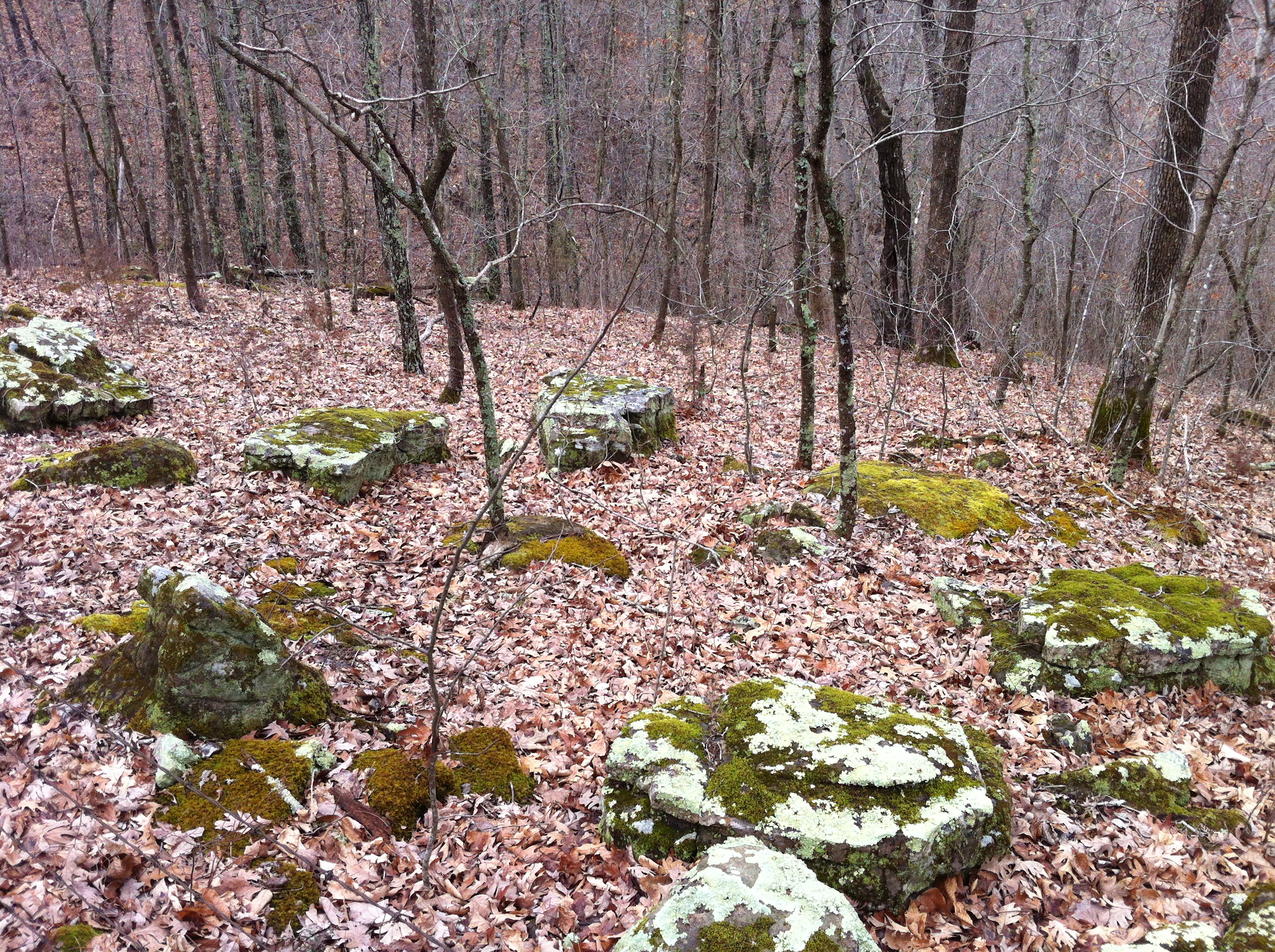
What were they thinking? Those ancient woman who transformed stone into potent and enduring images of the Goddess. Who crafted with their hands, something that persisted for 5,000, 10,000, 15, 000, 20,000, 30,000 years. Images so compelling that they reach across time, space, and understanding to say hello. Who made them and what was she thinking? Who am I and what am I thinking? Perhaps it is encoded in the layers of our being. Carrying on a legacy. The next link in a chain that spans the centuries and that is beyond the reach of history.

During our last women’s circle meeting we talked about our personal cultural histories and we began work on “sacred bundles” that we will continue to add to throughout the year-long course. I added photos of my ancestors, a fossilized stone shell, (because the Earth itself represents the shared cultural history of us all!), and one of my own Goddess sculptures and I tied the bundle with a Goddess of Willendorf necklace. I surprised myself by bursting into tears when I tried to explain the significance of my items, feeling the swift swirl of time and how those grandmothers in my pictures are now gone, but they were people, just like me. I also shared about the deep connection I feel to the land I live on and how my parents moved here in the 1970’s, so maybe this isn’t really where I “come from,” but that this is where my blood and roots belong. I continued crying as I described how when I sculpt my little figures, I feel like I’m part of an unbroken chain that stretches back at least 35,000 years, from the person who carved the Willendorf Goddess, all the way down to me with my rocks and clay. Later that week, my dad said he needed to talk to me and he shared that in our family history it is really only HIM who “broke the chain” of being “from” this exact patch of the Earth, here in Missouri. He was actually the only member of his side of the family in a long time who wasn’t born here and that, in truth, six generations of my family were born, lived, and died within a 25 mile radius of this very hillside that I find so meaningful. He said that he feels like his blood called him back here and he returned to this land as a young man and raised his own children here because it called so powerfully (I was born one mile from where I now live). So, he said, no wonder you feel like this is your cultural heritage and where you belong. Your lineage is right here, right where you like to be.

When I was taking a Goddess history class at OSC, I wrote the following about the common use of red ochre on Goddess figures:

As I saw the slideshow and reflected on goddess figures I have known and loved, I was suddenly struck by the realization that the walls of my home are, in a sense, colored with red ochre. We live in a straw bale house and the walls are plastered with an earthen plaster that include the red Missouri “clay dirt” that is a feature of the Ozarks region in which I live. The clay is red because of iron oxide, which is what red ochre is defined as. I looked at the Goddess of Willendorf on my altar and at her rich reddish color that exactly matches the shade of the earth on my bedroom walls. No wonder I feel such a deep, personal connection to these ancient figures—quite literally, some part of me identifies Her with home!

Last month when I shared a photo of some of my Goddess sculptures on Facebook, someone left a comment saying simply: Echoes of Mesopotamia. And, I really liked that.

Goddesscraft. 20130311-153757.jpg
Womancraft.
Lifecraft.
Who molds who?
Who sculpts who?
Is it just one beautiful dance
of exuberant co-creation?

Expansive memory,
silent witness,
inner wisdom,
embodied connection
solid space
all twisted together
in an incredible tapestry
of time
culture
power
and life.

Today, in the woods, I carried some of the sculptures I’ve made recently and am getting ready to ship to their new homes and I offered this prayer for them:

In this place of elemental peace 20130311-153846.jpg
with the earth, stone, trees, sky
as my witnesses
I bless, dedicate, and consecrate
these sculptures.

May they go forth
in wisdom
love
grace
and peace

May they bring a message
may they carry with them
the loving intention
with which they were birthed
and may they go forward
to speak to those who need to hear from
to enter the hands and homes of other women
with love, joy, power, and connection

May they recall deep wisdom of deep places
bright kindness
of bright spaces
and may they be just
what another woman needs

20130311-153723.jpg

Categories: art, blessings, Goddess, nature, OSC, prayers, sculpture, spirituality, theapoetics, womanspirit, women's circle, woodspriestess | 6 Comments

Create a free website or blog at WordPress.com.