thealogy

More Guest Posts!

This week I had another guest post published and the Feminism and Religion blog. Lots of powerful voices there and I’m really proud to be included amongst them!
Who is She? The Existence of an Ontological Goddess

I do feel Her presence directly in my life—call it an energy, call it the sacred feminine, call it the divine, call it source, call it soul, call it spirit, call it the great mystery…I perceive a web of relatedness and love within the world and I choose to put a feminine form to that energy—to name it and know it as Goddess…

And then, based on a blog post here by the same name, my essay about The Role of Death in the Circle of Life was published in the Fall Equinox issue of The Oracle.

While looking up something else, I came across the Wikipedia entry for Goddess movement and appreciated this explanation of who/what Goddess is:

Another point of discussion is whether the Goddess is immanent, or transcendent, or both, or something else. Starhawk (1988) speaks of the Goddess as immanent (infusing all of nature) but sometimes also simultaneously transcendent (existing independently of the material world). Many Goddess authors agree and also describe Goddess as, at one and the same time, immanently pantheistic and panentheistic. The former means that Goddess flows into and through each individual aspect of nature—each tree, blade of grass, human, animal, planet; the latter means that all exist within the Goddess (Starhawk 1979, Laura 1997, Christ 1997).

Starhawk (1979:77) also speaks of the Goddess as both a psychological symbol and “manifest reality. She exists and we create Her” (italics hers). Laura (1997:175) describes Goddess as being interactive. Possibly building on Mary Daly’s (1973 and 1978) suggestion that the divine be understood not as a Being (noun), but as Be-ing (verb), Carol P. Christ (2003), shows the similarities between Goddess theology and process theology, and suggests that Goddess theologians adopt more of the process viewpoint.

Categories: feminist thealogy, Goddess, spirituality, thealogy, writing | Leave a comment

The Central Value of Relationship

This post was originally published in The Oracle, the publication of Global Goddess and is based on a lesson I completed during one of my classes at Ocean Seminary College.

According to one of my favorite Goddess scholars, Carol Christ, the central ethical vision of Goddess religion is that all beings are embedded in a web of interconnected relatedness. All beings are part of the web of life. Everything is in relation—indeed it is possible to have relationships with the sun, sky, wind, and rainbow, as well as to other people, animals, plants, and the Divine. Everything is interconnected and does not exist without connection/relationship. Connection is strength, not weakness, and it is central.

As Christ explains, “The rituals and symbols of Goddess religion…[bring] experience and deep feeling to consciousness so that they can shape our lives; helping us broaden and deepen our understanding of our interdependence to include all beings and all people; binding us to others and shaping communities in which concern for the earth and all people can be embodied.” This connection is celebrated ritually through:

  • Invoking the four directions in ritual
  • Earth-honoring practices
  • Invoking the four elements in ritual and including symbolic representations of them
  • Visioning the Earth as the body of the divine
  • Venerating the Divine Female, which celebrates rather than denigrates women, the body, the earth, and the natural cycles of life
  • Wheel of the year orientation/celebration

These things are the mythos of Goddess religion and the ethos that results is:

  • Women who have pride in being female and pride in and love for their bodies.
  • Men who respect women as inherently valuable
  • A planet that is treated responsibly and with care
  • People who act as if they are a part of rather than apart from it—damaging the earth becomes no longer acceptable
  • Nurturing life and caregiving are acts that are valued
  • Motherhood and children and parenting are treated as worthwhile and meaningful activities and this is reflected in cultural, social, and political practices (such as in paid maternity leave of adequate duration)

Goddess ethics are “discovered within the web of life” rather than imposed from without. This has been true for me as a non-religious person for much of my life, who later discovered Unitarian Universalism and through that Goddess spirituality. I’ve never seen the need to have religion define for me what is a good, moral action and what is not (my experience is that many people with Christian backgrounds can’t understand how this is possible). What feels right and good and moral and ethical can be learned through living and in the context of family and relationship, it is does not have to be doctrine. Some people would argue that you cannot trust your “feelings” as to moral action, but I find more evidence to support the idea that ignoring your feelings and doing what you’re told instead has historically created a good deal of harm.

Also according to Christ there is “no self that is not created in relationship with another.” I used to struggle somewhat with this notion—my inherent understanding of the world was of the central value of human relationship, but if this is true, then without my relationships who am I? Relatedness as central originally seemed to me to make humans your “god.” I spent what feels like years trying to figure out who I was independent of other people and it is basically impossible to do so, BUT, this also gives other people too much credit or responsibility for my identity. I was consumed with needing to find my core self, my true self, and I chafed at the notion of “no self” or “selflessness” from Buddhist traditions. I have since learned that defining myself in the context of relationships to other people is too narrow a lens, I left out many other pieces of the web of connection. I exist in relation to the world, not just other people, and that includes Goddess power/energy. I name the holding web as Goddess.

It is profoundly disordered to think you can exist independently of others, but I also believe that you can be in relation to yourself, in a sense, in a healthy and strong way.

Interestingly, it was through my discovery of women’ spirituality and Goddess that I finally was able to regain a sense of myself as inherently worthy and valuable and NOT have this worth tied to doing for others, because I found that I could be related/relational TO the web or larger whole rather than just other people, whose affection towards or need of me may be transient. I used to feel so buffeted by the whims of others, rather than having a solid sense of being held in the hand of the Goddess (embedded in the web of relatedness). My sense of related embeddedness allows me to still be intimately engaged with and related to, while still not dependent on others for self-concept/identity/definition. My sense of self can come from within a relationship to my perceived place in a larger whole or web of existence. I feel I have reached a point where I can value all relatedness/relationships, rather than identity seeking through relationship or role exclusively with other people.

My favorite quote about the concept of existing in the context of relationship comes from another of Christ’s books, She Who Changes:

“Martin Buber, there can be no ‘I’ without a ‘thou,’ no self apart from relationship. Martin Buber said that before speech is developed, the hand of the infant reaches out for its mother (or other nurturer).’ In other words, before Descartes could formulate a thought, and certainly before he knew that he thought, he reached out his hand in relationship. The existence of the other is as certain as the existence of the self. Long before infants learn to speak, they come into relationship with others besides the mother, and with the physical world, with cribs, toys, sunbeams, shadows of leaves blowing in the wind. The existence of a world and the existence of others can be doubted only by someone who imagines that he or she could exist apart from relationships. According to process philosophy, a person who imagines he has no relationships is to be pitied-or committed to a mental institution. His thoughts on this matter certainly should not have become the foundation of modern western thought.” (Christ, 74)

I have learned a lot about the fundamental truth of relatedness through my own experiences as a mother and the quote above brings chills to my body. Relationship is our first and deepest urge. The infant’s first instinct is to connect with others. Before an infant can verbalize or mobilize, she reaches out a hand to her mother. I have most definitely seen this with my own babies. Mothering is a profoundly physical experience. The mother’s body is the baby’s “habitat” in pregnancy and for many months following birth. Through the mother’s body is how the baby learns to interpret and to relate to the rest of the world and it is to mother’s body that she returns for safety, nurturance, and peace. Birth and breastfeeding exist on a continuum as well, with mother’s chest becoming baby’s new “home” after having lived in her womb for nine months. These thoroughly embodied experiences of the act of giving life and in creating someone else’s life and relationship to the world are profoundly meaningful. With my last baby, I actively introduced her to the world—taking her out one morning and touching her feet to the earth and introducing her to the planet.

With my baby, I also see so clearly how she sees herself reflected in my eyes—loved and worthy and wonderful and true and beautiful. She looks to me, in my eyes, to gauge safety and danger as well as worth and respect. She sees me seeing her and what I see is SO GOOD. (And, I also see her seeing me and I’m pretty great myself!)

Molly is a certified birth educator, writer, and activist who lives with her husband and children in central Missouri. She is a breastfeeding counselor, a professor of human services, and doctoral student in women’s spirituality at Ocean Seminary College. She was recently ordained as a Priestess with Global Goddess. Molly blogs about birth, motherhood, and women’s issues at http://talkbirth.me and about thealogy and the Goddess at http://goddesspriestess.com

References: Carol P. Christ. She Who Changes: Re-imagining the Divine in the World. Kindle Edition.

20120912-161657.jpg

Categories: feminist thealogy, Goddess, spirituality, thealogy, women, writing | 3 Comments

Embodied Prayer

Sister, before you get all busy and serious about your new year resolutions,
take a moment to tune into that force which beats your heart,
which grows the leaves on the trees, which creates and tears down,
everything.
Tune into the captivating rhythm of evolution,
and dance your way into your holy calling.
The whole universe is dancing with you.

–Awakening Women Institute

I’ve felt a pull to return to this quote above and to something I wrote about embodied prayer at the dawning of 2012. I have had a tense, taut, and tight couple of days in which I’ve been irritable and impatient with those closest to me (for whatever reason, the people I know less well, usually get the “better” side of me, which just doesn’t seem like the way things should be!). It is strange because on one hand I feel like wonderful things are unfolding in my life in ways that feel meaningful, on purpose, and right, while at the same time I continue to struggle with finding the balance between what I need in my life for myself and what my children need/expect/deserve from me–the two often, frankly, feel incompatible. I continue to believe that there is a way for our family to live in harmony together, companionably meeting each member’s needs for self-expression, self-development, love, and authenticity, but then with weeks like this, I feel as if perhaps that IS an unreasonable hope!

When I became ordained as a priestess, one of the things that I vowed to myself was that I would remember to be a priestess of my own hearth first, rather than to become so pulled by the expectations of others outside my family that they get my best and my family gets the scraps. I’m amazed by how opportunities have been opening up to me since accepting the priestess call—I’m planning multiple rituals and ceremonies, I’m going to a Goddess festival next month, I continue to make steady progress on my doctoral degree and finished another one of my classes this week, my brain buzzes with ideas for my dissertation, I’m absolutely stoked to have two articles accepted for publication at the Feminism and Religion blog (one of which seems to actually be an original/fresh idea in the field of thealogy!), I have a guest post accepted for publication on The Divine Feminine blog,  and I had an essay published in The Oracle (the online zine for Global Goddess) called The Central Value of Relationship. I also have other ideas for classes/circles I’d like to facilitate and participate in. These things feel great. They feel right. They feel like where I belong. They also feel risky and brave and big and complex. I love the life of the mind and ideas that I’m experiencing in my classes. I love spending time in my own brain. I love thinking and writing and teaching and learning—“priestessing” my community in all of these ways. And, yet, then I feel bad and guilty about having snapped at my kids while trying to finish these–how ironic–essays on spiritual growth and development and then I feel like a fraud. And, every day I find myself with a “time deficit” and feeling taut and on the edge of freaking out because there is just SO. MUCH. TO. DO. All the time. And, I don’t feel like I ever get a break to just be still and rest. It is almost like I don’t know how to rest.

So, here’s what I wrote at the beginning of the year:

This year, I’d like to let go of shoulding myself. If I don’t truly have to do something, I’m only going to do it if I want to do it. If the word “should” enters the picture about anything, I’m going to use that as my cue to NOT do whatever it is I’m letting should me. Sound like a plan?

I enjoyed reading this post from Dreaming Aloud recently and the writer observes that she is only going to be able to be her for the new year: “I might even let myself mother to my own standards too! Wouldn’t that be nice, rather than failing every day because I don’t do everything the way the books say.” She also included this interesting idea about 3/4 baked: “Another influential book in my life…Zugunruhe… talks about the 3/4 baked philosophy, where the author urges us to do our work the best we can, but rather than spending all our energy in refining it ad infinitum, put it out to the world 3/4 baked and let the feedback and the inspiration it creates, and your own distance, do the final honing, because really there is no such thing as perfect.”

Embodied Prayer

My other  intention for 2012 was a very personal one that I felt extremely hesitant to write about. As soon as I read the quote I shared above from The Awakening Women Institute, I knew I wanted to share it. When I applied to graduate school in thealogy, I wrote in my application that I wanted my life to be a living prayer for social justice and women’s empowerment. Then, based on my work in my graduate classes, I started to be asked to write for publications focused on women and religion. I have always felt very cautious and wary of sharing any of my ideas about spirituality or religion publicly and so this makes me nervous for a variety of reasons. So did starting this blog and I’ve sort of tried to avoid connecting it to my “other life.” However, if I’m actually going to be writing these articles and having original ideas in the field, it is time to shed discomfort and speak my truth! I think my primary concept of living prayer is really about mindfulness. Being here and being aware.

In September, the Awakening Women Institute offered via Twitter to give people “temple names”—you were asked to respond to the question about “your edge right now in your life. What is calling you, what is challenging, what is opening?” I was instantly intrigued and responded to the offer with the following: “I have multiple edges–I feel at the edge of being able to truly live my faith, having my life be a living prayer. I also constantly teeter on the edge between meeting my children’s needs and meeting my own needs–and trying to find the harmony in that; trying to find the place in which our family works in harmony to meet each member’s needs (not requiring ‘sacrifice,’ because we have a seamless integration!).” The temple name I received was: Embodied Prayer. At first I felt slightly disappointed, like, yeah, I said that already. But, as I “rested” with the name and stated it aloud—i.e. “I am Embodied Prayer”—it became a powerful daily practice for me (that I seem to have lost hold of recently).

I have long sought strategies to integrate a sense of the sacred in daily life and have also known that at the root, what I’m really wanting is daily mindfulness. My “temple name” came to serve in some ways as mindfulness touchstone for me—as I go about my life, I ask myself what kind of “prayer” I’m offering in this moment. And, is this the kind of prayer I want to embody right now? (i.e. this week as I feel cranky and overextended and tense and annoyed, I’ve been stepping back slightly and looking at my “prayer” and realizing that I wanted to embody a much different sort of offering to the divine, to the web of life, than a stressed out cranky prayer.) This step back and self-reminder,  sometimes calms my mood and allows me to breathe more deeply and kindly, but recently I’ve solely been using it in a self-flagellating way: what kind of prayer is THAT, you loser! You think you’re a priestess?! What a JOKE, you SUCK. What about this priestess of your own hearth bit, failure woman?! I also become angry at myself when I forget to use it, forget to be mindful. I’ve also described this practice as reaching out to touch my thread in the fabric of the tapestry of the world. When I get caught up in my own busyness, I lose sight of my “weaving” within the overall tapestry of life, that holding web of incarnation that I call Goddess, and I’d like to always remain mindful of that connectedness—or, at least to notice when I’ve lost it and reach out my hand to that which is always there, surrounding me.

Then, as I was thinking these thoughts and berating myself, and always continuously trying to be better and dang it failing every single day at being better (and, yet, trying again the next day!), I read this blog post today from Jen Louden called I’m Not Liking Myself and I’m Not Doing Anything About It. Say what? Do you mean I DON’T always have to “be better” and to have my life be one long, relentless, ever-failing self-improvement project?! Maybe this is possible: “So if you ever find yourself not liking yourself, put down the self-improvement and take a nap.  But no mean thoughts allowed!”

Oh, and by the way…to what/why is this prayer of which you speak offered anyway?

This is actually part of the main subject of my upcoming guest posts on those other blog, but I’ll touch on it now anyway. Something that made me feel as if I belonged to our tiny little Unitarian Universalist church and like there was indeed a spiritual niche I fit into, was a hymn we sang during one of my first visits with a line of, “some call it evolution, and others call it God.” That notion that there is something widely felt by many, but called by different names and within vastly different systems of belief and understanding, is why I continue to identify as a UU, even though I’m not closely involved with the local church any longer. This force, this connecting “glue” that holds the universe together might be named by others “God” or “the Universe” or “Nature” or “Life Force” or “the Sacred” or “Divinity” or “the Tao”—I feel most satisfied when I personalize it as Goddess. I do also feel Her presence directly in my life—call it an energy, call it the sacred feminine, call it the divine, call it source, call it soul, call it spirit, call it the great mystery…I perceive a web of relatedness and love within the world and I choose to put a feminine form to that energy—to name it and know Her as “Goddess.” When I am embodied prayer, it is mindfulness of this connection and relatedness of which I speak.

Categories: family, Goddess, spirituality, thealogy, womanspirit | 4 Comments

Relatedness

Goddess, I enter your sacred space
space that is always there
waiting
open
welcoming

Space that I forget to touch
that I forget to drink from
space that I forget to look for
expansive space
space within
and space surrounding me
space that can be found in a group of women
and space that can be found
in a life with small children
perhaps difficult to see or grasp
but there waiting
holding
just the same

In the quiet I can hear myself
and I can hear You
I can feel myself
and I can feel You
Breathing
resting
holding
pulsing
in an everpresent ground of relationship
and relatedness
and beingness
together

The great invisible web of incarnation
in which we are all
held
touched
connected
deeply, authentically
and forever.
–Molly, 7/9/12

Categories: Goddess, poems, prayers, spirituality, thealogy, theapoetics, writing | 2 Comments

The role of death in the circle of life

20120629-153735.jpgAs I sit here
death is all around me
canopying the ground
with a blanket of brown
and yet still buzzing, teeming, throbbing with life.

My womb sheds its lining
another egg that didn’t make it.
and baby chicks in the nest hatch
and then fail to take a first breath

Sometimes things die
because they didn’t get something they needed
And, sometimes they die
because their time has come
Sometimes they die
to make room for something else
and sometimes they die
and nourish and nurture the new growth

It is all part of the same whole
this tapestry that Life is weaving
day in and day out
New bursting forth from old
giving birth
over and over and over again
letting go
over and over and over again
Shedding, bleeding, giving, dying, flowing, knowing
Saying goodbye and hello

This pulse, this rhythm too
this ebb, this flow
is part of the greater whole
each thread
some picked up,
some let go
becomes a part of the tapestry

Nature has a higher loss tolerance rate than we do
I know that from sad, personal experience
and a multitude of observations

What matters
is that the overall pulse keeps beating
that the overall heart keeps singing
and that mother hens continue trying to hatch new chicks.

–Molly, 2012

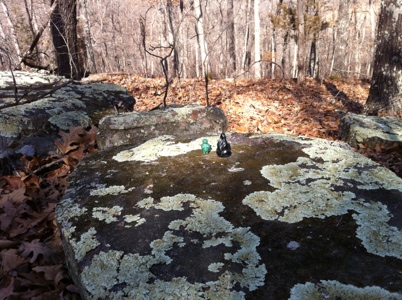
When I go down to the woods alone, sit on a rock and open my mouth, sometimes poetry comes out. Last month, I was very sad when one of our mother hens hatched two new babies who died immediately. It is depressing to have them come so far and then not make it. For one of my ecology lessons at OSC, I wrote the following:

… baby chicks are one of the things that make me believe in “the Goddess.” Maybe that sounds silly, but when I sit before a nest and see the bright black eyes and soft down of a new baby chick, where before there was just an egg, I feel like I am truly in the presence of divinity. This, this is Goddess, I think whenever I see one. There is just something about the magic of a new chick that brings the miracle of the sustaining force of life to my attention in a profound way. (New babies of all kinds do it for me, but there is something extra special about chicks!) Of course, when several died, I couldn’t help but feel sad about all of that work and that wasted potential and how that little baby had come so far only to die shortly after hatching, but that, to me, is part of Goddess/Nature/Life Force too. I do not believe in a controlling/power-over deity who can give life or take it away at will or at random. I know that things just happen, that the wheel keeps turning, and that while that force that I name Goddess is ever-present and able to be sensed and felt in the world and in daily life, it/she does not have any kind of ultimate “control” over outcomes.

Anyway, I was feeling sort of like, WHY, why did they get this far and then die so quickly? And, when I sat in the woods and opened my mouth, the answer that I’ve transcribed above is what came out…

I decided that now was the perfect time to post it since this morning I went out to the broody coop and in it was a brand new chick—the mother kept sitting and she got a fresh, bright, breathing baby for her efforts. The new baby is the one in the photo above…

Categories: poems, spirituality, thealogy, theapoetics, writing | 7 Comments

Theapoetics

20120619-163448.jpg

Paying attention…

One of my favorite verses in my life with children and as a conscious observer of the rhythms and flow of life is:

Instructions for living a life:
Pay attention.
Be astonished.
Tell about it. -Mary Oliver

These experiences remind me of a quote about the need for, or role of, “theapoetics”: “[Stanley Hopper] recommends we replace theology, the rationalistic interpretation of belief, with theopoetics, finding God[dess] through poetry and fiction, which neither wither before modern science nor conflict with the complexity of what we know now to be the self” (in Original Self by Thomas Moore).

I also have a favorite passage from Susan Griffin about the earth in which she exclaims, “We are stunned by this beauty.” That is exactly how I feel. This relationship to the planet is what used to make me feel that a conception of deity was unnecessary—isn’t it enough to just marvel at what is, right here in front of us? The majesty and the miracle of the natural world. I am stunned by this beauty. I am stunned by the realization that we are all suspended in space, spinning timelessly through the universe on this beautiful planet, so small in the vastness of all that surrounds us, and yet so big that it is literally our whole world. Sometimes when I have a bad day or feel overwhelmed by the swirl of daily tasks I remember that old saying about, “sometimes I go about pitying myself when all the while I am being carried by a great wind across the sky.” If we really stopped to think about this—to sense how we are carried by the great wind, I think the whole world would change, how people relate to each other and to the environment would be transformed. Stop, look, listen, breathe, and feel how we spin. Together.

20120619-162746.jpg

Mullein by the back porch

Categories: Goddess, spirituality, thealogy, theapoetics | 5 Comments

Ecofeminism

20120615-182229.jpgI consider myself to be a generally well-educated person as well as informed about feminism, social justice, and ecological issues. However, I had never actually heard the word “ecofeminism” until it was referenced in one of my courses at Ocean Seminary College. As such, when enrollment for the spring session of courses opened, I immediately signed up for an ecofeminism class as one of my electives.

In short, the foundation of ecofeminism is the perspective that the basic issues of ecological concern around the globe—water, wood, food, health care, climate change, environmental justice—are intimately intertwined with the status of women, their value and treatment. Many of the issues of domination, control, degradation, and oppression that affect women on this planet, also impact the health of the planet itself.

Ecofeminism is a diverse field of study with varying philosophies and approaches, all sharing the concept that there is a connection between, “unjustified domination of women and nature.” From a religious and spiritual perspective, I’ve always been interested by how women are associated with nature, the earthy, the mundane, the body; matters of the flesh and soil. Matter and mother are intimately connected. One of the ways in which patriarchal religion controls women is by asserting that women are connected to the body and the flesh, rather than to the (superior) realm of the mind and the spirit. As Carol Christ notes in her book, She Who Changes, “Feminist theologians have long recognized that women have been viewed as secondary or subordinate in dualistic anti-body traditions that follow Plato in making a sharp distinction between God and the unchanging soul on the one hand, and the changing body and nature on the other. In dualistic philosophies created by men, the rational soul of man is associated with the unchanging immortal realm of (a male) God, while woman is identified with the body, nature, and death.” [and sin!]…one set of qualities—the unchanging, the rational, the soul, the male—is valued more highly than the other—the changing, the natural, the body, the female. In such traditions God must be imaged as male because maleness is associated with the unchangeable realm of soul and spirit. God cannot be imaged as female because femaleness is associated with the changing body, nature, and death.”

In Karen Warren’s book Ecofeminist Philosophy she explains, “just as women’s bodies and labor are colonized by a combination of capitalism and patriarchy (or capitalist patriarchy), so is nature” (p. 26). I have previously written that patriarchy is built and maintained on the bodies of women. It is also built and maintained on the control of nature and natural resources. As someone with a special interest in the power of language and story to shape our world, I was most fascinated by the exploration of the connection between sexist-naturist language, emphasizing that, “Animalizing women in a patriarchal culture where animals are seen as inferior to human, thereby reinforces and authorizes women’s inferior status…similarly language that feminizes nature in a patriarchal culture, where women are viewed as subordinate and inferior, reinforces and authorizes the domination of nature” (p. 27). Language is used as a tool of social control and to reinforce patriarchal messages about ownership of body and resources. Exploitation of nature is justified by feminization of natural places and things and exploitation of women is justified by naturalizing their characteristics, roles, or value.

I also appreciate the observation that the root issue is, “’a social system in which the power of the Blade is idealized—in which both men and women are taught to equate true masculinity with violence and dominance…” (p. 21). These are primarily cultural and social structures, not biological imperatives. When domination of the earth, its resources, and its women is equated with a holy responsibility or sacred mandate, positions that uphold the rights of women and the sanctity of the earth have difficulty gaining ground.

Goddess worship and the symbol of the Goddess plays an important role in re-conceptualizing and restructuring the role of women, the value of nature, and the social order. “Many spiritual ecofeminists invoke the notion of ‘the Goddess’ to capture the sacredness of both nonhuman nature and the human body…the symbol of the Goddess ‘aids the process of naming and reclaiming the female body and its cycles and processes.” Rather than something to dominate and control, the earth becomes the body of the Goddess and is acknowledged as both literal and spiritual home and is something inseparably linked to personal well-being—planetary health and personal health become synonymous—and both treated with reverence and respect.

In another book about ecofeminism, Reweaving the World: The Emergence of Ecofeminism, Charlene Spretnak notes that there are two paths to ecofeminism the first originating in the study of politics and history (patriarchy and dominance of women) and the second path is “exposure to nature-based religion, usually that of the Goddess” (p. 5). I identify with both of these paths.

Spretnak also observes that ecofeminists ask, “…surely you’ve noticed that Western conquest and degradation of nature are based on fear and resentment; we can demonstrate that that dynamic is linked closely to patriarchal fear and resentment of of the elemental power of the female” (p. 11).

Ecofeminism also draws on an ethic of care, finding philosophical issue analysis to be, “…sterile and inadequate, a veiled attempt, yet again, to distance oneself from wonder and awe, from the emotional involvement and caring that the natural world calls forth” (p. 12).

In reflecting on this material I recalled a quote I used for post recently about menstruation: womb ecology reflects world ecology.

Categories: feminism, feminist thealogy, Goddess, thealogy, women | 3 Comments

Getting Started…

Recently I was asked by a friend where to get started learning about the Goddess. And, of course I had recommendations! To start, you might be interested in Carol Christ’s classic essay, Why Women Need the Goddess.

Good books to look into are:

  • When God was a Woman by Merlin Stone
  • Rebirth of the Goddess by Carol Christ
  • Dance of the Dissident Daughter by Sue Monk Kidd.

Also, check out Karen Tate’s amazing radio show Voices of the Sacred Feminine.

Sage Woman magazine is a great publication.

I enjoy this blog about feminism and religion too (lots of varied writers, including Carol Christ who I recommend above, and also me!).

There is some good historical and basic information here from Temple of the Goddess.

If you google for more resources, I suggest looking up things like “women’s spirituality” and “thealogy” (with an “a”) and “goddess spirituality.” Otherwise, you end up with stuff that is focused more on paganism and Wicca, which are not the same thing. I spent some time looking into pagan/wiccan resources and finding that there was something big missing for me in those traditions. It wasn’t until I started looking into “women’s spirituality” that I discovered that there is a whole other area of study, focused on the Goddess, that IS a great match for me. I finally made the connection when I trained as a Cakes for the Queen of Heaven facilitator (Cakes is a religious education curriculum originally published by the UU church and now offered by the UU Women and Religion organization. It is a great introduction to thealogy and to women’s spirituality).

20120613-142142.jpg

Categories: feminist thealogy, Goddess, resources, thealogy, women | Leave a comment

Our Mother Prayer

Our Mother who is within us
we celebrate your many names.
Your wisdom come.
Your will be done,
unfolding from the depths within us.
Each day you give us all that we need.
You remind us of our limits
and we let go.
You support us in our power
and we act with courage.
For you are the dwelling place within us
the empowerment around us
and the celebration among us
now and for ever. Amen

–Text by Miriam Therese Winter

via herchurch.

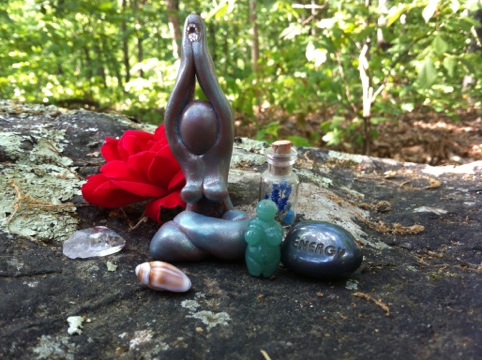
Goddess rosary

Categories: feminist thealogy, Goddess, liturgy, prayers, thealogy | 1 Comment

Create a free website or blog at WordPress.com.