nature

Sun-Oriented Naturalist Invocation

Across the field at sunset in July.

Across the field at sunset in July.

East: In the East we call upon the power of the Rising Sun, the yellow light of morning. Here we ask for new beginnings and we commit to renewing ourselves.

South: In the South, we call upon the power of the Sun at High Noon, the bright, orange light that warms the day. Here we ask for strength to be with us, and we commit to using our strength for the good of the community.

West: In the West, we call upon the power of the Setting Sun, the deep red light that calms the mind at the end of the day. Here we ask for a sense of satisfaction, and we pledge to take care of ourselves.

North: In the North we call upon the power of the Moon in the Night Sky, the silvery Moon who permits us to rest. Here we ask for the vision of dreams, and we agree to meet our ancestors in that place.

–Luisah Teish in Jump Up

I am particularly attracted to invocations that use naturalist-based language and that appeal to a wide variety of personal beliefs, while still striking the chord of the sacred within us all. I’m preparing two moon rituals for an assignment and I think I’m going to rework the above into a Moon-oriented invocation…

Another idea from Teish’s book, unrelated to the above, is for an egg wish giveaway for a spring ritual. Children (or others) stir up wildflower seeds while sharing their blessings and wishes for people for the year. Encourage them to create a song, chant, or poem while they bless the seeds. They then fill up plastic eggs with seeds and give these to relatives and friends as a “blessing from future generations.” Nice idea for an equinox ritual!

Categories: family, holidays, invocations, liturgy, nature, ritual | 2 Comments

Desert Priestess Book

desertpriestess

Desert Priestess: a memoir (Amazon affiliate link included)

I absolutely loved this book! Written by Anne Key, Desert Priestess: a memoir, is a memoir of her three years as the priestess at the Sekhmet Goddess Temple in Nevada. The memoir is beautifully written in a very honest manner with the narrative including her self-doubts and follies as well as her priestessly moments. After I finished it, I felt like my heart was yearning to take a pilgrimage to the desert, as well as to further deepen and refine my own priestess path! I highlighted several sections of the Kindle version of the text to share:

Writing about her role as a priestess, Anne explains:

…And I can only say that, as priestess, I worked so very hard to open my heart to each person who came, to meet each in perfect love and perfect trust of the structure and beauty of our desert wreath. To do this, I realized that I had to be not only sure of my purpose and strong in my stance but that I also had to see each person as an integral and necessary part of our circle. To do that, I had to be clear about myself and my intentions and I had to stay connected to the Divine…

I realized early in my tenure as priestess that I must stay connected to the Divine to allow things to come through me instead of from me. Everything depended on that: my ability to lead ritual, my ability to stay centered, my ability to understand those who came to the temple, my ability to see my way out of difficult issues. Striving to stay connected to the Divine made another point painfully apparent: I had to be clear, to the depths of my soul. I had to understand what I was, where my limits were, and accept totally who I was. I had to be able to be fully and totally present at each moment of ritual, wide open to everything, and firmly, firmly rooted. This was a real challenge…

Key, Anne (2011-03-29). Desert Priestess: a memoir (p. 45). Goddess Ink. Kindle Edition.

Another very good section of Desert Priestess was Key’s exploration of why it matters to call the Divine “Goddess”:

I lecture at various academic venues on Goddess Spirituality, and I continue to be amazed at the answer to my question: “Does your god have a gender?” While the wording would seem to make the question rhetorical, people almost always answer: “No, my god does not have a gender.” Given the statistic that over 75 percent of people living in the United States claim Christianity as their faith, when I lecture I assume that most of my audience is Christian. When I ask them to describe their god, to tell me what that god looks like in art, many times someone will mention a long white beard, which firmly answers the gender inquiry. But even if they don’t go as far as to mention a beard, when I ask them if their god is a woman, they are shocked and absolutely, defiantly sure that their genderless god is not a woman. We women who create life, the highest of all divine acts, cannot be considered a god.

Between my experiences at the temple and in academia, it has become clear to me that most women in twenty-first-century American culture never see themselves as divine. And it is no wonder. The most predominant images of women in the modern media are as accoutrements to products such as cars or purses. This to me is one of the greatest gifts of the goddess temples, because images of the Female Divine are important. They are important because they begin the process of consecrating women’s bodies as divine. When we as women begin to see our bodies as a reflection of the Divine, then our bodies are removed from the sole category of “object of the male gaze” to corporealized divinity, the embodiment of the Divine.

When women come into the temple, they see themselves, and they see themselves venerated. They see themselves in various shapes and colors, from the round and almond-eyed Madre del Mundo to the black and slim Sekhmet to the brown and regal Virgen de Guadalupe. We women have lived our lives trying to see ourselves in the image of the Christian God, living with the cognitive dissonance of the sound of Charlton Heston’s voice as God, in Michelangelo’s beefy finger, and in the picture tacked on the wall in Sunday school of a man’s aged and ageless face whose white beard melts into the clouds. We live in this culture of the image of God as white and male. As if this were not enough to get the point across, most of those who represent God in the Christian religion—the priests, preachers, and pastors—are men. And if women do represent the Christian God, there is almost always a controversy involved. Still, we women have persevered to find ourselves in the Divine and to see ourselves as divine, and even more courageously to represent the Divine. A sigh of relief automatically escapes me and the cognitive dissonance melts away when I am in the presence of an image of the Divine that is female. Images of the Female Divine are important because they embody the divine qualities of the feminine. The roles of mother, healer, guide, protector, lover, provider, and nurturer combine with the qualities of compassion, justice, truth, fertility, strength, and love to present women in multiple dimensions…

Key, Anne (2011-03-29). Desert Priestess: a memoir (pp. 50-52). Goddess Ink. Kindle Edition.
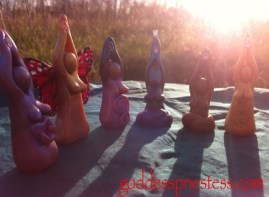
Sculptures hanging out in the sunshine!

Sculptures hanging out in the sunshine!

She goes on to make this important point: “It is of course no small wonder why graven images are so tightly controlled by religious traditions.” (p. 52) Sometimes I feel like this is what I’m tapping into when I make my own goddess sculptures—a resistance to tight control over graven images and over personalization of divinity as female in essence!

Later, Anne writes about creating a sisterhood of priestesses and she describes their vow to each other in a lovely way:

As sisters, we are one another’s truth tellers. We are one another’s loving and honest mirrors. We advise, even when we are not queried. And we let go so that each may fly on her own wings. Our sisters are our bonds with the deepest mysteries. As sisters, we are the ones who bleed, we are the ones who birth, we are the ones who nourish, we are the ones who weave the web, and we are the ones who cut the cord. As women, as sisters, as priestesses, we stand at the doorways of life and death, bonded by the cycles of our bodies and our lives.

Key, Anne (2011-03-29). Desert Priestess: a memoir (p. 57). Goddess Ink. Kindle Edition.

She also writes about creating ritual and liturgy in a desert climate:

At the beginning of each ceremony, we honored the four directions and an element associated with each: east and air; south and fire; west and water; north and earth. Many times when the directions are called, they are written with a wet, lush environment in mind: cool breeze, deep black earth, rushing rivers, dense forests. But these images did not reflect the desert land, a dry, thriving environment.

I wrote a call of directions specifically for this land, for this place, for this temple:

Winds of the mind, open free.

Breath of life, breathe in me.

Red flame of truth, burning pure.

Spark of life, ignite me.

Water of my soul, blood of earth.

Spring of life, wash me.

Bones of rock, sand, and earth.

Roots of life, ground me.

Key, Anne (2011-03-29). Desert Priestess: a memoir (pp. 90-91). Goddess Ink. Kindle Edition.

And, finally, another section I marked was in her description of feeding sweet little birds outside her window, only to see them snapped out of the air and eaten by a hawk. She says,  “Of course, I would have preferred that the hawks eat the mice. Much as I loved the cute little mice, the mess they left in our kitchen cupboards was disgusting and infuriating. But the birds! The little birds had done nothing but entertain us.” (Amen!) But, then she goes to make the best point ever about nature: “Obviously, this cycle was not about me, or what I thought was cute” (p. 116).

I really recommend this book! It is of particular interest to priestesses and to those interested in Goddess Temples and women’s spirituality in general, but I also think it would be interesting to people who like memoirs and stories about women’s lives and simple, yet profound, adventures.

Categories: books, nature, priestess, quotes, resources, reviews, spirituality, womanspirit, women | 2 Comments

Circle Closing

Open up the circle of healing and trust.
To the South, innocence and joy,
To the East, new beginnings,
To the North, cool winds of reason,
To the West, nighttime for dreaming,
Up above, the source of light, the Sky,
Beneath our feet, the womb of life, Mother Earth,
Open up the circle of healing and trust.

(modified version of a closing found here)

A good source for ritual chants is this site.

I’m in the process of planning a New Year’s Eve ritual right now and working hard to find readings and songs that will work well with a multi-age, mixed gender group (my first ritual of the sort–I’m nervous!)

December 2012 108

Categories: invocations, nature, readings, ritual, spirituality | 2 Comments

Stand Still…

I chose this recent picture of me listening to the forest...and, remembering not to take myself too seriously ;)

I chose this recent picture of me listening to the forest…and…other things. This is a reminder to me to remember not to take myself/my life TOO seriously 😉

Stand still. The trees ahead and the bushes beside you

Are not lost. Where ever you are is called HERE.

And you must treat it as a powerful stranger.

Must ask permission to know it and be known.

The forest breathes. Listen. It answers,

I have made this place around you.

If you leave it, you may come back again, saying, HERE.

No two trees are the same to Raven.

No two branches are the same to wren.

If what a tree or a bush does is lost on you,

You are surely lost. Stand still. The forest knows

Where you are. You must let it find you.

–David Wagoner, in Life Prayers

Categories: nature, poems, prayers, quotes, readings, spirituality, theapoetics | 3 Comments

Thanksgiving

My life is like a flower, opening to the sun.
My life is like a fountain, spilling up from the deep.
Peace, I am discovering, is not a state of being, but a process of becoming.

–Ann Kreilkamp in SageWoman, 54, Summer 2001 (p. 50)

I have a special affinity for interfaith prayers and readings that strike the chord of the sacred within us all, without being identified with any particular belief structure, or, indeed, belief in anything outside of the natural world. So, I liked this Thanksgiving blessing from Starhawk:

“We give thanks for this good green earth and all that lives upon it.

Thanks for the air, the Great Breath that flows from leaf to lung and back again, sustaining life.

Thanks for fire, leaping flame and glowing hearth, warmth in the cold season.

Thanks for water, the life-renewing rain, the springs, streams, and rivers, the pools and lakes, the great oceans, womb of the first life….”

–Starhawk, A Pagan Thanksgiving blessing (that anyone can use)

I also really enjoyed this article by Shiloh Sophia, Ten Ideas for a Grateful Thanksgiving Day. The ideas are wonderful and I wish I’d read the article before yesterday so that I could more readily incorporate some of them into our family dinner today!

20121123-112701.jpg

Categories: blessings, invocations, liturgy, nature, poems, prayers, quotes, theapoetics | Leave a comment

Invocation Poem

by Lee Lanning and Nett Hart

We honor the energy of the elements within us.

We are earth, We are dark, we are heavy, we are substantial.

We are grounded.

We are water. We are fluid, we are clear, we are vital.

We are renewed.

We are fire. We are bright, we are hot, we are intense.

We are inflamed.

We are air. We are light, we are movement, we are open.

We are changed.

in the book Casting the Circle by Diane Stein

Categories: art, blessings, invocations, nature, prayers, quotes | Leave a comment

The Web of Life

This essay is modified from one written for my Ecofeminism class at Ocean Seminary College.

Carol Christ’s understanding of “profound connection of all beings in the web of life,” (p. 58) is integral to my own understanding of the world, ethics, feminism, and spirituality. I very often return to the idea from Naomi Wolf of the “great invisible web of incarnation of which we are all a part,” indeed it forms the very foundation of my personal thealogy. My introduction to Goddess spirituality as a viable spiritual path distinct from Wicca came from my involvement with the UU Church, which holds an awareness of the web of life as one of its six core principles: “Respect for the interdependent web of all existence of which we are a part.” UU’s also draw from “seven sources,” one of which is: “Direct experience of that transcending mystery and wonder, affirmed in all cultures, which moves us to a renewal of the spirit and an openness to the forces which create and uphold life” and another of which is: “Spiritual teachings of earth-centered traditions which celebrate the sacred circle of life and instruct us to live in harmony with the rhythms of nature.” (http://www.uua.org/beliefs/principles/)  I find that direct experience for me comes most clearly and cleanly through nature and thus identified with Starhawk’s explanation in Reweaving the World that, “we must preserve the wilderness that’s left because that’s the place we go for renewal, where we can most strongly feel the immanence of the Goddess” (p. 82). This is dramatically true for me and in August I explored my relationship with the Goddess in the woods in a guest post on the Feminism and Religion blog about Theapoetics, based on earlier work I did with OSC.

As I just used in my prior post, I again thought of this quote: “When you grow, care for, cook, and eat a vegetable, you become emotionally attached to that vegetable for life. You eat with your heart, not with your mind.” –Liz Snyder (quoted in “Home Grown: Helping Your Child Develop a Love of Gardening” in Natural Life Magazine, May/June 2011). While this is about vegetables, I think we could say the same about animals and also about people. The direct relationship and connection is the key. I really do feel like the relational context of our lives is the fundamental core of the human experience. We cannot not be in relationship to the things around us, not just in terms of other humans, but plants, trees and animals. We are even in relationship with the sun, the wind, and the rain. And, the net that holds the whole, is what I name as Goddess/Divinity. Everything is interconnected and does not exist without connection/relationship. Connection is strength, not weakness, and it is central.  Goddess ethics are “discovered within the web of life” rather than imposed from without.  If we acted with our hearts and with love rather than with “logic” and if a corresponding ethic of care underlaid our beliefs, actions, and social structures, the overall functioning of society would change for the better.

As I read these final chapters in Reweaving the World, particularly Christ’s quote from Alice Walker about being a part of everything, “not separate at all,” I also thought about one of my long ago observations from my Ecology and the Sacred class:

My reflection was about how quickly the woods close in around human-made structures. When we built our house, it felt like we had scarred the land—we cleared some trees and had to dig for the septic tank and so forth. The ground looked stripped, some trees were damaged (or cut down), and our house was kind of plopped down there in the middle of the scar. We moved in to our house four years ago and you can no longer see these environmental scars—indeed, it feels at times like we have to hold the woods back from taking the area back over and reclaiming the land. A variety of grasses and wildflowers grow in the cleared areas and trees stretch out all around our house. I reflect upon how if we no longer lived here, our house would be swallowed up by the forest within only a handful of years. This is reassuring to me in a strange way. No matter how we have altered the landscape by our human presence and “meddling” with our ecosystem, Nature is waiting to reclaim and transform what we have attempted to mold and make our own.I also reflected about how we, as human inhabitants of this patch of ground, are part of the woods and the forest ecosystem. I guess in some ways I feel like we have “invaded” here, carving out a large footprint. But, while standing on our back deck, and looking all around me at the trees, grasses, and flowers, closing in…pressing in almost…on our house, I felt a sudden sense that we and our home were a part of these woods. We live here in our—albeit excessively large–“nest,” much like any other animal inhabits its nest or burrow within the forest. And, we are within it too, not on top of or apart from it.

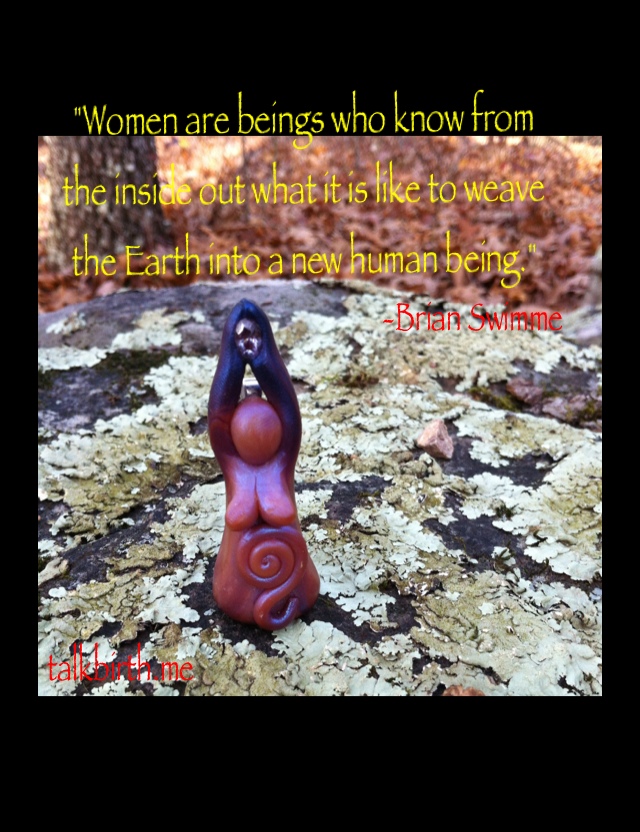
This idea that I was a legitimate part of nature and the woods as well was an important epiphany for me. Likewise, as I read Christ’s essay and I had another epiphany about interconnectedness and “all being one.” I’ve always struggled somewhat with the phrase, “we are all one,” but as I read her words, I had this new sense of clarity about it—we are all one weaving. A favorite example from earlier in this course is in Brian Swimme’s description of the Great Birth (Big Bang) in his essay in Reweaving the World: “From a single fireball the galaxies and stars were all woven. Out of a single molten planet the hummingbirds and pterodactyls and gray whales were all woven. What could be more obvious than this all-pervasive fact of cosmic and terrestrial weaving? Out of a single group of microorganisms, the Krebs cycle was woven, the convoluted human brain was woven, the Pali Canon was woven, all part of the radiant tapestry of being. Show us this weaving? Why, it is impossible to point to anything that does not show it, for this creative, interlacing energy envelops us entirely. Our lives in truth are nothing less than a further unfurling of this primordial ordering activity…Women are beings who know from the inside out what it is like to weave the Earth into a new human being” (Reweaving the World, p. 21. Emphasis mine).

I also greatly enjoyed Starhawk’s essay in Reweaving the World. As I read it and her passionate exploration of the earth-based tradition of paganism, I thought of a question I recently saw touched upon by a pagan blogger I enjoy, Bishop in the Grove, of whether or not pagans are still earth-based?  Explaining based on other posts and conversations Bishop asks:

“Lastly, are we “earth-based” anymore? It came up in response to Gus’s later statements about the political landscape that there are a wide-variety of Pagans, many of whom no longer identify as “earth-based.” This struck a chord with some people, and I’ve already received some feedback on Facebook which voiced appreciation for pointing out that some Pagans are more centered around deity.I think this one is worthy of a little unpacking. Do a little research, and you’ll see that the roots of the Neopagan movement were very much in the dirt, if you will. Earth-centered, or at the very least earth-aware spirituality has, up until fairly recently, been synonymous with Paganism. How exactly did we get to a place where someone could consider themselves a Pagan and not be “earth-based?” www.bishopinthegrove.com/archives/huffpost-live-paganism-roundtable-followup/

What would Starhawk make of this question I wonder, since her paganism is clearly deeply earth-based, indeed the earth is the foundation of her work, life, activism, teaching, and spirituality?! Starhawk reminds us that environmental issues are women’s issues, “for women sicken, starve, and die from toxins, droughts, and famines, their capacity to bear new life is threatened by pollution and they bear the brunt of care for the sick and the dying as well as for the next generation…unless we understand all the interconnections we are vulnerable to manipulation” (p. 83)

Starhawk passionately explains that earth-based principles call us to action: “earth-based spirituality makes certain demands. That is, when we start to understand that the Earth is alive, she calls us to act to preserve her life. When we understand that everything is interconnected, we are called to a politics and set of actions that come from compassion, from the ability to literally feel with all living beings on the Earth. That feeling is the ground upon which we can build community and come together and take action and find direction” (p. 74).

Categories: feminist thealogy, Goddess, nature, spirituality, thealogy, writing | 1 Comment

Mealtime Prayer

I send prayers of gratitude to all

that has given of itself on this day.

The strong beans, and the hardy grains,

the beautiful leafy green plants and the sweet juicy fruits.

I thank the sun that warmed and vitalized them,

just as it does me,

and the earth that held and nourished them, as it does me,

and the waters that bathed and refreshed them, as they do for me.

I thank the fire that transformed them,

just as I wish to be transformed by the fires of Spirit.

I thank the hands that grew and prepared this food,

just as I thank all those that have touched me in so many ways.

–Sedonia Cahill in Life Prayers

Categories: blessings, nature, prayers | 2 Comments

Indivisible

“…Blessed is the Creation

In its magnificence.

For the Spirit dwells

In every living thing.

And is indivisible.”

–Mary de La Valette (in Life Prayers)

20120908-175409.jpg

Categories: liturgy, nature, spirituality | Leave a comment

Making Your Own Sistrum

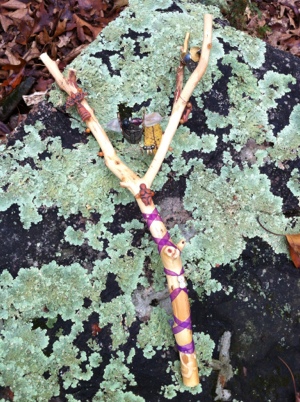
In ancient Egypt, priestesses used a sacred rattle-like instrument called a sistrum. Similar rattles were also used ceremonially in Africa and by shamans of various cultures. I learned about sistra when reading Karen Tate’s book Walking an Ancient Path. She refers to using a sistrum as a modern-day priestess to cast a circle, to invoke the four directions, and to cleanse houses and sacred spaces. I was immediately intrigued and did a little online research. My eye was immediately caught by a primitive style of sistrum made using a forked cedar stick and I became obsessed with making one of my own. Last weekend, Mark and I went out into the woods where we’d cut down some cedar trees earlier this year and we found piles of perfect forked sticks to use. First we peeled all the bark off which took several hours. Mark discovered that underneath the bark, his stick had been “carved by nature” (i.e. bugs!) in very, very cool patterns.

20120903-135101.jpg

We drilled holes in either side of the forked branches and poked wire through on which we strung a variety of beads, charms, and stones.

20120903-135148.jpg

They weren’t satisfyingly jingly enough, so Mark cut out some circles out of a sheet of brass and drilled holes through the middle. That was the perfect touch!

20120903-135110.jpg

I was ridiculously pleased with my results. I absolutely love it!

20120903-135257.jpg

I fancied mine up by wiring three awesome clay Goddess beads on the outside and adding a ribbon and handmade pewter spiral bead.
20120903-135305.jpg

This was a fabulously fun and enriching project! I highly recommend it. Coincidentally, or cosmically, we collected 12 extra forked cedar sticks in the woods and I think that is just perfect for making these at our fall women’s retreat. We just randomly collected them until we felt done and I said, “I probably need about twelve of these if we’re going to make these at our retreat.” We counted them and…amazingly…there were exactly twelve of them! So, I think it is meant to be 🙂

20120903-135310.jpg

Categories: art, nature, ritual, women's circle | 1 Comment

I can hear Her breathing…

20120907-134122.jpg

Sitting on the earth before it
I feel it

Life force, energy

Powerful, potent

running throughout

Everything is something

Life prevails and is beautiful.

–Molly, April 30, 2002

Several years ago, I jotted this down while sitting next to a special rosebush in my front yard. I was thinking about it this morning and realizing that today I would personalize that “it” as Goddess, but also that I’ve had a sense of “it”–this divine web of incarnation–for a long time.

She is always whispering to us

we may call Her by different names

yet She is always there

even when we forget to listen


My attention was caught by these quotes via Facebook this week:

“‎The most beautiful thing we can experience is the mysterious. It is the source of all true art and science. [She] to whom this emotion is a stranger, who can no longer pause to wonder and stand wrapt in awe, is as good as dead.” —Albert Einstein

“‎What you are basically, deep, deep down, far, far in, is simply the fabric and structure of existence itself.”
~ Alan Watts
via www.pantheism.net

“So for me the Goddess was just a certainty, easy to contact, no need for temples. All you need is to walk out in nature. If you have nothing, just a blade of grass, you pray with that one blade of grass and she will still come. It seemed like a loving, ever present deity who liked to take care of her own, appreciated being prayed to.” ~ Z Budapest

via The Girl God

Categories: Goddess, nature, poems, quotes, spirituality, theapoetics | 1 Comment

Earth Mother

Our Mother, whose body is the Earth,
Sacred is thy being. Thy gardens grow.
Thy will be done in our cities,
as it is in nature.
Thanks be this day
for food, and air, and water.
Forgive us our sins against Earth,
as we are learning to forgive one another.
And surrender us not unto extinction,
but deliver us from our folly.
For thine is the beauty, and the power,
and all life, from birth to death,
from beginning to end. Amen.
So be it.
Forever.
Blessed be.

–Henry Horton in Life Prayers

Categories: blessings, invocations, nature, poems, prayers, quotes, readings, spirituality | 2 Comments

May I…

May my feet rest firmly on the ground
May my head touch the sky
May I see clearly
May I have the capacity to listen
May I be free to touch
May my words be true
May my heart and mind be open
May my hands be empty to fill the need
May my arms be open to others
May my gifts be revealed to me
So I may return that which has been given
Completing the great circle.

–The Terma Collective in Life Prayers

Categories: nature, prayers, quotes, spirituality, womanspirit | Leave a comment

Gratitude Prayer

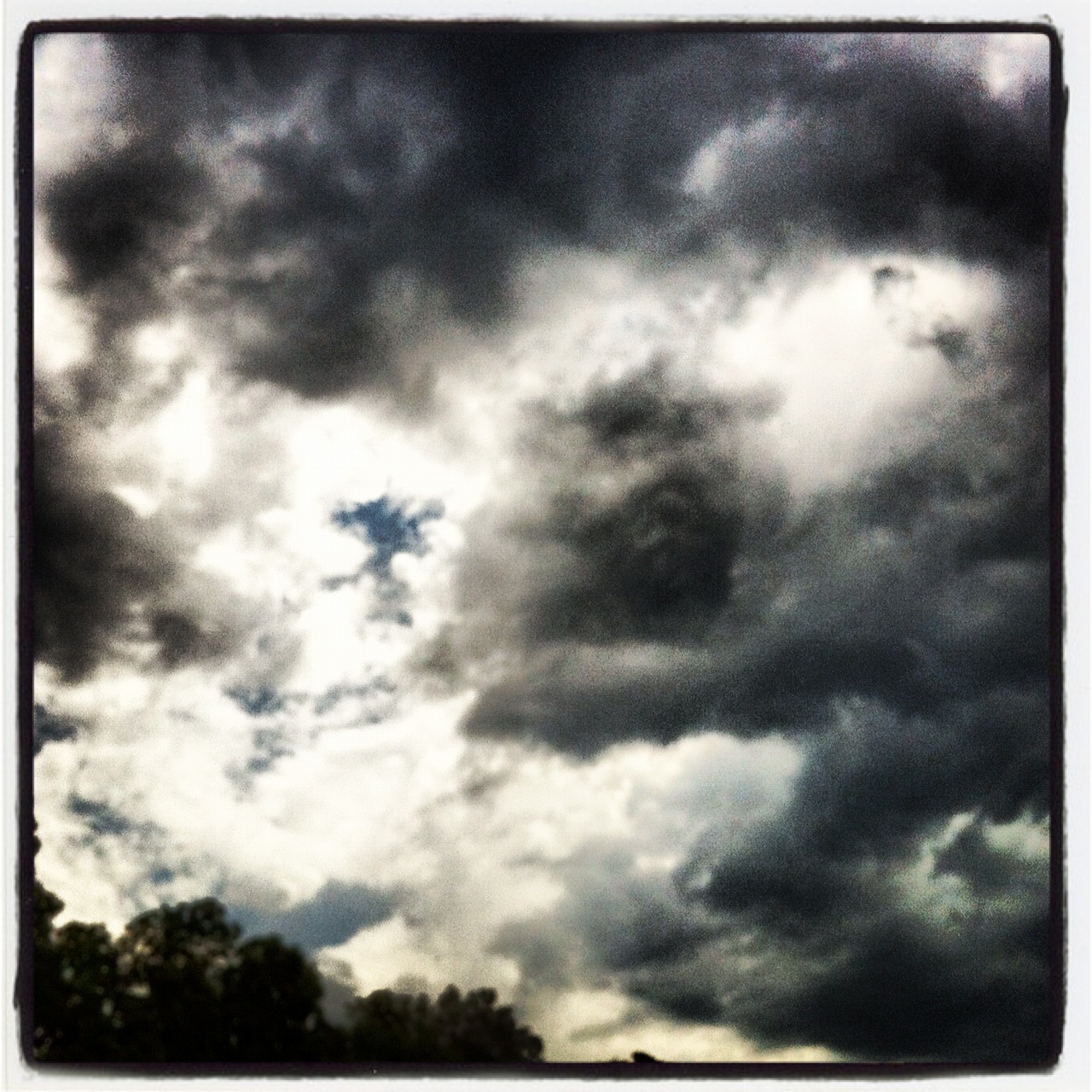
Beautifully cloudy sky

Goddess, thank you for the rain that has fallen.
thank you for this reprieve from summer’s heat
the coolness of the air
the freshness of the breeze
thank you for the mantle of green that has settled back softly into its rightful forest home

thank you for this sacred place
where I can come to listen
and to be heard

thank you, Goddess, for these beautiful rocks on which to sit
for the security of having a place upon the earth
for being a part of the whole

thank you for the steady pulse of my heart
thank you for the easy rhythm of my breath

thank you for the endless creativity of my mind and of my womb
Goddess, I thank you for the many blessings of my life.

–Molly, August 13, 2012

Categories: Goddess, nature, poems, prayers, spirituality, theapoetics, writing | Leave a comment

I stand on holy ground

I do not have to go
To Sacred Places
In far-off lands.
The ground I stand on
Is holy.

Here, in this little garden
I tend
My pilgrimage ends.
The wild honeybees
The hummingbird mothers
The flickering fireflies at dusk
Are a microcosm
Of the Universe.
Each seed that grows
Each spade of soil
Is full of miracles.

And I toil and sweat
And watch and wonder
And am full of love.
Living in place
In this place.
For truth and beauty
Dwell here.

–Mary de La Valette in Life Prayers

There’s definitely a theme in the poems and prayers that catch my eye lately. I love my home and where I live. I do not have wanderlust at all and while I do like to take occasional trips with my family, I’m not that big on travel and going other places. I like my own place.

When I took a class last year called Ecology and the Sacred, I was interested by the explanation in  our class textbook about how we typically, “tell the story of our cultural lives and our interactions with other people…” While I definitely share this tendency, I do also feel deeply rooted to my natural place—the land on which I live and on which I grew up. My parents homesteaded their property in the 1970’s and I was born at home and spent my entire childhood on the same piece of land on which I was born, playing in the woods. They are very connected to their land and literally their blood, sweat, and tears have gone into their “place” in the natural world. Nine years ago, my husband and I bought a parcel of my parents’ property and built our own home there. We live on a different road than my parents, but are still only one mile from where I was born, and our property is bordered by theirs on two sides. My husband and I have now invested a lot of time and energy into this piece of land, now our blood, and sweat, and tears are part of this piece of land and we feel permanent in this location. We do not—indeed, cannot—envision ever moving and living anywhere else. Sometimes my husband and I talk about whether this sense of permanence is binding or restrictive—i.e. what about the sense of possibility, about being able to “start over” anywhere—but we’ve concluded that rootedness has a great deal of personal value to us and we wouldn’t want to trade our roots for “wings.” While this isn’t quite the same as a natural history of place, I do feel that my own identity and social story includes an interwoven, personally important element of natural place. This part of the country is where I belong and I am invested in it. I feel safest in the woods, in locations surrounded by trees. It is my place!

During this class, I also reflected on how quickly the woods close in around human-made structures. When we built our house, it felt like we had scarred the land—we cleared some trees and had to dig for the septic tank and so forth. The ground looked stripped, some trees were damaged (or cut down), and our house was kind of plopped down there in the middle of the scar. We moved into our house five years ago and you can no longer see these environmental scars—indeed, it feels at times like we have to hold the woods back from taking the area back over and reclaiming the land. A variety of grasses and wildflowers grow in the cleared areas and trees stretch out all around our house. I feel pretty certain that if we no longer lived here, our house would be swallowed up by the forest within only a handful of years. This is reassuring to me in a strange way. No matter how we have altered the landscape by our human presence and ‘meddling’ with our ecosystem, Nature is waiting to reclaim and transform what we have attempted to mold and make our own.

I also reflected about how we, as human inhabitants of this patch of ground, are part of the woods and the forest ecosystem. I guess in some ways I feel like we are the invaders here, carving out a large footprint. But, while standing on our back deck, and looking all around me at the trees, grasses, and flowers, closing in…pressing in almost…on our house, it feels as if we, and our home, are a part of these woods. We live here in our—albeit excessively large–“nest,” much like any other animal inhabits its nest or burrow within the forest. And, we are within it too, not on top of or apart from it, mutually adapting to each other’s presence and all trying to survive and thrive.

Categories: family, nature, poems, quotes, readings, theapoetics | 1 Comment

Create a free website or blog at WordPress.com.