Monthly Archives: June 2012

The role of death in the circle of life

20120629-153735.jpgAs I sit here
death is all around me
canopying the ground
with a blanket of brown
and yet still buzzing, teeming, throbbing with life.

My womb sheds its lining
another egg that didn’t make it.
and baby chicks in the nest hatch
and then fail to take a first breath

Sometimes things die
because they didn’t get something they needed
And, sometimes they die
because their time has come
Sometimes they die
to make room for something else
and sometimes they die
and nourish and nurture the new growth

It is all part of the same whole
this tapestry that Life is weaving
day in and day out
New bursting forth from old
giving birth
over and over and over again
letting go
over and over and over again
Shedding, bleeding, giving, dying, flowing, knowing
Saying goodbye and hello

This pulse, this rhythm too
this ebb, this flow
is part of the greater whole
each thread
some picked up,
some let go
becomes a part of the tapestry

Nature has a higher loss tolerance rate than we do
I know that from sad, personal experience
and a multitude of observations

What matters
is that the overall pulse keeps beating
that the overall heart keeps singing
and that mother hens continue trying to hatch new chicks.

–Molly, 2012

When I go down to the woods alone, sit on a rock and open my mouth, sometimes poetry comes out. Last month, I was very sad when one of our mother hens hatched two new babies who died immediately. It is depressing to have them come so far and then not make it. For one of my ecology lessons at OSC, I wrote the following:

… baby chicks are one of the things that make me believe in “the Goddess.” Maybe that sounds silly, but when I sit before a nest and see the bright black eyes and soft down of a new baby chick, where before there was just an egg, I feel like I am truly in the presence of divinity. This, this is Goddess, I think whenever I see one. There is just something about the magic of a new chick that brings the miracle of the sustaining force of life to my attention in a profound way. (New babies of all kinds do it for me, but there is something extra special about chicks!) Of course, when several died, I couldn’t help but feel sad about all of that work and that wasted potential and how that little baby had come so far only to die shortly after hatching, but that, to me, is part of Goddess/Nature/Life Force too. I do not believe in a controlling/power-over deity who can give life or take it away at will or at random. I know that things just happen, that the wheel keeps turning, and that while that force that I name Goddess is ever-present and able to be sensed and felt in the world and in daily life, it/she does not have any kind of ultimate “control” over outcomes.

Anyway, I was feeling sort of like, WHY, why did they get this far and then die so quickly? And, when I sat in the woods and opened my mouth, the answer that I’ve transcribed above is what came out…

I decided that now was the perfect time to post it since this morning I went out to the broody coop and in it was a brand new chick—the mother kept sitting and she got a fresh, bright, breathing baby for her efforts. The new baby is the one in the photo above…

Categories: poems, spirituality, thealogy, theapoetics, writing | 7 Comments

Senses

20120625-170929.jpg

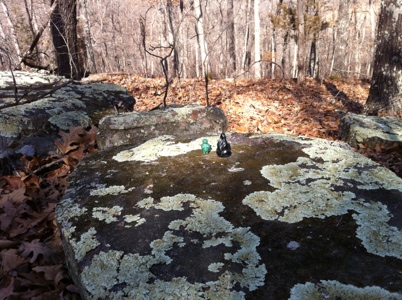
Priestess rocks behind my house

This is a place of holy beauty

This life is my prayer

I open my arms to the fullness that surrounds me

Breathing deep

Listening well

Touching softly

Tasting gently

Inhale…

Exhale…

–Molly, June 25, 2012

Spoken word poem that emerged unbidden in the woods today…

Categories: poems, prayers, spirituality, theapoetics | Tags: | Leave a comment

My Explanation…

20120620-150518.jpg

My little farm baby in the field

My Explanation
Pick up a stone.
Hold it in your hand.
Feel the vibration?
Pick up a leaf.
Trace the vines.
Feel the life?
Climb a tree.
Trust the sturdy branches.
Feel the stability?
Go out side right before a storm.
Hear the thunder, watch the lightning.
Feel the energy building?
Lie down in a field on a cool day when the sun is shining.
Feel it surround you with warmth and safety?
Stand up and turn around in circles.
Feel the wind rush through your hair.
Feel the spirit?
Go out to that same field at night when the moon is full.
Let the moon light guide your way.
Feel the magic?
As you look up to the sky
and count the stars
know that they hold no prejudice, no hate, and no judgment.
Know that you have a home in the universe (which means
one song)
as long as you know that you are a part of all that
surrounds you
and all that surrounds you is a part of you.
The vibration you felt in the rock,
the life in the leaf,
the stability of the tree,
the energy of the storm,
the warmth of the sun,
the spirit in the wind,
the magic of the moon,
and the unconditional love of the stars,
know those are your gods and goddesses,
and the earth is your bible.
Everything possesses a spark of divinity, including you.
You need to look no further than the world around you,
or your own mirror
to find God(dess) and know where you belong.
That is my religion.
–Diana “Sollitaire” H. in Talking to Goddess

20120620-150729.jpg

Wildflower in the field

Categories: family, Goddess, poems, readings, spirituality, theapoetics | Leave a comment

Calling the Directions

I enjoyed this invocation to the four directions in the book Goddess Spirituality for the 21st Century by Judith Laura:

We honor the East
Home of air
March wind
Morning’s song
Eagle’s flight
Aurora’s breath
Welcome East

We honor the South
Home of fire
Noon sun
Flame of change
Heat of passion
Pele’s power
Welcome South

We honor the West
Home of water
River’s flow
Font of feelings
World’s womb
Kwan Yin’s love
Welcome West

We honor the North
Home of Earth
Root of life
Shaded mystery
Ground of being
Gaia’s growth
Welcome North.

20120620-150428.jpg

Wildflower in the field.

Categories: invocations, liturgy, readings, ritual, women's circle | Leave a comment

Theapoetics

20120619-163448.jpg

Paying attention…

One of my favorite verses in my life with children and as a conscious observer of the rhythms and flow of life is:

Instructions for living a life:
Pay attention.
Be astonished.
Tell about it. -Mary Oliver

These experiences remind me of a quote about the need for, or role of, “theapoetics”: “[Stanley Hopper] recommends we replace theology, the rationalistic interpretation of belief, with theopoetics, finding God[dess] through poetry and fiction, which neither wither before modern science nor conflict with the complexity of what we know now to be the self” (in Original Self by Thomas Moore).

I also have a favorite passage from Susan Griffin about the earth in which she exclaims, “We are stunned by this beauty.” That is exactly how I feel. This relationship to the planet is what used to make me feel that a conception of deity was unnecessary—isn’t it enough to just marvel at what is, right here in front of us? The majesty and the miracle of the natural world. I am stunned by this beauty. I am stunned by the realization that we are all suspended in space, spinning timelessly through the universe on this beautiful planet, so small in the vastness of all that surrounds us, and yet so big that it is literally our whole world. Sometimes when I have a bad day or feel overwhelmed by the swirl of daily tasks I remember that old saying about, “sometimes I go about pitying myself when all the while I am being carried by a great wind across the sky.” If we really stopped to think about this—to sense how we are carried by the great wind, I think the whole world would change, how people relate to each other and to the environment would be transformed. Stop, look, listen, breathe, and feel how we spin. Together.

20120619-162746.jpg

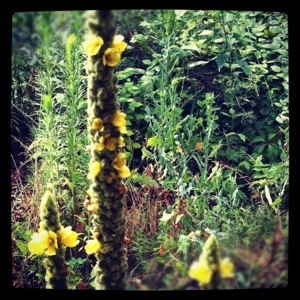
Mullein by the back porch

Categories: Goddess, spirituality, thealogy, theapoetics | 5 Comments

New Moon Blessing

20120619-160154.jpg

New goddess rosary from herchurch.org

New Moon Blessing

Shekhinah, we come to you at this time of the moon’s renewal,
to join you in regeneration and rebirth
to plant new seeds
to honor this time of piya wiconi—new beginnings.
As we embark on new projects and contemplate new
ways of being
help us to see ourselves and each other with new eyes
of appreciation and gratitude,
to remember to thank you, daily, for all our blessings.
Help us to reach our own fullness,
Even as we go inside,
in seclusion with Her
She Who is waiting for us
To discover divinity
in ourselves
–D’vorah J. Grenn, March 1998 in Talking to Goddess

Categories: blessings, poems, prayers, quotes, readings, ritual, spirituality, theapoetics, women's circle | Leave a comment

Ecofeminism

20120615-182229.jpgI consider myself to be a generally well-educated person as well as informed about feminism, social justice, and ecological issues. However, I had never actually heard the word “ecofeminism” until it was referenced in one of my courses at Ocean Seminary College. As such, when enrollment for the spring session of courses opened, I immediately signed up for an ecofeminism class as one of my electives.

In short, the foundation of ecofeminism is the perspective that the basic issues of ecological concern around the globe—water, wood, food, health care, climate change, environmental justice—are intimately intertwined with the status of women, their value and treatment. Many of the issues of domination, control, degradation, and oppression that affect women on this planet, also impact the health of the planet itself.

Ecofeminism is a diverse field of study with varying philosophies and approaches, all sharing the concept that there is a connection between, “unjustified domination of women and nature.” From a religious and spiritual perspective, I’ve always been interested by how women are associated with nature, the earthy, the mundane, the body; matters of the flesh and soil. Matter and mother are intimately connected. One of the ways in which patriarchal religion controls women is by asserting that women are connected to the body and the flesh, rather than to the (superior) realm of the mind and the spirit. As Carol Christ notes in her book, She Who Changes, “Feminist theologians have long recognized that women have been viewed as secondary or subordinate in dualistic anti-body traditions that follow Plato in making a sharp distinction between God and the unchanging soul on the one hand, and the changing body and nature on the other. In dualistic philosophies created by men, the rational soul of man is associated with the unchanging immortal realm of (a male) God, while woman is identified with the body, nature, and death.” [and sin!]…one set of qualities—the unchanging, the rational, the soul, the male—is valued more highly than the other—the changing, the natural, the body, the female. In such traditions God must be imaged as male because maleness is associated with the unchangeable realm of soul and spirit. God cannot be imaged as female because femaleness is associated with the changing body, nature, and death.”

In Karen Warren’s book Ecofeminist Philosophy she explains, “just as women’s bodies and labor are colonized by a combination of capitalism and patriarchy (or capitalist patriarchy), so is nature” (p. 26). I have previously written that patriarchy is built and maintained on the bodies of women. It is also built and maintained on the control of nature and natural resources. As someone with a special interest in the power of language and story to shape our world, I was most fascinated by the exploration of the connection between sexist-naturist language, emphasizing that, “Animalizing women in a patriarchal culture where animals are seen as inferior to human, thereby reinforces and authorizes women’s inferior status…similarly language that feminizes nature in a patriarchal culture, where women are viewed as subordinate and inferior, reinforces and authorizes the domination of nature” (p. 27). Language is used as a tool of social control and to reinforce patriarchal messages about ownership of body and resources. Exploitation of nature is justified by feminization of natural places and things and exploitation of women is justified by naturalizing their characteristics, roles, or value.

I also appreciate the observation that the root issue is, “’a social system in which the power of the Blade is idealized—in which both men and women are taught to equate true masculinity with violence and dominance…” (p. 21). These are primarily cultural and social structures, not biological imperatives. When domination of the earth, its resources, and its women is equated with a holy responsibility or sacred mandate, positions that uphold the rights of women and the sanctity of the earth have difficulty gaining ground.

Goddess worship and the symbol of the Goddess plays an important role in re-conceptualizing and restructuring the role of women, the value of nature, and the social order. “Many spiritual ecofeminists invoke the notion of ‘the Goddess’ to capture the sacredness of both nonhuman nature and the human body…the symbol of the Goddess ‘aids the process of naming and reclaiming the female body and its cycles and processes.” Rather than something to dominate and control, the earth becomes the body of the Goddess and is acknowledged as both literal and spiritual home and is something inseparably linked to personal well-being—planetary health and personal health become synonymous—and both treated with reverence and respect.

In another book about ecofeminism, Reweaving the World: The Emergence of Ecofeminism, Charlene Spretnak notes that there are two paths to ecofeminism the first originating in the study of politics and history (patriarchy and dominance of women) and the second path is “exposure to nature-based religion, usually that of the Goddess” (p. 5). I identify with both of these paths.

Spretnak also observes that ecofeminists ask, “…surely you’ve noticed that Western conquest and degradation of nature are based on fear and resentment; we can demonstrate that that dynamic is linked closely to patriarchal fear and resentment of of the elemental power of the female” (p. 11).

Ecofeminism also draws on an ethic of care, finding philosophical issue analysis to be, “…sterile and inadequate, a veiled attempt, yet again, to distance oneself from wonder and awe, from the emotional involvement and caring that the natural world calls forth” (p. 12).

In reflecting on this material I recalled a quote I used for post recently about menstruation: womb ecology reflects world ecology.

Categories: feminism, feminist thealogy, Goddess, thealogy, women | 3 Comments

Getting Started…

Recently I was asked by a friend where to get started learning about the Goddess. And, of course I had recommendations! To start, you might be interested in Carol Christ’s classic essay, Why Women Need the Goddess.

Good books to look into are:

  • When God was a Woman by Merlin Stone
  • Rebirth of the Goddess by Carol Christ
  • Dance of the Dissident Daughter by Sue Monk Kidd.

Also, check out Karen Tate’s amazing radio show Voices of the Sacred Feminine.

Sage Woman magazine is a great publication.

I enjoy this blog about feminism and religion too (lots of varied writers, including Carol Christ who I recommend above, and also me!).

There is some good historical and basic information here from Temple of the Goddess.

If you google for more resources, I suggest looking up things like “women’s spirituality” and “thealogy” (with an “a”) and “goddess spirituality.” Otherwise, you end up with stuff that is focused more on paganism and Wicca, which are not the same thing. I spent some time looking into pagan/wiccan resources and finding that there was something big missing for me in those traditions. It wasn’t until I started looking into “women’s spirituality” that I discovered that there is a whole other area of study, focused on the Goddess, that IS a great match for me. I finally made the connection when I trained as a Cakes for the Queen of Heaven facilitator (Cakes is a religious education curriculum originally published by the UU church and now offered by the UU Women and Religion organization. It is a great introduction to thealogy and to women’s spirituality).

20120613-142142.jpg

Categories: feminist thealogy, Goddess, resources, thealogy, women | Leave a comment

Our Mother Prayer, Version 2

This version of the Our Mother prayer is from Patricia Lynn Reilly:

Our Mother, who art within us,
We celebrate your many names.
Your wisdom come. Your will be done,
Unfolding from the depths of us.
Each day You give us all that we need.
You remind us of our limits and we let go.
You support us in our power and we act with courage.
For you are the dwelling place within us,
the empowerment around us, and the celebration among us.
As it was in the very beginning, may it be now.

20120611-112754.jpg

Categories: Goddess, liturgy, prayers, readings, ritual, spirituality, theapoetics | 1 Comment

Inner Wisdom

Inner Wisdom
Once upon a time, before the study of theology,
there was inner wisdom.
Before church buildings
there was the earth beneath my feet.
Before religious hymns,
there were the spontaneous chants inspired by the season’s blazing colors. Before preachers,
there was my grandfather, with his big old picture Bible,
adding flare and nuance to those old stories
in a way the preachers could hardly imagine.
But even before the Bible,
there were stories of my life, and Demetra’s and Rebecca’s,
and the little boy who lived down the street.
Before Sunday dresses and Easter hats,
there were blue jeans and cotton blouses that were made for caressing
the earth, trees, and railroad tracks that ran behind our house.
Before words and liturgy,
there was dance and motion…circling, jumping, leaping my prayers
among my friends the trees, the sun, the shadows, the spiders.
Before solemn statues,
was the Spirit of Life within, around, and beyond me,
and there was my mother with her kind words,
her crystals and her fresh-baked bread from the oven.
Before the baptism of salvation,
there was the baptism of summer rain showers,
and before that,
the baptism of birth in the waters of the womb.
Before lines,
there were circles.
Before ladders,
there were spirals.
So I circle and I spiral to the wisdom of my childself. </

–Shea Darian, Seven Times the Sun, p. 172

20120610-131239.jpg

Categories: poems, readings, spirituality | Leave a comment

Participatory Circle Prayer

From the book Seven Times the Sun, p. 45:

A simple participatory prayer is the circle prayer…someone might begin: ‘Spirit of Life, bless the activities of our day.’ The prayer travels around the table as each person names a special event, work to be accomplished, time with a friend, etc. For a Thanksgiving meal, someone might begin: ‘Creator, we offer thanks for the blessings of our lives.’ The prayer comes full circle as each person names a blessing from the year past for which they wish to offer thanks.

20120610-125740.jpg

Categories: family, prayers | Leave a comment

Our Mother Prayer

Our Mother who is within us
we celebrate your many names.
Your wisdom come.
Your will be done,
unfolding from the depths within us.
Each day you give us all that we need.
You remind us of our limits
and we let go.
You support us in our power
and we act with courage.
For you are the dwelling place within us
the empowerment around us
and the celebration among us
now and for ever. Amen

–Text by Miriam Therese Winter

via herchurch.

Goddess rosary

Categories: feminist thealogy, Goddess, liturgy, prayers, thealogy | 1 Comment

Summer Solstice Prayer

This prayer was reprinted in this month’s e-newsletter from Temple of the Goddess and I want to remember it for our family’ summer solstice ritual: Image

A Prayer of Healing
From the United Nations Environmental Sabbath

We come together this Summer Solstice under old oak trees, nurtured by the ground, the living green grass under our feet, to honor the longest day of the year. We see the pain of the Earth, the devastation of Her body. But today we celebrate Her. We say Prayers of Healing, for the world and for all Her children.

We join with the earth and with each other.
To celebrate the seas.
To rejoice the sunlight.
To sing the song of the stars.

We join with the earth and with each other.
To recall our destiny.
To renew our spirits.
To reinvigorate our bodies.

We join with the earth and with each other.
To create the human community.
To promote justice and peace.
To remember our children.

We join together as many and diverse expressions of one loving mystery: for the healing of the earth and the renewal of all life. We join with the earth and with each other.
To bring new life to the land.
To restore the waters.
To refresh the air.

We join with the earth and with each other.
To renew the forests.
To care for the plants.
To protect the creatures.

Categories: liturgy, poems, prayers, readings, theapoetics | 1 Comment

The sum of human culture…

Thousands of years
of history have passed…
and during all that time
human beings
have fought, killed
plundered and wronged each other
in every possible way.

Of such stuff history is made.
But also during that time,
other human beings
have quietly and patiently persevered
in the development
of the arts, crafts
inventions, ideas and programs.
From these millions of creative persons,
most of them unnoticed and unknown
in the upheavals of history,
have come the good and lasting things
in the sum of human culture.

–Barbara G. Walker in Life Prayers

Image

3-D journaling, my birth art series

Categories: art, readings, theapoetics | Leave a comment

That holy fire

‎”Dare to let that holy flame within you
grow hot and dangerous,
and you will be able to look the world straight in the eyes,
and say
oh yes, I have seen into the depths of beauty
and I will not settle for anything less
than the real deal”

From this post by Awakening Women Institute.

20120604-130452.jpg

(Photo taken by a friend at a weekend campfire.)

Categories: quotes, readings, spirituality, women | 1 Comment

Create a free website or blog at WordPress.com.