Monthly Archives: September 2012

Blessingways and the role of ritual

I saw this gorgeous blessingway image pinned on Pinterest a while ago. Love it!

In this circle No Fear
In this circle Deep Peace
In this circle Great Happiness
In this circle Rich Connection

I’ve recently been on a reading streak with books on ritual. I’ve always been interested in ritual, especially women’s rituals, and I’ve planned and facilitated a lot of different rituals. I also have a huge variety of books that include information on planning rituals, women’s spirituality books, books about blessingways, and more. I’m branching out even more with my recent kick though, starting with buying books on officiating/planning wedding ceremonies (I have two weddings coming up in October). Then, I was talking to some mothers of newly teenage boys about planning some kind of coming of age rite/ritual for them and  bought some more books on creating sacred ceremonies for teenagers. (I’m good with books for women/girls, but sadly lacking in resources for ceremonies and celebrations for boys/men.) One of the books I purchased was Rituals for Our Times, a book about “celebrating, healing, and changing our lives and relationships.” I left a mini-review on goodreads already:

There were some good things about this book about the meaning, value, purpose, and role of ritual in family life. I lost interest about halfway through and ended up skimming the second half. While it does contain some planning lists/worksheets for considering your own family rituals, the overall emphasis is on short vignettes of how other families have coped with challenges or occasions in their own lives. Also, the focus is on very conventional, mainstream “ritual” occasions–birthdays, anniversaries, holidays–rather than on life cycle rites of passage and other more spiritual transitions in one’s life.

However, one section I marked was about the elements that make ritual work for us and I thought about blessingways and how they neatly fulfill all of the necessary ritual elements (which I would note are not about symbols, actions, and physical objects, but are instead about the emotional elements of connection, affection, and relationship):

Relating–”the shaping, expressing, and maintaining of important relationships…established relationships were reaffirmed and new relationship possibilities opened.” Many women choose to invite those from their inner circle to their blessingways. This means of deeply engaging with and connecting with those closest to you, reaffirms and strengthens important relationships. In my own life, I’ve always chosen to invite more women than just those in my “inner circle” (thinking of it as the next circle out from inner circle) and in so doing have found that it is true that new relationship possibilities emerge from the reaching out and inclusion of those who were originally less close, but who after the connection of shared ritual, then became closer friends.

Changing–”the making and marking of transitions for self and others.” Birth and the entry into motherhood—an intense and permanent life change–is one of life’s most significant transitions. A blessingway marks the significance of this huge change.

Healing–”recovery from loss,” special tributes, recovering from fears or scars from previous births or cultural socialization about birth. My mom and some close friends had a meaningful ceremony for me following the miscarriage-birth of my third baby. I’ve also planned several blessingways in which releasing fears was a potent element of the ritual.

Believing–”the voicing of beliefs and the making of meaning.” By honoring a pregnant woman through ceremony, we are affirming that pregnancy, birth, and motherhood are valuable and meaningful rites of passage deserving of celebration and acknowledgement.

Celebrating–”the expressing of deep joy and the honoring of life with festivity.” Celebrating accomplishments of…one’s very being.

Notice that what is NOT included is any mention of a specific religion, deity, or “should do” list of what color of candle to include! I’ve observed that many people are starved for ritual, but they may so too be deeply scarred from rituals of their pasts. I come from a family history of “non-religious” people and I feel like I seem to have less baggage about ritual and ceremony than other people do. An example from the recent planning for a mother blessing ceremony: we were talking about one of the blessingway songs that we customarily sing–Call Down Blessing–we weren’t sure if we should include it for fear that it would seem too “spiritual” or metaphysical for the honoree (i.e. blessings from where?!) and I remembered another friend asking during a body blessing ritual we did at a women’s retreat, “but WHO’s doing the blessing?” As someone who does not come a religious framework in which blessings are traditionally bestowed from outside sources–i.e. a priest/priestess or an Abrahamic God–the answer felt simple, well, WE are. We’re blessing each other. When we “call down a blessing” we’re invoking the connection of the women around us, the women of all past times and places, and of the beautiful world that surrounds us. We might each personally add something more to that calling down, but at the root, to me, it is an affirmation of connection to the rhythms and cycles of relationship, time, and place. Blessings come from within and around us all the time, there’s nothing supernatural about it.

I also think, though I could be wrong, that it is possible to plan and facilitate women’s rituals that speak to the “womanspirit” in all of us and do not require a specifically shared spiritual framework or belief system in order to gain something special from the connection with other women.

In another book I finished recently, The Power of Ritual, the author explains:

“Ritual opens a doorway in the invisible wall that seems to separate the spiritual and the physical. The formal quality of ritual allows us to move into the space between the worlds, experience what we need, and then step back and once more close the doorway so we can return to our lives enriched.”

She goes on to say:

You do not actually have to accept the ideas of any single tradition, or even believe in divine forces at all, to take part in ritual. Ritual is a direct experience, not a doctrine. Though it will certainly help to suspend your disbelief for the time of the ritual, you could attend a group ritual, take part in the chanting and drumming, and find yourself transported to a sense of wonder at the simple beauty of it all without ever actually believing in any of the claims made or the Spirits invoked. You can also adapt rituals to your own beliefs. If evolution means more to you than a Creator, you could see ritual as a way to connect yourself to the life force…

As I continued to think about these ideas, I finished reading another book on ritual called The Goddess Celebrates. An anthology of women’s rituals, this book included two essays by wisewoman birthkeeper, Jeannine Pavarti Baker. She says:

The entire Blessingway Ceremony is a template for childbirth. The beginning rituals are like nesting and early labor. The grooming and washing like active labor. The gift giving like giving birth and the closing songs/prayers, delivery of the placenta and postpartum. A shamanic midwife learns how to read a Blessingway diagnostically and mythically, sharing what she saw with the pregnant woman in order to clear the road better for birth.

[emphasis mine, because isn’t that just a cool idea?! I feel another blog post coming on in which I “read” my own blessingway experiences and how they cleared the way for my births]

Baker goes on to describe the potent meaning of birth and its affirmation through and by ritual acknowledgement:

Birth is a woman’s spiritual vision quest. When this idea is ritualized beforehand, the deeper meanings of childbirth can more readily be accessed. Birth is also beyond any one woman’s personal desires and will, binding her in the community of all women. Like the birthing beads, her experiences is one more bead on a very long strand connecting all mothers. Rituals for birth hone these birthing beads, bringing to light each facet of the journey of birth…

20120818-120826.jpg

I wish for you a life full of ritual and community.” —Flaming Rainbow Woman, Spiritual Warrior 

(in The Thundering Years: Rituals and Sacred Wisdom for Teens)

Genuine, heartfelt ritual helps us reconnect with power and vision as well as with the sadness and pain of the human condition. When the power and vision come together, there’s some sense of doing things properly for their own sake.” —Pema Chodron

(in The Thundering Years: Rituals and Sacred Wisdom for Teens)

Other posts about mother blessings can be found here.


Amazon affiliate links included in book titles.

This post was originally published on Talk Birth

Categories: blessings, resources, ritual, womanspirit, women, women's circle | 4 Comments

The Central Value of Relationship

This post was originally published in The Oracle, the publication of Global Goddess and is based on a lesson I completed during one of my classes at Ocean Seminary College.

According to one of my favorite Goddess scholars, Carol Christ, the central ethical vision of Goddess religion is that all beings are embedded in a web of interconnected relatedness. All beings are part of the web of life. Everything is in relation—indeed it is possible to have relationships with the sun, sky, wind, and rainbow, as well as to other people, animals, plants, and the Divine. Everything is interconnected and does not exist without connection/relationship. Connection is strength, not weakness, and it is central.

As Christ explains, “The rituals and symbols of Goddess religion…[bring] experience and deep feeling to consciousness so that they can shape our lives; helping us broaden and deepen our understanding of our interdependence to include all beings and all people; binding us to others and shaping communities in which concern for the earth and all people can be embodied.” This connection is celebrated ritually through:

  • Invoking the four directions in ritual
  • Earth-honoring practices
  • Invoking the four elements in ritual and including symbolic representations of them
  • Visioning the Earth as the body of the divine
  • Venerating the Divine Female, which celebrates rather than denigrates women, the body, the earth, and the natural cycles of life
  • Wheel of the year orientation/celebration

These things are the mythos of Goddess religion and the ethos that results is:

  • Women who have pride in being female and pride in and love for their bodies.
  • Men who respect women as inherently valuable
  • A planet that is treated responsibly and with care
  • People who act as if they are a part of rather than apart from it—damaging the earth becomes no longer acceptable
  • Nurturing life and caregiving are acts that are valued
  • Motherhood and children and parenting are treated as worthwhile and meaningful activities and this is reflected in cultural, social, and political practices (such as in paid maternity leave of adequate duration)

Goddess ethics are “discovered within the web of life” rather than imposed from without. This has been true for me as a non-religious person for much of my life, who later discovered Unitarian Universalism and through that Goddess spirituality. I’ve never seen the need to have religion define for me what is a good, moral action and what is not (my experience is that many people with Christian backgrounds can’t understand how this is possible). What feels right and good and moral and ethical can be learned through living and in the context of family and relationship, it is does not have to be doctrine. Some people would argue that you cannot trust your “feelings” as to moral action, but I find more evidence to support the idea that ignoring your feelings and doing what you’re told instead has historically created a good deal of harm.

Also according to Christ there is “no self that is not created in relationship with another.” I used to struggle somewhat with this notion—my inherent understanding of the world was of the central value of human relationship, but if this is true, then without my relationships who am I? Relatedness as central originally seemed to me to make humans your “god.” I spent what feels like years trying to figure out who I was independent of other people and it is basically impossible to do so, BUT, this also gives other people too much credit or responsibility for my identity. I was consumed with needing to find my core self, my true self, and I chafed at the notion of “no self” or “selflessness” from Buddhist traditions. I have since learned that defining myself in the context of relationships to other people is too narrow a lens, I left out many other pieces of the web of connection. I exist in relation to the world, not just other people, and that includes Goddess power/energy. I name the holding web as Goddess.

It is profoundly disordered to think you can exist independently of others, but I also believe that you can be in relation to yourself, in a sense, in a healthy and strong way.

Interestingly, it was through my discovery of women’ spirituality and Goddess that I finally was able to regain a sense of myself as inherently worthy and valuable and NOT have this worth tied to doing for others, because I found that I could be related/relational TO the web or larger whole rather than just other people, whose affection towards or need of me may be transient. I used to feel so buffeted by the whims of others, rather than having a solid sense of being held in the hand of the Goddess (embedded in the web of relatedness). My sense of related embeddedness allows me to still be intimately engaged with and related to, while still not dependent on others for self-concept/identity/definition. My sense of self can come from within a relationship to my perceived place in a larger whole or web of existence. I feel I have reached a point where I can value all relatedness/relationships, rather than identity seeking through relationship or role exclusively with other people.

My favorite quote about the concept of existing in the context of relationship comes from another of Christ’s books, She Who Changes:

“Martin Buber, there can be no ‘I’ without a ‘thou,’ no self apart from relationship. Martin Buber said that before speech is developed, the hand of the infant reaches out for its mother (or other nurturer).’ In other words, before Descartes could formulate a thought, and certainly before he knew that he thought, he reached out his hand in relationship. The existence of the other is as certain as the existence of the self. Long before infants learn to speak, they come into relationship with others besides the mother, and with the physical world, with cribs, toys, sunbeams, shadows of leaves blowing in the wind. The existence of a world and the existence of others can be doubted only by someone who imagines that he or she could exist apart from relationships. According to process philosophy, a person who imagines he has no relationships is to be pitied-or committed to a mental institution. His thoughts on this matter certainly should not have become the foundation of modern western thought.” (Christ, 74)

I have learned a lot about the fundamental truth of relatedness through my own experiences as a mother and the quote above brings chills to my body. Relationship is our first and deepest urge. The infant’s first instinct is to connect with others. Before an infant can verbalize or mobilize, she reaches out a hand to her mother. I have most definitely seen this with my own babies. Mothering is a profoundly physical experience. The mother’s body is the baby’s “habitat” in pregnancy and for many months following birth. Through the mother’s body is how the baby learns to interpret and to relate to the rest of the world and it is to mother’s body that she returns for safety, nurturance, and peace. Birth and breastfeeding exist on a continuum as well, with mother’s chest becoming baby’s new “home” after having lived in her womb for nine months. These thoroughly embodied experiences of the act of giving life and in creating someone else’s life and relationship to the world are profoundly meaningful. With my last baby, I actively introduced her to the world—taking her out one morning and touching her feet to the earth and introducing her to the planet.

With my baby, I also see so clearly how she sees herself reflected in my eyes—loved and worthy and wonderful and true and beautiful. She looks to me, in my eyes, to gauge safety and danger as well as worth and respect. She sees me seeing her and what I see is SO GOOD. (And, I also see her seeing me and I’m pretty great myself!)

Molly is a certified birth educator, writer, and activist who lives with her husband and children in central Missouri. She is a breastfeeding counselor, a professor of human services, and doctoral student in women’s spirituality at Ocean Seminary College. She was recently ordained as a Priestess with Global Goddess. Molly blogs about birth, motherhood, and women’s issues at http://talkbirth.me and about thealogy and the Goddess at http://goddesspriestess.com

References: Carol P. Christ. She Who Changes: Re-imagining the Divine in the World. Kindle Edition.

20120912-161657.jpg

Categories: feminist thealogy, Goddess, spirituality, thealogy, women, writing | 3 Comments

Mealtime Prayer

I send prayers of gratitude to all

that has given of itself on this day.

The strong beans, and the hardy grains,

the beautiful leafy green plants and the sweet juicy fruits.

I thank the sun that warmed and vitalized them,

just as it does me,

and the earth that held and nourished them, as it does me,

and the waters that bathed and refreshed them, as they do for me.

I thank the fire that transformed them,

just as I wish to be transformed by the fires of Spirit.

I thank the hands that grew and prepared this food,

just as I thank all those that have touched me in so many ways.

–Sedonia Cahill in Life Prayers

Categories: blessings, nature, prayers | 2 Comments

Indivisible

“…Blessed is the Creation

In its magnificence.

For the Spirit dwells

In every living thing.

And is indivisible.”

–Mary de La Valette (in Life Prayers)

20120908-175409.jpg

Categories: liturgy, nature, spirituality | Leave a comment

Making Your Own Sistrum

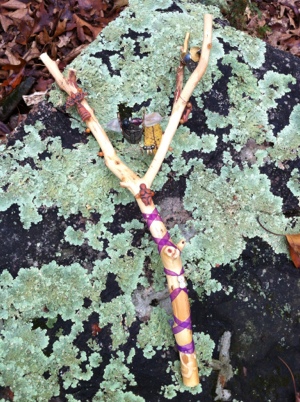
In ancient Egypt, priestesses used a sacred rattle-like instrument called a sistrum. Similar rattles were also used ceremonially in Africa and by shamans of various cultures. I learned about sistra when reading Karen Tate’s book Walking an Ancient Path. She refers to using a sistrum as a modern-day priestess to cast a circle, to invoke the four directions, and to cleanse houses and sacred spaces. I was immediately intrigued and did a little online research. My eye was immediately caught by a primitive style of sistrum made using a forked cedar stick and I became obsessed with making one of my own. Last weekend, Mark and I went out into the woods where we’d cut down some cedar trees earlier this year and we found piles of perfect forked sticks to use. First we peeled all the bark off which took several hours. Mark discovered that underneath the bark, his stick had been “carved by nature” (i.e. bugs!) in very, very cool patterns.

20120903-135101.jpg

We drilled holes in either side of the forked branches and poked wire through on which we strung a variety of beads, charms, and stones.

20120903-135148.jpg

They weren’t satisfyingly jingly enough, so Mark cut out some circles out of a sheet of brass and drilled holes through the middle. That was the perfect touch!

20120903-135110.jpg

I was ridiculously pleased with my results. I absolutely love it!

20120903-135257.jpg

I fancied mine up by wiring three awesome clay Goddess beads on the outside and adding a ribbon and handmade pewter spiral bead.
20120903-135305.jpg

This was a fabulously fun and enriching project! I highly recommend it. Coincidentally, or cosmically, we collected 12 extra forked cedar sticks in the woods and I think that is just perfect for making these at our fall women’s retreat. We just randomly collected them until we felt done and I said, “I probably need about twelve of these if we’re going to make these at our retreat.” We counted them and…amazingly…there were exactly twelve of them! So, I think it is meant to be 🙂

20120903-135310.jpg

Categories: art, nature, ritual, women's circle | 1 Comment

I can hear Her breathing…

20120907-134122.jpg

Sitting on the earth before it
I feel it

Life force, energy

Powerful, potent

running throughout

Everything is something

Life prevails and is beautiful.

–Molly, April 30, 2002

Several years ago, I jotted this down while sitting next to a special rosebush in my front yard. I was thinking about it this morning and realizing that today I would personalize that “it” as Goddess, but also that I’ve had a sense of “it”–this divine web of incarnation–for a long time.

She is always whispering to us

we may call Her by different names

yet She is always there

even when we forget to listen


My attention was caught by these quotes via Facebook this week:

“‎The most beautiful thing we can experience is the mysterious. It is the source of all true art and science. [She] to whom this emotion is a stranger, who can no longer pause to wonder and stand wrapt in awe, is as good as dead.” —Albert Einstein

“‎What you are basically, deep, deep down, far, far in, is simply the fabric and structure of existence itself.”
~ Alan Watts
via www.pantheism.net

“So for me the Goddess was just a certainty, easy to contact, no need for temples. All you need is to walk out in nature. If you have nothing, just a blade of grass, you pray with that one blade of grass and she will still come. It seemed like a loving, ever present deity who liked to take care of her own, appreciated being prayed to.” ~ Z Budapest

via The Girl God

Categories: Goddess, nature, poems, quotes, spirituality, theapoetics | 1 Comment

Blog at WordPress.com.